APNIC Policy: How Shaila Sharmin Shapes Rules
With billions of users globally, APNIC manages resources for 56 Asia-Pacific economies through community consensus. (APNIC's organization)
The APNIC Policy SIG operates as the critical engine for regional Internet governance, proving that technical operators must drive resource allocation rather than distant bureaucrats. This bottom-up mechanism ensures that the realities of network engineering directly shape the rules governing Internet number resources, preventing bureaucratic drift in a region serving nearly three-quarters of the world's population.
Readers will dissect the specific governance role this Special Interest Group plays in maintaining equitable access across diverse markets. The analysis details the consensus-based process where proposals evolve from operational necessity into binding regional policy, bypassing top-down mandates. Finally, the text outlines practical engagement steps for engineers to transition from configuring routers to shaping the policy framework that sustains them, following the trajectory of leaders like Shaila Sharmin.
The Role of the APNIC Policy SIG in Regional Internet Governance
APNIC Policy SIG as a Bottom-Up Consensus Mechanism
The APNIC Regulation SIG functions as a volunteer-led forum where the community itself develops rules for Internet number resources across 56 economies. This mechanism delegates authority to operators rather than centralized bodies, ensuring policy reflects actual network constraints. APNIC serves as the Regional Internet Registry for the Asia-Pacific, managing allocation for a region containing a significant portion of the global billions of internet users. The process relies on rough consensus, allowing diverse stakeholders from governments to civil society to shape the multi-stakeholder model without direct state control.
Unlike top-down mandates, this approach requires participants to negotiate technical feasibility against economic reality. The limitation is speed; achieving agreement among conflicting interests often delays critical updates compared to unilateral directives. However, the resulting policies possess higher compliance rates because operators helped draft them. This structure prevents the fragmentation seen in regions where governments unilaterally dictate addressing.
| Feature | Bottom-Up Consensus | Centralized Mandate |
|---|---|---|
| Origin | Community proposal | Government decree |
| Validation | Technical review | Legal compliance |
| Adoption | Voluntary implementation | Enforced regulation |
Operators gain direct influence over how IPv6 adoption proceeds in developing markets through this channel. The cost of participation is time spent in discussion, but the benefit is a stable routing environment tailored to local infrastructure. Ignoring this forum leaves networks subject to external policies that may lack operational viability.
Shaila Sharmin transitioned from network engineer to Policy SIG Co-Chair after attending APRICOT 2016 as a Fellow. Her trajectory demonstrates that regional Internet governance rewards sustained technical participation over the political appointment. Operators observing this path see a clear mechanism: initial exposure to the bottom-up process converts operational curiosity into leadership roles. The consensus-based model requires neutrality, a skill Sharmin refined while balancing ISP and banking sector constraints. Participation demands time, yet the APNIC Fellowship program lowers entry barriers for engineers in developing economies. Unlike centralized ITU approaches, this multi-stakeholder model forces direct confrontation between technical feasibility and policy intent. Engineers gain influence by drafting proposals that survive rigorous community scrutiny rather than lobbying regulators. The cost involves mastering procedural rules alongside routing protocols, a dual competency few possess. Governance is not abstract; it is the cumulative result of individual operators choosing to engage.
Voluntary Collaboration Versus Mandatory Regulatory Approaches
Voluntary collaboration defines the APNIC model, contrasting sharply with state-enforced mandates like China's Interim Measures for Generative AI.
The multi-stakeholder approach integrates technical reality through a messy but proven consensus process involving governments and civil society. This structure allows network operators to shape policy directly, unlike centralized systems where regulations dictate resource usage without operational input. The bottom-up mechanism ensures that allocation rules reflect actual infrastructure constraints across the region's 56 economies.
| Feature | APNIC Model | Centralized Regulation |
|---|---|---|
| Authority Source | Community Consensus | Government Decree |
| Adaptation Speed | High (Iterative) | Low (Legislative) |
| Technical Input | Direct Operator Feedback | Indirect or Absent |
| Enforcement | Peer Pressure / Revocation | Legal Penalties |
Global bodies like ICANN operate similarly, managing identifiers without direct state control to preserve Internet stability. However, the voluntary nature introduces latency; reaching rough consensus takes longer than issuing a top-down order. Operators must invest time in dialogue rather than simply complying with static rules. This trade-off yields policies that withstand technical scrutiny, whereas mandatory decrees often fracture under real-world routing complexity. The regulatory philosophy gap determines whether resources support innovation or merely enforce compliance.
Consensus-Based Resource Distribution in the Asia-Pacific Region
Policy proposals originate from operators managing IPv6 adoption across 56 economies rather than top-down mandates. The mechanism functions through a strict sequence: a draft circulates on the mailing list, receives discussion at an open micro-policy session, and proceeds to consensus confirmation only if no substantive technical objections remain. This workflow ensures that resource distribution rules reflect actual network constraints, such as the strategic priority placed on capacity building in developing regions.
The process demands active participation to validate technical feasibility before implementation.
| Phase | Actor | Output |
|---|---|---|
| Drafting | Community Member | Policy Proposal Document |
| Discussion | Mailing List | Revised Text |
| Consensus | Policy SIG Chair | Recommendation to EC |
A hidden tension exists between inclusivity and speed; broad consensus prevents hasty errors but delays responses to urgent routing crises. Operators seeking to influence these outcomes should engage immediately, as the APNIC Fellowship program accepts applications until 13 March 2026. New voices often overlook that neutrality during chairing is a hard constraint, not a suggestion, which filters out advocacy-driven proposals. The system relies on rough consensus to function, meaning a single valid technical argument can block a proposal regardless of supporter count.
Reliability and Trust Requirements in Banking Sector Cybersecurity
Banking operations prioritize durability over connectivity expansion, forcing distinct policy outcomes compared to ISP environments. Shaila Sharmin notes that while ISPs focus on resource efficiency, financial cybersecurity demands absolute reliability and trust. This divergence shapes how the Policy Development Process accommodates sector-specific constraints. Financial institutions increasingly mandate sovereign cloud terms by 2027, specifying operator nationality alongside data location. Such requirements exceed simple residency rules, complicating global resource allocation.
The operational gap between sectors manifests in routing strategies. Enterprise backbones apply BGP Local Preference attributes to engineer traffic paths, forcing primary flows through specific providers while maintaining backups. This technique, demonstrated by Verizon's BGP Traffic Engineering, illustrates how banking-grade redundancy relies on granular policy control rather than default best-path selection. General connectivity models often lack this precision.
| Feature | ISP Focus | Banking Focus |
|---|---|---|
| Primary Goal | Connectivity expansion | System durability |
| Resource View | Efficiency metric | Trust anchor |
| Policy Driver | Volume growth | Risk mitigation |
Implementing standards like IEC 62443 carries heavy economic weight, with compliance costs estimated between $3 million and $8 million over 18 months. These figures dictate that policy proposals affecting financial infrastructure must account for significant deployment lag. The bottom-up model allows operators to flag such barriers early, preventing unworkable mandates. ISP expansion prioritizes throughput, whereas banking mandates sovereign cloud Connectivity providers in WiMAX environments chase resource efficiency to capture market share, often accepting variable latency. Financial institutions reject this trade-off, requiring infrastructure where reliability and trust supersede raw speed. The Policy SIG must mediate these opposing operational realities without favoring one economic model.
Neutrality becomes difficult when policy discussions ignore the disparate cost structures of these sectors. Implementing rigorous standards like IEC 62443 creates financial barriers that small ISPs cannot clear. A single policy framework cannot equally serve a growth-oriented carrier and a risk-averse vault. Governance strategies further split between infrastructure providers focusing on depth and platforms managing identity. This divergence forces the community to draft rules that accommodate both high-velocity deployment and static security postures. The bottom-up model fails if the definition of "stable infrastructure" remains ambiguous across industries.
Practical Steps for Engaging with the Technical Community
Defining the Policy SIG Mailing List and Regional NOG System
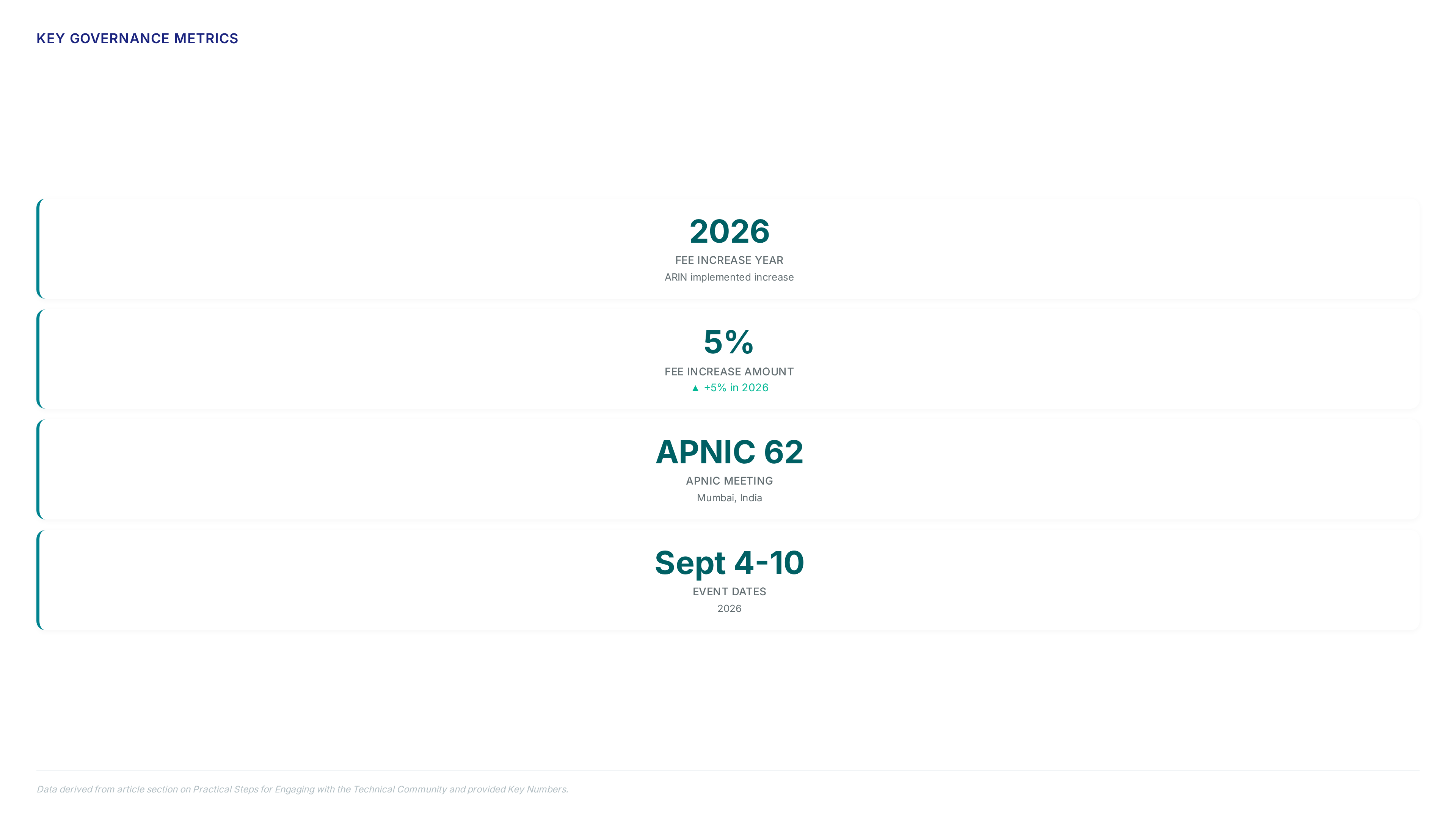
Subscription to the Policy SIG mailing list initiates the mandatory listening phase for any operator seeking influence over regional resource governance. Shaila Sharmin advises newcomers to join this channel immediately to read active proposals before attempting to author new directives. Engagement extends beyond email archives into physical gatherings like APNIC 62 in Mumbai, where consensus forms through face-to-face debate rather than remote voting.
Regional Network Operator Groups provide the necessary scaffolding for this participation by building local technical trust.
- Register for the Policy SIG mailing list to receive draft texts directly.
- Attend SANOG or PacNOG meetings to establish peer relationships before speaking at APNIC forums.
- Review past policy outcomes to understand the threshold for community agreement.
Participation in these forums transforms isolated engineers into community leaders capable of shaping the bottom-up consensus model. The not-for-profit membership model funding these operations relies on fees that scale with address holdings, creating a direct financial link between resource usage and governance access. Operators ignoring this system risk having policies imposed that contradict their physical network constraints.
Proven leadership requires balancing technical neutrality with the aggressive defense of operational reality.
Executing Participation via APNIC 62 in Mumbai and IGF 2026 in Nairobi
Operators must mark 4 to 10 September 2026 for APNIC 62 in Mumbai, India to engage directly with the APNIC PDP.
- Subscribe to the Directive SIG mailing list to review draft texts before the conference week begins.
- Attend the open micro-policy session in Mumbai, India to voice technical objections or support verbally.
- Submit a fellowship application before the March deadline to secure funding for travel and registration costs.
- Travel to Nairobi, Kenya for the 21st annual Internet Governance Forum from 14 to 18 December 2026 to broaden the governance scope.
Physical attendance forces a level of accountability absent in remote participation, as face-to-face debate exposes weak technical arguments immediately. The multi-stakeholder model thrives on this friction, yet operators often underestimate the time required to build consensus across diverse sectors. Hybrid attendance options exist, but they frequently dilute the urgency of decision-making when critical infrastructure risks are debated.
Virtual participation serves best for maintaining continuity between substantial events rather than launching new proposals. The cost of missing these windows includes delayed resource allocation and reduced influence over regional Internet number resources.
Navigating IPv6 Transition Risks and IPv4 Scarcity Fairness Challenges
Declining Autonomous System growth since late 2020 signals market saturation, forcing operators to prioritize IPv6 adoption over IPv4 expansion.
- Audit existing routing tables for multiprotocol extensions support to carry both address families simultaneously.
- Review the revised fee schedule proven from 2025 before submitting non-member address space applications.
- Draft policy proposals addressing fairness constraints for remaining IPv4 blocks via the APNIC PDP.
The cost of delayed migration is measurable: physical power limits now constrain new infrastructure more than address availability. While APNIC emphasizes capacity building, the tension between scarcity management and equitable distribution creates friction for newcomers. Operators often overlook that IPv4 transfer markets inadvertently favor large incumbents, skewing the consensus-based outcomes intended by the community.
Defining the Operational-to-Governance Transition Trigger
| Operational Mindset | Governance Mindset |
|---|---|
| Configures local BGP peers | Defines regional allocation rules |
| Reacts to route leaks | Prevents leaks via policy consensus |
| Optimizes for uptime | Balances fairness with scarcity |
The limitation of this transition is the time required to build consensus compared to the speed of automated deployment tools.
Establishing a dedicated mailing list like APAC-ICT-Women provides the structural foundation for hesitant voices to enter technical discourse without immediate public exposure. Many talented females hesitate to participate because they feel unsure if their voice matters, requiring intentional effort rather than passive openness. Operators should align local meetups with substantial regional capacity-building events to maximize attendance and mentorship opportunities. Applications for the Regional Asia Pacific Internet Governance Academy open in March, offering a structured pathway for newcomers to learn governance mechanics in Busan. Facilitators must actively invite quiet participants to speak during these sessions, countering the natural tendency for dominant voices to monopolize conversation.
| Action Item | Target Audience | Expected Outcome |
|---|---|---|
| Launch APAC-ICT-Women list | Female engineers | Increased proposal submissions |
| Coordinate with bdNOG events | Local operators | Stronger regional consensus |
| Promote APIGA 2026 | Junior staff | Diversified leadership pipeline |
The cost of excluding these perspectives is a narrower policy scope that fails to address diverse operational realities across the Asia Pacific. Mobile web traffic now accounts for a significant majority of total volume, demanding governance inputs from those managing high-density consumer networks rather than just enterprise backbones. Exclusion results in policies that optimize for legacy infrastructure while ignoring the constraints of rapidly expanding mobile-first economies.
Validating Policy Readiness Through APNIC PDP and Resource Impact Analysis
A Cyber Security Architect validates readiness by quantifying how IPv4 scarcity impacts fee structures before leading governance. Operators must analyze whether their organization can absorb the economic variance created when peers face different cost models for identical resources.
| Operational Metric | Governance Impact |
|---|---|
| Local route filtering | Regional allocation fairness |
| Uptime SLA compliance | Long-term resource sustainability |
| Incident response time | Consensus building speed |
The transition from operations to policy leadership occurs when an engineer recognizes that technical constraints like BGP path limits dictate broader regional service scope. A specific tension exists between rapid deployment and the slow consensus required to modify these underlying rules. InterLIR recommends drafting a mock proposal addressing IPv6 adoption gaps to test personal understanding of the APNIC PDP. This exercise reveals whether the operator grasps the downstream effects of address distribution on network growth. Without this validation, leaders risk proposing policies that ignore the financial reality of smaller networks facing unequal regulatory approach. The cost of skipping this analysis is measurable in rejected proposals and lost community trust.
About
Nikita Sinitsyn serves as a Customer Service Specialist at InterLIR, where his daily work directly intersects with the global governance of IP resources discussed in the APNIC Policy Special Interest Group. With eight years of experience in telecommunications, Nikita manages critical RIPE and ARIN database operations, giving him practical insight into the regulatory frameworks that Policy SIGs strive to refine. His expertise in KYC procedures and spam control ensures that IPv4 transfers remain secure and compliant, mirroring the community-driven goals of APNIC to maintain a stable Internet system. At InterLIR, a specialized IPv4 marketplace focused on transparency and efficiency, Nikita applies these policy principles to solve real-world network availability challenges. This hands-on involvement with IP address redistribution qualifies him to analyze how regional policies impact global market dynamics and technical implementation across the industry.
Conclusion
Scaling governance beyond technical committees reveals that consensus latency becomes the primary bottleneck when mobile traffic volumes surge. As the remaining IPv4 pool shrinks, the administrative overhead of validating fairness constraints creates a hidden operational tax that slows deployment for high-density networks. This friction does not disappear with improved tools; it intensifies as economic disparities between large and small operators widen. Organizations must shift from passive observation to active drafting immediately, rather than waiting for perfect conditions.
Commit to submitting the policy draft within the next six months if your network handles over a substantial amount of mobile traffic. Do not attempt to lead regional sustainability efforts without first proving you can navigate the specific procedural hurdles of the development process. Waiting until Q4 to engage guarantees your infrastructure requirements will be misaligned with the final ruleset. The window to influence allocation logic before the next exhaustion phase closes rapidly.
Start by auditing your current BGP path limits against proposed fairness models this week. Map exactly where your existing peering agreements would fail under strict new distribution rules. This specific data point provides the necessary use to frame your upcoming proposal in terms of regional stability rather than individual gain.
Frequently Asked Questions
APNIC manages resources for a region containing a significant portion of the global user base. This bottom-up mechanism ensures equitable access across diverse markets serving nearly 6 billion internet users worldwide.
The group delegates authority to operators rather than centralized bodies to reflect actual network constraints. This approach prevents fragmentation while managing resources for a region with nearly 6 billion internet users globally.
Engineers transition by attending fellowship programs and participating in consensus-based policy discussions over time. Sustained technical participation converts operational curiosity into leadership, serving a community of 6 billion users effectively.
Voluntary collaboration integrates technical reality through a messy but effective multistakeholder model for users. This ensures policies possess higher compliance rates among the nearly 6 billion internet users in the region.
Operators engage to ensure technical realities of running networks feed directly into regional policy discussions. This direct influence shapes rules for nearly 6 billion users, preventing external policies lacking operational viability.