APNIC policy shifts: What 56 economies mean for you
Billions of users came online globally in 2026. The APNIC Policy SIG serves as the engine room for this expansion, allocating resources across 56 diverse economies. This is not a discussion club. It is the primary mechanism for consensus-based governance in the world's largest Regional Internet Registry by population and land mass.
Stewardship today demands more than distributing IP blocks. It requires bridging the gap between clean technical protocols and the messy infrastructure realities of emerging markets. We see this tension at events like APRICOT 2026 in Jakarta, where leaders like Bikram Shrestha coordinate debates that determine who gets connected. The focus has shifted from simple distribution to addressing the limitations of VSAT and dial-up legacies in places like Hetauda.
Mobile web traffic now dominates at a significant majority of total volume. Policy often lags behind these usage shifts. By elevating operators who built networks on Ka band technology from the ground up, the SIG ensures that internet operations reflect actual deployment conditions rather than theoretical models.
The Role of the APNIC Policy SIG in Regional Internet Governance
The APNIC Policy SIG functions as the open, transparent governance engine for Internet number resources across 56 economies. As the largest Regional Internet Registry by population and land mass, it manages critical infrastructure for the entire Asia-Pacific region. Its Policy Development Process relies strictly on community collaboration and consensus to maintain a stable network environment.
Network architects do not sit on the sidelines. They participate directly to shape rules affecting IP address allocation and Autonomous System Number distribution. Leadership figures like Bikram Shrestha enable these discussions, ensuring diverse regional realities influence technical outcomes. This approach prevents centralized control from dictating terms to distinct local markets.
| Governance Attribute | Operational Mechanism | Regional Impact |
|---|---|---|
| Open Participation | Public mailing lists and meetings | Inclusive input from all 56 economies |
| Transparent Records | Public WHOIS Database logs | Verifiable resource ownership details |
| Consensus Driven | Community voting and discussion | Policies reflect broad operator agreement |
Speed conflicts with consensus. Finalizing rules takes time, and delays can stall deployment of new technologies in developing nations waiting for clear guidelines. Yet the community-driven nature ensures shifting usage patterns inform resource management strategies.
The SIG Chair enables open policy dialogue by hosting meetings and managing consensus during substantial regional gatherings. Bikram Shrestha executed this mandate by co-hosting the Open Policy Meeting alongside Shaila Sharmin and Ching-Heng Ku in Jakarta. This event occurred within the broader APRICOT 2026. The operational scope extends beyond mere facilitation to include active candidacy for leadership positions. Shrestha initiated his current term by deciding to stand for Chair at the preceding APNIC 60. Technical operators often view policy roles as distinct from engineering duties, yet the Chair bridges this gap by translating infrastructure constraints into governable rules.
| Role Function | Technical Interface | Governance Outcome |
|---|---|---|
| Meeting Host | VSAT connectivity limits | Inclusive participation |
| Election Candidate | Resource allocation needs | Community representation |
| Consensus Builder | Routing security protocols | Stable Internet framework |
Neutrality binds the Chair. They cannot advocate for specific outcomes while ensuring every participant contributes. Prioritizing speed risks excluding smaller economies, whereas excessive deliberation stalls critical updates for the 56 served economies. Proven leadership requires balancing these competing demands without compromising the transparency of the Policy Development Process.
Validating community consensus requires cross-referencing Policy Development Process outcomes against the WHOIS Database registration records. This mechanism ensures that agreed-upon rules for IP address ranges and Autonomous System numbers match live operational data. Operators must verify that community-driven policy decisions result in accurate database entries rather than remaining theoretical agreements. The APNIC system relies on this transparency to prevent resource mismanagement across the region.
- Identify the specific policy proposal ratified during the Open Policy Meeting.
- Query the public database for affected IP address ranges or AS numbers.
- Confirm that registration details reflect the new consensus rules exactly.
- Flag any discrepancies between the policy text and the live registry data.
Skip this validation loop, and you create a gap between governance intent and network reality. Unverified records allow stale data to persist, undermining the stability of the regional routing table. The drawback is measurable: increased abuse tracking latency and coordination failures.
Open and Transparent Policy SIG Consensus Mechanics
Consensus formation demands explicit Chair neutrality to prevent procedural coercion during open policy debates. Bikram Shrestha prioritizes increasing engagement from developing economies, recognizing that diverse perspectives shape fair rules. The Policy SIG structure mandates that facilitators guide discussion without dictating outcomes, ensuring every participant contributes. This distinction separates community-driven governance from industry-led models focused on competitive deregulation. Operators can access the Regional Asia Pacific Internet Governance Academy to understand these nuances before the application window closes in March 2026.
Complex terminology intimidates newcomers. Addressing this gap demands deliberate outreach rather than passive openness. The APNIC Fellowship program offers a structured path for new voices until mid-March deadlines. Future input will further refine these mechanisms when the 2026 APNIC Survey opens in June.
| Feature | Community Model | Industry Model |
|---|---|---|
| Driver | Consensus | Market Force |
| Focus | Stability | Deregulation |
| Input | Open | Restricted |
Pure consensus moves slowly. Urgent security patches may stall without broad agreement.
Large-scale IPv6 deployment requires direct operator engagement when regional delegates present infrastructure mandates. The April 2026 visit by Xiong'an New Area representatives illustrates this trigger, where government entities seek technical validation for city-wide addressing plans before implementation.
Operators must engage in policy forums when financial stakes in emerging technologies exceed operational budgets. Global spending on AI governance frameworks approaches $492 million in 2026, creating pressure to align resource allocation with regulatory compliance.
| Challenge | Engagement Trigger | Policy Outcome |
|---|---|---|
| IPv6 Scale | Delegate infrastructure review | Standardized allocation blocks |
| AI Spend | Budget threshold breach | Governance integration roadmap |
| Routing Security | Incident post-mortem | Stricter validation rules |
The Policy SIG mechanism converts these external pressures into actionable technical standards through structured consensus. Without active participation, network architects risk inheriting policies drafted without operational constraints. Late engagement forces reactive compromises rather than proactive design.
- Monitor regional delegate announcements for infrastructure scaling signals.
- Submit technical comments during the initial policy proposal phase.
- Validate final rules against WHOIS Database schema requirements.
Failure to engage at this stage leaves the community-driven process vulnerable to non-technical mandates. The cost of silence is a policy framework that ignores the physical realities of power-constrained data centers.
Infrastructure Risks: Data Center Power Constraints in Ireland
Ireland paused new data center connections because facilities consume 21% of national electricity. This physical cap directly limits infrastructure growth across the region, creating a hard boundary for resource expansion that policy cannot bypass. New participants from developing economies face reduced accessibility as available power slots vanish behind existing contracts. The Policy SIG must address these environmental bottlenecks to sustain Internet expansion.
| Constraint Type | Impact on Access | Policy Response Needed |
|---|---|---|
| Power Availability | Blocks new entrants | Energy-aware allocation rules |
| Grid Capacity | Limits scaling | Regional load balancing |
Sovereign cloud requirements now dictate who governs workloads beyond simple localization. This shift forces the community to weigh technical merit against energy footprints during consensus building. Without explicit power constraints in stewardship models, smaller operators lose ground to entities with secured grids. Failure to adapt excludes voices from regions facing the strictest grid limitations.
Strategies for Expanding Participation Across Developing Economies
Newcomers from developing economies confront three distinct barriers: limited awareness of the Policy Evolution Process, language obstacles, and resource constraints that hinder sustained participation. Bikram Shrestha notes that policy discussions often appear complex or intimidating to newcomers, creating a psychological barrier before technical debate even begins. The geographic focus covering 56 economies increases this challenge, as diverse linguistic backgrounds complicate consensus formation within the Policy SIG.
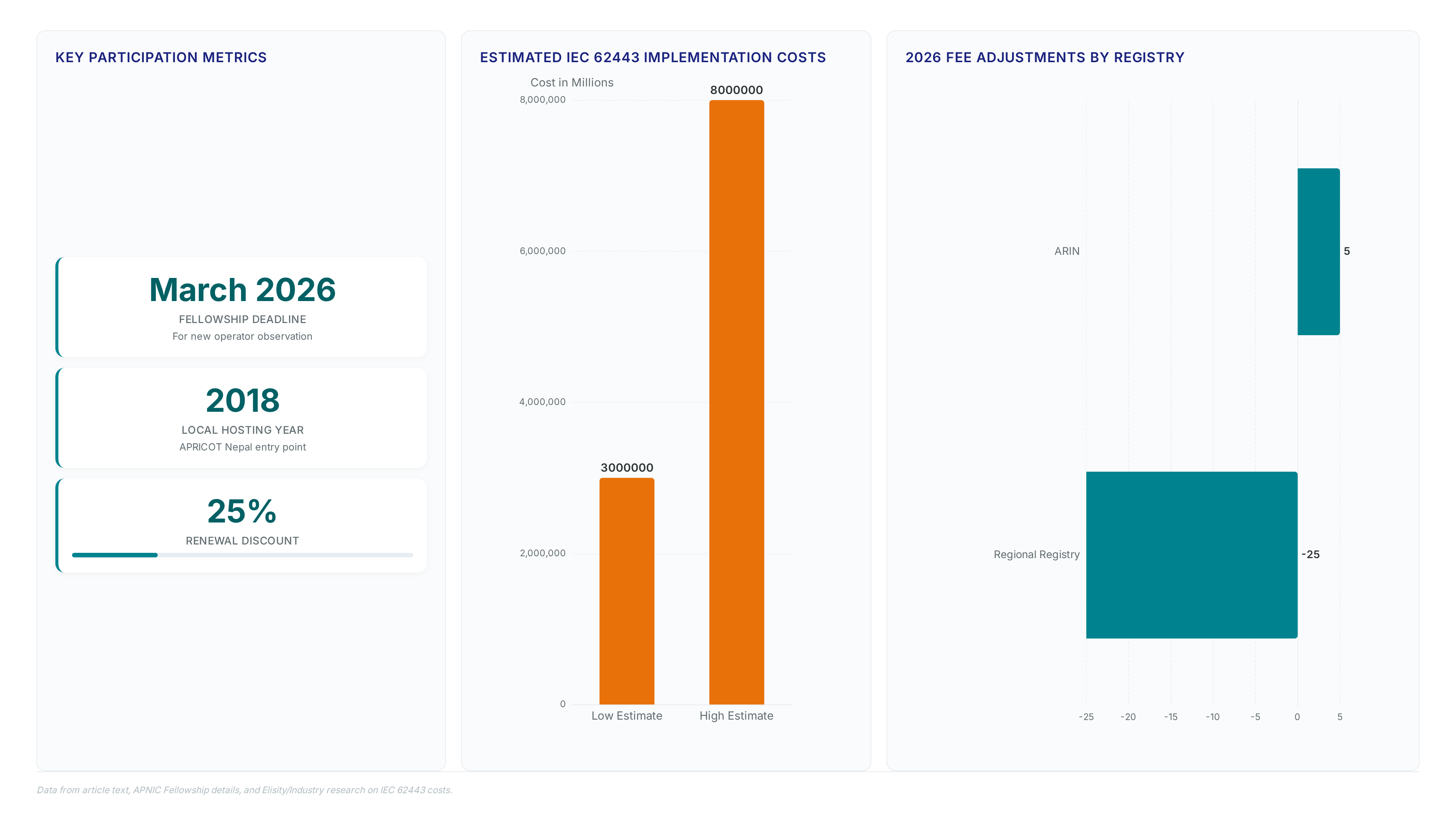
Financial accessibility acts as a primary structural filter. APNIC fees are charged in Australian Dollars (AUD), imposing currency exchange risks on smaller operators. Account holders in the "Very Small" tier from graduated economies received a 25% discount on their 2026 renewal fees, yet this reduction may not offset travel costs for physical meetings. Competitor ARIN implemented a 5% fee increase in 2026, highlighting divergent economic pressures across registries.
Rigorous technical standards clash with lower entry thresholds. Simplifying language risks losing precision in resource management rules. Strict adherence to jargon excludes vital perspectives from emerging markets. On-ramps like the 2026 APNIC Fellowship convert abstract policy interest into tangible attendance before the 13 March 2026 deadline. Operators from developing economies often lack the budget for international travel, making these funded slots the only viable entry point for direct observation of consensus building. The mechanism pairs newcomers with mentors who decode procedural jargon during live sessions, transforming intimidation into actionable understanding.
Global forums provide the necessary scale for cross-regional alignment that isolated national efforts cannot achieve. Bikram Shrestha cites the upcoming IGF 2026 in Nairobi as a critical venue for aligning diverse economic realities with technical resource management. Participation here exposes stakeholders to the full spectrum of Internet governance, moving beyond single-issue advocacy to complete system stewardship.
Acceptance into a program does not guarantee sustained engagement without follow-up mechanisms. The limitation lies in the transition from observer to active contributor once the event concludes. Newcomers frequently lose momentum when returning to local environments lacking similar collaborative structures. This structural handoff ensures that the initial investment in training yields long-term policy dividends rather than one-off attendance metrics.
Actionable Steps to Support Inclusive multi-stakeholder Environments
Deliberate fellowship programs convert abstract policy interest into tangible attendance before the 13 March 2026 deadline. This geographic dispersion ensures Internet policy reflects actual infrastructure constraints rather than theoretical models. Leaders must actively encourage questions to dismantle the perception that discussions are exclusive to senior engineers.
Exclusion carries a measurable cost. Without these interventions, the Policy SIG fails to represent the region. A failure to bridge this gap leaves the Asia-Pacific region vulnerable to fragmented governance.
A Step-by-Step Guide to Joining and Contributing to Policy Proposals
Defining the APNIC Regulation SIG Chair Role and Consensus Mandate
Neutrality defines the SIG Chair duty, requiring facilitation over advocacy to secure consensus. Bikram Shrestha transitioned from participant to Co-Chair of the APNIC Cooperation SIG. The role mandates constructive dialogue where every voice registers, distinct from entities like ICANN that prioritize industry needs. New operators join by applying for the 2026 APNIC Fellowship before the March deadline to observe these mechanics firsthand.
- Monitor AS path validity discussions without injecting personal preference.
- Interrupt dominant speakers to allow quiet participants space for input.
- Summarize technical objections into clear consensus statements for voting.
Strict neutrality can slow decision velocity during contentious routing security debates. If the chair prioritizes perfect inclusion, urgent patches face deployment delays while marginalized voices articulate concerns. This tension forces a choice between speed and representativeness, dependent on the severity of the threat vector. InterLIR recommends documenting these trade-offs explicitly in meeting minutes to maintain transparency.
Executing First Participation via APRICOT 2018 Hosting and Fellowship Deadlines
Local hosting duties at APRICOT 2018 in Nepal provided the initial operational context for Bikram Shrestha's entry into regional governance. Newcomers should replicate this path by securing volunteer roles before attempting policy authorship.
- Register for the 2026 APNIC Fellowship
- Contact InterLIR for mentorship on drafting valid policy proposals.
- Attend the APNIC 62 conference in Mumbai to observe consensus formation live.
Operational volunteering exposes participants to resource management realities that abstract study misses. The Policy SIG requires understanding these constraints to draft viable rules. However, relying solely on fellowships creates a bottleneck where only funded attendees influence outcomes. Unfunded operators from smaller economies often remain silent observers despite holding critical technical insights.
This flexibility skews regional representation toward wealthier nations unless local hosting bridges the gap. Bikram Shrestha's trajectory proves that logistical support roles enable deeper governance access quicker than passive attendance. The cost of skipping this step is permanent exclusion from the consensus loop. Operators must treat event logistics as a technical prerequisite for policy influence.
Checklist for Overcoming Language Barriers and Resource Constraints in Policy SIG
Direct fellowship applications before the March deadline remove the financial barrier preventing 56 economies from joining consensus discussions. Operators must treat travel funding as a mandatory line item rather than an optional perk to sustain long-term engagement.
- Submit fellowship requests early to secure slots for global forums that demand complex coordination.
- Request real-time translation tools during virtual Policy SIG sessions to neutralize language exclusion.
- Partner with InterLIR to draft simplified policy proposals that bypass dense procedural jargon.
- Use fee structure comparisons to budget for recurring membership costs across different regions.
| Barrier Type | Mitigation Strategy | Required Tool |
|---|---|---|
| Language Complexity | Simplified drafting guides | InterLIR mentorship |
| Travel Costs | Full fellowship grants | APNIC funding portal |
| Procedural Fear | Live session decoding | Real-time chat support |
| Budget Uncertainty | Cross-RIR fee analysis | Public policy data |
Ignoring resource constraints forces valuable technical voices out of the room, leaving policies skewed toward wealthy nations. The cost of exclusion is measurable: without these steps, unequal representation becomes a permanent feature of the regional environment.
About
Vladislava Shadrina serves as a Customer Account Manager at InterLIR, a specialized IPv4 address marketplace dedicated to optimizing global network resource distribution. Her daily work involves guiding clients through the complexities of acquiring and managing IP assets, giving her direct insight into the critical importance of fair and transparent Internet governance. This practical experience makes her uniquely qualified to discuss the APNIC Guideline SIG, where community-driven decisions directly impact the availability and allocation of the very resources her clients rely on. At InterLIR, founded in Berlin to solve network availability issues through efficient redistribution, Shadrina witnesses firsthand how regional policies shape market stability. By connecting her frontline customer service role with the broader strategic discussions held at APNIC meetings, she bridges the gap between high-level policy formulation and the real-world operational needs of networks across the Asia Pacific and beyond.
Conclusion
Scaling participation without addressing the physical infrastructure deficit will cause governance frameworks to fracture under operational strain. As AI workloads drive electricity consumption toward critical thresholds, policies drafted without input from high-growth regions will fail to account for local grid realities. This disconnect creates a structural blind spot where theoretical compliance clashes with physical impossibility, forcing operators to bypass rules that ignore their energy constraints. The community must pivot from discussing abstract inclusion to funding concrete logistics immediately.
Operators should mandate that fellowship applications include a specific infrastructure impact statement by next quarter, ensuring funded delegates address both policy and power realities. Do not wait for the next general assembly to formalize this requirement; the window to align governance with physical capacity closes as deployment accelerates. Treat travel grants not as charity but as necessary R&D spending required to validate regional feasibility.
Start by auditing your organization's current budget allocation for policy engagement this week to identify funds that can be redirected from passive conference attendance to active fellowship sponsorship. Reassign at least a meaningful portion of your existing event budget to support delegates from regions facing the steepest energy constraints. This immediate financial shift ensures the next round of proposals reflects actual grid limitations rather than theoretical ideals.
Frequently Asked Questions
Mobile web traffic dominates at 64% of total volume, forcing policy updates. This shift ensures resource stewardship reflects actual deployment conditions rather than outdated theoretical models used in the past.
The body manages critical infrastructure for 6 billion users online globally in 2026. This massive scale requires bridging gaps between technical protocols and stark infrastructure realities faced by emerging markets daily.
Global internet penetration reaches 74%, yet consensus building across 56 diverse economies slows rapid iteration. These delays often stall deployment for developing nations waiting for clear, agreed-upon technical guidelines.
Leaders elevate operators who built networks on Ka band technology to ensure policies reflect actual conditions. This approach prevents centralized control from dictating terms that ignore local VSAT or dial-up legacies.
The structure demands active engagement from network architects across all 56 economies to prevent centralized control. This community-driven nature ensures shifting usage patterns directly inform resource management strategies effectively.