ARIN 2026 NomCom: Who Vets the Three Board Seats?
ARIN locked in three new General Member representatives from submissions received between 14 and 28 April to finalize its 2026 governance roster. (ARIN's fee schedule) The stakes could not be higher. The 2026 Nomination Committee acts as the gatekeeper for leadership managing North America's disproportionate 39.5% share of global IPv4 allocations. This statistic, reported by ARIN, defines the gravity of the election cycle. We are dissecting the mechanics of the NomCom selection process, specifically how Trustee members vet community volunteers for the 2026–2027 terms. The roadmap ahead maps the 2026 election calendar, pinpointing the June nomination windows and October voting periods that decide three Board seats and five Advisory Council positions. Beyond internal politics, the committee recruits nominees for the NRO Number Council, a move essential to maintaining technical rigor as global demands shift.
External analysts might argue AI-driven Wi-Fi management will dominate 2026, but that view misses the foundation. Internal governance at ARIN remains the bedrock enabling such evolution. The decisions made by this group of eight individuals-including returning representatives Christopher Quesada and William Sylvester-will either enable or hinder the region's ability to adapt number resource policies to emerging technical realities.
The Role of the Nomination Committee in ARIN Governance
The 2026 Nomination Committee (NomCom) operates under strict bylaws to recruit candidates for the Board of Trustees, Advisory Council, and NRO NC. On 6 May 2026, ARIN announced that Andrew Dul, Brian Jones, and John Stitt joined the roster to fill upcoming vacancies. This body governs a region holding 39.5% of global IPv4 allocations, making selection criteria vital for resource stability. The committee targets three Board seats, five Advisory Council positions, and one NRO NC appointment for terms starting 1 January 2027.
Commercial entities like Dataprise fill enterprise skill gaps; the NomCom sustains bottom-up policy authority. The Advisory Council provides ratified policy direction, not the vendor-specific security intelligence found in tools like Bitsight. President John Curran guides the mission, but the committee executes the vetting. Voting occurs during the scheduled 2026 ARIN Elections from October 22 to October 30.
A structural friction exists here. The need for rapid appointment clashes with the months-long solicitation window ending in April. When community submissions drag, Trustee members select from a reduced pool, narrowing ideological diversity. Operators must submit nominations during the early June call to influence the Board of Trustees composition effectively.
Trustee members selected new representatives from submissions received between 14 and 28 April to finalize the committee roster. This 2026 Nomination Committee (NomCom) now targets three Board seats, five Advisory Council positions, and one NRO NC appointment for terms starting 1 January 2027. The Call for Nominations arrives in early June, overlapping with the Community Grant Program deadline on 14 June 2026. This timing forces a hard choice: draft governance proposals or secure project funding. Standard election calendars often ignore this conflict.
The Board of Trustees holds fiduciary authority while the Advisory Council drives policy development. These roles demand distinct skill sets. Voting occurs later during the 2026 ARIN Elections scheduled for October 22 through October 30. Legacy fee caps at $250 annually for pre-2024 agreements remain static, yet governance shifts could alter future resource valuation models significantly. Operators must recognize that NomCom selections directly influence how nonprofit corporation structures manage IPv4 scarcity alongside IPv6 growth. Blurring these roles leads to misaligned nominations that stall policy ratification.
This separation ensures financial oversight remains distinct from technical resource allocation strategies. North America manages a dominant share of global IPv4 space, necessitating clear role definition. The Board ratifies policies but cannot initiate them. The 15-member Advisory Council crafts the specific rules governing number resources.
| Feature | Board of Trustees | Advisory Council |
|---|---|---|
| Primary Duty | Corporate governance | Policy development |
| Selection Method | NomCom election | NomCom election |
| Output | Ratified bylaws | Policy proposals |
| Scope | Financial oversight | Technical allocation |
Recruitment for both entities occurs simultaneously because the organizational structure relies on their interdependence. The Board lacks the technical mandate to set allocation rules without Council input. Conversely, the Council cannot enforce policies without Board ratification. This dual-recruitment model prevents stagnation in the policy authority chain during leadership transitions. Council seats focus on technical nuance; Trustee roles demand legal accountability. The 2026 cycle fills multiple vacancies in both groups to maintain this balance. Failure to distinguish these duties creates governance bottlenecks where financial concerns override technical necessity.
Defining Voter Eligibility Deadlines and Nomination Windows
The 7 September hard stop for voter eligibility precedes the October ballot by six weeks. This locks the participant roster before campaign activities begin. The gap prevents last-minute resource transfers designed solely to manufacture voting power for the 2026 ARIN Elections. Operators must align internal administrative updates with the Call for Nominations window running 8–22 June to ensure valid candidate slates. Missing this June window forces a twelve-month delay in governance influence; no mid-cycle petitions exist.
The release of Version 2025.1 of the Number Resource Policy Manual on 3 March 2026 introduces policy changes voters must digest before casting ballots. Compliance with these updated rules determines whether an organization qualifies as a voting member under the new fiscal criteria.
| Phase | Date Window | Operational Constraint |
|---|---|---|
| Nomination Solicitation | 8–22 June | Requires active General Member status |
| Eligibility Lock | 7 September | Freezes transfer history for voting rights |
| Ballot Casting | 22-30 October | Restricted to pre-verified accounts |
Waiting until September risks disaster. Recent IPv4 market acquisitions at $0.50 per IP do not count toward eligibility thresholds if the transfer posted after the cutoff. The system accepts no late documentation. Late-qualifying organizations become invisible to the ballot generation logic.
Executing the NomCom Workflow for Board and Advisory Council Seats
The workflow initiates with the 8–22 June nomination window. Candidates must declare intent before the 7 September eligibility cutoff. This sequence forces a rigid dependency: administrative validation precedes any campaign activity. Late-entry strategic maneuvers are impossible. The committee evaluates submissions against the ARIN Bylaws to ensure nominees possess the specific technical background required for managing North American number resources.
Selection mechanics differ by target body, creating distinct evaluation criteria for each governance layer:
| Target Seat | Evaluation Focus | Term Start |
|---|---|---|
| Board of Trustees | Fiduciary oversight | 1 January 2027 |
| Advisory Council | Policy development | 1 January 2027 |
| NRO NC | Global coordination | 1 January 2027 |
Trustees assess candidates on their ability to separate corporate governance from the bottom-up policy authority defining the region's operational framework. The process explicitly rejects applicants whose experience mirrors commercial managed IT service providers. It prioritizes community-driven stewardship over vendor-specific skill sets. A trustee term spans three years, demanding sustained availability that conflicts with the short-term project cycles typical of the Community Grant Program.
Voting occurs during the 22-30 October period for the 2026 ARIN Elections, finalizing the roster for the upcoming cycle. The rigid timeline creates a bottleneck. Qualified candidates often withdraw because they cannot balance grant deliverables with board duties. Failure to align these commitments results in a governance gap where technical expertise exists but remains unavailable for selection.
Validating Candidacy Against 2027 Term Start Requirements
The 1 January 2027 term start date mandates that all candidates secure voter validation by the 7 September deadline to appear on the ballot. This hard cutoff creates a rigid dependency where administrative status must precede any campaign activity. Late-entry strategic maneuvers for the Board of Trustees or Advisory Council are eliminated. Operators often overlook how the expiring IPv6 Fee Waiver on 31 December 2026 complicates this timeline for organizations relying on the 3x-Small fee structure. A candidate representing an entity with pending IPv6 allocations risks disqualification if fee status remains unresolved before the eligibility window closes.
Validation requires strict adherence to the published sequence rather than ad-hoc verification:
- Confirm organizational standing during the 8–22 June nomination window.
- Settle all outstanding fee liabilities before the September 7 hard stop.
- Verify that the grant applications for community projects do not conflict with governance disclosure requirements.
The Number Resource Organization Number Council seat demands specific technical expertise distinct from the fiduciary focus required for trustee roles. Failure to align financial compliance with the nomination calendar results in automatic ineligibility, regardless of technical merit.
ARIN Elections Team Contact Protocol and Resource Links
Direct all specific election inquiries to [email protected] to receive authoritative guidance on the 2026 cycle. This channel remains the sole verified path for resolving eligibility disputes before the 7 September deadline. Operators must cross-reference internal records against the official NomCom Charter to validate candidate submission rules. Relying on informal community summaries risks non-compliance with the strict ARIN Bylaws governing trustee selection.
Access the complete procedural framework through these primary resources:
- Review the Election Processes document for step-by-step nomination workflows.
- Consult the Full Election Calendar to track the 22-30 October voting window.
- Verify technical service contacts like Brad Gorman for RPKI-related governance questions.
Confusion frequently arises between policy authority and technical execution. While ARIN shapes policy through a bottom-up community process, the actual voting mechanics rely on rigid administrative validation rather than technical merit alone. This separation means a technically qualified nominee may fail candidacy if administrative deadlines are missed by even one day. The cost is measurable: late submissions receive no exceptions, forcing a twelve-month delay in governance participation. Operators treating the election as a purely technical exercise often overlook the administrative hard stops that govern the Advisory Council seats.
Navigating the June Call for Nominations and September Eligibility Deadline
Submit nominations between 8–22 June to secure ballot placement before the 7 September eligibility cutoff.
- Access the Call for Nominations portal during the open window to declare candidate intent.
- Verify organizational standing against the fee schedule to prevent disqualification from unpaid balances.
- Confirm voter status early, as administrative processing often lags behind the submission deadline.
Operators frequently miss the dependency between financial compliance and voting rights. The expiring IPv6 Fee Waiver on 31 December 2026 creates a hidden trap for entities relying on reduced fee structures during the eligibility review. Unresolved fee status before September results in immediate ballot removal, regardless of nomination timing. This rigid sequence forces operators to prioritize accounting reconciliation over technical merit when preparing governance submissions.
The 2026 ARIN Elections demand strict adherence to these temporal constraints. No mid-cycle petitions exist to remedy missed deadlines. Failure to align administrative updates with the voting period timeline cedes influence to competitors who validated their status earlier. The cost of delay is a full twelve-month exclusion from board selection processes.
Voting Period Execution Checklist for the 22–30 October Window
Submit ballots between 22-30 October only after verifying voter status against the 7 September cutoff.
- Confirm organizational standing to prevent rejected submissions during the 2026 ARIN Elections window.
- Cross-reference internal records with Version 2025.1 of the NRPM to ensure policy compliance before casting votes.
- Validate that no pending IPv6 Fee Waiver issues exist, as financial disputes void eligibility regardless of technical merit.
| Validation Step | Required Artifact | Failure Consequence |
|---|---|---|
| Identity Check | ARIN Online Account | Ballot rejection |
| Policy Review | NRPM v2025.1 text | Invalid vote count |
| Financial Audit | Fee payment receipt | Disqualification |
Operators often assume nomination success guarantees voting rights. Yet the separation between the 8–22 June nomination window and October voting creates a gap where financial status can change. A candidate selected during the spring may represent an organization that loses voting power by autumn due to unpaid fees. Net. The Election Processes document details the specific cryptographic signatures required for valid submission.
This rigid logic prevents wasted effort on invalid ballots. The cost of skipping this verification is total disenfranchisement for the entire cycle.
Strategic Impact of Community Representation on Internet Infrastructure
Defining the Strategic Gap Between Enterprise IPv4 Reliance and IPv6 Adoption
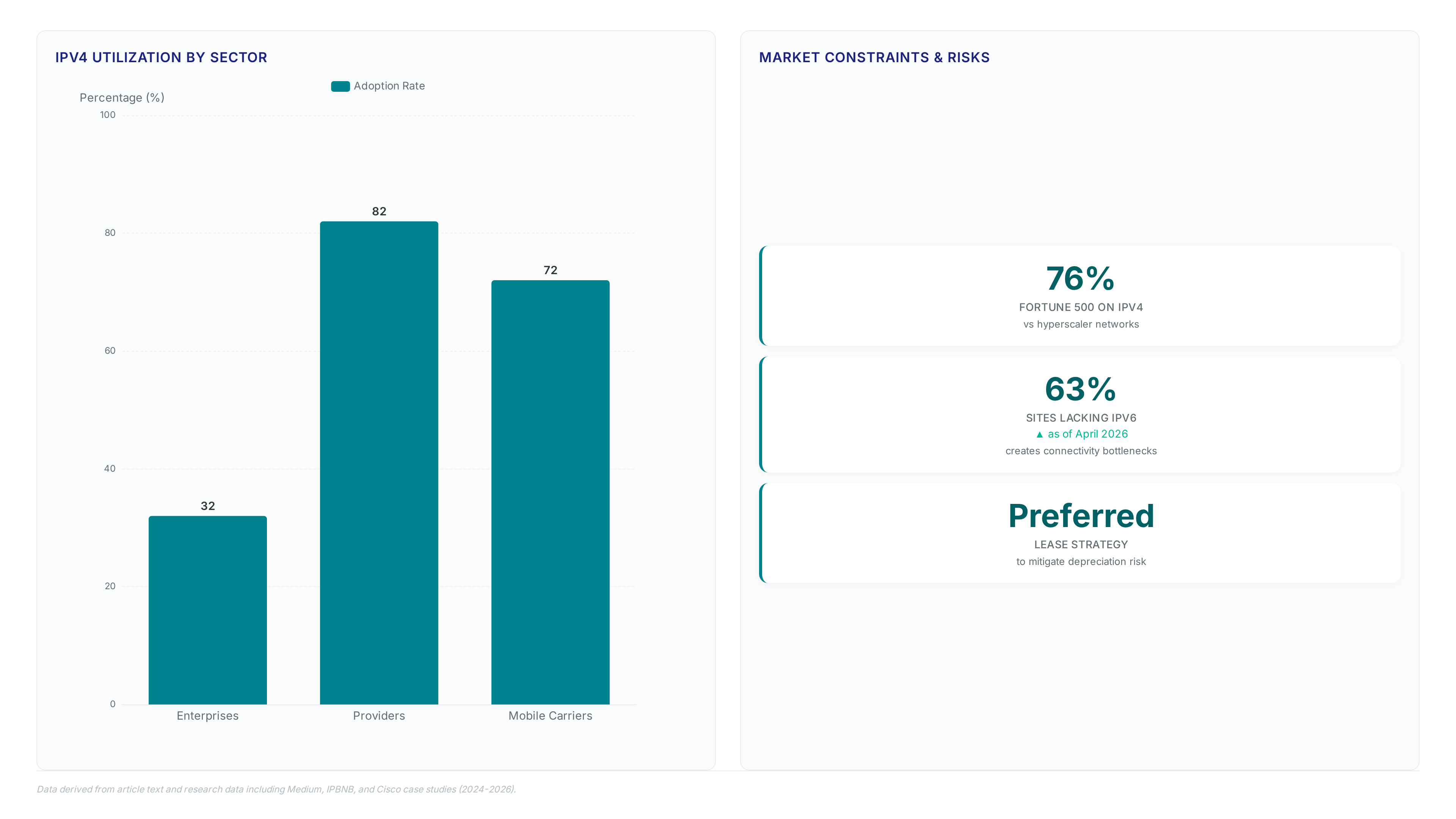
Seventy-six percent of Fortune 500 companies operate primarily on IPv4 infrastructure, creating a stark divergence from hyperscaler networks. This market dichotomy leaves enterprise adoption at roughly 32% while providers like Google report 82% utilization. The ARIN Board of Trustees appointment process directly addresses this imbalance by selecting community representatives who understand both legacy constraints and modern requirements. Policy development without such targeted governance risks favoring one segment over the other, exacerbating the adoption gaps visible in current traffic statistics. Most organizations opt to lease rather than buy address space to mitigate depreciation risk, a strategy that sustains IPv4 dependency indefinitely.
The 2026 NomCom selections directly influence this market behavior by appointing Board Trustees who understand these economic pressures. Operators must align resource strategies with the governance direction set during the Call for Nominations window in June. A mismatch between board expertise and market reality risks policy lag that penalizes agile leasing models. Network architects face a tension between immediate cash flow preservation and decade-long asset ownership. Selecting the wrong path locks an organization into either inflated operational costs or stranded capital assets.
Infrastructure Risks of Operating Without IPv6 Support Amidst Global Traffic Shifts
Sixty-three percent of websites globally lack IPv6 support as of April 2026, creating immediate connectivity bottlenecks for mobile-first users. Mobile carriers lead adoption at 72%, yet enterprises ignoring this shift face degraded performance when global internet traffic tips toward IPv6 dominance in early 2026. The operational risk manifests as asymmetric routing failures where mobile clients time out waiting for IPv4 fallbacks that never complete. Organizations failing to implement dual-stack operation face severe consequences. The ARIN Board of Trustees appointment process directly influences mitigation strategies by selecting representatives who prioritize protocol transition grants over indefinite IPv4 subsidies. Without governance focused on these adoption gaps, network operators will bear the full cost of maintaining parallel infrastructures through 2040. InterLIR recommends immediate auditing of customer edge routers to identify single-stack dependencies before traffic shifts become irreversible.
About
Nikita Sinitsyn, Customer Service Specialist at InterLIR, brings necessary frontline perspective to the discussion on the Nomination Committee. With eight years of experience in telecommunications support, Nikita directly manages ARIN database operations and KYC procedures daily, ensuring clients navigate complex regional internet registry policies successfully. This hands-on involvement with IPv4 resource redistribution makes him uniquely qualified to analyze how governance bodies like the 2026 NomCom impact market stability and access. At InterLIR, a Berlin-based marketplace dedicated to transparent IPv4 leasing, Nikita witnesses firsthand how regulatory decisions affect network availability across North America and globally. His work bridging technical compliance with customer needs provides a practical lens for understanding the critical role of committee selections in maintaining a fair and efficient IP address system.
Conclusion
Scaling dual-stack architectures reveals a critical breaking point. The operational overhead of maintaining legacy IPv4 logic grows exponentially as mobile traffic dominates, eroding the marginal savings from cheap IP acquisitions. Relying on recent market purchases at depressed rates creates a false sense of security while ignoring the impending depreciation of non-transitioned assets. Enterprises must pivot immediately from hoarding addresses to engineering protocol agility. The cost of parallel infrastructure will soon outweigh any capital preservation strategy. Governance bodies must prioritize candidates with demonstrated transition execution experience over those focused solely on asset accumulation to prevent policy stagnation.
Organizations should commit to a mandatory dual-stack roadmap by Q3 2026. Treat IPv4 not as a permanent asset but as a depreciating legacy interface. Delaying this shift locks firms into inflated maintenance contracts and excludes them from emerging mobile-first content delivery networks. The window for cost-effective migration narrows rapidly as native IPv6 paths become the default standard for new infrastructure. Start by auditing your edge router configurations this week to identify any hard-coded IPv4 dependencies that block native IPv6 traffic, then schedule a remediation sprint before the next governance election cycle closes. This immediate technical inventory provides the data necessary to align your capital strategy with the inevitable traffic shift.
Frequently Asked Questions
Legacy holders with pre-2024 agreements pay a capped fee of $250 annually. This fixed cost applies regardless of the total volume of IPv4 resources currently held by the organization.
The ARIN region manages a disproportionate 39.5% share of global IPv4 allocations. This significant volume makes the selection criteria for committee leadership vital for maintaining overall resource stability.
Voting occurs during the scheduled period from October 22 to October 30. General members must participate within these dates to determine who fills the open Board and Council seats.
The committee targets five specific seats to fill on the Advisory Council for the upcoming term. These roles are distinct from Board seats and focus on driving policy development.
Trustee members selected new representatives from submissions received between 14 and 28 April. Volunteers missing this specific solicitation window cannot join the committee for the current election cycle.