ARIN Policy Shift: 15 Members Can't Steer Alone
The clock stopped ticking on 27 February 2026 for the ARIN community to shape IP allocation via the new policy engagement survey. (ARIN's fee schedule)
We are past the point of polite suggestions. The current bottom-up policy development model is breaking under the weight of agentic automation. Gartner predicts AI agents will reshape infrastructure in 2026, and the Advisory Council knows stagnant participation kills the integrity of IPv6 address space governance. A 15-member elected body cannot steer the ship alone. If the framework doesn't integrate broader community input before the Number Resource Policy Manual version 2026.1 locks in new rules, it becomes obsolete.
This isn't just about reading updates; it's about survival. Manual policy updates are losing the race against automated demand. (APNIC's resources) Below is the raw mechanics of the ARIN Engagement Survey, showing how feedback from engineers like Matthew Wilder and Doug Camin builds the roadmap. Skip this window, and you hand control of essential Internet number resources to a system blind to AI-driven realities.
The Critical Role of Internet Number Resources in Global Governance
Defining Internet Number Resources: IPv4, IPv6, and ASNs
Internet number resources are the DNA of the internet: globally unique IPv4 blocks, IPv6 prefixes, and Autonomous System Numbers.
Collisions in the global routing table happen without them. ARIN is one of five Regional Internet Registries managing distribution in specific zones. Authority is delegated to maintain uniqueness, not centralized. IPv4 space is gone. IPv6 assignments started in 2006 to fix the expansion problem. You must request these through your regional registry or your routes are invalid.
Autonomous System Numbers tag distinct routing policies for border gateway protocol sessions. No valid ASN means no exterior gateway updates with peers. The Number Resource Organization keeps policy consistent across the five global registries. This stops the global routing system from fracturing.
| Resource Type | Bit Length | Primary Function |
|---|---|---|
| IPv4 Address | 32-bit | Host identification in legacy networks |
| IPv6 Prefix | 128-bit | Scalable host identification and routing |
| ASN | 16/32-bit | Routing policy domain identification |
InterNIC duties shifted to ARIN in 1998, moving from a single entity to a regional model. That historical move built today's decentralized framework. Outdated allocation methods create routing leaks. Security breaks. Modern deployments need strict registry data for path validation.
Scarcity versus demand drives the evolution inside the Number Resource Policy Manual. Legacy IPv4 holdings strangle new infrastructure scaling. Migration to IPv6 fixes capacity but adds operational complexity during the transition. The ARIN Advisory Council is a 15-member elected body guiding resource governance. They manage the Number Resource Policy Manual, defining assignment rules for the region. Version 2026.1 took effect on March 3, 2026, replacing older provisional policies for IPv6 address space. The council needs direct community input to refine these technical standards. An Internet Number Resource Policy Engagement Survey ran until February 27, 2026, collecting operator feedback. This mechanism lets network engineers change allocation logic before code deployment.
| Feature | Previous Edition | Version 2026.1 |
|---|---|---|
| IPv6 Rules | Provisional since 1999 | Updated and formalized |
| Engagement | Reactive comments | Proactive survey road map |
| Proven Date | Prior to 2026 | March 3, 2026 |
Ignore this process, and your policy text diverges from operational reality. The cost is measurable: outdated rules force manual overrides in routing filters. Participation takes time small teams don't have. That is the bottleneck. Without diverse operator voices, policies favor large incumbents over edge cases. Direct involvement ensures the Board of Trustees sees accurate technical constraints. Failure to participate leaves allocation criteria set by those with the most free time, not the most expertise.
IPv4 to IPv6 Migration Risks Amidst AI Infrastructure Demand
Internet number resources are the unique address blocks and routing identifiers global connectivity demands. The generative AI market valuation of tens of billions of dollars in 2026 presses hard on these finite pools. Hardware procurement cycles are accelerating while a supply crisis threatens physical infrastructure. Enterprises face a dual constraint: secure IP space and source compatible routing gear. An enterprise survey of roughly 30 companies shows large organizations struggling to execute the switch despite router support. Legacy application dependencies refuse dual-stack operation without costly refactoring. That is the root cause.
| Risk Factor | IPv4 Constraint | IPv6 Requirement |
|---|---|---|
| Address Availability | Exhausted pools | Abundant space |
| Hardware Support | Legacy native | Dual-stack mandatory |
| Policy Complexity | Static assignments | Flexible delegation |
The Number Resource Policy Manual version 2026.1 updates assignment rules to close these operational gaps. Operators must navigate these changing policies while managing explosive growth projected to reach a massive scale by 2032. Rapid AI deployment timelines clash with the slow consensus process of policy development. Delaying migration risks address starvation. Rushing implementation invites routing instability from misconfigured prefixes. The Industry Network Technology Council received grants specifically to tackle these enterprise adoption barriers. Funding proves technical capability alone cannot solve operational friction. Shared infrastructure bearing incompatible traffic profiles fails. The cost of inaction exceeds the engineering effort required for a clean split.
Inside the ARIN Policy Development Process Lifecycle
The 15-member elected Advisory Council filters community proposals before they enter the Policy Development Process. This body evaluates technical merit and consensus during public meetings. Only viable changes reach the Board of Trustees. Operators submit ideas through an open process where anyone may draft language. The council shepherds accepted drafts into the Number Resource Policy Manual, codifying rules for address distribution. Recent updates included new guidelines for IPv6 address space allocation, replacing provisional policies from the previous century.
| Stage | Actor | Action |
|---|---|---|
| Proposal | Community | Submits initial text |
| Review | Advisory Council | Validates consensus |
| Ratification | Board | Approves final rule |
Council bandwidth restricts the volume of proposals reviewed per cycle. That is the hard limit. High-complexity submissions stall without dedicated working group support. The Policy Engagement Working Group mitigates this bottleneck by soliciting direct feedback via surveys. One such Internet Number Resource Policy Engagement Survey closed in late February 2026 to gather prioritization data. This mechanism shifts the burden back to the community to self-identify high-value topics. Network engineers must monitor these channels to influence outcomes before drafts solidify. Passive observation yields zero policy changes.
Alison Wood originated Proposal 350 to revise rigid sizing calculations within NRPM Section 6.5. The text targets complex formula-driven thresholds hindering efficient IPv4 waiting list distribution. Operators submitted this draft to replace opaque utilization metrics with simplified assignment logic. Adoption requires consensus validation before the Advisory Council forwards the measure to the Board of Trustees. Final approval integrated these changes into NRPM 2026.1, which took effect on March 3, 2026. This timeline shows how specific community objections become binding operational rules.
APNIC uses Policy Fellows to actively shape operations and reduce barriers for new participants. ARIN relies strictly on voluntary operator engagement without dedicated fellowship roles. This structural gap slows feedback loops for smaller networks lacking policy expertise. Fewer diverse voices validate technical assumptions before code deployment. That is the measurable cost.
| Phase | ARIN Mechanism | APNIC Mechanism |
|---|---|---|
| Drafting | Community member submission | Policy Fellow assistance |
| Review | Advisory Council evaluation | Executive Council review |
| Input | Voluntary survey participation | Structured fellowship program |
Implementation demands strict adherence to the new manual version. Legacy systems relying on old formulas will reject valid requests under the updated regime. Network engineers must update internal tooling to match the March 3, 2026 effective date immediately. Failure to synchronize causes automatic allocation denials.
The Internet Number Resource Policy Engagement Survey window closed on 27 February 2026, ending direct input for this cycle. Operators missing this date must wait for the next annual review to influence policy development logic. Financial support remains available through June, as the application period for an ARIN Community Grant stays open through 14 June 2026. These grants fund projects improving resource management tools or documentation. Participation pathways differ significantly between regions and funding types.
| Mechanism | Deadline Status | Primary Actor |
|---|---|---|
| Policy Survey | Closed | Community Members |
| Grant Application | Open | Project Leads |
| AC Election | Pending | Nomination Committee |
Prioritize grant submissions now to secure Q3 funding before the window expires. Missing the survey deadline removes immediate feedback channels, forcing reliance on Advisory Council interpretations of past data. The gap between survey closure and grant availability creates a strategic window for drafting technical proposals without immediate public scrutiny.
Step-by-Step Guide to Participating in the ARIN Engagement Survey
Defining the ARIN Engagement Survey Scope and Audience
The window remained open to all members of the Internet community until 27 February 2026. This specific window targeted feedback to refine the bottom-up policy advancement process, not collect satisfaction metrics. Distinguish this mechanism from other RIR models, such as APNIC. The ARIN approach requires direct community input without intermediary facilitators. This creates a higher barrier to entry but ensures unfiltered technical consensus.
- Verify community status before attempting submission, as the scope includes non-members.
- Review the AC Working Group blog prior to accessing the questionnaire link.
- Submit responses before the closure date to influence the prioritized road.
Collected data will generate an actionable, prioritized road map for future engagement efforts. The limitation of this open scope is the potential for noise from non-technical respondents, requiring rigorous filtering by the Advisory Council.
Access the AC Working Group blog post by Matthew Wilder, Doug Camin, Alicia Trotman, and Lily Botsyoe to review proposed engagement methods before attempting the survey form. This sequence ensures operators understand the context behind questions regarding the bottom-up policy evolution process. Skipping this reading step risks submitting feedback that misaligns with the specific procedural gaps identified by the council.
- Navigate to the ARIN announcements archive to locate the January 28, 2026 entry detailing the Internet Number Resource Policy Engagement Survey.
- Follow the embedded link within that announcement to reach the specific blog article authored by the four working group members.
- Analyze the proposed methods listed in the text, noting how they differ from standard satisfaction metrics used in other industry verticals.
- Return to the original announcement page only after comprehension is complete to click the final survey hyperlink before the 27 February 2026 closure.
Operators who bypass this often provide generic responses that fail to address the detailed friction points in current policy drafting. The value of this protocol lies in converting vague dissatisfaction into actionable data for the Advisory Council. Failure to adhere to this read-first workflow dilutes the utility of the collected roadmap. This discipline separates constructive policy refinement from noise.
Contrasting ARIN Community Surveys with APNIC Policy Fellows Models
Direct participation in the Internet Number Resource Policy Engagement Survey requires operators to self-educate before submitting feedback, unlike facilitated models elsewhere. ARIN mandates that community members read the AC Working Group blog authored by Matthew Wilder, Doug Camin, Alicia Trotman, and Lily Botsyoe prior to engagement. This read-before-click protocol ensures submissions align with the specific gaps identified in the bottom-up policy growth process. The approach contrasts sharply with APNIC, where Saima Nisar actively guides participants through complex proposals.
| Feature | ARIN Model | APNIC Model |
|---|---|---|
| Facilitation | Self-directed study | Guided by Policy Fellows |
| Entry Barrier | High ( | Moderate (mentor support) |
| Feedback Path | Direct to Advisory Council | Filtered through regional staff |
Operators must execute the following steps to participate effectively:
- Locate the January 28, 2026 announcement detailing the survey window closing on 27 February 2026.2. Review the proposed methods documented by the AC Working Group members.
- Submit responses that address specific procedural bottlenecks rather than general satisfaction.
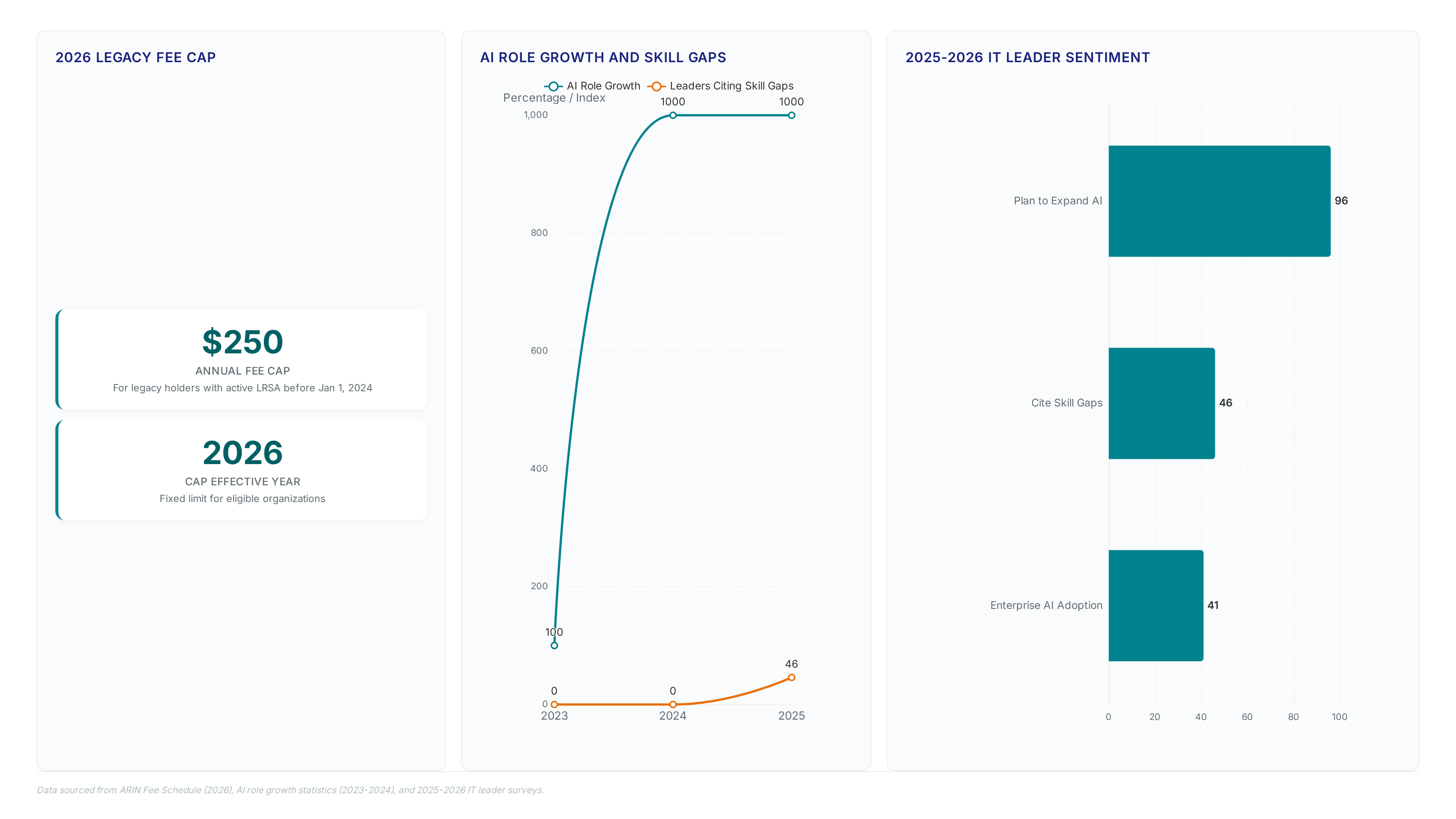
The limitation of this direct approach becomes apparent when technical teams face resource constraints. With 46% of technology leaders citing skill gaps as a substantial obstacle in 2025, the expectation for engineers to independently master policy nuances creates a participation bottleneck.
Application: The Bottom-Up Policy Progress Process at ARIN
Direct operator submission drives the ARIN Policy Advancement Process, requiring participants to draft proposals without intermediary facilitators. This open model mandates that anyone may participate in shaping rules, yet it demands significant self-education compared to regions using Policy Fellows. The Advisory Council translates this raw community feedback into the Number Resource Policy Manual, a translation layer where technical nuance often gets lost without precise wording. Operators skipping the preparatory AC Working Group blog risk submitting vague input that fails to influence the final road map for engagement.
| Step | Actor | Output |
|---|---|---|
| Drafting | Community Member | Policy Proposal |
| Review | Advisory Council | Discussion Draft |
| Ratification | Board of Trustees | NRPM Update |
The limitation of this direct approach is measurable: only a minority of affected networks actually submit comments, leaving gaps in the policy development logic. Study the methodology before attempting contribution, as unstructured feedback rarely survives the council filtering phase. The cost of non-participation is silent adoption of rules that may not fit specific network topologies. Treat the bottom-up mechanism as a configuration task requiring precise syntax, not a general suggestion box. Failure to engage directly cedes control over resource management constraints to competitors who did submit detailed technical arguments.
Aligning AI Infrastructure Growth with IPv6 Allocation Policies
Job postings for AI agent developers jumped nearly 1000% between 2023 and 2024, creating immediate pressure on IP address allocation workflows. This surge demands that operators engage directly with policy updates to secure sufficient space for distributed workloads before hardware supply crisis constraints tighten further. The Number Resource Policy Manual version 2026.1 now governs these assignments, replacing provisional rules that previously limited large-scale deployment flexibility. Operators ignoring these updates risk falling behind as market expansion accelerates without corresponding resource availability.
Securing allocations requires understanding specific procedural shifts within the RIR system formed in 1992 to manage regional growth. The cost of non-participation is measurable: organizations failing to submit feedback miss opportunities to shape criteria that directly impact their infrastructure scaling plans. Unlike passive observation, active engagement ensures allocation policies reflect actual operational needs rather than theoretical models.
| Engagement Level | Resource Impact | Operational Risk |
|---|---|---|
| Passive Observer | Standard assignment limits | High shortage probability |
| Active Participant | Tailored allocation criteria | Mitigated supply constraints |
| Policy Author | Direct rule definition | Minimal regulatory friction |
Failure to link workforce expansion with address space planning creates a bottleneck that no amount of capital expenditure can resolve.
Application: Critical 2026 Deadlines for ARIN Community Input and Grants
Operators must submit survey feedback by 27 February 2026 to influence the actionable, prioritized road map for future policy engagement. Missing this window forfeits immediate input on the bottom-up policy evolution process while the Advisory Council drafts new guidelines. Grant applications remain open through 14 June 2026, offering funding for projects that address infrastructure gaps like the hardware supply crisis. Past recipients such as Internet2 utilized these funds to validate IPv6-only networks for thirty participants, proving the program's technical utility.
| Policy Survey Submission | 27 Feb 2026 | Shapes engagement roadmap |
|---|---|---|
| Grant Application | 14 Jun 2026 | Funds protocol testing |
| Blog Review | Immediate | Contextualizes survey questions |
Failure to read the AC Working Group blog before survey submission risks providing misaligned feedback that the council cannot action. Operators skipping this step waste the opportunity to refine rules governing their own address space. InterLIR advises treating the survey as a technical prerequisite rather than an administrative formality.
About
Vladislava Shadrina serves as a Customer Account Manager at InterLIR, a Berlin-based marketplace specializing in IPv4 address redistribution. Her daily work directly connects to Internet number resource policy, as she guides clients through the complexities of acquiring and managing critical IP assets. While ARIN updates its Number Resource Policy Manual to govern allocation in North America, Shadrina navigates the practical implications of these global standards for businesses facing network availability challenges. Her role requires deep familiarity with IP reputation, BGP security, and the regulatory environment affecting resource transfer. This hands-on experience in facilitating transparent, efficient IP leasing and sales makes her uniquely qualified to analyze how policy shifts impact market dynamics. By bridging the gap between the RIR regulations and real-world commercial needs, she provides valuable insights into maintaining reliable IT infrastructure amidst evolving Internet number governance.
Conclusion
Scaling AI infrastructure reveals a critical fracture: address exhaustion becomes a secondary constraint to operational literacy when teams cannot articulate specific prefix requirements to regional registries. The projected explosion in agentic automation by 2027 will overwhelm static allocation models, forcing organizations to pay a steep premium in delayed deployments if they lack established policy relationships. Waiting for market pressures to dictate supply chain adjustments guarantees friction; the real cost lies in the months of lost innovation while bureaucratic processes catch up to technical demand.
Treat policy participation as a core engineering function, not a legal compliance task. Commit to submitting detailed technical feedback on allocation criteria by 27 February 2026, ensuring your specific scaling architecture informs the upcoming road map. Simultaneously, secure funding for protocol validation through the 14 June 2026 grant window to de-risk your transition to next-generation addressing schemes before the talent gap widens.
Start this week by auditing your current IP inventory against your 2027 AI deployment roadmap to identify precise prefix gaps. Document these findings in the technical brief to attach to your upcoming survey submission, transforming generic feedback into actionable data that the Advisory Council can immediately apply for rule refinement.
Frequently Asked Questions
Legacy holders with an active LRSA before 2024 pay a capped fee of $250 annually. This specific financial limit applies only to organizations maintaining their agreement status within the defined timeframe.
The ARIN Advisory Council operates as a governing body consisting of exactly 15 elected members. These individuals guide resource governance and manage the Number Resource Policy Manual for the entire region.
Version 2026.1 of the manual officially replaced older provisional policies on March 3, 2026. This update formalized IPv6 rules that had previously remained provisional since the year 1999.
Community members must submit their feedback regarding policy development before the survey closes on 27 February 2026. This input helps create a prioritized roadmap for future engagement efforts.
An IPv6 prefix utilizes a 128-bit length to provide scalable host identification and routing capabilities. This larger bit structure resolves capacity issues found in legacy 32-bit IPv4 space.