Interconnect last mile ends manual handoffs now
Weeks of manual coordination collapse into a few clicks with the April 15, 2026 launch of AWS Interconnect – last mile. This integration dissolves the operational silo between enterprise networks and public cloud infrastructure. Legacy handoffs are obsolete. Automated, on-demand provisioning is no longer a luxury; it is a strict requirement for sustaining the bandwidth demands of modern GenAI workloads.
CloudZero data confirms that AI spending growth in 2026 forces enterprises to abandon rigid, multi-vendor procurement cycles for low-latency pathways. By using an open specification, AWS allows partners like Lumen Technologies to extend private connectivity directly through the AWS Console and Amazon CLI. This shift eliminates the traditional friction where IT and cloud teams struggled with mismatched operational models, replacing weeks of negotiation with instant, scalable deployment.
This cloud-network integration changes enterprise architecture by removing manual configuration bottlenecks. The analysis below covers strategies for provisioning high-speed connectivity specifically tailored to support hybrid machine learning clusters and data-intensive analytics.
The Role of Cloud-Network Integration in Modern Enterprise Architecture
AWS Interconnect Last Mile and Lumen Cloud Interconnect Set
AWS Interconnect – last mile merges cloud provisioning with physical fiber logistics to eliminate manual BGP configuration steps. This architecture defines cloud-network integration as a unified control plane where the AWS Console triggers backend orchestration across partner infrastructure. Unlike Google Cloud's Partner Interconnect, which often leaves last-mile logistics to customers, this solution automates the full path from premises to edge. Lumen Cloud Interconnect serves as the transport layer, using 340,000 global fiber route miles to reach enterprise sites without new civil works. The collaboration was first announced in late 2025 before reaching general availability on 15 Apr 2026.
| Feature | Traditional Interconnect | AWS Interconnect – Last Mile |
|---|---|---|
| Provisioning Interface | Carrier Portal + AWS Console | AWS Console Only |
| Last-Mile Responsibility | Customer or Partner Managed | Provider Automated |
| Configuration Scope | VLAN + BGP Manual Entry | Zero-Touch Automation |
Speed comes at the cost of vendor neutrality during the initial deployment phase. Relying on a single qualified delivery partner like Lumen simplifies operations yet creates a dependency on that provider's specific metro footprint. Sites outside the 2,200 supported third-party data centers face standard lead times rather than instant activation. This trade-off favors organizations prioritizing deployment velocity over multi-carrier diversity for their primary GenAI uplinks.
Operators initiate high-bandwidth sessions through the AWS Console, bypassing the weeks of ticketing previously required for circuit turns. This automation collapses the timeline for deploying GenAI workloads that demand consistent low latency. The shift reflects a broader industry move where hybrid cloud architectures now default to zero-trust models requiring persistent private paths. Lumen Technologies acts as the initial partner, using its metro fiber to extend the control plane directly to customer premises.
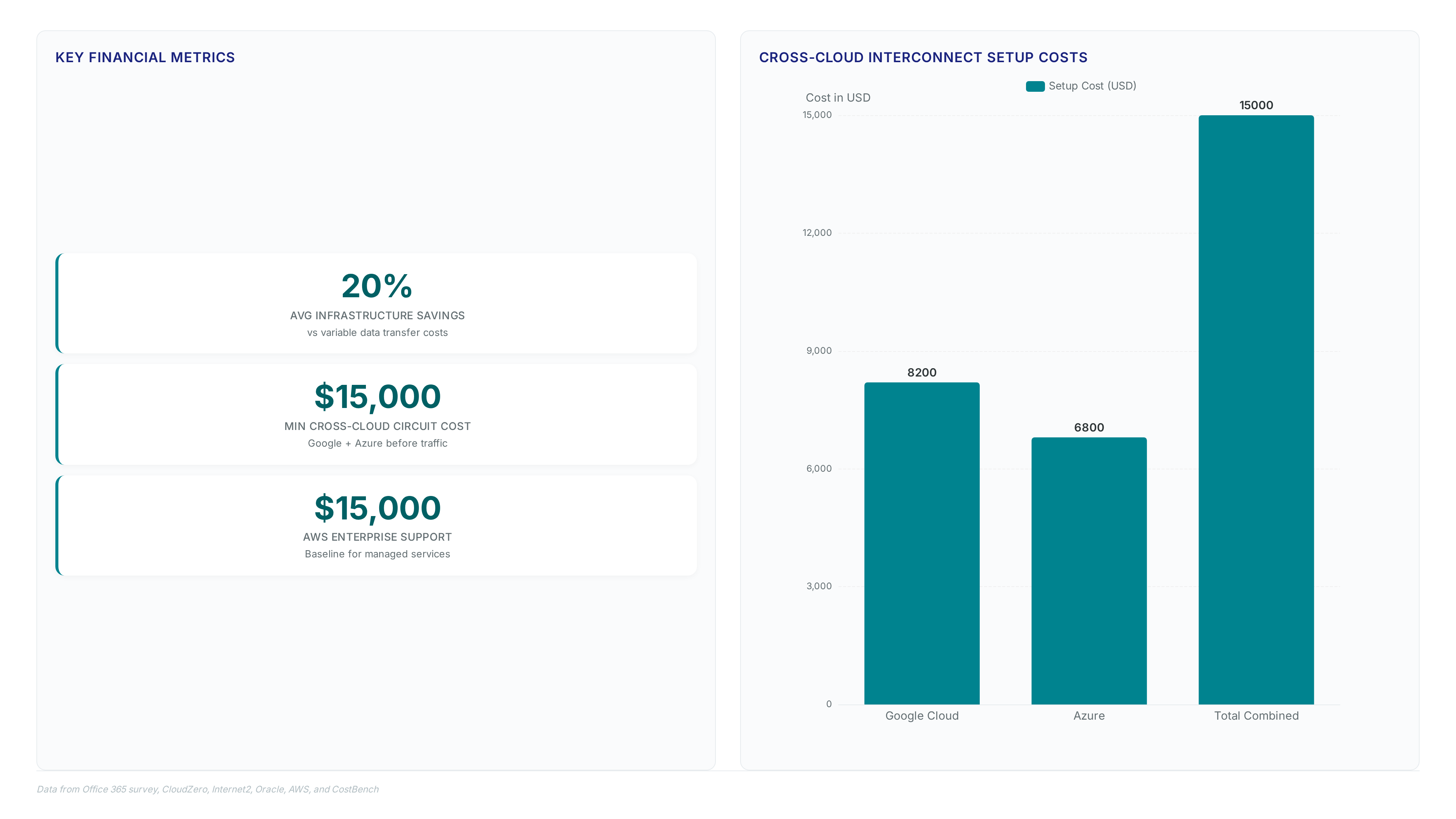
Traditional multi-cloud architectures impose a minimum setup cost exceeding $15,000 due to fragmented vendor coordination and custom engineering. This legacy model forces operators to manage separate contracts for fiber delivery and cloud port activation, creating operational silos. In contrast, the automated approach supports seven granular bandwidth tiers ranging from 1 Gbps to 100 Gbps without requiring new physical orders for scaling. Operators gain the ability to align connectivity costs precisely with workload demands rather than over-provisioning for peak capacity. However, this efficiency introduces a dependency on the specific open specification adopted by AWS, potentially limiting multi-vendor abstraction compared to agnostic SD-WAN overlays. The reduction in manual touchpoints removes a common source of configuration drift but centralizes failure domains within the provider's orchestration logic. Enterprises must weigh the speed of deployment against the loss of granular control over the underlying transport path.
Inside Automated BGP and MACsec Encryption for Private Cloud Access
MACsec encryption secures data frames at Layer 2 using default keys on the AWS-to-partner interconnect boundary. The protocol encrypts Ethernet payloads between the customer edge and the cloud router, eliminating manual key distribution cycles. Security features activate automatically within the AWS Console workflow, removing the operational burden of configuring cipher suites or managing Security Association Keying Protocol exchanges. This default posture contrasts with competitor architectures that often require specific hardware support or explicit enablement steps to achieve similar encryption standards. Lumen's fiber infrastructure provides the physical redundancy required to maintain these encrypted sessions during link failures, ensuring continuous end-to-end protection from premises through the cloud.
| Configuration Aspect | Manual Direct Connect | AWS Interconnect Last Mile |
|---|---|---|
| Key Management | Operator-defined lifecycle | Automatic rotation |
| Activation Trigger | CLI command or ticket | Service provisioning |
| Failure Mode | Silent plaintext fallback | Session termination |
Operators gain data in transit security without altering existing BGP policies or VLAN tagging schemes. The architectural trade-off involves reduced visibility into cipher negotiation details, as the abstraction layer hides lower-layer parameters from network monitoring tools. This opacity simplifies deployment but complicates troubleshooting when interoperability issues arise between non-standard transceivers and the managed boundary. Enterprises must rely on provider logs rather than local packet captures to verify MACsec session states during incidents.
Executing Automated BGP Peering via Activation Key Workflow
The workflow begins when operators select location, partner, and bandwidth within the AWS Console to trigger backend orchestration. This selection process generates a unique activation key that serves as the cryptographic token for session establishment. Customers authenticate directly with Lumen using this key, which binds the request to specific physical ports without manual ticketing. The system then provisions the connection end-to-end, configuring BGP sessions and VLAN tags automatically across the underlying fiber plant. This mechanism eliminates the traditional friction of coordinating layer-2 handoffs between distinct administrative domains.
Deployment follows a strict four-step sequence to ensure parameter consistency:
- AWS Interconnect – last mile automatically provisions four redundant connections. This architecture eliminates manual design errors common in legacy deployments where operators often miss diverse entry points. The system integrates with Transit Gateway to extend private reachability to any AWS Region globally via AWS Direct Connect Gateway. Enterprises moving heavy data workloads validate this approach to eliminate internet-rate egress billing for sustained high-volume transfers.
| Validation Step | Requirement | Verification Method |
|---|---|---|
| Physical Diversity | Two distinct entry facilities | Confirm dual-site provisioning in console |
| Link Count | Four active circuits | Inspect BGP session state counts |
| Global Reach | DXGW attachment status | Check route propagation to target Regions |
Operators must verify that MACsec encryption remains active across all four paths during failover events. The limitation lies in the current footprint; interconnection infrastructure resides in us-east-1, though continental U. S. customers connect over the Lumen backbone. Multi-region setups use Cloud WAN integration to manage complex topologies without custom scripting. Relying solely on logical redundancy without physical diversity creates a single point of failure at the building entrance.
Native Bandwidth Scaling Mechanics for GenAI Workloads
Instantaneous adjustment from 1 Gbps to 100 Gbps eliminates physical reprovisioning delays for fluctuating GenAI training cycles. This capability supports seven granular tiers: 1, 2, 5, 10, 25, 50, and 100 Gbps, allowing operators to match high-speed network capacity to exact inference demands without new fiber orders. Bandwidth scaling occurs natively through the console, bypassing the manual ticketing workflows that plague traditional last-mile providers. AI workloads drive cloud spending growth in 2026, creating volatile traffic patterns that static circuits cannot accommodate efficiently. Cloud computing statistics confirm this surge necessitates the low-latency flexibility inherent in the Interconnect- last mile architecture.
The cost of over-provisioning static links becomes measurable when training clusters idle; paying for unused 100 Gb pipes drains budgets reserved for compute. However, relying solely on automated scaling introduces a dependency on the control plane availability of the partner network during peak adjustment windows. Operators must verify that their BGP session timers align with these rapid throughput changes to prevent flapping during transient spikes. This mechanical shift transforms connectivity from a fixed capital expense into a variable operational parameter aligned with model iteration.
In practice, the collaboration between AT&T and AWS targets latency-sensitive agentic workflows requiring sub-millisecond jitter for real-time decision loops. Operators deploy this architecture when standard internet paths introduce unacceptable variance for GenAI inference engines. The integration uses an open specification API to bypass manual carrier ticketing, directly provisioning private circuits through the console. This approach eliminates the coordination friction that typically delays high-bandwidth deployments for months. Enterprises facing volatile traffic patterns benefit from eliminating variable egress charges associated with public internet transfers. Validating this financial model requires analyzing sustained transfer volumes against fixed hourly port rates. Organizations migrating heavy datasets often eliminate internet-rate egress billing to stabilize operational expenditure forecasts.
| Deployment Trigger | Traditional Circuit | Automated Interconnect |
|---|---|---|
| Provisioning Time | Weeks | Minutes |
| Configuration | Manual BGP/VLAN | API-driven |
| Encryption | Optional Add-on | MACsec Default |
| Scaling Model | Physical Truck Roll | Console Slider |
The primary constraint remains the reliance on partner fiber density in specific metropolitan zones. AT&T engineering teams must verify physical diversity before committing to redundant link designs for critical AI workloads. Market analysis identifies these compute-intensive tasks as the primary driver of cloud spending growth throughout 2026. Static bandwidth allocations fail to accommodate the bursty nature of model training cycles. Operators must align circuit capacity with flexible inference demands to prevent bottlenecks. Failure to automate this scaling results in underutilized assets during idle periods or dropped packets during peak loads. Strategic adoption hinges on matching the elasticity of the cloud network to the unpredictability of machine learning jobs.
May 2026 introduces a $0 minimum circuit cost for the new 500Mbps tier, drastically altering capital expenditure models for GenAI pilots. Establishing baseline connectivity between Google Cloud and Azure typically requires separate expenditures of roughly $8,200 and $6,800 respectively, locking teams into rigid financial commitments before a single byte transfers. AWS automatically provisions four redundant connections. This architectural difference means the competitor approach effectively doubles the already high entry price for high-availability designs. Operators must weigh the zero-cost entry against potential vendor lock-in, as the free tier applies only to local interconnects within specific regions. Scaling beyond the initial 500Mbps incurs standard hourly rates, yet the elimination of per-gigabyte data transfer charges provides predictable costing for bursty AI workloads. The decision framework favors AWS for iterative development cycles where budget flexibility outweighs the need for immediate multi-provider diversity.
Activation Key Workflow for Lumen Cloud Interconnect
The activation key serves as the cryptographic token linking AWS Console selections to Lumen's automated provisioning engine. Operators initiate the process by selecting a site and bandwidth tier, triggering the generation of a unique string. This key bridges the gap between cloud intent and physical circuit instantiation without manual ticketing.
- Generate the activation key within the AWS Interconnect interface after defining location parameters.
- Authenticate into the Lumen Connect portal using enterprise credentials to access the redemption field.
- Paste the token to trigger immediate bandwidth scaling logic and backend circuit ordering.
- Validate the establishment of four redundant links across dual physical sites before traffic migration.
This workflow abstracts the complex logistics typically managed by qualified delivery partners. Unlike legacy models requiring distinct orders for diverse entry points, the system enforces redundant connections. The limitation lies in the strict dependency on correct console inputs; an erroneous region selection propagates instantly to the carrier side, demanding a full teardown and restart rather than a simple modification.
Operators initiate private cloud access by selecting a site, Lumen as the partner, and a target AWS Region within the interface.
- Define the enterprise location and choose from seven bandwidth tiers ranging from 1 Gbps to 100 Gbps.
- Review the automated design which provisions four redundant connections.
- Generate the unique activation key displayed on the summary screen after confirming parameters.
- Log into the Lumen portal to paste the key, triggering immediate backend orchestration.
This workflow bypasses the fragmented procurement typically required for Azure ExpressRoute or Google Cloud Interconnect, consolidating carrier contracts into a single console action. Native bandwidth scaling allows adjustment between granular increments like 2 Gbps or 50 Gbps without physical truck rolls. The limitation lies in current geographic scope; while us-east-1 hosts the interconnection points today, continental U. S. sites rely on Lumen backbone transit rather than direct local presence. Operators must account for this hop when calculating jitter budgets for real-time GenAI inference loops.
Continental U. S. Sites use Lumen's backbone to reach us-east-1 and global AWS Regions via DXGW without manual circuit orders.
- Confirm the enterprise location falls within the continental United States to access the connectivity fabric supporting automated last-mile provisioning.
- Verify target workloads align with the latency profiles of a substantial backbone provider to ensure GenAI inference stability.
- Test BGP peering reachability against the AWS Direct Connect Gateway (DXGW) endpoint after activation key redemption.
Operators must distinguish between local metro access and long-haul transit capacity when validating paths. The limitation is that while Lumen provides extensive fiber, specific rural on-ramps may lack the diverse physical routing found in dense urban cores. This constraint forces a trade-off between immediate availability and the highest tier of physical redundancy for non-metro sites. InterLIR recommends validating the specific fiber route diversity before committing production GenAI traffic to the new link.
About
Nikita Sinitsyn serves as a Customer Service Specialist at InterLIR, where his daily work focuses on managing critical network resources and navigating complex registry operations. With eight years of experience in the telecommunications sector, Nikita possesses deep practical knowledge of IP infrastructure, making him uniquely qualified to analyze the implications of AWS Interconnect – last mile. His expertise in RIPE database operations and technical support allows him to understand how smooth connectivity solutions impact enterprise network architecture. At InterLIR, a specialized IPv4 address marketplace based in Berlin, Nikita helps clients secure the necessary IP assets required to use such high-speed cloud connections. This article bridges his frontline experience with customer connectivity challenges and the evolving environment of direct cloud access. By examining how Lumen Technologies and AWS simplify provisioning, Nikita provides valuable insights for organizations seeking to optimize their network boundaries and ensure reliable, private data transmission.
Conclusion
Scaling AI inference clusters exposes a critical fragility: the last-mile handoff often becomes the bottleneck even when backbone capacity is abundant. As 2026 workloads demand consistent sub-millisecond jitter, relying on shared transit paths introduces unpredictable variance that throttles model training efficiency. The operational burden shifts from simple provisioning to continuous path validation, where a single fiber cut in a non-diverse rural segment can stall distributed computing jobs for hours. This hidden latency tax accumulates rapidly, eroding the theoretical performance gains of high-bandwidth tiers.
Organizations targeting production GenAI deployment by Q3 2026 must mandate physical route diversity audits before signing any service level agreements. Do not assume carrier redundancy equals path independence; verify the actual fiber geography against your specific site coordinates. If your location relies on a single conduit for both primary and backup circuits, reject the implementation until diverse entry points are engineered. The cost of retrofitting redundancy post-deployment far exceeds the initial diligence required.
Start by requesting the fiber strand maps from your current carrier this week and overlay them with your facility's ingress points. Identify any single points of failure where both logical paths share the same physical trench. This immediate visual confirmation determines whether your infrastructure can sustain continuous AI operations or requires redesign before traffic migration begins.
Frequently Asked Questions
Traditional setups cost over $15,000 due to fragmented vendor coordination requirements. AWS Interconnect – last mile removes these complex fees by utilizing a single-fee pricing model based on bandwidth.
Starting May 2026, AWS provides one free 500Mbps local interconnect per region to lower entry barriers. This incentive encourages adoption without requiring immediate financial commitment for initial testing phases.
Deployment time shrinks from weeks of manual coordination to just a few clicks within the console. This automation supports scalable bandwidth needs essential for data-intensive analytics and hybrid machine learning clusters.
Traffic fails over automatically during maintenance without requiring any customer intervention or service disruption. The system maintains redundant links to ensure consistent low latency for your critical GenAI workloads.
Lumen utilizes 340,000 global fiber route miles to reach enterprise sites without new civil works. This extensive network accesses 2,200 third-party data centers to extend private connectivity directly to your premises.