SitetoSite VPN Limits: Stop Overprovisioning Now
The AWS VPN portfolio expanded to five distinct options following the November 2025 launches, demanding precise architectural selection to avoid performance bottlenecks. You will learn to differentiate between Standard AWS Site-to-Site VPN limits and the new Large Bandwidth Tunnels capable of 5 Gbps throughput. We also examine how the VPN Concentrator enables shared aggregate bandwidth for multiple sites while AWS Client VPN manages secure access for diverse employee devices.
Selecting the wrong termination point, whether a virtual private gateway or transit gateway, directly impacts your ability to scale hybrid connectivity without over-provisioning. The original article details how Standard AWS Site-to-Site VPN connections provide two redundant tunnels by default, ensuring high-availability for critical workloads. In contrast, newer architectures use AWS Cloud WAN for global policy-based management across regions. Understanding these distinctions prevents the common error of deploying expensive, high-throughput tunnels where standard 1.25 Gbps connections suffice.
The analysis extends to specific application patterns like VPN CloudHub for inter-site connectivity using unique Autonomous System Numbers. You will see how Private IP VPN enables connectivity over AWS Direct Connect using private addresses, a necessity for complex enterprise environments. By evaluating your infrastructure against these four factors, you can eliminate guesswork and align your hybrid network strategy with actual performance needs rather than hypothetical maximums.
Core AWS VPN Components and Hybrid Connectivity Definitions
AWS Site-to-Site VPN Redundant Tunnel Architecture
Every AWS Site-to-Site VPN connection structurally mandates exactly two redundant IPsec tunnels to ensure high-availability for hybrid network architectures. This fixed architectural constraint provides automatic failover capabilities, distinguishing managed services from self-managed EC2 solutions where operators must manually engineer redundancy. The Virtual Private Gateway serves as the primary AWS endpoint for VPC attachments, while complex multi-VPC environments often require a Transit Gateway to terminate these dual tunnels centrally. Scaling beyond this baseline requires deploying additional VPN connections or using ECMP with Transit Gateways. This design choice prioritizes deterministic failover behavior over raw aggregate throughput per single endpoint pair.
Network architects cannot tune tunnel counts for granular load balancing within a single connection object. Design. Optimizing these existing dual paths yields improved stability than seeking alternative addressing schemes. Contact InterLIR to audit your current tunnel utilization and identify unused capacity for redistribution.
Deploying AWS Client VPN for Diverse Employee Devices
AWS Client VPN operates as a managed, OpenVPN-based service delivering secure remote access to individual users across heterogeneous device ecosystems. Unlike site-to-site architectures constrained by fixed tunnel counts, this solution elastically scales to support thousands of concurrent connections from Windows, Mac, iOS, Android, and Linux endpoints. The underlying mechanism relies on standard OpenVPN protocols, allowing organizations to maintain compatibility with existing client configurations while offloading management overhead to the cloud provider. A European developer accessing an AWS-hosted database securely while traveling demonstrates the practical utility of this architecture for protecting credentials outside trusted networks. Secure remote access
Self-managed EC2 instances offer granular protocol flexibility. The managed Client VPN service trades this customization for operational stability and simplified authentication integration. The cost is a reliance on standardized OpenVPN parameters rather than bespoke cryptographic modules. Amazon CloudWatch Logs functions as the exclusive repository for auditing connection events, meaning all forensic analysis depends on this single data stream. CloudWatch Logs This centralization creates a dependency where log retention policies directly impact security post-incident visibility.
The service integrates smoothly with identity providers to enforce access controls before establishing the encrypted tunnel. The address pool must accommodate the maximum expected concurrent user count without exhaustion. Optimizing these resources ensures reliable connectivity without over-provisioning capacity. Contact InterLIR to assess your current IPv4 allocation against these scaling requirements.
Large Bandwidth Tunnels Versus Standard VPN Concentrator Limits
Large Bandwidth Tunnels deliver 5 Gb throughput per tunnel, fundamentally shifting capacity planning for high-volume sites. Launched in November 2025, this option supports organizations requiring massive single-link performance that exceeds the 1.25 Gb ceiling of standard configurations. In contrast, the VPN Concentrator aggregates traffic across many locations, offering shared bandwidth up to 5 Gb for the entire device rather than per site. This distinction prevents architects from over-provisioning expensive dedicated tunnels when site density is high but individual site demand remains low. Selecting the wrong model creates immediate bottlenecks or wasted capital on unused aggregate capacity.
Operators must note that Accelerated Site-to-Site VPN connections require NAT Traversal (NAT-T) to be enabled, a constraint that applies regardless of tunnel size. Poor initial selection leads to architectural rework, representing a hidden cost of ignoring specific site count and bandwidth requirements during design. Optimizing these resources avoids the trap of buying fixed large-capacity links unnecessarily. Contact InterLIR to refine your IPv4 and cloud connectivity strategy today.
Architectural Mechanics of Tunneling Protocols and Routing Topologies
ECMP Scaling Mechanics in TGW and Large VPN Architectures
Equal-Cost Multi-Path routing transforms aggregate throughput by distributing traffic across multiple parallel tunnels, a capability absent in standard Virtual Private Gateway configurations. Standard Site-to-Site VPN connections terminate on a VGW without ECMP support, capping effective bandwidth regardless of tunnel count. In contrast, Transit Gateway and Large VPN architectures use ECMP to scale performance linearly by activating additional paths dynamically. This mechanical difference dictates that high-throughput sites require TGW or Large VPN attachments rather than simple VGW links. Operators attempting to force scale on non-ECMP gateways encounter hard ceilings despite available physical bandwidth. The architectural shift toward centralized multi-VPC routing enables this path diversity necessary for modern hybrid clouds. However, enabling ECMP introduces complexity in BGP path selection and requires precise asymmetric routing controls to prevent packet reordering issues. Network teams must balance the desire for raw throughput against the operational overhead of managing multiple BGP sessions per site.
Mapping Per-Tunnel Throughput Limits to Site-to-Site Designs.
Matching site bandwidth demands to specific tunnel capacities prevents performance bottlenecks in hybrid architectures. Standard VGW configurations support moderate traffic loads but lack the packet processing power required for high-frequency trading or massive data replication workloads. Operators must distinguish between per-tunnel limits and aggregate capacity when designing for scale.
The VPN Concentrator model serves dense spoke-and-hub topologies where individual branch offices require only modest connectivity. This shared resource approach contrasts sharply with dedicated large bandwidth tunnels designed for single-site saturation. Selecting the wrong architecture forces costly migrations later.
| Feature | Standard VGW/TGW | Large Bandwidth | Concentrator |
|---|---|---|---|
| Per-tunnel BW | Up to 1.25 Gbps | Up to 5 Gbps | Up to 100 Mbps |
| PPS/tunnel | 140,000 | 400,000 | 10,000 |
| ECMP Support | Yes (TGW only) | Yes | No |
| Best Use Case | General Enterprise | Data Center Lift | Branch Aggregation |
High packet-per-second requirements often dictate the choice more than raw throughput. A link saturating at 800 Mbps with small packets may fail if the underlying gateway cannot handle the interrupt load, even if bandwidth appears available. Architects frequently overlook this processing ceiling until latency spikes during peak operations.
Avoid over-provisioning expensive dedicated links when site density is high but individual demand remains low. Precise alignment of technical constraints ensures optimal capital expenditure.
Throughput Bottlenecks in VPN Concentrator and Client VPN Deployments
Shared bandwidth pools in VPN Concentrator deployments create immediate contention when aggregate site traffic exceeds the device ceiling. Unlike dedicated large tunnels, this architecture caps individual site throughput at 100 Mbps while limiting the entire concentrator to a shared maximum. Operators ignoring this distinction face unpredictable latency spikes as neighbor noise consumes available capacity. The mechanical constraint forces a choice between oversubscribed shared resources or complex multi-device scaling.
Remote access architectures face similar elasticity limits where Client VPN performance depends entirely on subnet provisioning. Each user connection receives up to 50 Mbps, yet the service scales throughput by adding subnets rather than expanding a single pipe. This design means architectural rework becomes inevitable if initial subnet planning fails to anticipate concurrent user growth. The hidden cost lies in the operational overhead of managing multiple subnets to maintain per-user speeds during peak demand.
| Deployment Type | Scaling Mechanism | Primary Constraint |
|---|---|---|
| VPN Concentrator | Multiple Devices | Shared 5 Gb Aggregate |
| Client VPN | Additional Subnets | Per-User 50 Mbps Cap |
Ignoring these scaling mechanics guarantees performance degradation as organizational size increases.
Strategic Application Patterns for Enterprise and Retail Scenarios
Defining Large Bandwidth Tunnel and Accelerated VPN Capabilities
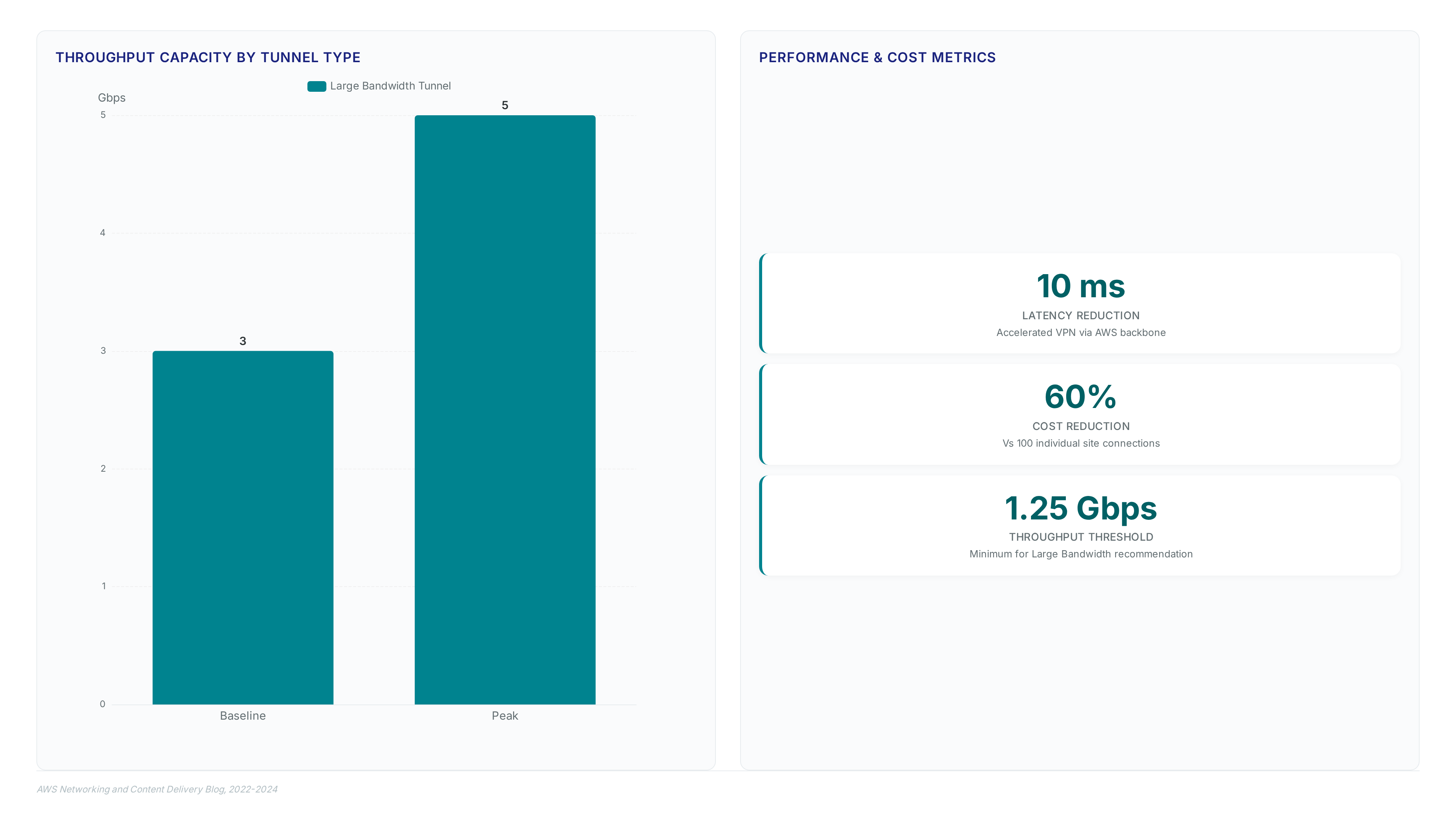
Large Bandwidth Tunnel and Accelerated VPN capabilities resolve distinct infrastructure bottlenecks by separating raw throughput from latency reduction requirements. The Large Bandwidth Tunnel specifically addresses massive single-link performance needs, handling a 3 Gbps baseline and reaching up to 5 Gbps peak within a single connection per factory. This architecture eliminates the operational complexity of managing multiple parallel tunnels just to saturate a fiber circuit. Conversely, Accelerated VPN routes traffic through the AWS backbone using Global Accelerator, entering at the nearest edge location and reducing latency to approximately 10 ms. This approach uses the AWS global fiber network to bypass unpredictable public internet congestion that plagues standard paths.
| Feature | Large Bandwidth Tunnel | Accelerated VPN |
|---|---|---|
| Primary Goal | Maximize single-tunnel throughput | Minimize round-trip latency |
| Infrastructure | Single high-capacity link | AWS backbone via edge locations |
| Gateway Requirement | Transit Gateway required | Transit Gateway required |
The critical tension lies in gateway compatibility; both solutions mandate a Transit Gateway, rendering them unavailable for simple Virtual Private Gateway deployments. Operators attempting to upgrade existing VGW architectures face a mandatory migration event rather than a configuration toggle. This structural requirement means organizations must weigh the immediate benefit of higher speeds against the disruption of recreating connections.
Selecting VPN Concentrator for Retail Chains Versus TGW for Factories.
Retail chains with hundreds of locations achieve significant cost reduction by deploying a VPN Concentrator instead of provisioning individual site connections. This architecture connects the stores through a single TGW attachment, delivering up to 60% cost reduction compared to 100 individual Standard VPN connections. The shared bandwidth model efficiently handles sporadic transaction data without over-provisioning capacity for idle periods. However, this approach strictly requires a Transit Gateway because termination on a Virtual Private Gateway is impossible for concentrator deployments. Operators attempting to migrate legacy VGW setups must delete existing connections and rebuild the topology to support this hub-and-spoke pattern.
Manufacturing facilities demand a different strategy due to massive machine-to-machine data flows that overwhelm shared pools. Heavy industrial sites require Large Bandwidth Tunnel configurations to sustain high-throughput telemetry without contention. Unlike the retail model, factories apply dedicated tunnel capacity rather than sharing aggregate bandwidth across multiple sites. Under-provisioning these links leads to architectural rework and severe performance bottlenecks. The trade-off is increased complexity in routing policies versus the absolute necessity of guaranteed throughput for operational technology.
| Feature | Retail Chain (Concentrator) | Factory (Large Tunnel) |
|---|---|---|
| Primary Driver | Cost Efficiency | Throughput Guarantee |
| Architecture | Shared Aggregation | Dedicated Link |
| Gateway Type | Transit Gateway Only | Transit Gateway Only |
| Scaling Method | Add Sites to Pool | Increase Tunnel Count |
Operational Risks in VGW Limits and Concentrator Expansion Constraints
Virtual Private Gateway route tables have specific limits on the number of connections, creating immediate failure modes for expanding enterprises attempting to scale beyond simple hub-and-spoke topologies. This limit forces a binary choice: prune necessary routes or migrate architecture entirely. Operators relying on Static routing within legacy configurations face even steeper hurdles, as VPN Concentrator deployments strictly support BGP only, rendering non-flexible on-premises equipment incompatible without flexible routing configuration.
The migration path introduces significant operational risk because no in-place upgrade exists for transitioning from Standard tunnels to Large Bandwidth variants. Existing connections must be deleted and recreated, inducing unavoidable network outages during the cutover window. This constraint complicates maintenance windows for organizations needing to bypass per-tunnel throughput ceilings. While the VPN Concentrator offers shared bandwidth efficiency, it terminates exclusively on a Transit Gateway, making direct attachment to a VGW impossible.
| Constraint | VGW Limitation | Concentrator Requirement |
|---|---|---|
| Routing Protocol | Static and BGP supported | BGP only supported |
| Upgrade Path | Delete and recreate | Delete and recreate |
| Gateway Type | Virtual Private Gateway | Transit Gateway required |
Ignoring the BGP only mandate for concentrators delays deployments when legacy hardware lacks flexible routing capabilities.
Implementation Steps for Deploying and Configuring AWS VPN Solutions
BGP Requirements and TGW Attachment Constraints for VPN Concentrator
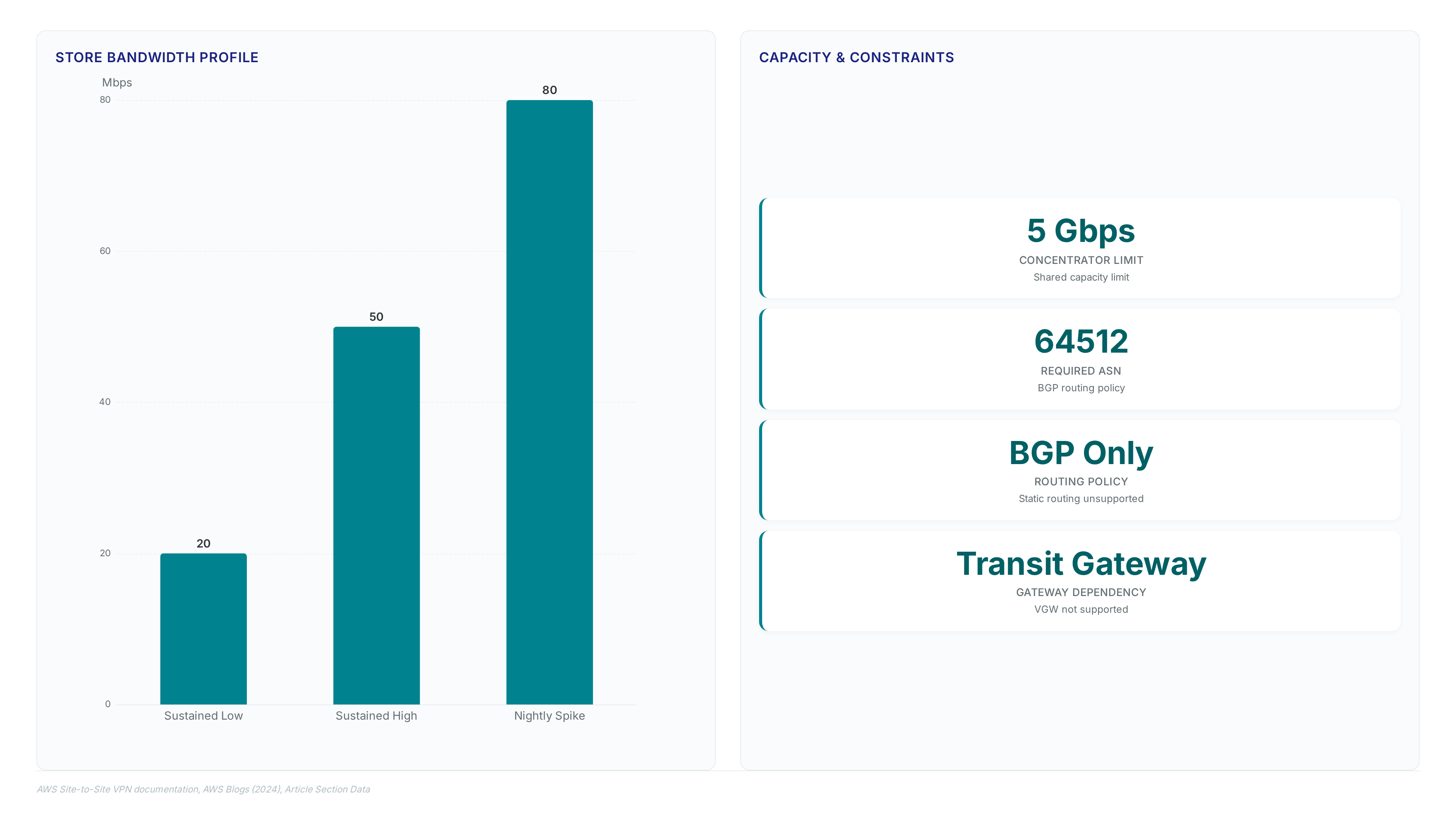
The VPN Concentrator enforces a strict BGP-only routing policy, differing from other AWS VPN options that support both BGP and static routing. This architectural mandate requires every on-premises edge device to support flexible path advertisement. While this ensures optimal route propagation across complex meshes, it creates a compatibility consideration for hardware fixtures unable to negotiate flexible sessions. Network architects should verify BGP capability before procurement. This solution demands attachment to a Transit Gateway, as direct termination on a Virtual Private Gateway is not supported. This dependency centralizes control plane operations. Organizations currently using VPN CloudHub patterns, which rely on VGWs, will need to architect a new topology to use the concentrator, as the concentrator is TGW-only. This impacts maintenance planning for large-scale deployments seeking the shared bandwidth efficiency of this model. For guidance on configuring BGP across multiple sites, consult the AWS Site-to-Site VPN documentation. InterLIR recommends auditing your current routing protocols before attempting this transition to ensure smooth integration.
Deploying VPN Concentrator for 100-Store Retail Inventory Sync
This architecture replaces individual tunnel sprawl with a centralized VPN Concentrator capable of handling shared bandwidth demands. Each store generates 20, 50 Mbps sustained across multiple VPCs in different accounts and Regions, with spikes to 80 Mbps during nightly inventory syncs. The aggregate demand fits comfortably within the 5 Gbps shared capacity limit of the concentrator unit, which supports up to 100 sites per concentrator. Operators achieve substantial cost savings compared to provisioning distinct connections for every endpoint.
Implementation requires strict adherence to flexible routing protocols because static configurations are unsupported.
- Attach the VPN Concentrator to the Transit Gateway.
- Establish BGP sessions between the on-premises edge and the concentrator.
The operational consideration lies in the routing requirement; legacy setups using Virtual Private Gateways cannot upgrade in place and require a new architecture. This necessitates a choice between maintaining fragmented architectures or implementing a modernized topology. Unlike self-managed remote access solutions on EC2 which offer great flexibility in security protocols, this managed service uses a standardized compatibility matrix to reduce overhead. Network teams must verify BGP capability on all store routers before procurement to avoid hardware incompatibility.
Scaling Risks: VGW Connection Limits Versus Concentrator Quotas
Hard caps on Virtual Private Gateway connections create immediate architectural ceilings that standard configurations cannot bypass without redesign. While a VGW restricts deployments to ten site links, the VPN Concentrator supports up to one hundred sites per concentrator.
| Feature | Virtual Private Gateway | VPN Concentrator |
|---|---|---|
| Max Sites | 10 | 100 (per concentrator) |
| Routing Type | BGP, Static | BGP only |
| Expansion Path | Migrate to TGW | Add concentrators |
Operators ignoring these thresholds face deployment halts during critical expansion phases. The requirement for BGP routing means that exceeding the 10 site default on a VGW may prompt a migration to TGW-based solutions like the concentrator for improved scalability. The concentrator mandates flexible routing, which requires on-premises devices to support BGP. This creates a dependency on network capabilities before scale becomes viable. Failure to align site growth trajectories with these quota realities results in costly service interruptions.
About
Alexander Timokhin, CEO of InterLIR, brings strategic oversight to the complex environment of cloud networking. While InterLIR specializes in optimizing IPv4 resource allocation, Timokhin's deep expertise in IT infrastructure and global connectivity makes him uniquely qualified to analyze AWS Site-to-Site VPN solutions. His daily work involves ensuring secure, efficient network pathways for diverse industries, directly correlating to the challenges of selecting the right tunneling architecture. As organizations navigate the expanded AWS portfolio, including Large Bandwidth Tunnels, the need for precise IP management and reliable connectivity grows. Timokhin connects these dots by applying his background in RIPE database administration and international network policy to practical deployment scenarios. At InterLIR, facilitating clean BGP routes and reliable IP reputation highlights the importance of the underlying network foundation that VPNs secure. This article uses his operational experience to guide engineers toward cost-effective, high-performance connectivity choices that align with broader network resource strategies.
Conclusion
Scaling beyond ten sites exposes the fundamental fragility of legacy Virtual Private Gateway architectures, where hard connection caps force abrupt redesigns rather than graceful growth. The shift to VPN Concentrator topologies resolves immediate throughput bottlenecks but introduces a rigid dependency on BGP competency that many edge devices lack. Organizations attempting to hybridize these models often incur hidden operational debt by maintaining parallel routing domains. The industry trajectory clearly favors centralized management via AWS Cloud WAN, suggesting that heavy investment in complex concentrator meshes may yield diminishing returns for enterprises planning broad regional expansion.
Deploy the VPN Concentrator only if your on-premises fleet natively supports flexible routing and you require immediate scaling beyond ten sites without a full Cloud WAN migration. If your hardware cannot sustain BGP sessions, delay procurement and prioritize edge device upgrades to prevent routing instability. This approach avoids the trap of building a high-throughput tunnel network that collapses under configuration complexity.
Start by inventorying your current router firmware versions this week to confirm BGP feature availability before designing any new tunnel endpoints. Verifying this compatibility early prevents costly hardware refresh cycles after deployment begins.
Frequently Asked Questions
Standard tunnels cap at 1.25 Gbps, so exceeding this causes bottlenecks. You must upgrade to Large Bandwidth Tunnels supporting 5 Gbps to maintain performance without packet loss.
Each connection includes exactly two redundant tunnels for automatic failover. This design ensures high availability while capping individual tunnel throughput at 1.25 Gbps for standard configurations.
Individual user connections receive up to 50 Mbps of bandwidth. The service scales total throughput by adding more subnets rather than increasing speed per single user session.
The concentrator caps individual site throughput at 100 Mbps. While the aggregate shared bandwidth reaches 5 Gbps, no single site can exceed this specific per-site limit.
Choose Large Bandwidth Tunnels when links saturate near 800 Mbps with small packets.
References