BGP visibility jumps with 300 new vantage points
A single BMP feed delivers 50+ distinct BGP perspectives, fundamentally altering network visibility. bgproutes. Io represents the operational maturation of next-generation routing data, moving beyond theoretical machine learning models to provide actionable, three-month window analytics for global engineers. This platform uses BMP-driven collection to expose discrete speaker states that legacy archives simply cannot capture.
Readers will examine how the architecture ingests data from over 300 vantage points, integrating feeds from RouteViews, RIPE RIS, PCH, and CGTF into a unified API. (RIPE's routing information service ris) The discussion also covers the deployment of intuitive dashboards that reveal the inference logic behind prefix and origin-AS selection.
With OVHcloud providing the bare metal infrastructure and research validation from the University of Strasbourg, this tool addresses the critical blind spots in modern peering ecosystems. Unlike earlier iterations focused solely on selecting the "Most valuable Vantage Point," the current iteration prioritizes speed and granular transaction history. As George Michaelson notes in this PING podcast episode, the shift from academic prototype to operational service marks a definitive turn in how we audit BGP transactions seen in the wild.
The Role of bgproutes.io in Modern BGP Visibility
bgproutes.io and the GILL Platform Architecture
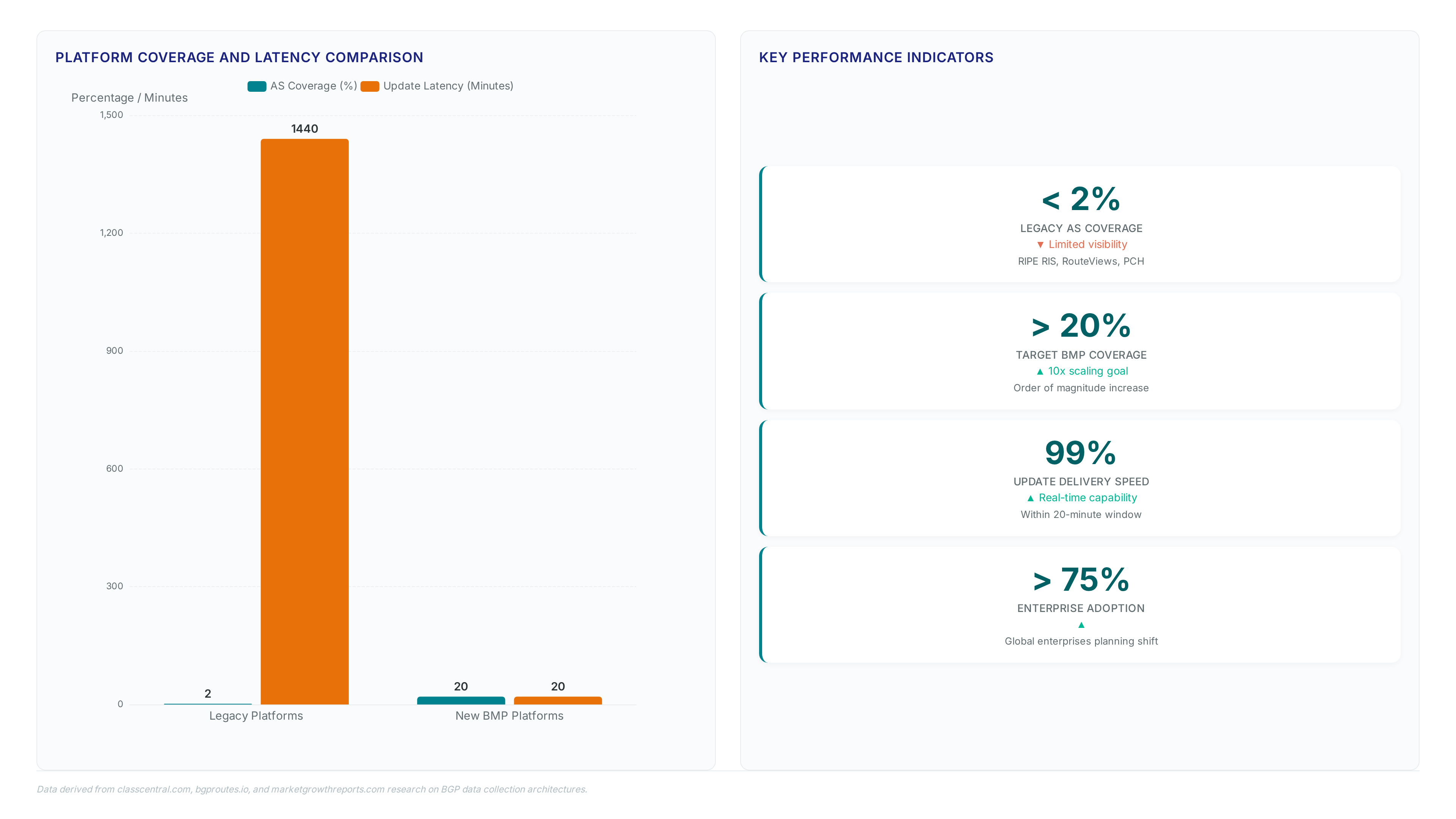
Stop thinking of a vantage point as a physical rack location. Bgproutes. Io defines it as a discrete BGP speaker session ingested via BMP. This distinction allows the GILL platform component to target route collection from an order of magnitude more routers than legacy systems. Traditional archives like RIPE RIS capture data from less than 2% of Autonomous Systems, creating significant blind spots in global routing visibility. The University of Strasbourg leads this initiative to expand coverage by 10x while constraining the marginal cost per new observation point. OVHcloud supplies the Bare Metal infrastructure required to sustain this expanded telemetry volume without proportional increases in human operational effort.
Disk space used to dictate strategy. Legacy Multi-threaded Routing Toolkit exports demand substantial storage, forcing operators to trade retention depth for broader coverage. Bgproutes. Io sidesteps this by processing discrete state updates rather than full table dumps, allowing a three-month visibility window at scale. The system integrates feeds from RouteViews and PCH yet adds unique perspectives through direct BMP sessions at Internet Exchange Points. A single BMP feed can expose over 50 distinct BGP views, drastically improving anomaly detection granularity.
Automation is no longer optional. The industry faces a projected shortfall of 1.2 million certified engineers. Deploying Most Valuable Vantage Point selection targets AI inference traffic paths where legacy archives miss a significant share of transient route updates. Organizations should adopt this architecture when inference workloads dominate data center demand, rendering static monitoring insufficient for real-time anomaly detection. MVP algorithms reduce the marginal cost per observation point while scaling collection volume notably beyond traditional limits.
| Legacy Monitoring | MVP-Based Analysis |
|---|---|
| Fixed router set | Flexible speaker selection |
| High manual overhead | Automated inference logic |
| Blind to transient leaks | Detects micro-bursts |
Physical locations lie during congestion events. A single IXP connection yields dozens of distinct perspectives, yet most dashboards aggregate these into a single noisy stream. Machine learning models fail without clean training data, generating false positives during path selection. Operators must configure filters to isolate high-value sessions before ingesting terabytes of raw updates. This approach bridges the operational gap created by the inability to hire sufficient staff for 24/7 NOC coverage.
This tenfold expansion addresses the blind spots inherent in traditional MRT export formats that force trade-offs between data retention and collection scope. The GILL platform component uses 300 vantage points to ingest BMP streams, capturing discrete speaker states that static collectors miss. Operators analyzing hypervisor traffic or AI inference paths require this density to detect transient anomalies before they cascade. Bgproutes. Io applies logic to remove duplicate observations before storage, optimizing the signal-to-noise ratio for hijack detection. Network teams should deploy this architecture when static monitoring fails to capture ephemeral route leaks affecting critical prefixes. The shift from physical router counts to discrete session ingestion changes the baseline for routing observability.
Inside the Architecture of BMP-Driven Data Collection
BMP streams expose discrete speaker states, yielding 50+ distinct perspectives from a single IXP feed. The protocol operates by pushing Route Monitoring messages from a BGP speaker to a collector, capturing Peer Down notifications and Initiation headers without polling. This mechanism contrasts sharply with legacy pull-based models that aggregate data into bulky MRT files. Traditional collection methods often trigger excessive CPU consumption on production routers when adding new sessions, forcing operators to limit visibility. BMP avoids this overhead by maintaining a dedicated, passive TCP session for telemetry export.
Granularity drives the architectural advantage. A single feed at an exchange point provides visibility into individual peering sessions rather than just aggregate router output. This density allows platforms to analyze redundancy between BGP updates before storage, discarding duplicate advertisements while preserving unique path attributes. Legacy systems struggling with expensive data storage cannot compete with this efficiency.
| Feature | BMP Stream | Legacy MRT Dump |
|---|---|---|
| Data Granularity | Per-peer state | Aggregated table |
| Transport | Persistent TCP | Periodic file transfer |
| Redundancy | Real-time filtering | Post-process dedup |
| Router Load | Low (passive push) | High (active pull) |
Operators gain immediate visibility into neighbor resets that aggregate logs obscure. Managing high-velocity stream processing replaces static file parsing.
Unified API endpoints eliminate the rigid trade-off between historical depth and collection scope found in legacy workflows. The new architecture applies redundancy algorithms to incoming BMP streams, discarding duplicate updates before storage to optimize retention within a three-month window. This approach shifts the burden from local compute cycles to server-side filtering, allowing immediate query execution against fresh data.
Implementing BMP feeds at IXPs yields granular speaker states that static collectors miss, yet the system prioritizes recent visibility over deep historical storage. Operators gain rapid access to transaction logs without managing petabytes of uncompressed data. The limitation remains the fixed retention period, which suits incident response but fails long-term trend analysis requiring multi-year datasets.
| Feature | Legacy MRT Workflow | API-Driven Model |
|---|---|---|
| Data Access | Local download | Remote query |
| Storage Cost | High (raw files) | Optimized (deduplicated) |
| Topology Build | Hours | Minutes |
| Retention Focus | Depth | Recency |
The topology endpoint reduces the operational friction of correlating prefix origins across hundreds of vantage points.
BMP Feeds Versus Traditional RIPE RIS and RouteViews Collection
Legacy archives like RIPE RIS rely on volunteer peers, creating fragmented visibility across the global routing table. Traditional systems force engineers to download massive MRT archives. This storage burden limits the scope of data available for real-time analysis. The protocol pushes Route Monitoring messages directly from the BGP speaker to the collector.
| Feature | Legacy Collectors | BMP-Driven Platforms |
|---|---|---|
| Data Access | Local File Download | Unified API Endpoints |
| Visibility Scope | Fragmented Voluntary Peers | Overshoot-and-Discard Scheme |
| Update Latency | High (Batch Processing) | Low (Real-Time Stream) |
| Storage Model | Raw Redundant Files | Deduplicated Streams |
The overshoot-and-discard scheme allows any AS to peer easily, filtering redundant data automatically. Operators gain the ability to construct full AS-level topologies in minutes rather than days. However, shifting to API-driven access requires trusting the central platform's filtering logic completely. Blind reliance on pre-processed streams removes the operator's ability to validate raw update sequences independently. This trade-off sacrifices granular auditability for immediate query speed and reduced local infrastructure costs.
Defining the MVP Selection Criterion in BGP Data Collection
Machine learning dynamically selects the Most Valuable Vantage Point based on specific researcher requirements rather than accepting static volunteer peers. Professor Cristal Pelsser from Louvain University established this criterion to filter high-signal routing data from the noise inherent in raw collection. The MVP system targets specific anomalies, reducing the marginal cost per new observation compared to traditional manual peering setups. Legacy archives force a rigid trade-off between coverage and retention due to bulky file formats, whereas targeted ingestion optimizes storage efficiency. Operators choosing MVP-based monitoring gain precision but sacrifice the exhaustive historical depth found in full-archive dumps.
| Dimension | Static Volunteer Peering | MVP-Driven Selection |
|---|---|---|
| Data Source | All available peers | Dynamically chosen nodes |
| Storage Overhead | High (full MRT dumps) | Low (deduplicated streams) |
| Signal Density | Low ( | High (anomaly-focused) |
| Human Effort | Significant manual curation | Automated ML filtering |
The GILL platform limits increased human effort despite scaling collection volume by an order of magnitude. This approach discards redundant updates before storage, effectively bypassing the disk space constraints that plague legacy systems. Traditional MRT archives create bottlenecks. The limitation remains that MVP selection relies on accurate training data; poor models may overlook novel attack vectors outside known patterns. Manual inspection of BGP updates fails when staff counts drop while infrastructure complexity rises. The GILL architecture filters noise before human review becomes necessary.
Legacy tools demand deep protocol expertise that fewer junior engineers possess today. Bgproutes. Io applies machine learning to highlight anomalies without requiring staff to parse raw MRT dumps. This shift allows remaining senior engineers to focus on policy design rather than data collection.
Over 75% of enterprises plan infrastructure modernization by 2027, yet hiring pipelines remain stagnant. Automation bridges this gap by encoding expert logic into the collection layer itself. The system identifies peer down events and route leaks instantly, removing the need for constant human vigilance.
However, reliance on AI introduces opacity into troubleshooting workflows. Engineers cannot audit the decision tree if the model rejects a valid path as suspicious. Trust requires transparency in how the MVP selection algorithm weights specific AS paths. Operators must validate findings against raw BMP streams during initial deployment phases.
The cost of inaction exceeds the risk of false positives. Unmonitored routes lead to traffic blackholing that no amount of manual logging can prevent after the fact.
BGPStream delivers 99% of update data within a strict 20-minute window, collapsing the detection timeline for route leaks. Legacy archives like RouteViews rely on periodic MRT dumps that introduce hours of delay before an operator can inspect the AS path. This latency gap defines the difference between containing an incident and watching it propagate globally. Traditional workflows force engineers to download massive MRT archives.
| Dimension | BGPStream/API Access | Legacy MRT Archives |
|---|---|---|
| Update Latency | < 20 minutes (99th percentile) | 4 to 24 hours |
| Data Format | Streamed JSON/CSV | Compressed binary files |
| Storage Model | Remote API query | Local disk array |
| Filtering | Server-side prefix match | Post-download parsing |
Real-time capability enables near-instant analysis with <20 minute latency for the vast majority of updates. However, this speed comes with a limited historical horizon compared to the decade-spanning repositories maintained by volunteer collectors. Operators gain immediate visibility but lose the ability to replay ancient routing states without switching providers. The cost is a fragmented view where recent anomalies are sharp, but long-term trend analysis requires hybrid tooling.
Application: BMP Protocol Mechanics for Discrete Router State Capture
BMP feeds deliver 50 distinct perspectives per IXP, isolating discrete states of individual BGP speakers rather than aggregating bulk updates. Legacy systems force engineers to download massive MRT archives. The bgproutes. Io API bypasses this bottleneck by querying specific origin-AS data directly, enabling topology reconstruction in minutes instead of hours. A single TCP session exports telemetry passively, eliminating the overhead associated with active polling mechanisms found in older tools.
Operational costs spike when traditional collectors add sessions, necessitating sparing deployment to avoid resource exhaustion on production gear. The GILL platform limits human effort increases despite scaling collection volume through an "overshoot-and-discard" scheme that filters redundancy before storage. This approach contrasts sharply with volunteer-dependent models where coverage remains fragmented across the global routing table.
| Collection Method | Data Latency | Resource Impact |
|---|---|---|
| Legacy MRT | Hours | High CPU/Memory |
| BMP Stream | Seconds | Negligible |
Direct API access allows operators to select prefixes without handling full file dumps. The trade-off is reliance on continuous stream availability rather than static snapshot retention. Unified API endpoints construct full AS-level topologies in minutes, bypassing the need for local MRT archive processing. Operators query specific prefixes and origin-AS values to retrieve BGP transactions seen in the wild without handling massive raw files. This approach eliminates the CPU overhead associated with parsing legacy dumps on local infrastructure. The system uses rich filtering parameters to isolate the path data, a capability documented in recent API capabilities descriptions.
The trade-off is reliance on the provider's retention window rather than unlimited local historical storage. Teams must align their forensic needs with the available three-month visibility scope. This shift reduces the barrier to entry for organizations lacking dedicated data engineering resources.
Validating Dashboard Inferences Against Three-Month Data Windows
Operators must cross-reference dashboard anomalies against raw BGP transactions within the three-month retention window to verify inference logic. The system displays both data points and the specific algorithms determining route stability, preventing blind reliance on automated flags. Legacy workflows often obscure the reasoning behind alerts, whereas this approach exposes the decision tree for manual audit.
Validation requires comparing inferred hijacks with the underlying update stream to confirm path manipulation. Traditional platforms rely on volunteer peering models that limit dataset breadth, while newer systems optimize sampling via redundancy removal algorithms to maintain efficiency. This distinction ensures that stored data represents unique state changes rather than propagated noise.
A critical tension exists between storage costs and historical depth when retaining full update streams. Economic models for public collectors often force a choice between coverage and retention due to expensive hardware requirements. Engineers should verify that dashboard conclusions match the discrete states visible in the BMP feed. InterLIR recommends auditing the three-month window monthly to ensureML models have not drifted from actual network behavior.
About
Alexander Timokhin, CEO of InterLIR, brings critical industry perspective to the evolution of bgproutes. Io. As the leader of a specialized IPv4 marketplace founded in Berlin, Timokhin manages complex global network resources where BGP integrity is paramount. His daily operations rely on verifying clean BGP announcements and maintaining accurate route objects to ensure security for clients leasing IP addresses. This direct experience with network availability and IP reputation makes him uniquely qualified to analyze next-generation data collection platforms. While bgproutes. Io represents a collaborative research effort involving OVHcloud and academic institutions, its impact connects deeply with InterLIR's mission to solve network resource distribution problems. Timokhin understands that advanced BGP data analysis is necessary for detecting anomalies and preventing hijacks in the modern internet system. His insights bridge the gap between theoretical network engineering advancements and the practical realities of managing critical IT infrastructure assets globally.
Conclusion
Scaling BGP observability reveals a critical fracture point: latency dictates survivability, not just data volume. When update streams lag beyond twenty minutes, automated mitigation systems react to ghosts, allowing transient hijacks to solidify before detection. The operational burden shifts from storing petabytes of raw MRT dumps to managing the compute intensity of real-time stream normalization. Organizations clinging to legacy archives face compounding technical debt as their forensic window widens while their reactive capability narrows.
Adopt stream-first architectures immediately if your security SLA demands sub-hour response times, but retain local cold storage only for compliance mandates extending beyond the standard three-month horizon. Do not attempt a full historical migration; instead, prioritize live path validation for critical prefixes first. This hybrid approach balances immediate threat visibility with long-term audit requirements without bankrupting your infrastructure budget.
Start by auditing your current BGP feed latency against the 20-minute threshold this week. Identify any prefix groups where update propagation exceeds this limit and isolate them for immediate API-based integration. This single step validates whether your existing monitoring stack can actually support modern routing hygiene before you commit to broader platform changes.
Frequently Asked Questions
Legacy archives capture data from less than 2% of Autonomous Systems, creating massive visibility gaps. This limited scope causes systems to miss 80% of transient route updates that modern BMP-driven platforms successfully detect.
The GILL platform reduces the marginal cost per new vantage point significantly compared to manual peering setups. This efficiency allows scaling collection by an order of magnitude without proportional increases in human operational effort.
Most Valuable Vantage Point algorithms target inference traffic paths where legacy archives miss 80% of transient route updates. This dynamic selection detects micro-bursts and anomalies that static snapshots from fixed router sets completely overlook.
The industry faces a projected shortfall of 1.2 million certified engineers, making manual 24/7 NOC coverage impossible. Automated inference logic bridges this gap by processing discrete state updates without requiring massive staff expansion.
A single BMP feed delivers over 50 distinct BGP perspectives from one physical connection point. This granularity exposes discrete speaker states that aggregated streams obscure during congestion events or complex peering scenarios.