Blackhole validation needs active path data now
Validating blackhole routes demands proof of active path existence, not arbitrary IRR data. Sparkle enforced this shift on February 3, 2026. The industry must abandon legacy IRR-derived filters for flexible verification that ties mitigation requests directly to live forwarding states. Unsigned lists with unknown provenance leave networks open to spoofed mitigation requests while legitimate traffic suffers.
We detail a concrete four-step validation process that eliminates dependency on fragile registry objects.
CISA mandates RPKI adoption for federal agencies by late 2026. Voluntary compliance windows have closed. Sparkle and Energotel already reject invalid prefixes, proving operational reliability now hinges on automated, data-driven scrutiny rather than trust-based registries. Engineers must build custom software to interpret these signals. Static configurations cannot survive modern DDoS landscapes where the primary link often fails precisely when mitigation is needed most.
The Critical Role of Active Path Validation in Modern BGP Security
Proof that a customer recently forwarded traffic via MRT logs is the only acceptable prerequisite before operators accept blackhole requests. This mechanism shifts trust away from static IRR registration toward flexible forwarding history. Job Snijders stated that in 2026 he would drop the requirement to register destinations in IRR, favoring checks on whether IP traffic actually reaches the customer. The original concept proposed that honoring blackholes should be contingent on whether IP traffic is even being forwarded at all to the requesting customer. Operators must record all BGP updates in MRT format to construct sliding time windows of active paths. Validation logic dictates that RTBH checks occur after RPKI verification so only valid origins qualify for suppression. Non-RIR databases like RADB lack cryptographic signatures, making them unsuitable for authoritative policy enforcement compared to signed RPKI ROAs.
Building software to parse MRT data and generate prefix lists demands engineering resources most teams lack. Relying on unsigned IRR data permits unauthorized blackholing attacks where malicious actors suppress legitimate traffic without owning the prefix. Rapid response times clash with the delay inherent in processing historical forwarding data. Operators must balance immediate threat neutralization against the risk of blocking traffic for customers currently experiencing control-plane outages. This method keeps blackholing as a facility of last resort rather than a global censorship tool available to any entity with an IRR account.
Implementing Forwarding Checks Using BGP Community 65535:666
Activating the BGP Blackhole Community 65535:666 requires verifying the customer previously held the active path via MRT logs. This mechanism replaces static IRR filters with flexible forwarding history to prevent unauthorized blackholing. Snijders framed this approach as a tabletop exercise requiring custom software rather than a verbatim deployment recipe. Normal routing forwards packets to a next hop, whereas blackholing redirects traffic to a null interface only after validation.
Operators must record all received updates in MRT format to construct sliding time windows of legitimate activity. If a customer did not forward traffic recently, their blackhole request represents an attempt to censor reachability they do not currently possess. Modern strategies increasingly favor RPKI over traditional registries because non-RIR databases lack cryptographic signatures. Cross-layer defenses now combine routing logic with packet forwarding success metrics to isolate malicious nodes dynamically.
Parsing MRT streams exceeds the effort of maintaining simple prefix lists. Unsigned data allows attackers to hijack blackhole communities for denial-of-service amplification. The blackhole community becomes a weapon against legitimate traffic rather than a shield without active path confirmation.
Unauthorized blackholing occurs when networks discard traffic for prefixes the customer never actively received. This forwarding state gap allows attackers to hijack null routes and deny service to legitimate destinations. Traditional validation relying on IRR data fails because registration does not prove active traffic flow. AWS defines a blackhole state specifically when route targets become unavailable, highlighting the need for flexible checks. Cisco IOS propagation behavior shows that invalid routes marked by ROV still appear in tables with the next hop set to a discard address if policies permit. Malicious actors trigger drops without carrying genuine load during this window. Networks effectively censor prefixes they never transported by ignoring this check. Snijders clarified that the slidedeck should be viewed as a tabletop exercise not a verbatim deployment guide. Implementing the spirit of this validation requires building custom software to cross-reference MRT logs against requests. Operators skipping this step risk becoming unwitting participants in route hijacks.
Inside MRT Data Recording and Sliding Time Window Mechanics
MRT Format Architecture for Centralized BGP Update Recording
Edge routers dump raw binary update streams to a central route collector using MRT format for durable storage. This architecture separates the high-frequency control plane from the analytical engine, letting operators reconstruct active path history without touching forwarding performance. Every edge router establishes a session with a dedicated collector that serializes BGP messages into timestamped records.
| Component | Function | Storage Target |
|---|---|---|
| Edge Router | Peers with collector | Volatile Memory |
| Route Collector | Serializes updates | Durable Storage |
| Analyzer | Parses MRT logs | Disk Array |
Recording all updates enables post-hoc debugging of BGP hijacks or unauthorized blackholing attempts that static filters miss. Withdrawal messages spiked from steady levels to approximately 75,000 per day during the mid-2022 instability period before stabilizing. Operators analyzing these logs distinguish between static blackhole events and legitimate RTBH filtering Storing full MRT streams demands significant disk capacity, often prohibiting long-term retention beyond a few weeks on standard hardware. The cost is clear: without this centralized archive, validating whether a customer held the active path becomes impossible, leaving the network vulnerable to false blackhole injection.
Constructing Active Path Lists Using 12 to 24 Hour Sliding Time Windows
Processing MRT data through a 12 to 24 hour sliding time window generates a definitive prefix list required for STEP 2 validation. Operators parse stored binary streams to isolate customer ASNs that served as the active path for normal routing during this specific interval. This mechanism replaces static IRR checks with flexible proof of traffic forwarding, ensuring only legitimate customers trigger drop policies.
- Ingest raw BGP updates from the central route collector into the analysis engine.
- Filter records to identify prefixes where the customer ASN appeared in the AS path.
- Aggregate results into a temporary allow-list updated every few hours.
The theory posits that if a customer forwarded IP traffic recently, they gain the privilege to request discarding future packets. Validating RTBH using MRT data prevents attackers from blackholing destinations the victim never actually reached. Unlike static blackhole Historical records from NANOG 30 established early policies, yet modern scale demands automated MRT parsing rather than manual review.
Maintaining durable storage for high-volume update streams introduces significant disk I/O overhead on the route collector. Infrastructure expansion becomes necessary, as retaining full history requires scaling beyond volatile memory buffers. The sliding window shrinks without this capacity, potentially excluding legitimate customers with bursty traffic patterns from protection.
Four-Step Validation Workflow from Raw MRT Data to Blackhole Verification
Snijders set STEP 1 as recording all customer BGP updates in MRT format to durable storage. Operators peer edge routers with a central collector, shifting reliance away from unverified IRR data toward cryptographically secure validation methods. This raw binary stream captures the exact AS path history required for forensic analysis.
STEP 2 applies a sliding time window to construct a prefix list where the customer was the active path. If no traffic flowed recently, the blackhole request represents a potential attack vector rather than a mitigation need. STEP 3 uploads these flexible lists as customer-specific filters, while STEP 4 repeats the cycle every few hours.
| Phase | Input Source | Validation Logic |
|---|---|---|
| Recording | Raw BGP Updates | Binary serialization |
| Analysis | Sliding Window | Active path check |
| Enforcement | Prefix Lists | Policy match |
Building this software replaces static registry checks with proof of forwarding state. The industry increasingly favors RPKI ROAs because non-RIR registries lack strict assignment validation. Storage costs present a constraint, yet the price prevents unauthorized censorship tools.
Implementation: Defining the Active Path Validation Logic for Blackhole Requests
Validating RTBH requests requires proving the customer held the active path within a recent sliding window, not merely possessing an IRR entry. This logic rejects static registry data in favor of flexible internal route analysis to confirm actual traffic forwarding before permitting drop policies. Operators must distinguish between a registered prefix and one actively carrying load, as unauthorized actors often exploit this gap to trigger censorship.
- Ingest MRT format streams from the central route collector into the parsing engine.
- Isolate prefixes where the requesting ASN served as the next hop during the last 12 hours.
- Cross-reference these flexible allow-lists against incoming blackhole community announcements.
- Reject any request lacking a corresponding active routing entry in the historical.
The industry shift toward RPKI ROAs supports this move away from unsigned database records, yet RPKI alone cannot prove current liveness. Standby links in active/standby pairs may not appear in the AS path during normal operations, potentially blocking legitimate emergency requests from the secondary circuit. This tension forces operators to balance strict validation against the need for rapid response during volumetric attacks.
Active link saturation blocks BGP updates, forcing operators to accept RTBH requests via secondary paths despite lower local preference.
- Detect primary link congestion where packet loss prevents BGP community
- Verify the requesting ASN held the active path within the last 24 hours using the generated MRT allow-list.
- Apply the blackhole policy immediately if the prefix exists in the sliding window cache, ignoring current path selection status.
This approach decouples mitigation authority from real-time reachability, acknowledging that DDoS traffic often destroys the control channel needed to request help. A specific real-world scenario involves a customer with primary and secondary connections where flood traffic congests the main circuit. The result is an inability to transmit the update required to trigger static blackhole Accepting the request over the standby link resolves the deadlock without requiring the victim to restore full connectivity first.
| Validation State | Primary Link Status | Action Taken |
|---|---|---|
| Active Path Confirmed | Congested / Flapping | Accept RTBH via Secondary |
| Active Path Confirmed | Operational | Accept RTBH via Primary |
| No Recent Traffic | Any State | Reject Request |
The drawback is that this method relies entirely on the integrity of the local MRT archive; missing records create blind spots for validation. Operators must ensure the sliding window logic persists across router reboots to maintain continuity during extended attacks. This strategy prioritizes service availability over strict topological adherence when the network faces existential threats.
Risks of Constructing Prefix Lists from Arbitrary IRR-Derived Data
IRR-derived prefix lists fail validation because unsigned registry entries lack proof of active traffic forwarding. Operators relying on static IRR data expose networks to unauthorized blackholing, as registry records do not confirm current path ownership. This gap allows arbitrary actors to request traffic drops for prefixes they do not actively route. The consequence is a policy bypass where legitimate traffic gets discarded based on stale or fabricated registry objects. Verifying the active path via MRT logs ensures only customers actually forwarding traffic can trigger mitigation. A real-world Kubernetes cluster on AWS suffered connectivity loss when its routing table filled with stale blackhole routes from old instances, illustrating the danger of unmanaged accumulation. This operational risk highlights why flexible verification supersedes static lists. Configuration logic must reject requests lacking recent BGP update history, regardless of registry status.
Without this shift, networks remain vulnerable to unauthorized blackholing attempts exploiting the trust placed in unsigned data.
Strategic Advantages of History-Based Validation Over Legacy IRR Systems
Contingent Blackholing Logic Based on Active IP Forwarding State
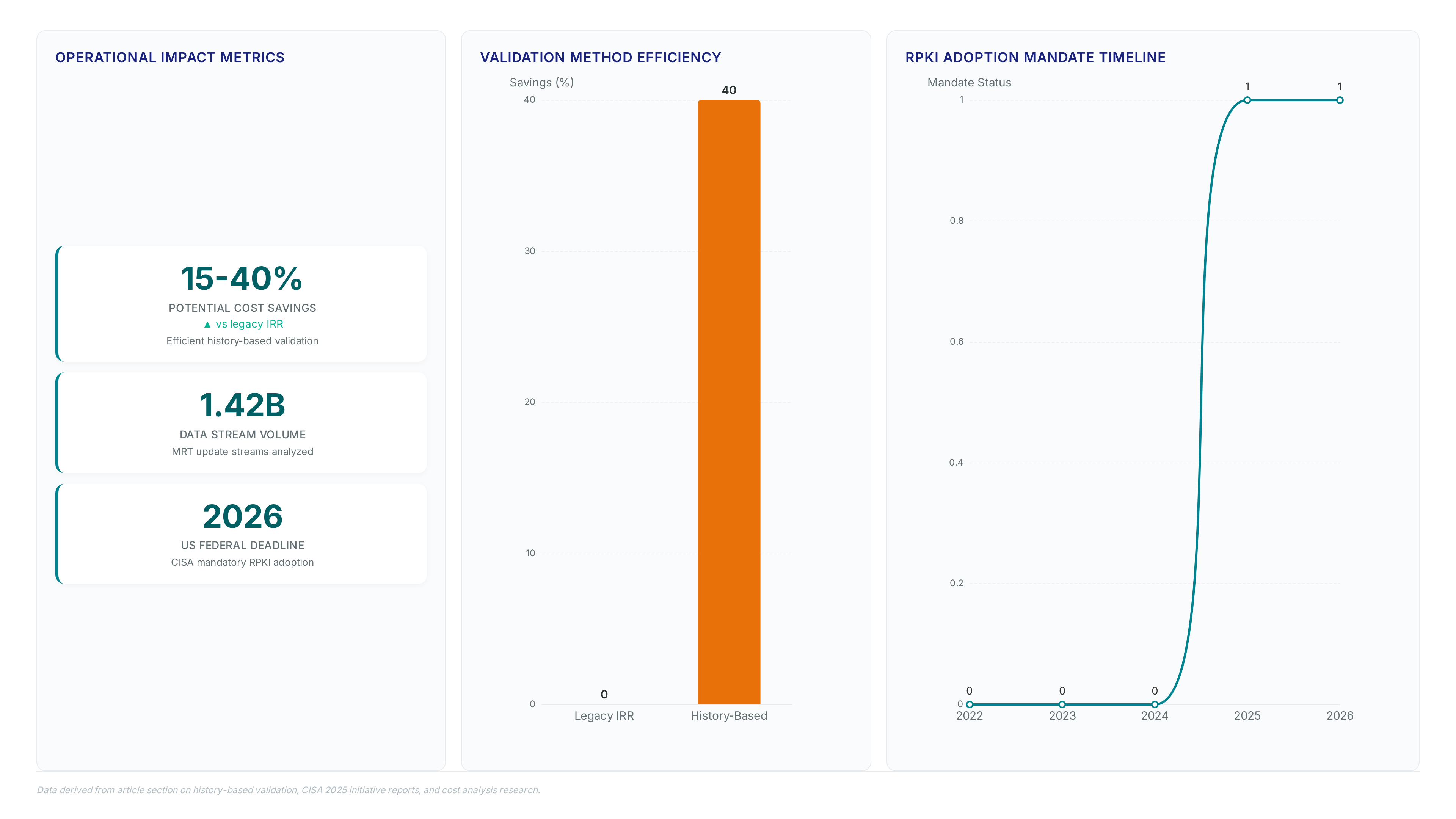
Honoring blackhole requests requires verifying the customer held the active path within a sliding time window, replacing arbitrary registry checks. Snijders explained seven years ago that validation logic must depend on whether IP traffic is actually forwarded to the requester. This mechanism ingests MRT format streams to construct flexible allow-lists, ensuring only operators currently carrying load can trigger drop policies. Providers like Arelion implement internal route analysis to cross-reference customer claims against real forwarding state before accepting RTBH announcements. The cost of this approach is the modest effort required to build software that parses binary logs into usable prefix filters. However, relying on static IRR entries creates a vulnerability where unauthorized actors request censorship for prefixes they do not route. Some cloud environments define a blackhole state when targets become unavailable, yet lack the historical context to prevent malicious activation. The implication for network engineers is clear: validation must occur after confirming the customer ASN served as the next hop recently. Without this check, networks risk discarding legitimate traffic based on stale or fabricated data.
Primary link saturation during volumetric attacks triggers BGP session resets, blocking the customer's ability to announce the standard blackhole community over the affected path.
In active/standby topologies, DDoS traffic floods the preferred circuit, causing control-plane timeouts that prevent real-time mitigation requests from reaching the edge router. Operators often rely on blackhole routing as a fundamental defense, yet the mechanism fails when the signaling channel itself is the casualty of congestion. The customer retains connectivity via the secondary link, but the router rejects the update because the requesting ASN is not the current best path. Legacy validation workflows stall here, demanding live reachability that the attack has already destroyed.
MRT-based history resolves this deadlock by decoupling authorization from instantaneous path selection. Recording all BGP updates in MRT format allows the network to verify if the customer held the active role within a sliding 24-hour window. If the prefix appears in the historical log, the system accepts the blackhole request even if the primary link is currently down. This approach validates the active path status retrospectively rather than requiring present-day availability. Junos implementations can enforce this by checking historical allow-lists before applying validation-state policies, ensuring legitimate customers retain mitigation rights during outages.
The limitation involves storage overhead and the complexity of parsing high-volume update streams for real-time decision making. Maintaining durable storage for every peer update demands significant disk I/O and processing power that smaller networks may lack. However, the alternative is leaving critical infrastructure defenseless when the primary control plane collapses under load. Prioritizing historical proof of forwarding ensures that mitigation capabilities survive the very attacks designed to blind them.
Arbitrary Nature of IRR-Derived Data for Prefix List Construction
Constructing prefix lists from IRR data invites unauthorized blackholing because registry entries remain arbitrary unsigned claims of unknown provenance. Snijders explicitly advocates dropping IRR checks in 2026 since IRR-derived data fails to prove active forwarding status. Operators relying on these static registries risk discarding legitimate traffic based on stale objects rather than actual network state. The mechanism of IRR allows any actor to create route objects, creating a policy bypass where validation logic trusts fabrications over observed reality. This flaw enables attackers to request traffic drops for prefixes they do not route.
Modern strategies increasingly favor RPKI validation over traditional IRR filters to mitigate origin spoofing risks. However, RPKI alone cannot verify if a customer currently holds the active path during a DDoS event. The limitation is that origin validity does not equate to current reachability authority. A more strong approach records all BGP updates in MRT format to build flexible allow-lists based on sliding time windows. This shift ensures only customers actually forwarding traffic gain the privilege to trigger RTBH policies. InterLIR recommends replacing static IRR imports with MRT-based historical analysis to prevent accidental traffic suppression.
About
Vladislava Shadrina serves as a Customer Account Manager at InterLIR, where she specializes in managing client relations within the complex domain of IP resources. While her background includes architecture, her daily work at InterLIR focuses heavily on network security and the integrity of BGP route objects, making her uniquely qualified to discuss blackhole routes. At InterLIR, a Berlin-based marketplace dedicated to transparent IPv4 redistribution, Shadrina ensures that all transferred addresses maintain clean reputations and valid routing configurations. This operational reality requires a deep understanding of how invalid or unvalidated routes can compromise network stability. By connecting practical account management experiences with technical routing standards, she bridges the gap between commercial IP transactions and the rigorous validation processes necessary for safe internet infrastructure. Her insights reflect InterLIR's core value of security, demonstrating why proper route handling is critical for maintaining trust in the global routing system.
Conclusion
Scaling MRT ingestion beyond 75,000 prefixes exposes a hidden friction point: the operational tax of maintaining high-speed storage for continuous sliding window analysis. While static IRR filters fail because they trust unsigned claims, purely flexible systems risk discarding valid mitigation signals if the processing pipeline lags behind the attack velocity. The real breakage occurs not in detection, but in the latency gap between observing a valid announcement and enforcing the corresponding drop policy during peak load. Operators must accept that historical proof of forwarding requires dedicated infrastructure, not just software tweaks.
Adopt a hybrid validation model by Q3 2026: retain RPKI for origin assurance but mandate MRT-derived sliding windows for any prefix requesting blackhole activation. Do not rely on registry entries alone for traffic suppression decisions. This approach ensures only entities demonstrably holding the active path within the last 24 hours can trigger network-wide drops, effectively neutralizing the policy bypass inherent in current IRR workflows.
Start by auditing your current BGP archive retention policy this week to confirm you possess at least 48 hours of raw MRT data accessible for immediate replay. If your storage tier cannot serve this historical data with sub-second latency, provision dedicated NVMe volumes before attempting to implement flexible allow-listing logic.
Frequently Asked Questions
Operators must record all received BGP updates in MRT format for durable storage. This process requires configuring a central route collector to write messages from every router peer.
Validation requires checking if the customer was the active path within a sliding 12 to 24 hour window. This timeframe proves they recently forwarded normal IP traffic successfully.
IRR-derived data represents arbitrary unsigned lists with unknown provenance that enable unauthorized attacks. Engineers should instead rely on dynamic forwarding history recorded directly from live BGP sessions.
Implementing the spirit of this design demands a modest effort to build custom software for parsing data. It cannot be deployed verbatim using standard static router configurations alone.
Validation checks if the customer ASN is the next-hop AS, not which specific IP interconnection was active. This allows acceptance even if the request arrives via a secondary link.