Centralized Endpoints Cut Costs: The FIS Case
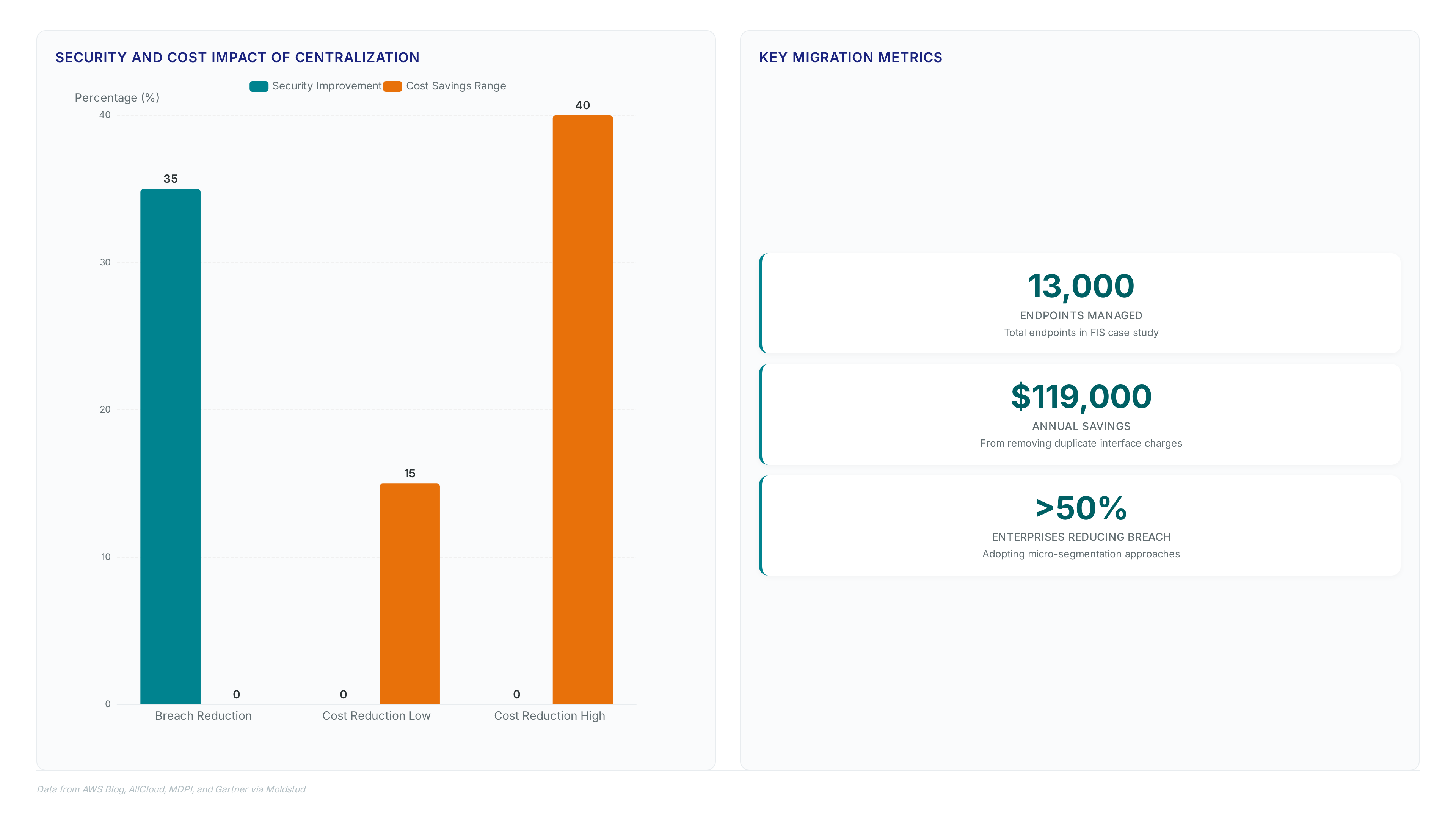
Consolidating 13,000 scattered VPC endpoints allowed FIS to eliminate public internet traversal for cross-Region API access. This case proves that centralized endpoint architectures are no longer optional for enterprises facing IPv4 exhaustion and spiraling cloud costs. Gartner reports that over 50% of enterprises adopting micro-segmentation approaches have reduced breach impact by at least 35%, validating the urgent shift away from distributed networking models where every application consumed scarce RFC 1918 address space.
FIS replaced hundreds of disjointed VPCs with a hub-and-spoke design powered by AWS Transit Gateway to resolve critical security gaps. The solution leverages Route 53 Profiles to manage private hosted zones across accounts, solving the DNS complexity that typically plagues large-scale migrations. A phased migration strategy using Terraform automation enabled the transition without disrupting the 40 billion annual transactions FIS processes for its global banking clients.
Legacy distributed patterns force traffic through insecure forward proxies while inflating bills. By centralizing interface endpoints into shared services VPCs, teams reclaim IP resources and enforce strict network boundaries. The following analysis dissects the specific routing configurations and DNS policies required to replicate this efficiency, demonstrating how modern cloud networking demands a fundamental rethinking of perimeter security.
The Strategic Role of Centralized VPC Endpoints in Enterprise Cloud Security
Placing interface services inside a shared hub VPC preserves RFC 1918 space by using the RFC 6598 range 100.64.0.0/10. This model consolidates connectivity through AWS Transit Gateway, enabling a hub-and-spoke topology that routes traffic from spoke VPCs to shared services without public internet exposure. Such an architecture eliminates redundant provisioning, with documented cases showing annual savings of $119,000 by removing duplicate interface charges. The carrier-grade NAT block specifically addresses IPv4 scarcity, allowing organizations to reserve private addresses for core application workloads rather than infrastructure overhead.
| Feature | Distributed Model | Centralized Model |
|---|---|---|
| IP Consumption | High (RFC 1918) | Low (RFC 6598) |
| Topology | Meshed/Flat | Hub-and-Spoke |
| DNS Management | Per-VPC PHZs | Shared Profiles |
FIS successfully migrated 13,000 endpoints using this method, freeing valuable address space while maintaining operational stability across seven regions. Reliance on Route 53 Profiles simplifies the DNS layer, yet operators must account for latency introduced by hair-pinning traffic through a central inspection point. Cost efficiency drives adoption, but the architectural shift requires strict security group management to prevent unauthorized lateral movement within the hub.
The previous architecture forced cross-region traffic through public internet forward proxies, introducing unacceptable latency and security exposure for sensitive banking data. Adopting a hub-and-spoke topology with AWS Transit Gateway allowed FIS to route traffic internally while preserving scarce RFC 1918 address space. Industry analysis indicates that transitioning to such centralized patterns yields cost reductions of 15%. The migration also used Route 53 Profiles to manage DNS resolution across seven regions without manual hosted zone associations.
Operational simplicity conflicts with regional failure isolation. Centralization reduces management overhead yet creates a single point of dependency for the endpoint services VPC. If the shared hub region experiences an outage, all spoke VPCs lose access to AWS services unless redundant hubs are provisioned. Network architects must weigh the efficiency gains against the risk of concentrated blast radius. FIS mitigated this by replicating the hub architecture in every active region, ensuring local durability while maintaining global policy consistency. This approach validates the centralized VPC endpoint model for enterprises seeking to balance cost control with high-availability requirements.
Distributed models demand 6,000 individual associations for 30 zones across 200 VPCs, creating unmanageable overhead. Centralized architectures collapse this into shared hubs, reducing management surface area while preserving access controls. The legacy approach forces operators to maintain distinct interface endpoints per VPC, consuming scarce RFC 1918 address space and multiplying configuration errors. A distributed VPC endpoint approach increases management complexity by isolating policies within individual VPC boundaries, whereas centralization aggregates traffic flows. This financial benefit stems from eliminating duplicate interface charges and optimizing IP allocation strategies.
Security posture changes visibly: centralizing endpoints expands the blast radius. Operators must weigh reduced operational toil against the risk of a single compromised endpoint affecting multiple spokes. The complexity shift moves from quantity of objects to quality of governance.
Architecting Hub-and-Spoke DNS Resolution with Route 53 Profiles and Transit Gateway
Route 53 Profiles Replace Manual Zone Associations
Route 53 Profiles, released in April 2024, aggregate private hosted zones to eliminate thousands of individual VPC associations required by legacy models. This mechanism functions by grouping Route 53 Private Hosted Zones (PHZs) into a single logical object that operators share across accounts via AWS Resource Access Manager (RAM). When private DNS is enabled on a VPC endpoint, AWS creates a managed PHZ that resolves public service endpoints to the private IP of the interface endpoint, enabling transparent traffic redirection within the VPC transparently redirecting.
| Legacy Association Model | Route 53 Profile Model |
|---|---|
| Manual zone attachment per VPC | Single profile association per account |
| High operational overhead | Centralized governance |
| Prone to configuration drift | Consistent policy enforcement |
Disabling AWS-managed private hosted zones to gain complete control over DNS resolution strategy requires operators to manually replicate zone records for every regional service control. The cost of interface endpoints and data processing fees makes reducing their count a primary lever for optimizing cloud spend, yet this centralization introduces a single point of DNS dependency cost. Network teams must weigh the operational simplicity of a hub-and-spoke topology against the risk of concentrator failure affecting all spoke VPCs simultaneously.
Operators must create custom private hosted zones for service domains like `ec2.us-east-1.amazonaws.com` within the shared services account to override default resolution. This manual step disables AWS-managed zones, granting full control over DNS strategy for centralized traffic flow. Without this specific configuration, API calls bypass the hub VPC entirely. The core mechanism involves configuring an A record at the zone apex as an Alias pointing to the centralized interface endpoint. This setup enables the resolution of public AWS service endpoints to the private IP address of the interface endpoint, effectively redirecting traffic within the VPC transparently redirecting. Engineers then aggregate these zones into a single Route 53 Profile per region. Sharing this profile across organizational accounts via AWS Resource Access Manager (RAM) eliminates the need for thousands of individual VPC associations.
| Component | Function | Scope |
|---|---|---|
| Custom PHZ | Overrides public DNS for specific services | Regional |
| Alias Record | Maps domain to central ENI private IP | Zone-level |
| Route 53 Profile | Groups zones for bulk association | Regional |
| AWS RAM | Shares profile with spoke accounts | Cross-account |
A critical limitation exists: this architecture fails if security groups on the central endpoint do not explicitly permit traffic from all spoke CIDR blocks globally. While DNS resolves correctly, the data plane drops packets without these permissive rules. Consequently, operators must manage dual prefix lists to handle both local and global access requirements efficiently. This tension between strict security postures and the need for ubiquitous connectivity defines the operational overhead of the model. Successful deployment requires balancing granular access controls with the broad permissions necessary for a functional system.
Avoiding RFC 1918 Exhaustion with Carrier-Grade NAT
Deploying the 100.64.0.0/10 range for the endpoint services VPC preserves scarce RFC 1918 address space while enabling full connectivity. Large-scale hub-and-spoke topologies risk depleting private IPv4 pools when hundreds of VPCs require unique interface endpoints per region. Using carrier-grade NAT ranges isolates infrastructure addressing from tenant addressing, preventing overlap during mergers or peering expansions. This approach avoids the operational friction of re-addressing legacy workloads later.
Centralized architectures rely on transparently redirecting public service traffic to private IPs without consuming customer address space. The mechanism functions by resolving public AWS service endpoints to the private IP of the interface endpoint within the hub. However, this design introduces a single point of failure if the hub VPC lacks sufficient redundancy across Availability Zones. Operators must balance address conservation against the blast radius of a central outage. Misconfiguration of the 64.0.0.0/10 block causes silent drops rather than explicit rejects, complicating troubleshooting.
Executing a Phased Migration to Centralized Networking with Terraform Automation
Phased Migration Mechanics via DNS Resolution Priority
Local VPC-associated zones take precedence over Route 53 Profile zones, enabling wave-based migration without traffic disruption. This hierarchy allows application teams to retain legacy endpoints while the central hub prepares for cutover. Operators use this DNS resolution priority to avoid simultaneous updates across hundreds of teams, mitigating the risk of widespread outages during the transition.
- Disable AWS-managed private hosted zones to gain control over resolution strategy.
- Create custom private hosted zones in the shared services account for target services.
- Associate these zones with a Route 53 Profile and share via RAM.
- Validate access using the AWS-provided DNS name of the centralized endpoint.
- Delete local VPC associations to trigger resolution to the hub.
Coordinating this scale requires rigorous planning. A critical tension exists between migration speed and blast radius; moving too fast risks overwhelming the central Security Group Rule Optimization limits if prefix lists are not pre-staged.
Migration waves must begin with non-production environments to validate connectivity before touching live traffic. This phased approach relies on DNS resolution priority rules where local VPC associations override shared profiles, allowing teams to shift traffic by simply deleting local zones. Operators structure these waves using detailed runbooks that include explicit rollback procedures, a requirement for reducing operational risk during complex transitions. Success depends on validating access using the AWS-provided DNS name of the centralized endpoint rather than the service name set in the hosted zone.
- Deploy shared infrastructure via Terraform modules to establish the hub VPC and Transit Gateway mesh.
- Validate connectivity and security group rules before cutover.
Security group rule exhaustion forces architecture changes when managing thousands of distributed endpoints. FIS addressed AWS service limits by optimizing prefix list usage. Local prefix lists contain CIDR blocks for the specific region's endpoint services VPC, while global lists aggregate CIDRs from all other regions. This design prevents unnecessary rule consumption for workloads that never require cross-region API access.
- Create a managed prefix list containing only the local region's endpoint service CIDR block.
- Define a second global prefix list referencing endpoint services VPCs across all seven regions.
- Apply the local list to security groups for same-region application VPCs to minimize rule count.
- Reserve the global list strictly for VPCs requiring inter-region communication capabilities.
Centralized PrivateLink architectures often use Amazon Route 53 private hosted zones to resolve public AWS service endpoints to the private IP of the interface endpoint. This capability is not inherent to Direct Connect, which operates strictly at the network layer without DNS integration. The drawback is that kernel-level optimizations require careful validation of compatibility with existing security monitoring tools. Transitioning to modern, decoupled data architectures using these patterns yields cost reductions for organizations compared to maintaining legacy, distributed systems. InterLIR recommends validating packet flow paths before decommissioning legacy forward proxies to ensure no loss of visibility.
About
Alexei Krylov, Head of Sales at InterLIR, brings a unique strategic perspective to the complexities of AWS VPC endpoint management. While his daily work focuses on optimizing IPv4 resource allocation and ensuring network availability for global clients, this expertise directly correlates with the infrastructure challenges FIS faced. Managing thousands of VPC endpoints requires the same rigorous attention to IP address efficiency, cost control, and security posture that defines InterLIR's mission. Krylov's deep understanding of how organizations scale network resources allows him to analyze FIS's centralization of 13,000 endpoints as a critical evolution in cloud operations. At InterLIR, a specialized marketplace for IP resources founded on transparency and efficiency, Krylov routinely advises businesses on maximizing their network infrastructure. This article connects those principles to real-world AWS architectures, demonstrating how centralized management not only reduces costs but also strengthens the security framework essential for financial technology leaders.
Conclusion
Centralizing VPC endpoints creates a fragile dependency on the regional hub's 64.0.0.0/10 block, where a single routing error triggers silent data plane failures across all connected spokes. While kernel-bypass mechanisms and eBPF optimization drastically reduce latency, they introduce a hidden operational tax: standard security monitors often blind themselves to this accelerated traffic, creating visibility gaps that traditional perimeter tools cannot detect. The initial performance gains quickly diminish if your team cannot audit packet flows in real-time, turning a performance upgrade into a compliance liability.
Organizations with more than five active regions must migrate to a centralized PrivateLink model within the next two quarters, but only after verifying that their security stack supports deep packet inspection on kernel-bypass paths. Do not attempt this transition if your current DNS resolution strategy relies on manual host file overrides, as this will break service discovery immediately upon cutover. The window for maintaining legacy, distributed endpoint architectures without incurring prohibitive latency costs is closing rapidly.
Start by auditing your Route 53 private hosted zone configurations against your actual interface endpoint IP assignments this week to identify any resolution mismatches before they cause an outage.
Frequently Asked Questions
Companies eliminate redundant provisioning to save money immediately. Documented cases show annual savings of $119,000 by removing duplicate interface endpoint charges across hundreds of VPCs.
Transitioning to centralized patterns yields significant cost reductions effectively. Industry analysis indicates cost reductions of 15% to 40% compared to legacy distributed systems currently in use.
Large financial leaders process massive transaction volumes annually. FIS handles over 40 billion transactions annually, requiring stable, centralized networking to avoid public internet exposure risks.
Adopting micro-segmentation approaches significantly reduces security breach impacts. Gartner reports that over 50% of enterprises adopting these approaches have reduced breach impact by at least 35%.
The design avoids using scarce private IP address ranges. Typical applications require more than 30 endpoints, but this model uses RFC 6598 to preserve critical address space.