Crossaccount CloudFront: Fix IPv4 Limits Now
The November 2025 CloudFront update finally decouples VPC origins from distribution accounts. This ends the forced choice between security isolation and operational bloat. As DigitalAPI. Ai notes, 2025 APIs now function as "decision endpoints" for autonomous agents. They demand the low-latency global reach of CloudFront without sacrificing the strict account boundaries required for governance.
We move beyond the legacy trade-off of consolidating resources into a single account or managing fragmented distributions per team. The internal mechanics of Host header validation determine how CloudFront matches team-specific subdomains to distinct API Gateway endpoints across account lines without leaking traffic. Below is the step-by-step implementation for deploying shared VPC origins. Networking teams manage a unified distribution while development teams retain full autonomy over their private backend services.
This shift eliminates the necessity to compromise security isolation or incur higher costs through redundant deployments. By using Amazon Web Services native resource sharing, organizations support complex multi-account strategies where API Gateway endpoints remain tightly scoped within dedicated accounts yet serve global traffic through a single, optimized edge network.
The Role of Cross-Account VPC Origins in Centralized Multi-Account Architectures
Cross-Account CloudFront VPC Origins and AWS RAM Sharing Mechanics
Cross-account CloudFront VPC origins define a November 2025 architecture separating distribution and origin accounts. Users keep Amazon VPC origins and CloudFront distributions in separate Amazon Web Services (AWS) accounts. AWS Resource Access Manager (RAM) bridges these security boundaries without consolidating resources. Resource owners in team accounts share specific VPC endpoints; a central networking account acts as the consumer. This model supports connectivity both within and outside AWS Organizations.
Security-first architectures drive the migration from public internet-based origins to private VPC origins, a trend accelerated by the 2025 cross-account feature release. Operators gain a single distribution serving multiple team subdomains, reducing management overhead. Strict IAM dependency creates a constraint: the consumer account cannot access shared resources without explicit RAM acceptance. Networking teams must wait for resource owners to initiate sharing. DNS and certificate management centralize, while API deployment remains distributed.
| Amazon VPC origin | Resource owner | Resource consumer |
|---|---|---|
| AWS RAM | Share VPC origin | Accept shared origins |
| Amazon CloudFront | None | Single distribution |
The three-account architecture assigns Team A and Team B as resource owners while the Networking account consumes shared origins. This structure resolves the tension between team autonomy and centralized governance without consolidating billing boundaries. Development teams retain full control over private Amazon API Gateway endpoints within dedicated accounts. The Networking account operates a single distribution serving multiple subdomains like team-a. Example.com and team-b. Example.com. Such separation prevents traffic from leaving the AWS network while isolating failure domains per team.
| Component | Team A / B Account | Networking Account |
|---|---|---|
| Custom Domain | Owns subdomain | Manages DNS records |
| API Gateway | Hosts private endpoint | No direct involvement |
| VPC Origin | Resource owner | Resource consumer |
| AWS RAM | Shares origin resource | Accepts shared origin |
| CloudFront | None | Single distribution |
Centralize CloudFront in multi-account setups when SSL certificate management costs outweigh the complexity of cross-account sharing. Decentralized strategies initially simplify integration by eliminating complex connectivity but often incur higher operational overhead later. A documented multi-tenant architecture case study confirmed this pattern achieves security isolation alongside operational efficiency. The drawback involves strict Host header validation requirements across all shared behaviors. Teams must align custom domains precisely with API Gateway configurations to avoid routing failures. This model suits organizations prioritizing security-first designs over simplified single-account deployments.
Centralized distribution collapses multiple team origins into a single edge entry point, eliminating the prior constraint forcing account consolidation. Before November 2025, operators faced a binary choice: merge resources into one account or deploy redundant distributions per team, inflating costs and fragmenting governance. The new model decouples these layers using AWS Resource Access Manager (RAM). Development teams retain autonomy over private Amazon API Gateway. This approach preserves security isolation without sacrificing operational efficiency.
| Feature | Per-Team Model | Centralized Cross-Account |
|---|---|---|
| Distribution Count | One per account | Single shared instance |
| Origin Location | Same account as distribution | Separate team accounts |
| Governance | Fragmented per team | Unified networking control |
| Cost Efficiency | Low (redundant requests) | High (aggregated volume) |
This architecture introduces a dependency on cross-account trust policies that can block propagation if IAM roles misalign. Operators must validate that the consumer account explicitly accepts shared resources before traffic flows. The limitation is operational friction during onboarding; every new team requires manual RAM acceptance steps rather than automatic discovery. Despite this overhead, the consolidated model reduces edge compute duplication notably. Teams avoid maintaining distinct SSL certificates and cache invalidation logic for identical content types. The shift enables a "single front door" pattern that competitors lack in smooth multi-cloud support.
Internal Mechanics of Host Header Validation and Resource Sharing Flows
Host header mismatches trigger immediate 403 errors unless Application Load Balancer rules explicitly match the incoming CloudFront hostname. The validation mechanism requires the origin to inspect the HTTP Host header and verify it against the expected private endpoint domain before processing the request. In multi-tenant migrations, operators must organize behaviors by path patterns and host headers. Configuration fails silently if the ALB listener expects a local DNS name while CloudFront sends the public custom domain.
Define specific listener rules where the condition value equals the exact CloudFront hostname. Documentation specifies that ALB rules must be configured using the "Host" header with the specific CloudFront hostname as the required match value. This strict binding ensures traffic reaches the correct target group associated with the private API Gateway. Without this alignment, the load balancer rejects the connection or routes it to a default action that returns access denied responses.
| Component | Required Value | Failure Mode |
|---|---|---|
| Listener Rule | Exact FQDN | Default 403 |
| Host Header | team-a.example.com | Mismatch error |
| Target Group | Private API IP | Unreachable |
Adopting this pattern allows development teams to retain autonomy over private endpoints while networking teams manage a single distribution. Case studies show this approach enables security isolation without requiring complex Lambda@Edge functions for header rewriting. The architectural trade-off remains the operational overhead of maintaining synchronized DNS and certificate records across accounts.
Routing Logic for Team-Specific Subdomains in Multi-Account Setups
DNS records in the Networking account map team-a. Example.com and team-b. Example.com to a single shared edge entry point. Request routing depends on the Host header value passed through the encrypted tunnel established via AWS Resource Access Manager. The CloudFront distribution inspects this header to select the correct behavior before forwarding traffic to the specific VPC origin. Team accounts retain autonomy over their private API Gateway.
| Flow Stage | Action | Responsible Account |
|---|---|---|
| DNS Resolution | Maps subdomain to CloudFront domain | Networking |
| Edge Validation | Matches Host header to behavior | Networking |
| Origin Selection | Routes to specific VPC endpoint | Team A / B |
| Header Check | Verifies incoming hostname | Team A / B |
Configure Application Load Balancer listener rules to expect the public custom domain rather than the private DNS name. A mismatch here causes immediate connection failures that standard logging often obscures. This architecture eliminates the need for Lambda@Edge functions to rewrite headers manually. The trade-off is strict coupling between DNS records and origin validation logic. Changing a subdomain requires synchronized updates across three distinct account boundaries. Failure to update the ALB rule when rotating certificates breaks the chain of trust. Most operators overlook that the Host header must match the certificate common name exactly.
AWS RAM requires explicit acceptance of shared VPC origins by the Networking account before CloudFront can route traffic. Operators must execute a precise sequence to enable cross-account connectivity without exposing private subnets.
- Team accounts initiate resource sharing
- The Networking account receives a pending invitation within the AWS RAM console.
- Administrators accept the share, establishing the trust boundary for the multi-tenant architecture
- CloudFront validates the association only after the consumer account marks the resource as active.
Failure to complete the acceptance step leaves the origin in a pending state, causing immediate 502 errors at the edge. This manual handshake prevents accidental data leakage but introduces operational latency during scaling events. Unlike same-account configurations, the cross-account access Misaligned permissions block the acceptance workflow entirely, stalling deployment pipelines. Network teams must verify that the resource share principle matches the exact CloudFront service principal for the region.
Step-by-Step Implementation of Shared VPC Origins and Private API Gateways
Prerequisites for Cross-Account VPC Origin Implementation
A wildcard SSL certificate for *. Example.com must be requested in AWS Certificate Manager (ACM) in the us-east-1 AWS Region. This single cryptographic asset deploys across all three accounts to validate CloudFront, Application Load Balancer, and API Gateway endpoints simultaneously. Operators skipping this regional constraint face immediate handshake failures during origin fetches. Amazon.
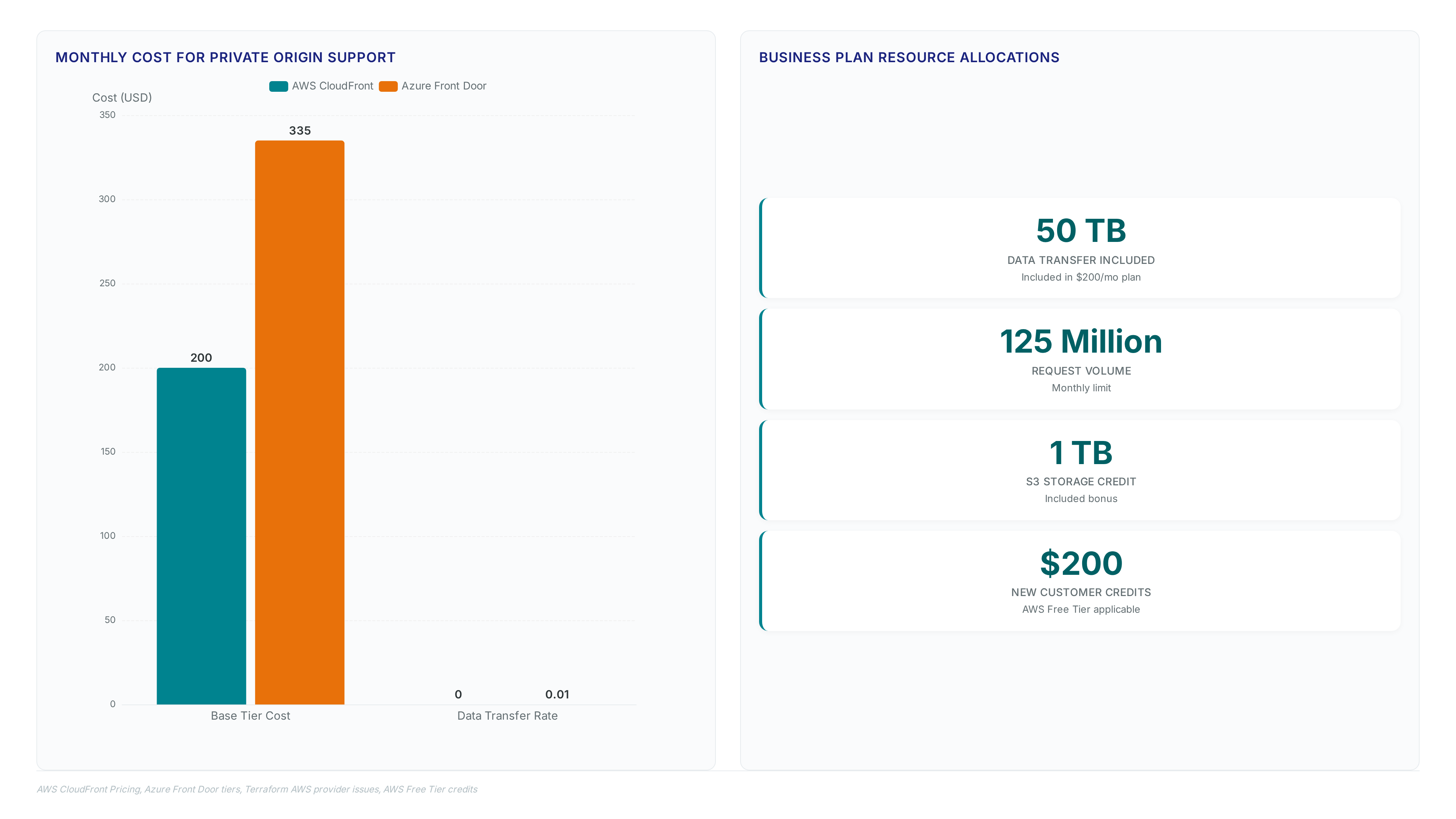
Administrative access grants IAM permissions to create VPC resources and manage cross-account sharing policies. The implementation requires Multiple AWS accounts structured as resource owners and a centralized consumer. A multi-tenant architecture case study demonstrated how development teams retained autonomy over private API Gateway endpoints in dedicated accounts while networking teams managed a single CloudFront distribution, achieving both security isolation and operational efficiency (multi-tenant architecture New customers receive up to $200 in AWS Free Tier credits applicable to services including Amazon API Gateway.
Infrastructure-as-Code pipelines may stall if tooling lags behind API capabilities. The Terraform AWS provider initially returned 404 errors when attempting to manage cross-account VPC Origin IDs, indicating a lag in Infrastructure-as-Code tool support relative to the API feature launch (Terraform AWS provider). Manual console acceptance of AWS RAM shares remains the fallback until providers update. Domain ownership and DNS management access via Amazon Route 53 complete the mandatory list.
Step 1 requires creating VPCs with private subnets in Team-A and Team-B accounts using distinct CIDR blocks to prevent routing overlaps. Operators deploy an execute-api VPC endpoint within these subnets to establish the necessary private connectivity fabric. Step 2 involves configuring a custom domain like team-a. Example.com on the private API Gateway and associating it via base path mapping. This sequence enables development teams to retain autonomy over private API Gateway.
- Create a VPC origin in each team account pointing to an internal Application Load Balancer configured for https-only traffic.
- Initiate an AWS RAM resource share for the VPC origin ARN targeting the specific Networking account.
- Accept the pending resource share invitation in the Networking account console to activate the cross-account link.
Step 4 completes the workflow by configuring the CloudFront distribution in the Networking account to consume the accepted shared origins. This architecture supports a multi-tenant architecture.
A critical limitation exists: the wildcard SSL certificate must be requested in us-east-1 and deployed manually across all three accounts to avoid handshake failures.
Verify the internal Application Load Balancer targets VPC endpoint network interfaces before associating resource policies.
- Confirm the target group registers healthy status for the execute-api VPC endpoint
- Inspect the API Gateway resource policy to ensure it explicitly restricts access to the specific VPC endpoint ID or source.
- Validate that the SSL certificate deployed on the ALB matches the wildcard domain requested in.
| Component | Verification Target | Failure Symptom |
|---|---|---|
| Internal ALB | Target Group Health | 502 Bad Gateway errors |
| Resource Policy | VPC Endpoint ID | 403 Forbidden responses |
| SSL Certificate | Domain Match | SSL Handshake failures |
Operators often overlook that AWS API Gateway private endpoints. This configuration gap exposes private APIs to any entity with network reachability to the load balancer. The cost of rigorous validation is minimal compared to the risk of data exfiltration through misconfigured boundaries.
Amazon. Manual verification introduces human error during rapid scaling events.
Operational Validation and Strategic Benefits of Centralized Distribution
Defining Cross-Domain Isolation via Host Header Authentication
Host header verification enforces strict team boundaries by rejecting mismatched domain requests with a 404 Not Found response. Operators confirm this isolation by executing `curl https://team-b.example.com/team-a/customers/123`, which must fail to retrieve data from the unauthorized account. This mechanism prevents cross-account data leakage without requiring complex Lambda@Edge functions for header manipulation. A specific migration scenario. The architecture supports a decentralized API deployment strategy where teams co-host services while the central network team governs global access.
| Test Case | Expected Result | Security Implication |
|---|---|---|
| `team-a.example.com/team-a/...` | 200 OK | Valid intra-team access |
| `team-b.example.com/team-a/...` | 404 Not Found | Blocked cross-team probe |
The cost of misconfiguration is measurable: a single wildcard certificate error invalidates the entire Host header chain. Unlike perimeter firewalls, this validation occurs at the application layer, meaning AWS WAF rules must complement rather than replace origin checks. A multi-tenant architecture case study. The limitation is operational rigidity; changing a team's domain name necessitates a full distribution update rather than a simple record tweak. Validating isolation requires `curl https://team-a.example.com/team-a/customers/123` to return JSON containing `"customerId": "123"` while cross-team requests fail immediately. Operators execute `curl https://team-b.example.com/team-a/customers/123` expecting a 404 Not Found response or `{"message":"Missing Authentication Token"}` to confirm strict boundary enforcement. This specific test pattern mitigates WAF bypass challenges where attackers previously referenced ALB domains from different accounts by exploiting permissive routing rules (WAF bypass challenges). Successful validation proves evolution teams retain autonomy over private API Gateway endpoints while networking teams manage a single distribution (private API Gateway.
| Request Target | Expected Outcome | Security Signal |
|---|---|---|
| `team-a.example.com/team-a/...` | 200 OK + JSON Data | Authorized Access |
| `team-b.example.com/team-a/...` | 404 Not Found | Isolation Enforced |
| `team-a.example.com/team-b/...` | Missing Auth Token | Policy Rejection |
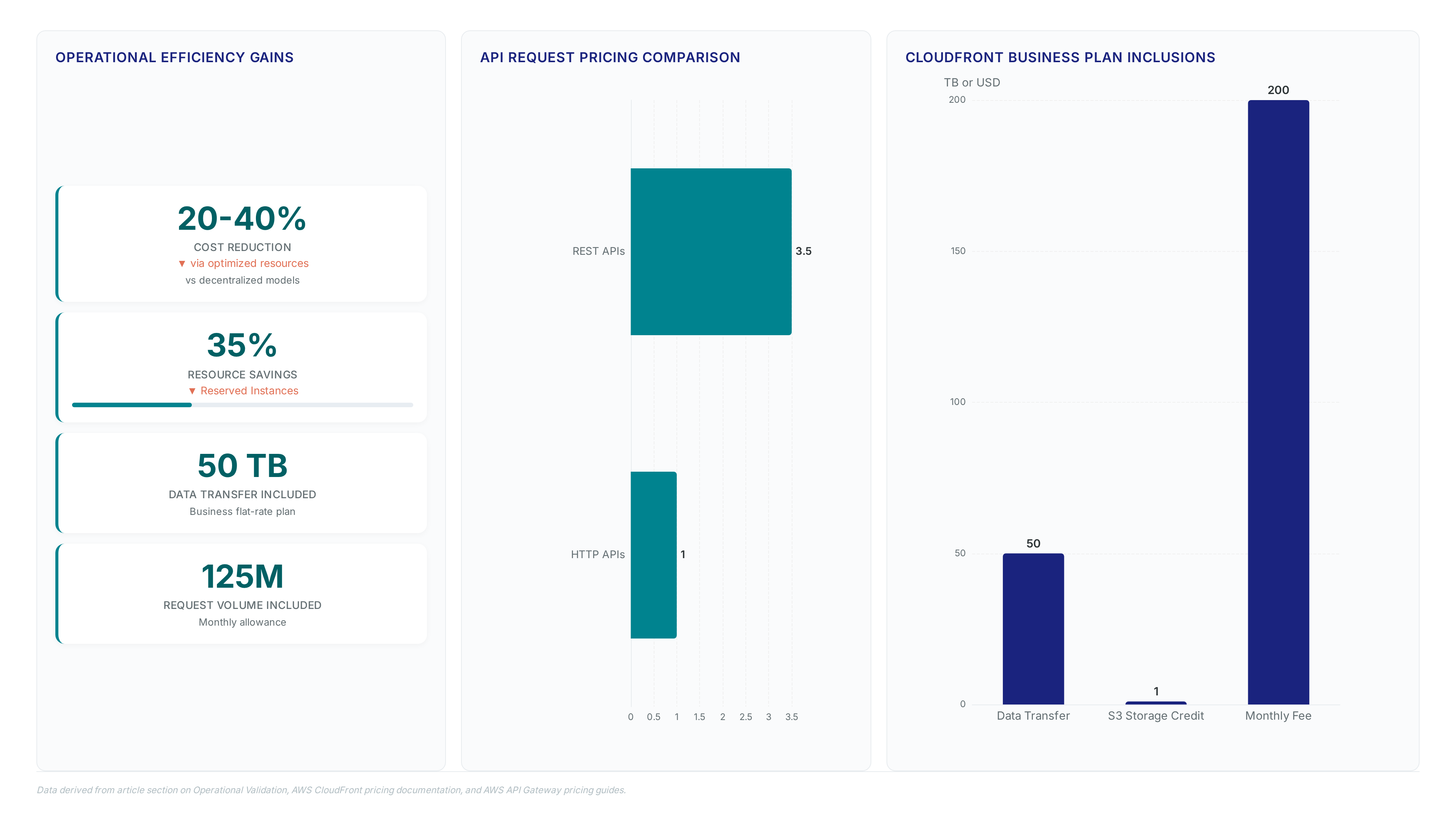
The limitation of this approach surfaces when teams modify base path mappings without synchronizing CloudFront behaviors, causing valid internal traffic to drop silently. Unlike monolithic deployments, this architecture allows independent scaling but introduces dependency on correct Host header propagation across account boundaries. Organizations migrating to such optimized architectures have reported cost savings reaching 35% alongside performance gains from reduced latency hops (cost savings Continuous monitoring via CloudWatch ensures that any deviation from expected isolation patterns triggers immediate alerts for network engineering teams.
Sequential Workflow for Deleting Shared VPC Origins
Disabling the CloudFront distribution must occur before unsharing resources to prevent orphaned network interfaces and traffic blackholing.
Operators execute a strict three-step deletion sequence to maintain architectural integrity during teardown. First, disable the active distribution consuming the origin. Second, revoke the AWS RAM Third, delete the origin resource locally once the consumer account no longer holds access rights. Skipping the initial disable step leaves the networking account with dangling references that fail silently rather than raising explicit errors. This specific order prevents race conditions where CloudWatch.
The cost implication of this workflow involves avoiding data transfer charges that accrue if stale origins attempt reconnection. AWS waives fees for valid paths, but misconfigured deletion sequences can trigger fallback routing through public endpoints.
| Step | Action | Risk of Skipping |
|---|---|---|
| 1 | Disable Distribution | Traffic blackholing |
| 2 | Unshare via RAM | Orphaned interface |
| 3 | Delete Origin | Billing leakage |
InterLIR recommends automating this checklist within CI/CD pipelines to enforce the dependency chain.
About
Nikita Sinitsyn serves as a Customer Service Specialist at InterLIR, bringing eight years of telecommunications expertise to complex network architecture discussions. While InterLIR specializes in IPv4 resource redistribution, Sinitsyn's daily work managing RIPE database operations and ensuring clean BGP routing provides deep insight into the critical importance of secure, scalable network boundaries. This article on cross-account VPC origins directly aligns with his professional focus on maintaining reliable infrastructure security and efficient IP management. As organizations increasingly adopt multi-account AWS strategies to isolate environments, Sinitsyn uses his background in technical support to explain how separating CloudFront distributions from VPC origins enhances overall network hygiene. His experience helping clients navigate strict compliance and routing policies makes him uniquely qualified to analyze how these new AWS features support transparent, secure, and efficient global API deployments without compromising account segregation.
Conclusion
Scaling cross-account VPC origins introduces a hidden operational tax: the latency of coordinated teardowns across security boundaries. As APIs evolve into decision endpoints for autonomous AI agents in 2025, the rigid three-step deletion sequence described becomes a bottleneck for flexible infrastructure. Manual execution fails when hundreds of ephemeral agent connections require rapid provisioning and de-provisioning, creating a window where billing leakage occurs through fallback public routing. The architecture must shift from static sharing policies to automated lifecycle hooks that bind distribution disabling directly to RAM policy revocation.
Organizations should mandate full automation of this dependency chain by Q4 2027, specifically for any workload serving machine-to-machine traffic. Relying on human operators to remember the precise order of operations is unsustainable when AI agents spin up thousands of transient sessions daily. The cost of a single misordered deletion exceeds the engineering effort required to script the safeguard.
Start by auditing your current CI/CD pipelines this week to identify any manual steps involved in disabling CloudFront distributions or revoking AWS RAM shares. Replace these human touchpoints with pre-merge validation scripts that simulate the teardown sequence to verify no orphaned interfaces remain before allowing code promotion.
Frequently Asked Questions
Companies report cost savings reaching 35% through reduced operational overhead. This efficiency comes from eliminating redundant deployments while maintaining strict security isolation across multiple development teams.
AWS API Gateway charges $3.50 per million requests for REST APIs. HTTP APIs cost less at $1.00 per million requests, supporting scalable multi-account architectures with predictable pricing models.
Data transfer between CloudFront and AWS origins is automatically waived when serving traffic. This elimination of egress charges specifically applies to traffic paths moving through the global edge network.
Starting July 15, 2025, new customers receive up to $200 in AWS Free Tier credits. These funds apply directly to services including Amazon API Gateway within the first year of usage.
Amazon CloudFront offers a Business flat-rate plan at $200/month including 50 TB of data transfer. This tier also covers Advanced WAF, DDoS protection, and specific VPC Origins support features.