DNS steering flaws: Why 4,300 edge POPs struggle
Akamai moves 15–a significant share of global internet traffic daily by relying on DNS-based content steering to map users to edge servers.
This model collapses when you assume a user's location matches their DNS resolver. Open resolvers like Cloudflare's 1.1.1.1 and Google's 8.8.8.8 shattered that assumption years ago. By 2026, artificial intelligence integrated throughout the CDN stack outperforms these legacy triangulation methods, making simple DNS responses inadequate for precise edge server selection.
We need to look at why Akamai's historical model-deploying over 4,300 Edge POPs across 700 cities inside consumer ISP racks-still matters. Then we must compare these proprietary CDN models against public anycast networks. The industry is pivoting away from low-TTL DNS tricks toward reliable, data-aware routing protocols for a reason.
The Role of DNS-Based Steering in Modern Content Distribution
DNS-Based Steering and Explicit Client Subnet Mechanics
DNS-based content steering maps users to edge servers by triangulating recursive resolver locations rather than end-user IPs. Akamai launched its first commercial CDN product in 1999, establishing this resolver-centric model as the industry baseline for latency reduction. The mechanism fails the moment users query open resolvers like Google's 8.8.8.8, decoupling the resolver location from the actual client geography.
Explicit Client Subnet (ECS) fixes this breakage. It embeds a truncated client IP prefix directly into the DNS query payload. RFC 7871 defines this extension, allowing authoritative servers to calculate proximity based on the user's subnet instead of the resolver's address. This granular routing decision enables operators to serve content from the optimal 4,300 points of presence globally. Sony uses such architecture to ensure digital distribution reaches users via the nearest cache node.
Privacy takes a hit, though. ECS leaks client network topology to every authoritative server in the resolution chain. RFC 7871 explicitly recommends disabling this feature by default unless a clear benefit exists, yet widespread adoption ignores this caution. Operators must weigh the latency gains of precise steering against the exposure of subscriber metadata to third-party infrastructure.
Explicit Client Subnet data enables Akamai to bypass resolver location errors across 1,200 connected access networks. The mechanism embeds a truncated client IP prefix into the DNS query, allowing the authoritative server to override the recursive resolver's geographic signal with actual user proximity. This precision directs traffic to specific edge caches rather than relying on the coarse granularity of the resolver's anycast address.
Akamai uses this subnet visibility to manage approximately 15–a significant share of global internet volume daily without overwhelming individual points of presence. The Traffic Management product executes these decisions at the DNS level, steering billions of users based on real-time network conditions rather than static geographic maps. Such flexible steering proves necessary during substantial global events where sudden traffic spikes would otherwise saturate regional infrastructure if routing relied solely on resolver location.
The operational cost involves exposing partial user identity to authoritative servers, creating friction with privacy-focused recursive operators who strip ECS data by default. Network engineers face a binary choice: accept degraded cache hit ratios for strict privacy compliance or enable ECS and risk user trust erosion. Unlike anycast systems that depend on BGP path selection, this DNS-centric model requires continuous query churn via low TTLs to maintain accuracy, increasing load on recursive resolvers.
Meanwhile, Explicit Client Subnet leaks user location data by embedding IP prefixes into authoritative DNS queries. This mechanism breaks the traditional privacy boundary where recursive resolvers shield end-user identity from upstream servers. Enabling ECS exposes the client's network scope to every authoritative nameserver in the chain, not just the CDN provider. A recursive resolver attaching a /24 prefix reveals specific geographic clusters that could otherwise remain anonymous behind a shared anycast address. The utility for traffic direction conflicts directly with the goal of minimizing metadata exposure. Operators must decide whether the latency gain justifies broadcasting user topology to third parties. Large enterprises like Sony rely on this precision for digital distribution, yet the same data could enable fingerprinting attacks. Unlike standard queries, ECS responses cache based on subnet, creating a persistent link between a user block and a specific edge server. The cost is a measurable reduction in user anonymity across the resolution path. The trade-off remains binary: precise steering requires sacrificing the obscurity provided by recursive aggregation.
Inside the Architecture of Edge Server Selection and Caching Hierarchies
Cache Mode Logic and Mid-Tier Server Referral Chains
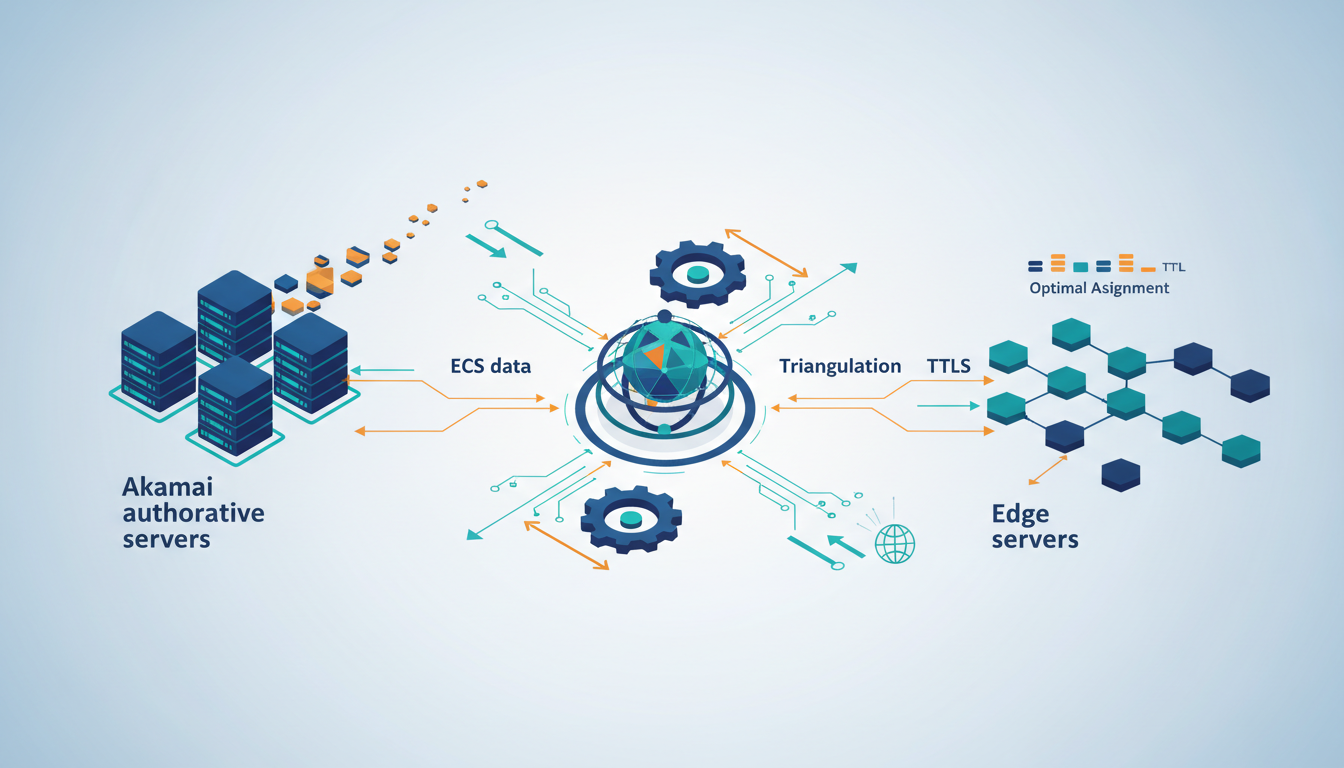
Edge POPs operate in cache mode, automatically referring unserved requests to mid-tier servers before contacting the origin. Akamai launched this hierarchical pull model in the late 1990's by placing managed content servers directly into consumer retail ISP racks. The mechanism functions through a strict two-step referral chain: first, the edge layer attempts a local hit; second, a miss triggers an upstream fetch from a larger mid-tier aggregate. This architecture avoids origin shield saturation by buffering demand at the intermediate layer.
The operational distinction between edge and mid-tier layers defines the caching hierarchy:
| Layer | Function | Trigger Condition |
|---|---|---|
| Edge POP | Direct user service | Request arrives from client |
| Mid-Tier | Aggregation and pull | Edge cache miss occurs |
| Origin | Source of truth | Mid-tier cache miss occurs |
Mid-tier deployment becomes necessary when edge performance requirements exceed the capacity of distributed leaf nodes to hold working sets. The cost of this indirection is measurable latency during the initial fetch, yet the benefit is sustained throughput for popular objects. Unlike anycast models relying on routing convergence, this logic depends entirely on application-layer referral states. A significant limitation arises because traffic flows over the public Internet rather than a private backbone, exposing fetch paths to external congestion. Operators must tune TTL values aggressively to prevent stale content delivery while minimizing redundant origin pulls. Balancing memory allocation at the mid-tier against the bandwidth cost of repeated upstream transfers is the real engineering challenge.
Scaling Content Delivery Across 700 Cities and 4,300 Edge POPs
DNS triangulation across 4,300 Edge POPs in 700 cities directs user requests to the nearest cache node. Akamai places servers inside ISP racks to minimize hops, a strategy initiated in the late 1990's that persists today. The system handles massive volume by absorbing traffic spikes during global events like the Olympics without collapsing the origin infrastructure. Unserved requests trigger a referral chain to mid-tier servers, preventing single-point saturation at the edge layer.
| Decision Factor | Legacy Resolver Method | ECS-Enabled Method |
|---|---|---|
| Location Signal | Recursive Resolver IP | Client Subnet Prefix |
| Accuracy | Low (Anycast distortion) | High (User proximity) |
| Privacy Impact | Minimal | Elevated metadata exposure |
Operators facing inaccurate server selection must enable Explicit Client Subnet to override resolver geography. This configuration forces the authoritative nameserver to calculate distance based on the user rather than the recursive hop. The trade-off involves exposing client network scope to upstream infrastructure, creating friction with privacy-centric policies.
Hyperscalers remain optimal for training, yet distributed edges reduce AI inference costs by up to 86% for real-time applications. This economic shift drives the expansion from pure caching toward compute-heavy workloads at the perimeter. Blind reliance on resolver proximity causes measurable latency penalties in regions with concentrated open DNS usage. The architectural limit remains the lack of a private backbone, forcing all cache fills to traverse the public internet.
Imperative SNMP Management vs Declarative gRPC and Yang Models
SNMP emerged in the early 90's using imperative GET and SET operations on a Management Information Base. This polling model forces controllers to request specific object identifiers sequentially, creating latency bottlenecks during rapid topology changes. Operators managing thousands of edge nodes face scaling limits when every state change requires a discrete query cycle. The rigid MIB structure struggles to describe complex, nested relationships found in modern caching hierarchies.
Google open-sourced gRPC in 2015, using protocol buffers over HTTP/2 to enable declarative streaming. This shift allows network devices to push Yang data models asynchronously, describing desired state rather than reacting to polled values. The declarative approach solves the latency issues inherent in request-response polling for real-time applications.
| Feature | SNMP (Imperative) | gRPC/Yang (Declarative) |
|---|---|---|
| Interaction Model | Polling (GET/SET) | Streaming (Push/Pull) |
| Data Description | Flat MIB objects | Nested Yang models |
| Transport Layer | UDP (typically) | HTTP/2 + TLS |
| State Management | Controller tracks state | Device reports intent |
DNS steering mechanisms suffer when TTL expiration lags behind network congestion events. Short TTLs force frequent re-resolution, amplifying the overhead of imperative management protocols during failover scenarios. A declarative model permits the edge to signal capacity constraints immediately without waiting for the next poll interval. Toyota demonstrated this operational shift by implementing an AI platform on Google Cloud to allow factory workers to deploy models directly at the operational edge. The cost of maintaining imperative logic is measurable in lost cache efficiency during volatile routing conditions.
Akamai's DNS-Heavy Edge Server Density vs Google Anycast
Akamai relies on DNS triangulation across 4,300 Edge POPs to steer traffic, whereas Google Anycast uses routing advertisements to direct users to the nearest node. The architectural divergence stems from Akamai's late 1990's strategy of placing servers inside consumer retail ISP racks, creating a dense cache layer that avoids backbone dependency. Google's model, by contrast, uses a unified global backbone where anycast IPs attract traffic based on BGP path length rather than resolver location. This fundamental difference dictates failure modes: Akamai suffers when recursive resolvers like 8.8.8.8 obscure user location, while Anycast faces congestion if a specific POP attracts disproportionate volume due to routing oscillations.
| Dimension | Akamai DNS-Heavy Model | Google Anycast Model |
|---|---|---|
| Traffic Steering | Authoritative DNS response | BGP route advertisement |
| Infrastructure | Public Internet transit | Private global backbone |
| Failure Scope | Local cache miss | Regional POP saturation |
Optimizing Granularity and Control for Specific Content Types
Video delivery workloads demand precise Explicit Client Subnet tuning because generic resolver mapping fails to isolate user location accurately. Enabling RFC 7871 allows authoritative servers to see the client subnet prefix, correcting steer errors caused by open resolvers like 8.8.8.8. This precision reduces WAN transport waste, as enterprise participants using optimized delivery saved an average of 22% annually on costs. Static asset distribution tolerates coarser granularity, whereas live streaming requires the low-latency path selection that ECS provides. The trade-off involves privacy exposure, prompting some operators to disable the extension despite performance gains. High-value AI inference workloads illustrate this tension, where custom pricing often starts between $8,000 and $25,000 per month for dedicated security and delivery tiers. Granular control directly impacts these contracts by ensuring traffic hits the correct edge node rather than traversing expensive mid-tier links.
| Content Type | Steering Requirement | ECS Benefit | Cost Impact |
|---|---|---|---|
| Live Video | Sub-second latency | High | Reduced backhaul |
| Software Updates | Throughput maximization | Low | Negligible |
| AI Inference | Geo-compliance | Critical | Avoids egress fees |
Blindly enabling client subnet data without adjusting cache expiration policies creates a false sense of optimization.
Trade-offs in Cost and Access Network Connectivity
Akamai's 1,200 access network connections drive higher transit expenses than public anycast alternatives relying on fewer peering points. Enterprises paying for Akamai Content Delivery Solutions accept this premium to bypass public internet congestion, whereas YouTube uses hybrid steering to balance cost against performance dithering. The economic model favors Sony and similar large-scale distributors who prioritize guaranteed last-mile reach over raw bandwidth efficiency. Public anycast networks reduce operational overhead by aggregating traffic onto a single global backbone, avoiding the complexity of managing thousands of bilateral sessions.
| Feature | Proprietary Access Model | Public Anycast Alternative |
|---|---|---|
| Peering Count | 1,200 direct access networks | Limited Tier-1 transit reliance |
| Steering Logic | DNS triangulation at edge | BGP path length selection |
| Cost Driver | Bilateral settlement fees | Backbone capacity upgrades |
| Failure Scope | Isolated POP cache misses | Regional routing blackholes |
Operators choosing proprietary models gain granular control over cache mode behavior but inherit the burden of maintaining diverse interconnects. The limitation is financial scalability; adding new regions requires fresh negotiation rather than simple routing advertisement. Public alternatives offer rapid deployment yet sacrifice the ability to tune next hop preferences for specific ISP subscribers. This tension forces a choice between optimized latency for known partners and uniform global reach.
Defining Hybrid Steering Strategies for Edge POP Deployment
Hybrid steering combines DNS-based mapping with real-time telemetry to override static resolver assumptions when directing traffic to optimal Edge POPs. Unlike pure anycast routing that relies solely on BGP path length, this approach actively dithers content chunks across candidate units to mitigate latency spikes caused by open resolvers. Google's YouTube uses this method to route clients to front-end service units, periodically shifting streams to maintain performance despite fluctuating network conditions. Operators deploying edge infrastructure must balance the precision of Explicit Client Subnet data against the privacy constraints outlined in RFC 7871, as excessive metadata exposure damages user trust. High-speed connections exceeding extremely high bandwidth are now mandatory for distributed AI training workloads, forcing edge deployments to adopt specific low-latency strategies beyond simple caching. The shift toward AI infrastructure necessitates moving compute closer to factory floors, similar to how Toyota implemented an AI platform on Google Cloud for operational ML models. While Akamai expanded its offerings through acquisitions like Linode to provide full cloud services, competitors like Gcore focus on integrated edge needs with a unified platform. The limitation remains that hybrid systems increase control-plane complexity, requiring operators to manage both DNS TTLs and active stream monitoring simultaneously.
Fibre upgrades to 2.5G/1.25G services often trigger ONT line termination misalignment, breaking Explicit Client Subnet propagation in multi-vendor environments. Operators must validate that recursive resolvers preserve the client subnet prefix across heterogeneous optical line termination units before enabling RFC 7871 features. Legacy GPON architectures frequently drop fragmented packets containing extended DNS options, causing authoritative servers to revert to resolver-based geolocation instead of precise user mapping. This failure mode mirrors visibility gaps observed when BARBRI utilized Dynatrace to resolve scaling blind spots during peak exam periods, where manual monitoring missed critical packet loss events.
Configuration requires strict alignment between DHCP lease scopes and advertised subnet masks to prevent ECS truncation.
| Failure Mode | Trigger Condition | Operational Impact |
|---|---|---|
| Subnet Truncation | Mismatched ONT vendor firmware | Authoritative server selects distant Edge POP |
| Fragmentation Drop | MTU < 1500 bytes on uplink | ECS option stripped, privacy preserved but accuracy lost |
| Latency Spike | Async cache refresh cycles | User directed to non-optimal mid-tier server |
The cost of enabling ECS without resolving underlying physical layer inconsistencies is measurable degradation in cache hit ratios. Unlike Cisco IT deployments that achieved lossless networks through unified infrastructure, heterogeneous PON environments lack a single control plane to enforce packet integrity. The tension remains between granular steering accuracy and the privacy risks of exposing user subnets to every authoritative query.
Validation Checklist for Upgrading to XGSPON and 100G Internal Links
In practice, the provider upgraded from Huawei to a Nokia Access network with a Cisco backbone core to achieve symmetric 10G capacity. This transition eliminates fragmentation drop issues common in multi-vendor GPON environments while enabling 100G internal links from spine equipment to OLTs. Operators must verify that ONT line termination cards align correctly before enabling Explicit Client Subnet features for granular location mapping.
| Legacy Component | Upgrade Target | Validation Metric |
|---|---|---|
| Huawei OLT | Nokia Access | Symmetric 10G throughput |
| 10G Trunks | 100G Spine Links | Zero packet drop rate |
| Single-vendor ONT | Multi-vendor Mix | DHCP lease success |
Infrastructure scaling now supports the density required for modern edge delivery, where Twin Turbo CDNs constitute 62% of large enterprise deployments. High-speed interconnects prevent the latency spikes that degrade AI-driven observability during traffic dithering operations. Failure to upgrade spine capacity creates a bottleneck that nullifies the precision gains from ECS data. InterLIR recommends validating DHCP lease success rates across all ONT models prior to production cutover.
About
Vladislava Shadrina serves as a Customer Account Manager at InterLIR, where she specializes in managing client relations within the critical domain of IP resources. While her daily work focuses on facilitating secure IPv4 address redistribution, this operational expertise provides a unique lens for analyzing DNS-based content steering. As networks evolve to handle traffic more efficiently, the underlying IP infrastructure becomes paramount. Shadrina's experience ensuring clean BGP announcements and high IP reputation at InterLIR directly correlates with the reliability required for proven DNS steering strategies. Her role at InterLIR, a Berlin-based marketplace dedicated to solving network availability problems, positions her to understand how resource allocation impacts broader content distribution models. By connecting practical IP management with emerging steering technologies, she offers valuable insights into maintaining reliable network performance. This perspective bridges the gap between static resource acquisition and flexible traffic optimization, highlighting the interdependence of IP assets and modern DNS architectures.
Conclusion
Scaling DNS-based steering beyond experimental pilots reveals a critical fracture: infrastructure latency often negates the theoretical savings of AI-optimized routing. When backbone links cannot sustain 100G throughput, the computational overhead of real-time decision-making creates a net performance loss, regardless of how precise the subnet mapping becomes. The operational burden shifts from simple configuration to continuous packet integrity monitoring, where even micro-bursts in heterogeneous PON environments destroy cache efficiency. Relying on legacy trunks while deploying advanced logic is a direct path to inflated inference costs rather than the projected 86% reduction.
Organizations must commit to a full spine-leaf upgrade within the next two quarters before activating granular ECS features. Delaying this hardware synchronization renders sophisticated steering algorithms ineffective, as the physical layer cannot support the required data velocity. Do not attempt to layer AI-driven observability on top of fragmented 10G trunks; the resulting dithering will degrade user experience quicker than static routing ever did. Start by auditing your current ONT DHCP lease success rates across all vendor models this week. If any device group falls below near-perfect stability, halt all steering configuration changes immediately and prioritize replacing those specific line termination cards. This baseline validation ensures your physical network can actually sustain the logic you intend to deploy.
Frequently Asked Questions
Open resolvers decouple user location from the query source, breaking geographic assumptions. This forces reliance on coarse resolver data instead of precise user proximity, rendering standard triangulation ineffective for accurate edge server selection without ECS.
ECS embeds a truncated client IP prefix directly into the DNS query payload. This allows authoritative servers to override resolver location signals and route traffic based on actual user subnet proximity rather than recursive resolver geography.
ECS leaks client network topology by exposing partial user identity to every authoritative server. This breaks traditional privacy boundaries where recursive resolvers usually shield end-user data from upstream infrastructure and third-party content providers.
Akamai leverages subnet visibility to direct traffic across 1,200 connected access networks globally. This extensive connectivity allows dynamic steering decisions that prevent individual points of presence from becoming overwhelmed during sudden traffic spikes.
Operators use this DNS-centric visibility to manage approximately 30% of global internet volume daily. This massive scale requires precise routing to ensure content delivery reaches users via the nearest cache node without saturation.