Flexible BGP routing fixes AWS static limits
Up to 5,000 outbound routes on a Transit Gateway make flexible BGP necessary for scaling beyond static limits. Clinging to static routing in production environments creates unnecessary single points of failure that automatic failover mechanisms specifically eliminate. When packet processing rates hit 1.25 Gbps, manual tunnel management becomes a bottleneck. Resilient architectures are no longer optional.
Amazon Web Services documentation confirms that while static routing suffices for simple topologies, it forces operators to manually intervene during tunnel failures. Modern networks cannot afford this luxury. Flexible BGP routing supports ECMP tunnel aggregation, allowing simultaneous use of multiple tunnels to maximize bandwidth rather than idling backup links.
We must examine the internal mechanics of route propagation that enable smooth traffic shifting during outages. You will execute a step-by-step migration from static to flexible configurations on Transit Gateway. This ensures your infrastructure handles the 140,000 packets per second throughput ceiling that AWS Site-to-Site VPN connections now support.
The Strategic Role of Flexible BGP Routing in Modern AWS Networks
Border Gateway Protocol (BGP) exchanges IP prefixes automatically across IP Security (IPSec) tunnels to enable flexible path selection. This mechanism replaces manual static entries with live session states that react to tunnel availability without operator intervention. Teams must configure AS numbers and manage route advertisements to establish peering between the customer gateway device and the AWS virtual private gateway. Flexible configurations support a packet processing rate of 140,000 packets per second, providing sufficient throughput for enterprise workloads while maintaining low latency. The architecture allows automatic route propagation to update VPC route tables instantly upon session establishment.
Managing session states and BGP attributes like local preference requires an operational shift. Unlike static models, flexible routing demands continuous monitoring of peer liveness and prefix validation to prevent flapping. Complexity increases when scaling to multiple sites, yet this approach remains the standard recommendation for durability in larger deployments according to configuration complexity analyses. A critical limitation involves the expertise gap; staff unfamiliar with BGP fundamentals may struggle to troubleshoot route selection issues during outages.
| Feature | Static Routing | Flexible BGP Routing |
|---|---|---|
| Failover Method | Manual intervention | Automatic detection |
| Route Updates | Manual entry | Automatic propagation |
| Scalability | Limited by manual effort | High via AS path manipulation |
Automated failover introduces a dependency on correct timer configuration. Mismatched hold-down values cause unnecessary session resets. Network architects must balance the benefit of ECMP support for tunnel aggregation against the increased troubleshooting depth required for protocol-level analysis.
Deploying Flexible BGP for high-availability Failover
Production networks require automatic failover capabilities that static configurations cannot provide without manual operator intervention. Static VPN setups often demand human action on the on-premises gateway when a tunnel fails, creating unacceptable downtime windows for critical services. Flexible routing eliminates this latency by using strong BGP liveness detection checks to instantly shift traffic to a secondary path. Administrators influence these path selections by tuning BGP attributes like priorities, policies, weights, and Multi-Exit Discriminator (MED) values rather than rewriting route tables. This granular control enables precise traffic engineering that static entries lack, as noted in AWS path control documentation.
The shift toward dynamically-routed connections reflects a market demand for resilient infrastructure that self-heals during outages. Operators seeking such resilient connections must accept increased configuration complexity as the price for automation. Throughput can reach 1.25 Gbps per connection when aggregating tunnels via ECMP on a transit gateway. Relying on device health checks alone introduces uncertainty compared to protocol-level session state verification. Manual route updates become unsustainable as network topology scales beyond single branch offices. Deeper troubleshooting requirements emerge during initial stabilization phases.
Static vs Flexible Routing: Route Limits and Management Overhead
Static routing caps inbound advertisements at 100 prefixes per gateway, creating a hard ceiling for expanding enterprise topologies. This route limit forces network architects to manually aggregate subnets or discard specific paths once the threshold is reached. In contrast, flexible configurations remove this bottleneck by supporting up to 5,000 outbound routes for Private IP VPNs. The operational burden shifts from continuous CLI updates to initial BGP session tuning.
Teams opting for static models face exponential management overhead as site count increases, since every new branch requires explicit route entries on the central gateway. Flexible approaches scale linearly because the protocol handles route management scale. However, this automation demands rigorous filter policies to prevent accidental advertisement of internal subnets to the cloud. Operators must evaluate whether their current topology scale justifies the complexity of maintaining thousands of manual entries versus implementing a self-healing flexible control plane.
BGP Session States and Route Advertisement Mechanics in Transit Gateway
The session transitions from Idle to Established only when the customer gateway terminates both IPsec and BGP protocols on the same hardware. This architecture requirement prevents split-brain scenarios where encryption exists without route exchange. Operators observing a stuck Active state usually find mismatched ASN configurations or failed TCP handshakes on port 179. Once Established, the Transit Gateway injects learned prefixes directly into the VPC routing domain. Static entries always override these propagated BGP routes creating a hidden trap where legacy configurations block flexible failover paths.
Route propagation depends entirely on the liveness of the underlying tunnel interface. For static routing prefixes appear only when the tunnel status reads UP, whereas flexible advertisements flow immediately upon session formation. This distinction eliminates the manual intervention window during primary link failures.
- Session moves from Idle to Connect upon timer expiration.
- TCP handshake completes before Open message exchange.
- Keepalive messages confirm neighbor reachability every 30 seconds.
- Established state triggers automatic VPC route table updates.
Troubleshooting depth increases because operators must analyze AS path attributes and timer values rather than simple reachability pings. A flapping session often indicates MTU mismatches fragmenting BGP packets inside the IPSec envelope. The cost of this complexity is measurable in the required expertise for staff managing MD5 authentication keys. Automatic failover succeeds only when the secondary tunnel advertises a more preferred local preference value.
Configuring Dual Tunnels with BGP for Palo Alto Firewall and StrongSwan
Assigning unique BGP Autonomous System Numbers to each spoke site prevents routing loops in hub-and-spoke topologies using Transit Gateway. Operators must terminate both IPsec and BGP sessions on the same customer gateway device to establish a valid peering state. Splitting these functions across different hardware components causes the session to remain stuck in the Active state, blocking all route propagation.
Configuration differs significantly between physical firewalls and software-based implementations. Palo Alto networks require explicit tunnel interface binding, whereas Linux deployments rely on daemon coordination. A simulated enterprise migration utilized StrongSwan on Ubuntu Linux 18.4 alongside FRRouting to validate dual-tunnel redundancy. This approach confirms that open-source stacks can match proprietary hardware reliability when configured correctly.
Administrators must enter the correct ASN and select the appropriate IP address type during the BGP configuration phase in the AWS console. Mismatched address families between the tunnel outer IP and the BGP neighbor definition will prevent session establishment entirely.
| Component | Configuration Requirement | Failure Mode if Incorrect |
|---|---|---|
| ASN | Unique per spoke site | Routing loops or path rejection |
| Tunnel Termination | Single device for IPsec+BGP | Session state remains Active |
| Address Family | Match outer tunnel IP | TCP handshake failure on port 179 |
Route advertisement issues often stem from missing export policies on the on-premises router rather than AWS-side restrictions. The Transit Gateway accepts prefixes only after the BGP finite state machine reaches the Established state. This sequence eliminates the vast majority of false-positive connectivity reports during initial deployment windows.
MED Behavior Uniformity and Monitoring Complexity in Transit Gateway
Transit Gateways assign identical MED values across all tunnels, neutralizing standard path-preference logic for incoming traffic. This uniformity forces on-premises routers to rely on local weight or AS path length rather than the advertised discriminator, a shift documented in Transit Gateway Migration guides. Operators migrating from Virtual Private Gateways often miss this behavioral change, resulting in suboptimal load balancing until routing policies are manually adjusted. The loss of granular MED control means traffic engineering decisions move entirely to the customer edge.
Active monitoring becomes mandatory because session flapping no longer presents as a simple link-down event. Teams must track BGP state machines and route advertisement volatility to detect instability before packet loss occurs. This Monitoring Complexity demands tooling that parses BGP logs rather than just interface counters. Static routing troubleshooting relied on binary up/down checks; flexible environments require analysis of timer expirations and update messages.
The operational burden increases significantly when ECMP aggregation masks individual tunnel degradation. Without deep visibility into the control plane, networks risk sustained performance degradation despite healthy-looking aggregate bandwidth.
Step-by-Step Migration from Static to Flexible Routing on Transit Gateway
Prerequisites for Migrating Static VPN to Flexible BGP on Transit Gateway
Migrating from static to flexible routing requires a customer gateway capable of terminating simultaneous IPsec and BGP sessions on identical hardware. Splitting these functions across distinct devices prevents session establishment entirely. Administrators must verify that the target architecture supports ECMP aggregation, a feature strictly unavailable to static configurations. This capability dictates whether the network can scale bandwidth without procuring expensive Direct Connect circuits.
- Validate that the on-premises device handles concurrent control-plane and data-plane processing.
- Secure a unique BGP Autonomous System Number (ASN) to prevent routing loops in hub-and-spoke designs.
- Confirm regional compliance, such as mandating Diffie-Hellman group 14 for GovCloud environments.
The reliance on unique ASNs creates an administrative bottleneck for organizations lacking a registered number pool. Failure to secure valid identifiers forces a redesign of the entire peering strategy.
Executing Zero-Downtime Migration by Creating New Flexible Connections First
Establishing a parallel flexible connection before deleting the legacy static link prevents traffic blackholing during the cutover window. Operators must navigate the VPC Console, select Transit Gateway as the target, and explicitly choose the Flexible (requires BGP) routing option. If the existing customer gateway lacks the correct BGP Autonomous System Number (ASN), provisioning a new gateway object becomes mandatory to satisfy peering requirements. This sequential approach ensures that both tunnels remain active, allowing for verification of route propagation before the final switchover.
- Document all existing static routes and current IPsec tunnel parameters to serve as a rollback baseline.
- Create the new flexible VPN connection targeting the same Transit Gateway while retaining the old static attachment.
- Download the device-specific configuration file and apply it to the on-premises gateway to initiate BGP session establishment.
- Verify that both tunnels show an "Established" state and that routes appear in the Transit Gateway route table.
- Remove static routes from the on-premises device and the AWS route table once flexible prefixes are confirmed.
- Delete the obsolete static VPN connection only after successful connectivity tests over the new flexible path.
Route priority creates the critical tension: static entries always override BGP-learned prefixes for identical destinations, necessitating precise removal timing. Failure to delete the static route first renders the new flexible tunnel useless for those specific prefixes, despite a healthy session. Unlike static configurations, this new architecture supports ECMP aggregation, enabling simultaneous use of multiple tunnels for increased bandwidth.
Virtual Private Gateways enforce a hard limit of one Site-to-Site VPN connection per customer gateway, blocking simultaneous static and flexible sessions. This architectural constraint forces operators to delete the active legacy tunnel before establishing the new BGP peering, guaranteeing an immediate connectivity interruption. Scheduling this cutover during a planned maintenance window is mandatory because no parallel path exists to sustain traffic flow during the transition.
| Feature | Virtual Private Gateway | Transit Gateway |
|---|---|---|
| Concurrent Connections | Single tunnel per CGW | Multiple tunnels supported |
| Migration Method | Delete-then-recreate | Parallel creation allowed |
| Routing Support | Static or Flexible (exclusive) | Static and Flexible coexistence |
| Bandwidth Aggregation | Not supported | Supports ECMP |
The migration sequence demands precise execution to restore service rapidly.
- Document all existing static routes and IPsec parameters before initiating any changes.
- Delete the legacy static VPN connection attached to the Virtual Private Gateway.
- Create a new flexible connection using the same customer gateway, ensuring the device terminates both IPsec and BGP processes.
- Apply the downloaded configuration to the on-premises edge to initiate the BGP Independent System Number (ASN) handshake.
Unlike Transit Gateway migrations that allow overlapping connectivity, this specific VGW limitation offers no fallback once the old tunnel is removed.
Real-World Application of BGP for High-Availability Enterprise Connectivity
Application: BGP Route Propagation and ECMP Mechanics in Transit Gateway
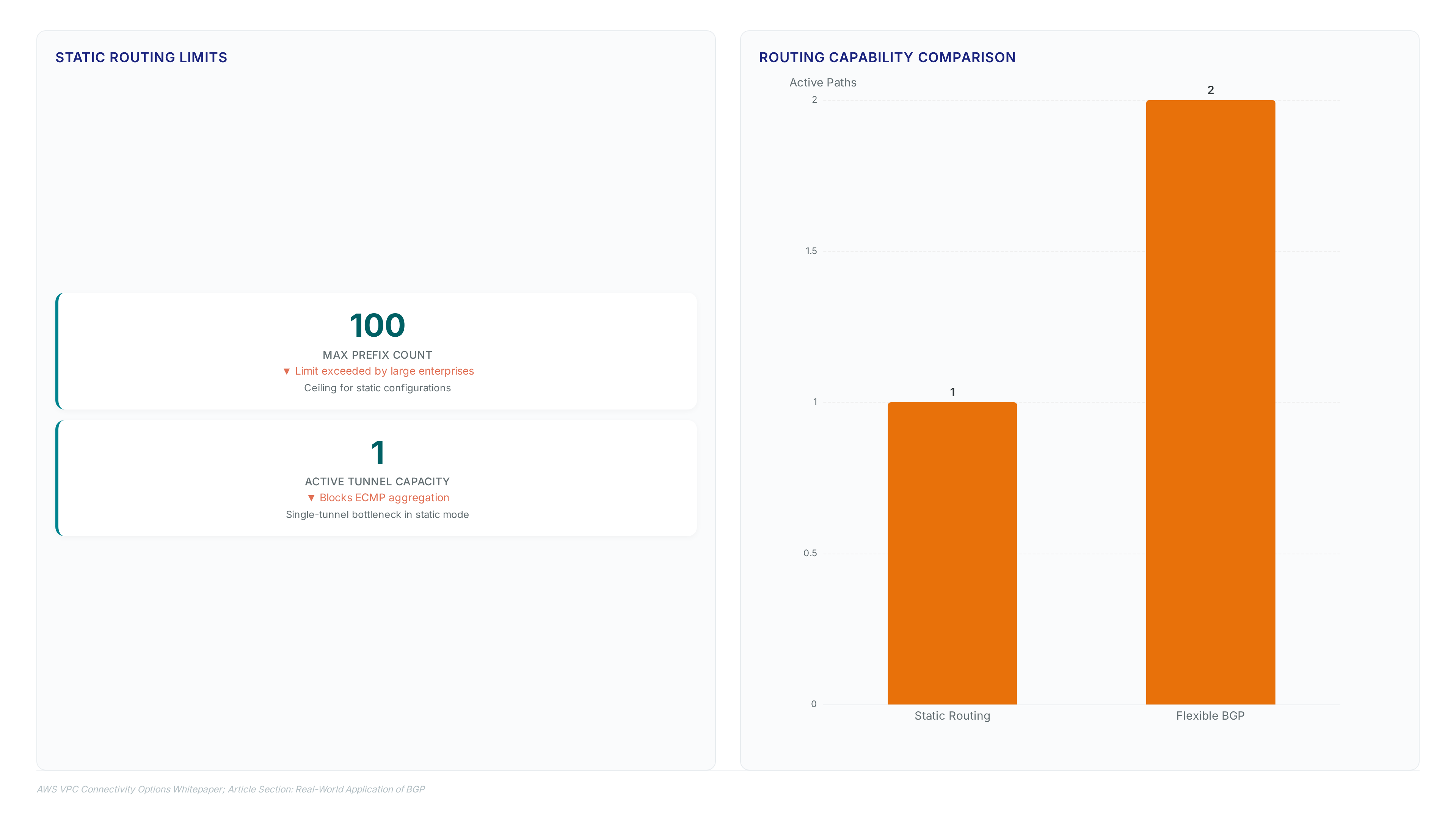
Static routing fundamentally blocks ECMP aggregation, forcing single-tunnel bottlenecks that cap available bandwidth regardless of provisioned capacity. Flexible BGP traffic steering resolves this constraint by automatically propagating routes to VPC route tables while enabling simultaneous use of multiple IPSec tunnels. This mechanism aggregates throughput across parallel paths, a capability explicitly absent in static configurations where only one tunnel remains active at any time.
| Routing Mode | Tunnel Utilization | Failover Mechanism | Route Propagation |
|---|---|---|---|
| Static | Single active tunnel | Manual intervention required | Manual entry only |
| Flexible BGP | Multiple active tunnels | Automatic detection | Automatic to VPC tables |
This architectural shift introduces a specific trade-off regarding traffic engineering control. Transit Gateway sets identical Multi-Exit Discriminator values across all tunnels, removing the ability to influence path selection via MED attributes from the AWS side. Operators must instead rely on local weight or AS path manipulation on the customer gateway to steer traffic. This limitation forces a redesign of existing traffic policies during migration. The cost of ignoring this behavior is suboptimal load balancing until on-premises routing logic is adjusted. Migration becomes mandatory when organizations anticipate growth or manage multiple sites where manual route updates create unsustainable operational overhead.
Migrating to flexible routing becomes mandatory when on-premises prefix counts exceed the 100-route ceiling imposed by static configurations. Large enterprises managing hundreds of branch offices frequently exhaust this limit, forcing a transition to Border Gateway Protocol to support complex topologies. The Private IP VPN This expansion allows organizations to propagate full routing tables across hybrid environments rather than summarizing prefixes and losing granular path control.
| Routing Model | Max Outbound Routes | Operational Overhead | Failover Mechanism |
|---|---|---|---|
| Static | 1,000 | High (manual edits) | Manual intervention |
| Flexible BGP | 5,000 | Low (automatic) | Automatic detection |
The cost of this scalability is increased configuration complexity, as operators must manage Autonomous System Numbers and monitor session states to prevent flapping. Unlike static entries that simply exist or fail, BGP attributes introduce variables like local preference and MED that require active tuning to influence traffic flow correctly. A hidden tension exists between route granularity and stability; advertising thousands of specific prefixes increases the surface area for potential route dampening events during network churn. Teams should adopt flexible routing only when the need for route management.
Policy-Based VPNs demand static routing to prevent security association mismatches when local traffic selectors must precisely match AWS configurations. Flexible protocols often struggle with the exact subnet specifications required for these legacy firewall rules, causing connection drops during negotiation. Operators managing small or simple networks. This approach eliminates the complexity of maintaining session states for a single branch office with routes that rarely change.
The limitation is absolute predictability; any topology change requires manual CLI updates on both ends, introducing human error risks absent in automated systems. While flexible models scale effortlessly, static configurations force administrators to manually verify every new subnet addition against existing security policies. This manual overhead becomes prohibitive as the network grows beyond a handful of stable prefixes. Organizations prioritizing strict path control over automation accept this operational burden to avoid unexpected route advertisements. Amazon. InterLIR recommends reserving static routing strictly for these constrained edge cases rather than core infrastructure.
About
Evgeny Sevastyanov serves as the Head of Customer Support and Support Team Leader at InterLIR, a specialized IPv4 marketplace based in Berlin. His daily responsibilities involve managing complex network configurations, including the creation and maintenance of BGP and Route Objects within RIPE and APNIC databases. This hands-on experience with global routing registries makes him uniquely qualified to discuss migrating from static to flexible BGP forwarding on AWS Site-to-Site VPNs. At InterLIR, ensuring clean BGP propagation and network security is central to their mission of redistributing unused IPv4 resources efficiently. Sevastyanov's direct involvement in troubleshooting connectivity issues and optimizing route availability for clients provides practical insights into why automatic failover and flexible routing are critical for production environments. His expertise bridges the gap between theoretical networking concepts and the real-world demands of maintaining reliable, secure connections between on-premises infrastructure and AWS cloud services.
Conclusion
Scaling static Site-to-Site VPN configurations inevitably hits a hard ceiling when prefix counts exceed the 100-route limit per gateway, forcing a costly architectural refactor rather than a simple expansion. While throughput aggregates effectively, the manual propagation of routes creates a linear operational cost that cripples teams managing more than five active branches. Relying on CLI edits for every subnet addition introduces latency that flexible BGP eliminates, making static routing a liability for any environment expecting frequent topology changes. Organizations should treat static IPsec as a temporary bridge for legacy hardware, not a permanent core strategy. Migrate to Transit Gateway or native BGP support within the next two fiscal quarters to avoid being locked into an unmanageable mesh. If your current setup lacks BGP capability on the customer premises equipment, budget for hardware refreshes immediately rather than patching software workarounds. Start by auditing your current prefix count against the 100-route threshold this week and flag any gateway approaching near-full capacity for immediate migration planning. This proactive inventory prevents the sudden failure that occurs when advertising limits are silently breached during peak expansion cycles.
Frequently Asked Questions
Packet processing rates hitting 1.25 Gbps demand shifting away from manual tunnel management. This throughput ceiling requires resilient architectures that static configurations cannot support effectively for enterprise workloads.
Static configurations cap your inbound route advertisements at merely 100 paths on a virtual private gateway. This hard ceiling severely restricts complex hybrid cloud designs compared to dynamic options.
Dynamic BGP routing supports ECMP tunnel aggregation to maximize bandwidth rather than idling backup links. This allows simultaneous use of multiple tunnels to reach the 1.25 Gbps throughput potential.
Static VPN setups often demand human action on the on-premises gateway when a tunnel fails. This creates unacceptable downtime windows that dynamic routing eliminates through automatic detection mechanisms.
Dynamic configurations support a packet processing rate of 140,000 packets per second for enterprise workloads. This provides sufficient throughput while maintaining low latency across your network infrastructure.