India's active sharing model cuts 5G costs fast
BSNL reported 95,511 on-air sites in January 2026. That number defines the battlefield. India's telecom survival now hinges on merging state and private assets. Infrastructure sharing has outgrown its role as a mere cost-cutting tactic; it is the only viable mechanism to prevent a permanent market duopoly between Reliance Jio and Bharti Airtel. The Department of Telecommunications is forcing a merger of operational capabilities, moving far beyond simple co-location. We are witnessing a shift toward active network convergence, integrating tower fiber and spectrum assets. IDC research suggests this convergence is critical for supporting local AI processing and sovereign cloud requirements by 2027.
This analysis details the execution of asset sharing models designed to slash capital expenditure while expanding rural 5G coverage to India's vast subscriber base. Vodafone Idea serves a massive user base, and the government holds a 49% stake following bailouts. The financial imperative to merge these networks is absolute. Light Reading confirms these talks represent a shift from survival mode to a calculated restructuring of India's entire digital infrastructure.
The Strategic Role of Infrastructure Sharing in India's Telecom Duopoly Prevention
Active vs Passive Infrastructure Sharing Models in Indian Telecom
Stop confusing co-location with integration. Infrastructure sharing separates passive tower assets from active spectrum elements to cut capital expenditure, but the distinction matters. Passive models involve co-locating equipment on physical structures like steel towers or fiber ducts without exchanging radio frequency rights. Active models extend this logic to include spectrum sharing, where operators pool frequency bands to increase total bandwidth availability. The Department of Telecommunications confirmed that current negotiations between Vodafone Idea and BSNL have progressed beyond simple tower sharing to include active infrastructure sharing.
| Feature | Passive Sharing | Active Sharing |
|---|---|---|
| Assets | Towers, power, fiber ducts | Spectrum, RAN, core network |
| Complexity | Low mechanical integration | High software coordination |
| Regulatory | Standard commercial lease | Requires DoT approval |
BSNL has deployed 97,672 4G sites, creating a dense rural footprint that private carriers lack. Vodafone Idea plans to add 20,000-25,000 unique sites, a target achievable quicker through joint deployment than solo builds. Here lies the friction: active sharing introduces significant operational headaches because public and private entities maintain divergent maintenance cultures. Bureaucratic approval cycles at state-owned firms often delay the rapid reconfiguration required for flexible spectrum pooling. Private operators risk service degradation if shared active elements fail due to slow public-sector repair workflows. The financial relief from capped spectrum fees allows reinvestment, yet cultural misalignment remains the primary barrier to full active integration.
The alliance avoids the regulatory friction of combining a private operator with a state-owned enterprise. Full consolidation requires resolving disparate labor policies and debt structures immediately. Sharing defers these cultural clashes to specific asset interfaces. Vodafone Idea plans to add thousands of sites via Indus Towers. This expands reach without balance sheet integration. The limitation remains spectrum compatibility; active sharing demands precise frequency alignment that passive tower co-location does not. Operators must map overlapping bands before traffic flows. A merger forces immediate technical unification, risking service disruption during migration. Sharing permits gradual interoperability testing. The strategic value lies in maintaining a viable third player to prevent duopoly pricing power.
Technical Mechanics of 900MHz Spectrum Sharing Between Vi and BSNL
Vodafone Idea holds 7,975.2 MHz of liberalized spectrum, enabling flexible refarming of the 900MHz band for BSNL integration without new acquisitions. This liberalized spectrum allows operators to bypass regulatory restrictions when shifting frequency assets from legacy 2G services to modern 4G or 5G deployment based on traffic demand. The mechanism relies on carrier aggregation, where BSNL base stations accept Vi's 900MHz carriers as secondary cells to extend coverage depth in rural zones.
| Parameter | Standard Allocation | Shared Liberalized Pool |
|---|---|---|
| Usage Rights | Fixed technology mandate | Flexible 4G/5G refarming |
| Acquisition Cost | High auction fees | Zero incremental capex |
| Deployment Speed | Months for licensing | Immediate technical activation |
Operators must configure neighbor relations manually since automated discovery fails across distinct core networks. The financial impact is measurable: Vi's annual payout for past spectrum fees faces a cap at 1 billion rupees, freeing capital that would otherwise service debt rather than fund radio access network upgrades. However, sharing introduces interference risks if guard bands between proprietary and state-owned frequencies remain uncoordinated. Network engineers must isolate inter-modulation distortion through precise filtering at the antenna interface. This technical arrangement transforms spectrum from a static liability into a liquid asset, allowing BSNL to expand its network infrastructure. The limitation remains operational: differing maintenance cultures could delay fault resolution when shared carriers drop.
The twenty-third report highlights how this integration merges Vodafone Idea's dense urban fiber backhaul with BSNL's extensive rural radio access network to eliminate duplicate capital expenditure. Operators pursue spectrum sharing when standalone deployment costs exceed the marginal revenue of new subscribers in low-density zones. The mechanism requires mapping Vi's city-centric footprint against the state operator's deep penetration in the country's hinterland.
| Integration Layer | Primary Asset Source | Technical Constraint |
|---|---|---|
| Backhaul | Vodafone Idea Urban Fiber | Latency synchronization across domains |
| Radio Access | BSNL On-Air Sites | Spectrum band compatibility checks |
| Core Network | Shared Virtual Functions | Policy charging rule alignment |
- Identify overlapping service areas where one operator lacks physical infrastructure.
- Establish active infrastructure sharing agreements that include flexible spectrum pooling.
- Configure base stations to accept liberalized spectrum from the partner entity.
- Validate end-to-end quality of service metrics before commercial traffic handover.
A significant limitation arises from the bureaucratic working style of the public entity clashing with private sector agility. This cultural friction delays the technical execution of fiber interoperability even after commercial terms are settled. The stock price surge of 75% reflects market confidence, yet operational reality demands resolving these procedural mismatches first. Successful deployment hinges on treating the combined network as a single logical topology rather than two distinct silos.
Navigating Corporate Versus Bureaucratic Work Cultures in Network Partnerships
Commercial interest mandates from Telecom Minister Jyotiraditya Scindia exclude DoT oversight, forcing direct resolution of cultural friction between entities. Vodafone Idea operates as a well-managed corporate company, contrasting sharply with the bureaucratic working style inherent to BSNL's social mandate. This divergence creates operational risk where negotiation timelines expand due to mismatched decision velocities and approval hierarchies. Private operators prioritize speed-to-market, whereas state entities adhere to rigid procedural compliance that delays asset integration.
| Attribute | Corporate Model | Bureaucratic Model |
|---|---|---|
| Decision Driver | Profit maximization | Social obligation |
| Approval Speed | Days | Months |
| Risk Tolerance | Calculated | Minimal |
The anchor network strategy employed by the private carrier requires rapid reconfiguration, conflicting with public sector procurement cycles. Such misalignment threatens the viability of active backbone sharing despite clear geographic synergies. Operators adding over 6,900 4G towers in a single quarter demonstrate an expansion tempo incompatible with static government planning. The limitation is measurable: commercial agreements stall when bureaucratic processes cannot match corporate deployment schedules. Successful collaboration demands a hybrid governance framework that isolates technical teams from administrative bottlenecks. Without this structural exception, the partnership risks becoming a theoretical exercise rather than a functional network upgrade.
Executing Asset Sharing to Reduce Capex and Expand Rural 5G Coverage
Defining Active Grid Sharing for Rural 5G Rollout
Active platform sharing between Vodafone Idea and BSNL extends beyond passive tower colocation to include joint utilization of spectrum assets and fiber backhaul. Implementing this model requires mapping Vodafone Idea's urban density against BSNL's rural footprint to eliminate duplicate capital expenditure in overlapping zones.
- Audit liberalized spectrum holdings to identify refarming candidates for 4G or 5G deployment.
- Establish fiber interconnection points where backhaul capacity exceeds current traffic demand.
- Configure base stations to accept external carriers as secondary cells for coverage extension.
- Define commercial settlement models that separate asset ownership from usage rights.
Economictimes. Indiatimes. Technical integration faces friction because Vodafone Idea operates with corporate agility while BSNL adheres to bureaucratic protocols that delay asset activation. This cultural mismatch risks stalling the network integration timeline despite clear commercial incentives.
Deploying Vodafone Idea's 900MHz band across BSNL's 95,511 on-air sites requires reconfiguring baseband units to accept external carriers as secondary cells.
- Audit the 7,975.2 MHz of liberalized spectrum to identify refarming candidates for immediate 4G or 5G deployment.
- Map Vi's urban fiber backhaul against the state operator's deep penetration in the country's hinterland.
- Configure remote radio heads to aggregate the 900MHz low-band signal with existing mid-band carriers.
- Define commercial settlement metrics based on traffic offload rather than fixed site rental fees.
The technical limitation lies in synchronization; mismatched timing sources between private and state equipment cause handover failures in border zones. Integration teams often overlook that BSNL's indigenous tech stack requires specific firmware patches to recognize non-standard spectrum assets from external vendors. This approach bypasses the need for new spectrum auctions while using existing physical infrastructure. The cost saving is measurable, yet the operational complexity of merging distinct network management systems remains a significant hurdle for engineering teams.
Implementation: Navigating Corporate Versus Bureaucratic Work Cultures in Network Partnerships
Direct commercial mandates exclude DoT oversight, forcing operators to resolve cultural friction between corporate speed and bureaucratic procedure independently. Vodafone Idea functions as a well-managed corporate company, contrasting sharply with the bureaucratic working style inherent to BSNL's social mandate. Private entities prioritize rapid deployment, whereas state bodies adhere to rigid compliance that delays asset integration.
- Define a joint steering committee with equal voting rights to override procedural stagnation.
- Map the unique operational model of anchor networks to identify compatible handover points between disparate systems.
- Establish automated commercial settlement triggers to prevent manual billing disputes from halting traffic flow.
- Implement silent mobile verification to validate user identity across both networks without adding friction.
Economictimes. Indiatimes. Without this buffer, the partnership stalls regardless of spectrum compatibility or fiber density.
Overcoming Operational Friction to Secure Viability for a Third Market Player
Defining the Third Player Viability Threshold Against Jio-Airtel Duopoly
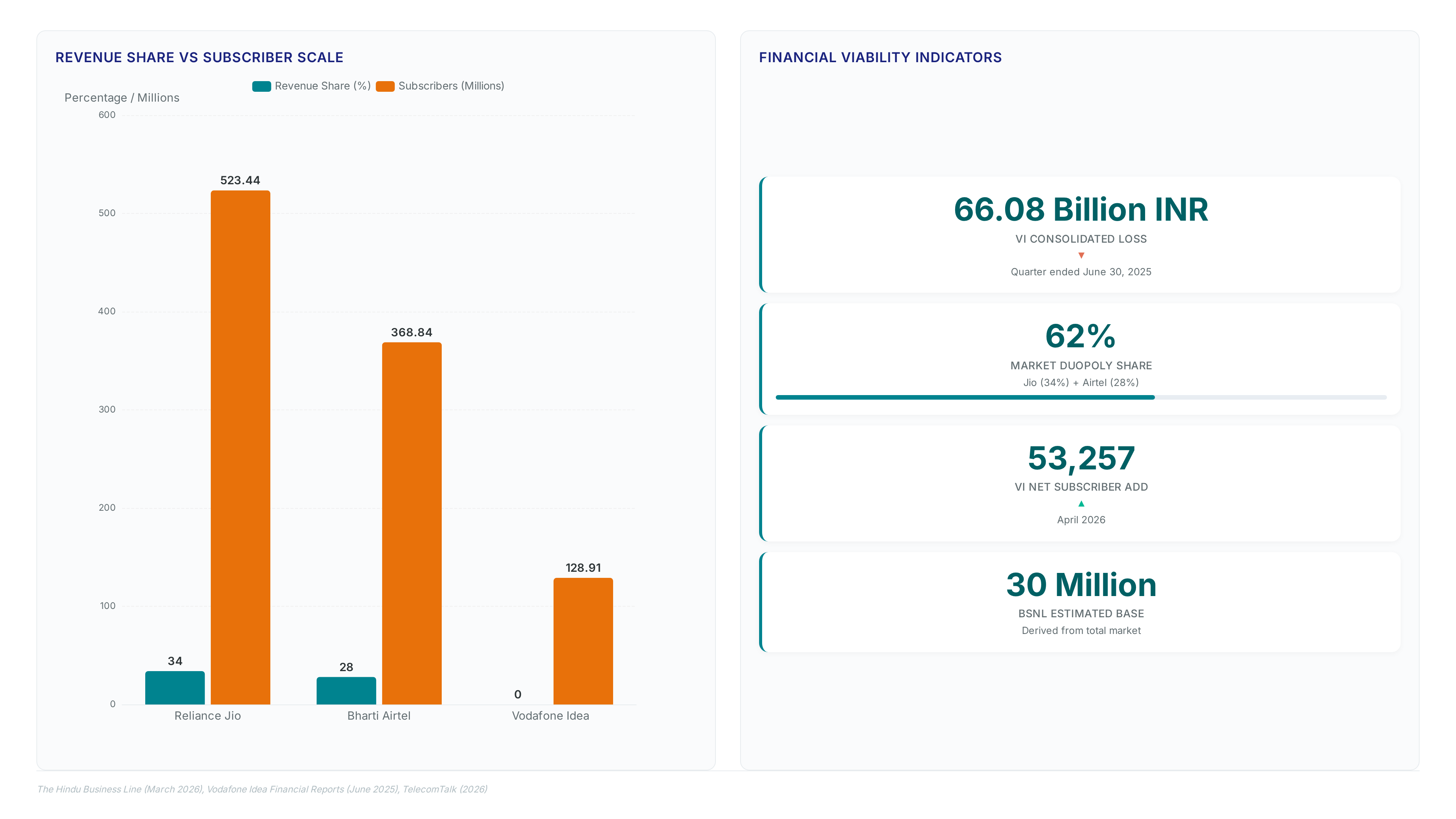
Revenue share disparity defines the survival line, with Reliance Jio holding 34% and Bharti Airtel securing 28% of the market. This 6-point gap creates a duopoly dominance that squeezes remaining operators out of sustainable capital expenditure cycles. Vodafone Idea reported a consolidated loss after tax of 66.08 billion rupees in the quarter ended June 30, 2025, illustrating the financial bleed required to maintain network relevance. The threshold for viability demands closing this revenue void through telecom cost reduction mechanisms rather than organic subscriber growth alone. Broadband subs data indicates the leader commands over 523 million users, dwarfing the distressed competitor's base. The limitation is clear: passive tower sharing fails to address the spectrum efficiency gap needed to lower unit costs. Operators must integrate active radio access networks to achieve the density required for profitable rural coverage. Failure to merge these assets results in a market slide toward permanent two-operator control. InterLIR analysis suggests only deep asset consolidation can reverse the current trajectory.
Accelerating BSNL 5G Launch in Rural Regions Using Vi Network Economics
Vodafone Idea added a net 53,257 wireless subscribers in April 2026, proving its network economics can now subsidize rural expansion for BSNL. This momentum allows the state operator to bypass heavy spectrum acquisition costs by using Vi's existing assets in low-ARPU zones. The partnership transforms Vi's recent subscriber gains into a shared utility, where urban revenue stability funds hinterland infrastructure that neither could afford alone.
Deploying this model requires mapping Vi's improved 5G experience metrics: 1.2.3.
The limitation lies in the divergent operational velocities; corporate agility clashes with bureaucratic procedure, often stalling spectrum compatibility checks. While Vi optimizes for speed, BSNL adheres to rigid social mandates that delay asset integration. This friction means network expansion timelines frequently exceed technical estimates by months, regardless of available funding. Without such governance, the collaboration challenges between public and private telcos will negate the financial benefits of shared tower density. The survival of a third market player depends on resolving these cultural gaps quicker than the duopoly expands its lead.
Leadership Transition Risks with Abhijit Kishore's August 2025 CEO Appointment
Abhijit Kishore assumes the CEO role on 19 August 2025, introducing a strategic pivot that may clash with BSNL's bureaucratic timelines. This financial bleed demands rapid cost rationalization, a goal incompatible with state-owned approval cycles.
Kishore operates within an anchor network strategy that relies on distinct regional infrastructures, complicating the standardization required for smooth asset sharing. Private operators prioritize speed to market, whereas BSNL adheres to rigid social mandates that delay active infrastructure deployment. The tension creates a specific failure mode: negotiation deadlocks where commercial urgency meets procedural stagnation.
| Risk Factor | Private Sector Driver | Public Sector Constraint |
|---|---|---|
| Decision Velocity | Quarterly earnings pressure | Parliamentary oversight |
| Asset Valuation | Market-based pricing | Book value adherence |
| Deployment Goal | ARPU maximization | Universal service obligation |
The cost of this misalignment is measurable delay in rural 5G coverage, directly undermining the third-player viability thesis. InterLir recommends establishing a binding arbitration clause for joint ventures to bypass hierarchical bottlenecks. Without such mechanisms, the leadership transition risks stalling the collaboration before technical integration begins.
About
Alexei Krylov, Head of Sales at InterLIR, brings critical expertise to the discussion on infrastructure sharing through his deep understanding of network resource optimization. While the article focuses on Indian telecom giants sharing physical towers and fiber, Krylov's daily work involves the strategic redistribution of scarce IPv4 addresses, a parallel form of necessary digital infrastructure. His background in B2B sales and navigating Regional Internet Registries provides a unique lens on how operators can maximize asset utility to remain competitive. At InterLIR, a Berlin-based marketplace dedicated to solving network availability issues, Krylov enables transactions that ensure efficient IP utilization without hidden intermediaries. This experience directly connects to the thesis that sharing underutilized resources-whether spectrum or IP blocks-is vital for reducing costs and expanding coverage in a saturated market. His practical insights into resource efficiency highlight the broader industry shift toward collaborative models.
Conclusion
Infrastructure sharing collapses not from technical incompatibility but from divergent operational velocities. When a private entity driven by quarterly earnings attempts to merge assets with a state-owned body bound by parliamentary oversight, the resulting friction creates a permanent latency tax on network upgrades. This misalignment ensures that every joint deployment incurs hidden coordination costs that erode the projected savings of tower consolidation. The market cannot sustain a third player if asset integration remains held hostage by bureaucratic valuation cycles rather than market realities.
Operators must implement a binding arbitration framework for all joint ventures before the August 2025 leadership transition solidifies current inefficiencies. This legal mechanism is the only viable path to bypass hierarchical bottlenecks that standard commercial contracts cannot resolve. Without this specific governance layer, the collaboration will degrade into a series of negotiation deadlocks, rendering the shared infrastructure economically unviable within eighteen months.
Start by auditing your current partnership agreements this week to identify missing arbitration clauses regarding asset valuation disputes. Insert a mandatory 30-day resolution window for any disagreement exceeding a specific monetary threshold before the next fiscal quarter begins. This immediate contractual adjustment prevents procedural stagnation from derailing future 5G expansion plans.
Frequently Asked Questions
Sharing assets prevents market collapse by merging state and private resources effectively. This alliance supports connectivity for India's 1.32 billion subscribers while stopping Reliance Jio and Bharti Airtel from dominating the entire sector alone.
The partners combine city strength with deep hinterland penetration for total reach. Vodafone Idea covers 98% of urban areas, which perfectly fills the gaps in BSNL's extensive rural deployment across the country.
State control drives these negotiations through significant equity stakes in both firms. The government holds nearly 49% of Vodafone Idea, creating political oversight that shapes commercial technical decisions for this unique alliance.
The operator currently manages a massive user base facing severe financial pressure. Vodafone Idea serves 192.80 million users, making the imperative to merge networks with BSNL absolutely essential for survival.
Divergent maintenance cultures between public and private entities cause significant operational delays. Bureaucratic approval cycles often slow down rapid reconfiguration, risking service degradation if shared active elements fail due to slow repairs.