Interconnect removes manual colocation patches
Provisioning cross-cloud links now takes minutes instead of weeks, a shift AWS confirms with its April 29, 2026 general availability launch.
Manual colocation patches are dead. AWS Interconnect establishes a new baseline where Layer 3 private connections are software-set commodities rather than physical construction projects. This service eliminates the traditional friction of managing VPN tunnels or negotiating with colocation facilities, allowing engineers to provision bandwidth directly through the Direct Connect console. By abstracting the physical layer, AWS forces competitors to match this level of integration or risk becoming legacy bottlenecks in modern hybrid cloud strategies.
This analysis dissects how Interconnect multi-cloud automates route propagation between AWS VPCs and Google Cloud, removing the need for manual activation keys. We expose the internal security protocols governing these pre-provisioned interconnect paths and analyze why Interconnect last mile renders traditional branch office wiring schemes inefficient. Finally, we contrast this managed approach against Microsoft Azure ExpressRoute, highlighting the specific architectural gaps AWS aims to fill before Oracle Cloud Infrastructure integration arrives later in 2026.
Gartner predicts that 90% of organizations will adopt a hybrid cloud approach by 2027, making these automated connectivity standards necessary for managing inevitable complexity. AWS and Google Cloud have jointly engineered this standard to fuse high-availability directly into the provisioning workflow, ensuring that cross-cloud data flow no longer requires specialized network teams to maintain physical cross-connects.
The Role of AWS Interconnect in Modern multi-cloud Architecture
AWS Interconnect multi-cloud and Last Mile Connectivity Set
AWS Interconnect launched generally available on Apr 29, 2026, abstracting physical layer complexity through two distinct managed capabilities. Interconnect multi-cloud establishes Layer 3 private paths between AWS VPCs and external providers using pre-provisioned capacity at global Points of Presence. This architecture eliminates manual cross-connects by using pre-provisioned interconnect capacity to automate routing propagation. Operators gain immediate peering without colocation negotiations, yet this convenience introduces a strict dependency on provider API stability for path activation. Interconnect last mile extends this model to on-premises sites by engaging participating network providers for final-hop delivery.
Interconnect last mile automatically provisions four redundant connections across two physical sites with MACsec and Jumbo Frames enabled. This architecture eliminates manual BGP session configuration by distributing capacity across independent power domains in distinct facilities. Resiliency Architecture prevents single-point failures that typically plague DIY multi-cloud builds relying on manual router pairing. Operators gain immediate fault tolerance without negotiating colocation cross-connects or managing physical fiber paths. Lumen Technologies serves as the initial network operator, using its massive fiber footprint to deliver these high-speed cloud services globally.
The single-fee pricing structure removes per-gigabyte data transfer charges, contrasting sharply with variable cost models found elsewhere. Google Cloud Interconnect, for instance, applies hourly fees plus discounted outbound data transfer costs that complicate budget forecasting. Operators gain financial predictability but lose the ability to negotiate custom port speeds below 1 Gbps. This constraint favors standardized enterprise workloads while potentially excluding edge sites requiring sub-gigabit circuits. The abstraction of physical layers shifts control from network engineers to software policies, reducing manual error but increasing dependency on vendor API stability.
Internal Mechanics of Cross-Cloud Data Flow and Security Protocols
MACsec Encryption and AWS Global Backbone Traffic Flow
IEEE 802.1AE MACsec encryption secures every physical link between edge routers, eliminating public internet traversal for cross-cloud data. Traffic flows exclusively over the AWS global backbone and Google Cloud private network, creating a sealed corridor that bypasses external routing domains. This architecture enforces confidentiality at Layer 2, keeping frames encrypted from the source router to the destination peer without relying on IPsec tunnels. Operators gain inherent protection against wiretapping, yet the rigid dependency on MACsec enabled by default creates friction when extending beyond two providers. Adding Microsoft Azure ExpressRoute to a similar configuration incurs an estimated additional cost of roughly $6,800, bringing the combined minimum baseline for a dual-cloud private link to over $15,000 before traffic charges. Such expenses force architects to weigh strict security requirements against budget constraints when designing multi-hyperscaler topologies.
| Security Layer | Implementation Scope | Operator Control |
|---|---|---|
| MACsec | Physical link between routers | None (mandatory) |
| IPsec | Logical tunnel overlay | Full policy definition |
| TLS | Application payload | Certificate management |
Uniform security posture clashes with operational flexibility. Troubleshooting latency spikes requires correlating metrics in CloudWatch rather than inspecting router cipher logs directly. This shift demands new diagnostic workflows for teams accustomed to granular control over cryptographic parameters. Secondary BGP sessions terminate in the same address family to resolve silent data loss caused by MTU mismatches between peered VPCs. Operators must manually verify Maximum Transmission Unit alignment because default values differ across cloud providers, creating a frequent trigger for fragmented packets and degraded throughput.
Provisioning capacity occurs in minutes through abstracted physical components, contrasting sharply with the days-long engineering cycles required for traditional DIY multi-cloud networking. This speed advantage relies on Google Cloud collaboration to simplify the handshake process, yet operators remain responsible for validating IP range non-overlap. Failure to align these parameters results in dropped sessions despite successful physical layer establishment.
Silent data loss occurs when MTU settings diverge between AWS and Google Cloud peered VPCs, dropping oversized frames without generating ICMP errors. The default Maximum Transmission Unit on AWS interfaces often exceeds the standard Ethernet limit used by legacy Google Cloud configurations, triggering fragmentation that security policies frequently block. Operators managing 92% of workloads across multiple clouds face compounded visibility gaps when packet drops remain unlogged by standard monitoring tools.
| Parameter | AWS Default | Google Cloud Default | Risk Outcome |
|---|---|---|---|
| Frame Size | 9001 bytes | 1460 bytes | Silent Drop |
| Fragmentation | Disabled | Disabled | Connection Reset |
| Detection | Passive | Passive | Throughput Degradation |
Resolving this mismatch requires manual alignment before traffic flows, as the automated provisioning of 4-way resiliency does not negotiate Layer 2 frame sizes between heterogeneous providers. The financial stakes rise when enterprises attempt to replicate private link architectures, since a minimum Google Cross-Cloud Interconnect configuration already demands significant capital before accounting for troubleshooting labor. This constraint limits jumbo frame benefits for large database replication but guarantees baseline connectivity stability across the hybrid fabric.
Market Positioning Against Traditional ExpressRoute and Third-Party Solutions
AWS Interconnect multi-cloud Versus Manual Third-Party Fabrics
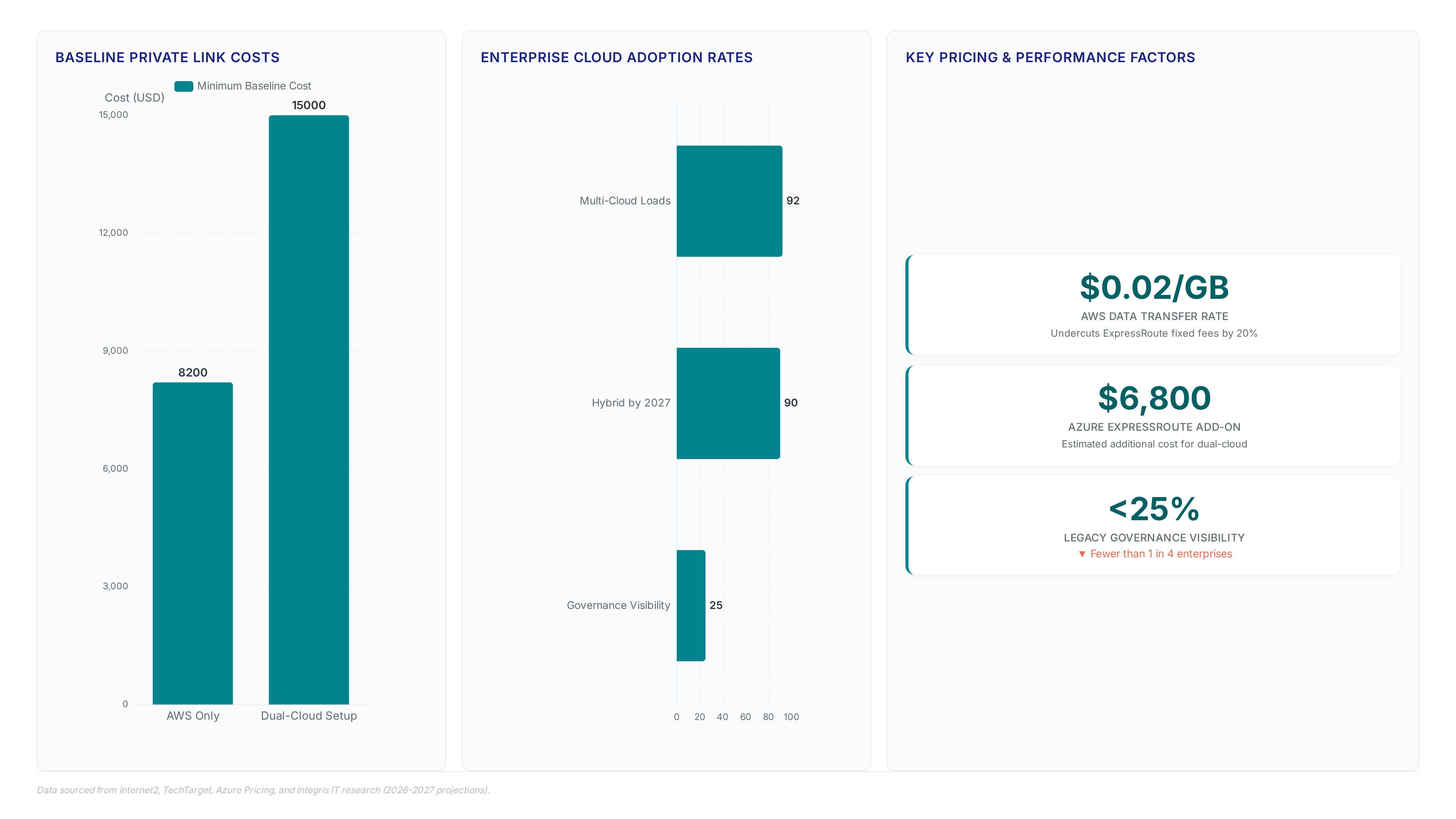
Legacy multi-cloud fabrics demand weeks of engineering to configure colocation cross-connects, whereas Interconnect multi-cloud compresses this timeline drastically. Operators previously managed VPN tunnels and third-party routing policies manually, creating brittle dependencies on external vendors for every topology change. The new workflow abstracts physical devices, allowing console-based activation that propagates BGP routes automatically between AWS Direct Connect and Google Cloud.
| Dimension | Manual Third-Party Fabric | AWS Interconnect multi-cloud |
|---|---|---|
| Provisioning Time | Weeks to months | Minutes |
| Physical Management | Colocation coordination required | Fully abstracted layer |
| Routing Configuration | Manual BGP session setup | Automatic route propagation |
| Resiliency Setup | Single-facility risk | Dual-facility redundancy |
Traditional approaches often concentrate logical links within one data center, exposing the path to single-point power failures. In contrast, the automated service distributes connections across physically distinct facilities with independent infrastructure. This architectural shift eliminates the operational burden of coordinating rack space and fiber patches with colocation providers. However, the speed gain introduces a new constraint: operators lose granular control over physical port selection and cable paths. Rapid deployment suits flexible workloads, yet static, high-compliance environments may still require the audit trails provided by manual third-party network fabrics. Velocity wins for most enterprises, but legacy governance models might resist the reduced visibility into the physical layer.
Provisioning begins by selecting regions and entering a Google Cloud project ID to trigger automatic activation key generation. AWS creates this credential to finalize the peer relationship, causing BGP routes to propagate bidirectionally without manual route-map engineering. This workflow eliminates the weeks-long delay previously required for colocation cross-connects, compressing deployment into a console-driven operation.
| Feature | AWS-Google Managed Link | Azure ExpressRoute Add-on | Manual Third-Party Fabric |
|---|---|---|---|
| Provisioning Method | Console API Call | Portal + CLI Script | Physical Cross-Connect Order |
| Baseline Cost | Included in Transit | ~$8,200 minimum | Variable Vendor Quotes |
| Route Sync | Automatic Bidirectional | Manual BGP Peer Config | External Orchestrator Required |
| Physical Layer | Abstracted by Provider | Dual Microsoft Edge Routers | Customer-Managed Patch Panels |
Operators comparing AWS-Google versus AWS-Azure connectivity face a sharp economic divergence. The jointly engineered approach between AWS and Google removes the physical cross-connect step entirely, whereas Azure still demands customer-managed routing via colocation facilities or third-party providers like Megaport. A critical limitation remains: Google Cloud currently lacks a web console for this specific provisioning task, forcing operators to execute CLI commands for the transport resource despite the automated key exchange. This asymmetry creates a hybrid operational model where activation is instant but validation requires script-based verification.
Traditional ExpressRoute and third-party fabrics require engineers to order physical cross-connects, configure specific VLAN IDs, and manage Cloud Router instances individually. This legacy approach introduces significant operational overhead compared to the provisioning speed of the new model. Operators trading direct hardware control for abstraction lose granular visibility into physical port statistics, a necessary concession for rapid deployment. The shift removes the need for colocation facility coordination entirely.
| Dimension | Traditional ExpressRoute/Fabric | AWS Interconnect multi-cloud |
|---|---|---|
| Physical Layer | Manual Cross-Connect Orders | Fully Abstracted |
| VLAN Config | Per-Attachment ID Management | Auto-Generated |
| Router Logic | Manual Cloud Router Setup | Implicit in Transport |
| Lead Time | Weeks to Months | Minutes |
Direct hardware access remains superior for forensic troubleshooting of layer-1 faults, whereas the abstracted model hides these details behind a consolidated API. Network teams accepting this trade-off gain consistency but sacrifice the ability to tune physical interface parameters directly. The reduction in human error during provisioning outweighs the loss of low-level control for most standard enterprise deployments.
Practical Implementation Steps for Provisioning Last-Mile Connectivity
IP Range Overlap and MTU Mismatch Constraints in Peered VPCs

Silent data loss occurs immediately when IP address ranges overlap or MTU values mismatch between peered environments. Operators must execute these validation steps before activating the link to prevent connectivity failures:
- Audit CIDR blocks on both sides to guarantee zero overlap, as routing tables cannot distinguish duplicate subnets.
- Align Maximum Transmission Unit settings explicitly, since AWS defaults to jumbo frames while Google Cloud often retains standard Ethernet sizes.
- Verify fragmentation handling policies, because mismatched frame sizes trigger drops that standard monitoring tools frequently miss.
A specific tension exists between automation and safety: the system propagates BGP routes automatically, yet it does not block sessions with incompatible MTU settings. This design choice shifts the burden of validation entirely to the network engineer prior to commitment. Unlike manual cross-connects where physical testing often reveals mismatches early, this abstracted model allows invalid logical states to persist until traffic flows. The consequence is a silent failure mode where large packets drop without generating standard ICMP errors, degrading throughput for specific applications while keeping control planes healthy.
Lumen Technologies uses its 340,000+ mile network to support these connections. Operators initiate this process by selecting source and destination regions, then specifying capacity tiers ranging from 1 Gbps to 100 Gbps within the console. The system provisions hosted connections on authorized partner infrastructure without requiring manual cross-connect orders or colocation coordination. AT&T collaboration expands available path diversity, supporting high-bandwidth workloads up to 1.6 Tbps across key metro routes. This automation replaces weeks of vendor coordination with a console-driven workflow that activates MACsec encryption and BGP routing by default.
- Define on-premises location coordinates to trigger provider selection logic.
- Enable Network Synthetic Monitor probes to detect packet loss trends before breaching SLA thresholds.
- Adjust bandwidth utilization sliders in the console to scale capacity, avoiding the reprovisioning delays common in legacy fabrics.
- Cross-reference partner footprints against latency-sensitive workload requirements to ensure physical path diversity matches logical redundancy claims.
- Validate that hosted connections retain their specific tier limits during flexible scaling events.
| Validation Metric | Manual Fabric Check | Interconnect Console |
|---|---|---|
| Latency Baseline | External Script Required | Built-in Synthetic Monitor |
| Scaling Action | Physical Re-cabling | Instant Slider Adjustment |
| Encryption State | Manual Verification | Default MACsec Active |
| Path Diversity | Site Survey Needed | Automatic Dual-Facility |
Bandwidth adjustments trigger immediate BGP session resets if MTU values drift between peered endpoints during the transition. This silent failure mode often escapes detection until large data transfers stall, making pre-change MTU audits mandatory. While Direct Connect Partners authorize specific tiers like 2 Gbps or 5 Gbps, the console permits granular tuning within those caps without partner ticket escalation. The cost of this flexibility is a reliance on correct initial IP address planning, as overlapping ranges cause route suppression that bandwidth changes cannot fix. InterLIR recommends automating these checks within CI/CD pipelines to prevent configuration drift from invalidating the connection.
About
Evgeny Sevastyanov serves as the Support Team Leader at InterLIR, a Berlin-based IPv4 marketplace specializing in critical network resource redistribution. His daily work managing RIPE and APNIC database objects and overseeing complex IPv4 leasing projects provides unique insight into the infrastructure challenges addressed by AWS Interconnect. As organizations increasingly adopt multi-cloud strategies involving Google Cloud and Azure, the demand for clean, reliable IP resources and private Layer 3 connectivity surges. Sevastyanov's direct experience ensuring BGP hygiene and network availability makes him uniquely qualified to analyze how managed interconnect services solve last-mile connectivity issues. At InterLIR, where transparency and efficiency are core values, he understands firsthand how smooth private connections between cloud providers enhance the utility of leased IP assets. This article bridges his practical expertise in network resource management with the evolving environment of global cloud interconnection.
Conclusion
Scaling beyond single metro routes exposes a critical fragility: logical redundancy often masks physical co-location risks when partners share trenching paths outside the demarcation point. As hybrid architectures become the default by 2027, the operational burden shifts from provisioning bandwidth to continuously validating that diverse fiber paths actually exist in the real world. The rigid tier structure forces a choice between wasted capacity or performance bottlenecks, but the deeper danger lies in configuration drift during flexible scaling. When bandwidth sliders adjust instantly, underlying BGP sessions can reset silently if MTU values mismatch, causing throughput collapse that standard monitoring misses until business operations stall.
Organizations must mandate a dual-facility audit for any connection claiming high-availability before Q3 2026, refusing to rely solely on console status indicators. Do not assume automatic path diversity; verify physical separation maps against your latency-sensitive workload requirements immediately. Start by scripting an MTU consistency check across all peered endpoints within your CI/CD pipeline this week to prevent silent route suppression during future capacity expansions. This proactive validation ensures that your network fabric supports genuine durability rather than just presenting an illusion of redundancy while costing you thousands in unused tiers.
Frequently Asked Questions
AWS Interconnect uses a single-fee structure with no per-gigabyte charges. In contrast, a minimum Google Cross-Cloud Interconnect configuration costs approximately $8,200 excluding opposing provider fees.
Yes, a new Free Tier Interconnect offers a fully managed connection to another Cloud Service Provider at no charge. This specific tier provides exactly 500 Mb of bandwidth starting May 2026.
Bandwidth scales dynamically from 1 Gb to 100 Gb via console adjustments without requiring physical truck rolls. This flexibility removes the need for discrete capacity tiers found in legacy solutions.
AT&T collaborates with AWS to expand network capacities up to 1.6 Tb across key metro routes. This partnership enables latency-sensitive workloads to scale without traditional engineering delays.
The service provisions four redundant connections across dual physical locations to meet a 99.99% availability SLA. This architecture prevents single-point failures that typically plague DIY multicloud builds.