IPv4 addresses: Why 3.7B remain but none are free
Only 3.7 billion of the theoretical 4.3 billion IPv4 addresses remain available for ordinary global use. This mathematical scarcity defines the IPv4 address not merely as a technical label, but as a finite economic asset driving complex market corrections in 2026. While CircleID reports a downward drift in large block prices, smaller units remain firm, proving that network identity commands a premium regardless of broader valuation trends.
The 32-bit structure imposes a hard ceiling on capacity, making the shift from rigid classes to CIDR a survival mechanism rather than an optimization. Strategic NAT implementation allows organizations to mask private addresses like 192.168. X. X, bypassing exhaustion while maintaining connectivity.
The protocol's "best effort" delivery model offers no guarantees, yet it remains the backbone of internet traffic. Understanding the precise division of four octets and the routing constraints of a /24 block is mandatory for network architects. The era of abundant connectivity ended long ago; today, proven management requires a cynical appreciation of scarcity and a rigorous approach to segmentation. (ARIN's ip addresses through 2025)
The Fundamental Role of IPv4 Addresses in Network Identity
IPv4 as a 32-bit Connectionless Identifier
An IPv4 address functions as a unique 32-bit label identifying network interfaces exchanging data across the Internet Protocol. Technically, the protocol operates as a connectionless system relying on a best-effort delivery model that guarantees neither packet sequencing nor arrival. This architectural choice shifts reliability responsibilities entirely to upper-layer protocols like TCP, leaving the network layer free to route based solely on destination logic. The address structure itself comprises four eight-bit binary numbers, or octets, rendered in decimal form as values between 0 and 255. Operators recognize this dotted-quad notation, such as 192.168.0.1, as the human-readable representation of the underlying binary identity. While the theoretical 4.3 billion address space once seemed infinite, modern cloud economics expose the scarcity of public identifiers. AWS implemented charges for public IPv4 addresses on February 1, 2024, forcing architects to re-evaluate NAT gateway usage patterns to avoid unnecessary overhead. Private ranges like 192.168. X. X remain exempt from these costs but require translation for external connectivity. Operators must deploy supplementary monitoring to compensate for the protocol's inability to signal delivery failures natively.
Shentel mapped 16,384 customer IPs to just 256 public addresses using Carrier Grade NAT. This deployment illustrates the operational necessity of translating private IPv4 addresses for global routing. Devices using non-routable ranges like 192.168. X. X require a NAT gateway to communicate over the internet, as these identifiers lack global uniqueness. The mechanism aggregates thousands of internal sessions onto a sparse pool of public-facing interfaces, effectively decoupling internal topology from external reachability constraints.
AT&T leads global holdings with 95 million IPv4 addresses as of early 2026, highlighting the stark disparity in asset distribution. Such concentration forces smaller providers to adopt aggressive sharing ratios that introduce stateful bottlenecks. The result involves increased latency and broken inbound connectivity for customers behind the translation layer. Applications relying on direct peer-to-peer initiation fail without explicit port forwarding rules or auxiliary tunneling protocols.
| Feature | Public Address | Private Address |
|---|---|---|
| Routing Scope | Global Internet | Local Network Only |
| Uniqueness | Globally Unique | Locally Unique |
| Translation | Not Required | Mandatory NAT |
Exhausting state tables causes dropped connections rather than queueing, creating hard failure modes during traffic spikes. Operators must dimension hardware to handle the maximum concurrent flow count multiplied by the sharing ratio. Failure to account for this multiplier results in collateral outages where single heavy users consume resources for thousands of others.
RFC 1918 Private Ranges Versus Public Routable Blocks
RFC 1918 reserves private address blocks like 192.168. X. X for internal use, preventing direct internet routing. Public IPv4 addresses remain globally unique and routable across the wider network infrastructure. The smallest unit of IPv4 address space independently routed on the public internet is a /24 block, enforcing strict aggregation boundaries for edge operators. This segmentation forces an architectural dependency on translation gateways at network perimeters.
Organizations using Carrier Grade NAT can map thousands of customer IPs to a sparse public pool, drastically reducing procurement costs. AWS recently shifted cost models by announcing charges for provided public IPv4 addresses, altering cloud deployment economics. Subnetting divides larger networks into manageable sections, yet private ranges rely entirely on gateway state for external reachability. Balancing internal addressing flexibility against the finite supply of public identifiers defines the modern operational challenge.
DHCP Server Assignment Versus Manual Static Configuration
A DHCP server assigns flexible addresses that change per session, whereas static addresses require manual entry to remain permanent. Flexible allocation reduces administrative overhead but introduces variability unsuitable for infrastructure endpoints requiring consistent reachability. Operators configure static IPs directly on the interface to guarantee a fixed next hop or management target, avoiding lease expiration risks.
| Feature | Flexible Assignment | Static Configuration |
|---|---|---|
| Persistence | Temporary lease | Permanent until edited |
| Overhead | Low (automated) | High (manual) |
| Use Case | Client workstations | Servers, routers, printers |
The cost of public address scarcity drives distinct strategies for each mode. Buying two /17 blocks instead of a single /16 can save approximately 25% while doubling route table entries. This fragmentation complicates static planning but optimizes capital expenditure for large estates. Conversely, flexible pools allow tighter aggregation of scarce resources. Following the 2024 policy shift, AWS public IPv4 charging forced many to re-evaluate NAT gateway usage patterns to avoid unnecessary costs Static assignments on cloud instances now represent a direct operational expense rather than a neutral configuration choice.
Subnetting divides a larger network into smaller, more manageable sub-networks to isolate traffic domains. This segmentation enforces strict boundaries that improve network efficiency and security by containing broadcast storms within local sections. However, historical IPv4 fragmentation has left many organizations with scattered address spaces, significantly increasing operational complexity. Operators facing this disjointed reality often find that optimization strategies like full renumbering become necessary to restore logical hierarchy.
The decision to subnet usually balances isolation against the scarcity of available bits. A typical deployment might allocate distinct blocks for user access, server farms, and management planes. Yet, the sheer scale of modern demand complicates this; the US federal BEAD program represents a massive $42 billion initiative expected to drive double-digit percentage growth in IPv4 requirements. Such pressure forces engineers to maximize every allocated bit rather than reserving large contiguous blocks for future expansion.
| Constraint | Impact on Design |
|---|---|
| Scattered Blocks | Prevents large contiguous subnets |
| Security Zones | Requires multiple small subnets |
| Address Scarcity | Limits waste in each segment |
Routing tables expand as specific host routes replace aggregate summaries. Operators must accept this overhead to maintain visibility across fragmented infrastructure. Failure to renumber results in inefficient routing policies that leak internal topology details to external peers.
Operational Risks of IPv4 Fragmentation and Renumbering Complexity
Scattered address blocks force operators into complex renumbering projects that destabilize network management. Historical allocation patterns leave enterprises with non-contiguous IPv4 address space, preventing efficient aggregation and increasing routing table size. This fragmentation compels teams to choose between inefficient static assignments or flexible pools that complicate firewall rule maintenance. When to use subnetting becomes a trade-off between security isolation and the administrative burden of managing disjointed prefixes across multiple sites.
AWS implemented charges for public IPv4 usage, forcing a reevaluation of NAT gateway deployment strategies to avoid unnecessary costs. Organizations must now audit workloads to determine if flexible allocation suffices or if static persistence justifies the expense. The latency introduced by additional translation layers further degrades performance for real-time applications dependent on end-to-end connectivity.
Operators should prioritize consolidating fragmented blocks where possible to restore hierarchical routing logic. Failure to address these structural inefficiencies results in compounding operational debt as the network scales.
Strategic Implementation of NAT and Address Management
NAT Mechanics for Private IPv4 Internet Access
Private prefixes such as 192.168 lack global routability, forcing devices to rely on Network Address Translation for public access. A gateway at the network edge swaps internal source identifiers for a valid public IPv4 address before forwarding packets upstream. This boundary defines the transition from local isolation to internet visibility. Operational scale often demands aggressive consolidation ratios to remain financially viable. Shentel demonstrated this efficiency by mapping 16,384 customer endpoints to just 256 public addresses through Carrier Grade NAT, proving that massive over-subscription is technically feasible. Direct end-to-end connectivity disappears in this model, complicating peer-to-peer applications and necessitating complex stateful tracking. Flexible mapping introduces latency and breaks protocols relying on embedded address information unlike static assignments. Operators must configure translation rules carefully to avoid session collisions during high-traffic periods. Precise tuning prevents the latency and complexity of deep translation stacks from degrading user experience despite preserving connectivity. Architectural dependency on these gateways creates a single point of failure requiring redundant hardware deployment.
Application: Deploying CGNAT to Map 16384 Customers to 256 Public IPs
Shentel mapped 16,384 customer IP addresses to just 256 public IP addresses, achieving a 64:1 consolidation ratio that bypasses IPv4 scarcity. This deployment relies on Carrier Grade NAT to translate private RFC 1918 traffic at the network edge, allowing devices using non-routable ranges like 192.168. X. X to access the global internet. The mechanism functions by pooling subscriber sessions onto a limited set of public IPv4 address resources, a strategy that delivers enormous cost savings compared to purchasing additional blocks on the open market. Operators implementing this architecture must configure DHCP servers to assign flexible leases rather than static identifiers, ensuring efficient reuse of the limited private pool.
- Define the private address pool scope for subscriber assignment.
- Configure the NAT gateway to maintain stateful translation tables.
- Establish logging protocols to map internal sessions to public ports.
End-to-end connectivity loss breaks applications requiring inbound initiation or unique source identification. Shentel utilized this ratio effectively yet faced increased complexity in troubleshooting and potential conflicts with IP-based authentication systems.
Comparison: Defining Static Stability Versus Flexible DHCP Assignment
Static IP addresses require manual configuration on the interface whereas flexible allocation relies on a DHCP server to assign temporary leases. Financial pressure forces a choice between contiguous space for simple routing or scattered prefixes that demand rigorous subnetting strategies.
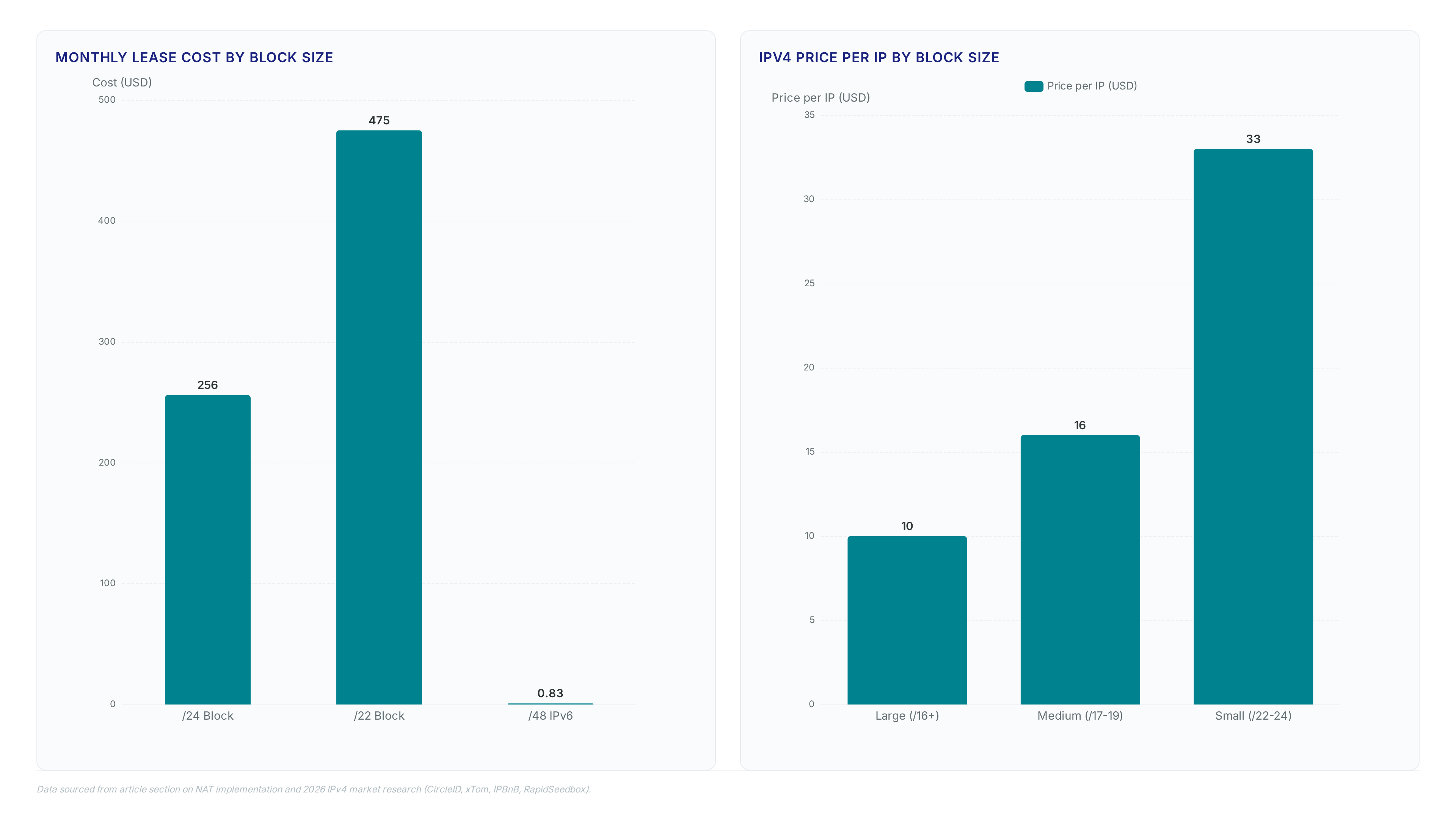
Manual entry introduces human error risks that flexible pools mitigate through centralized lease management. Operators buying fragmented blocks instead of contiguous space face increased configuration burdens that complicate firewall rule maintenance. The market reflects this scarcity, with large blocks trading near $10 per address while smaller units command higher premiums. Lease rates for small blocks can reach $384 monthly, making efficient reuse critical for profitability. Infrastructure requiring fixed next hop reachability demands static stability while general user endpoints benefit from the fluidity of flexible addresses.
IPv4 Exhaustion Risks Limiting Static Address Availability
ARIN distributed addresses to 587 organizations from its waiting list on October 10, 2025, proving that free allocation is dead for new static deployments. Scarcity forces network architects to choose between expensive secondary market purchases or flexible alternatives.
| Constraint | Static Assignment | Flexible Leasing |
|---|---|---|
| Availability | Near-zero in RIR pools | High via brokers |
| CapEx Impact | High upfront purchase | Low monthly OpEx |
| Permanence | Permanent ownership | Temporary access |
Market analysts predict transfers will dominate access methods rather than new allocations after 2026, locking small operators out of ownership. Relying on static allocation now requires significant capital that could otherwise fund infrastructure upgrades. Continuity depends on financial liquidity rather than technical merit. InterLIR recommends leasing for non-critical endpoints to preserve capital for core network infrastructure. Device notation impacts operational speed during outages. Simple dotted-decimal formats allow quicker troubleshooting than hexadecimal alternatives found in mobile network protocols. Routing tables grow complex without strict discipline, especially when managing scattered prefixes from historical fragmentation . Flexible assignment sacrifices pinpoint traceability for scale.
Organizations deciding should I use static or flexible IP must weigh fixed infrastructure costs against volatile secondary market rates in early 2026. Small blocks /22 to /24 remain firm in the $30 to $36 range, punishing new entrants who need only limited public routability. The global IPv4 secondary market is estimated to be worth over $2.5 billion annually, yet price divergence between block sizes complicates capital expenditure planning for static deployments. Operators ignoring this shift risk overpaying for address space that may depreciate further if IPv6 transition accelerates. Static addressing demands upfront liquidity that flexible models avoid entirely.
About
Vladislava Shadrina serves as a Customer Account Manager at InterLIR Marketplace, where she specializes in client relations within the complex domain of IP resources. Her daily work involves guiding organizations through the acquisition and management of critical network assets, making her uniquely qualified to explain the fundamentals of IPv4 addresses. At InterLIR, a Berlin-based company dedicated to solving network availability problems through the redistribution of unused IPv4 resources, Vladislava helps clients navigate the scarcity and technical nuances of these unique identifiers. Her direct experience addressing customer needs regarding IP leasing and rental allows her to translate technical concepts, such as the "best effort" delivery model of IPv4, into practical business insights. By connecting her frontline account management role with InterLIR's mission of transparency and efficiency, she provides a clear, factual perspective on why IPv4 addresses remain the necessary "street addresses" of the internet infrastructure.
Conclusion
The financial model for static allocation fractures when operational scale meets the 2026 market correction. While large blocks see price declines, the persistent premium on small /22 to /24 ranges creates a hidden tax on growth that flexible leasing bypasses entirely. Architects must recognize that holding legacy address space now incurs an opportunity cost exceeding the technical benefit of permanence for non-critical workloads. The shift from asset ownership to service-based access is not merely theoretical; it is a liquidity imperative for surviving volatile secondary market rates.
Organizations should mandate a transition to flexible leasing for all edge endpoints by Q4 2026, reserving capital purchases strictly for core infrastructure requiring immutable identity. This hybrid approach isolates your network from depreciation risks while maintaining necessary routing stability. Do not attempt to purchase additional small blocks unless you possess a verified five-year requirement that leasing cannot satisfy financially.
Start by auditing your current IPv4 portfolio this week to identify any statically assigned addresses serving transient development or testing environments. Migrate these specific targets to flexible pools immediately to stop the bleeding of operational budget on unnecessary permanence. This targeted reduction in fixed assets frees up resources for essential IPv6 coexistence upgrades without disrupting production traffic flows.
Frequently Asked Questions
Only 3.7 billion addresses exist for ordinary global use today. The theoretical limit is 4.3 billion, but reserved blocks reduce availability below one per person.
AT&T leads global holdings with 95 million IPv4 addresses as of early 2026. This concentration forces smaller providers to adopt aggressive sharing ratios that introduce stateful bottlenecks.
Exhausting state tables causes dropped connections rather than queueing packets. This creates hard failure modes where single heavy users consume resources intended for thousands of other concurrent network sessions.
Private addresses like 192.168.x.x lack global uniqueness required for direct internet routing. They must use a NAT gateway to translate internal labels into publicly routable identifiers for external communication.
The 32-bit structure creates a hard ceiling of 4.3 billion theoretical addresses. However, only 3.7 billion remain available for ordinary use due to reserved ranges and historical allocation inefficiencies.