IPv4 collisions: The 127.x solution explained
Google reported 50.10% IPv6 usage in March 2026. For complex enterprises, that statistic masks a gritty reality: the transition remains practically broken.
Jamie Thain argues IPv8 offers a necessary pragmatic upgrade to IPv4 specifically to resolve the chronic 10. X collision problem plaguing merged corporate networks. Forget forcing a complete IPv6 migration. While APNIC measurements show global capacity at 43%, network architects managing acquisitions face messy overlapping private subnets that current standards fail to address efficiently. Thain's proposal repurposes the 127. X. X. X range to create 10 billion IP addresses segmented by internal ASN numbers. This provides a structured alternative to the chaotic 10. X. X. X defaults everyone currently uses.
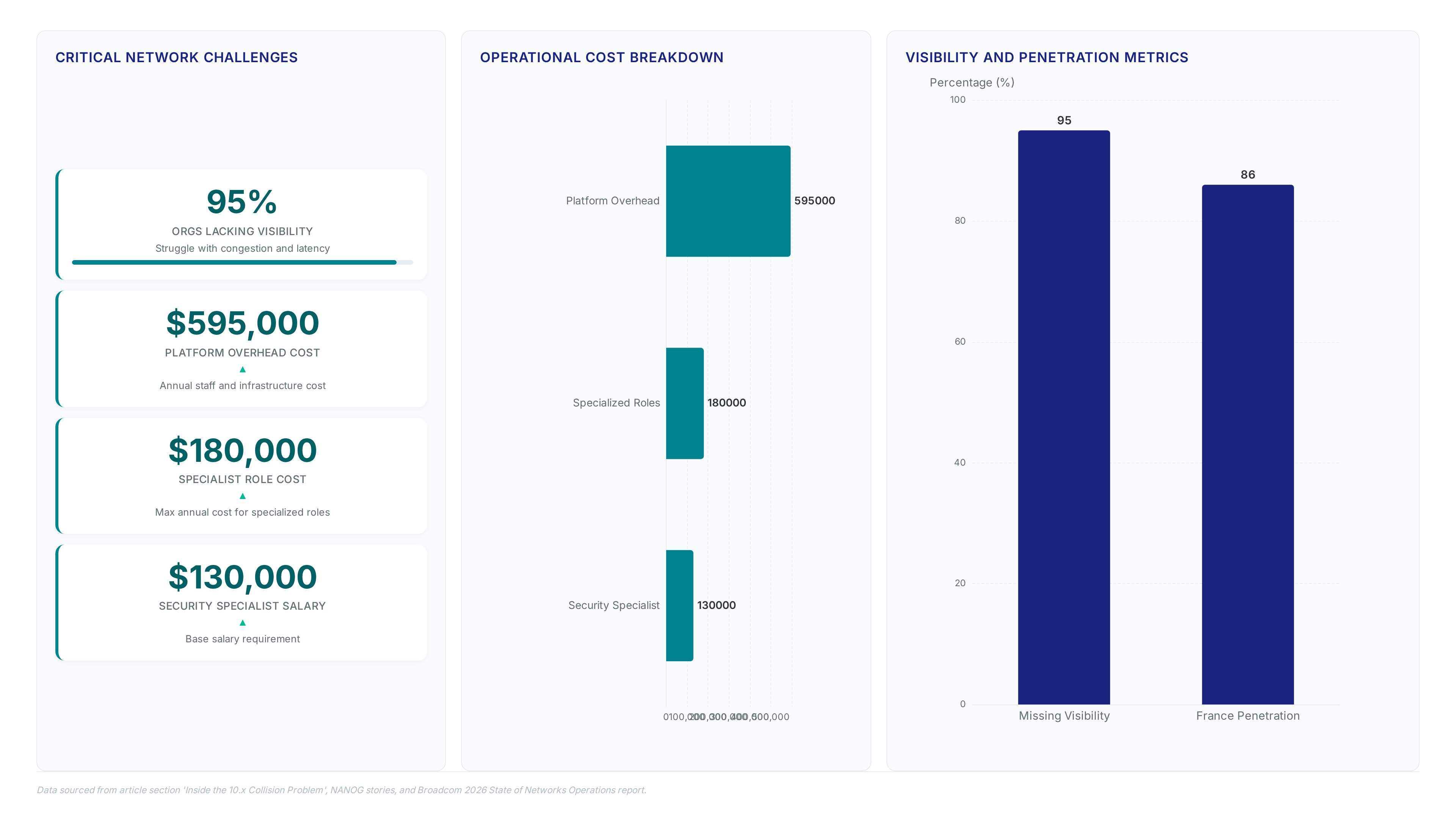
This analysis positions IPv8 within modern network architecture as a targeted fix for organizational sprawl, avoiding a total infrastructure overhaul. We will dissect the mechanics of the 10. X collision problem and demonstrate how the 127. X. X. X solution enables secure, isolated, and auditable network segments by department and region. Finally, we contrast IPv8 versus IPv6 adoption paths, evaluating why some enterprises might prefer this free, patent-free upgrade over the stalled momentum seen in regions lagging behind France's 86% penetration rate.
The Role of IPv8 in Modern Network Architecture
Jamie Thain's IPv8 Proposal as an IPv4 Upgrade
Jamie Thain defines ipv8 as an upgrade to ipv4 using a 64-bit architecture to resolve private address collisions without requiring a dual-stack migration. The proposal segments internal networks by mapping the ASN directly into the IP address space, specifically repurposing the 127. X. X. X range instead of the standard 10. X. X. X blocks. This architectural shift targets the documented friction of merging to companies both using 10. X during acquisitions, a scenario where distinct entities share overlapping private subnets. Proponents argue this method offers native backward compatibility, claiming participation requires no changes to existing devices unlike the complex transitions seen in IPv6 deployment.
Global IPv6 usage reached 50.10% on March 28, 2026, creating a high barrier for alternative protocols like ipv8. Momentum behind the existing transition reduces the operational incentive to deploy an unproven upgrade to ipv4. APNIC measurements placed global capacity at approximately 43% over the preceding month, indicating that saturation is incomplete yet dominant. Thain states that 'Unless a move is made ipv4 will still be running the warp drive', yet the market favors standardization over proprietary fixes for merging to companies both using 10. X. The cost of introducing a parallel stack outweighs the benefit of solving private address collisions when dual-stack architectures already handle public routing. No substantial hardware vendor has committed to the Zone Server model required for ipv8 functionality. The feasibility of ipv8 remains low while half the internet already speaks IPv6.
Inside the 10.x Collision Problem and 127.x.x.x Solution
The 10.x Collision Problem in Merged Corporate Networks
Larry Brower notes the scenario of Company A buying Company B, C, D, and E in a year creates immediate routing conflicts. X space triggers packet loss without extensive renumbering efforts. Traditional remediation requires rewriting every host configuration to fit a new private range, a process that stalls integration timelines. X..
Operational reality contradicts the theoretical simplicity of avoiding IPv6 migration. Critics argue that existing tools already solve visibility gaps where 95% of organizations struggle with congestion and latency. The cost of internet outages for manufacturing facilities can reach millions of dollars per hour, driving the need for resilient, locally managed network solutions rather than unproven protocol stacks. Deploying a novel addressing scheme introduces risk where established FreeRADIUS deployments already ensure continuity.
| Feature | Standard IPv4 NAT | IPv8 Proposal |
|---|---|---|
| Address Space | Limited private blocks | 10 Billion IPs |
| Collision Risk | High during mergers | None (ASN-bound) |
| Migration Path | Manual renumbering | Theoretical upgrade |
The limitation remains that no substantial vendor supports this non-standard interpretation of loopback space. Network operators face a choice between painful re-addressing or betting on an unsupported draft. ### Implementing 127. X..
Mapping internal ASN values into the 127. X. X. X range creates unique subnets that prevent address overlap during mergers. This mechanism assigns a distinct block to every department or region, mathematically eliminating the 10. X collision problem without full renumbering. Unlike standard private ranges, this approach embeds routing identity directly into the host address, allowing Zone Server platforms to manage DHCP8 and ACL8 functions with granular precision. Operators avoid the costly manual reconfiguration typically required when Company A acquires entities B through.
| Feature | Standard 10.x Space | 127.x.x.x ASN Segmentation |
|---|---|---|
| Collision Risk | High during mergers | None via ASN mapping |
| Address Scope | Static 24-bit block | Flexible per entity |
| Management | Manual renumbering | Automated via Zone Server |
Deploying this architecture demands significant capital, with core platform overhead reaching a substantial annual sum for staff and infrastructure. The financial burden includes specialized roles costing up to a substantial annual salary per year, creating a barrier for smaller enterprises. Manufacturing facilities facing millions in hourly outage losses might justify the expense for locally managed ### Larry Brower's Critique on.
Larry Brower asks how the 127. X. X. X range functionally differs from existing 10. X or 172.16. X private blocks. The Network Specialist at Texas Department of Insurance argues that current RFC 1918 spaces already support secured, isolated, and auditable networks without protocol modification. (RFC's draft thain ipv8 00) Brower challenges the necessity of this proposal by asking how it improves upon IPv6, which provides sufficient address space for global scaling. Specifically, global IPv6 capacity
The functional distinction between standard private ranges and the proposed ASN-based segmentation remains theoretical rather than practical. Existing tools allow operators to manage network collisions during mergers through standard NAT or renumbering procedures. Introducing a parallel stack creates dual-stack complexity without solving the underlying governance issues of internal addressing. The cost of training staff on a new numbering plan outweighs the benefit of eliminating rare collision scenarios. Most enterprises prefer using existing IPv6 deployment trends over implementing custom addressing schemes. Without vendor buy-in, the 127. X. X. X proposal remains an isolated experiment rather than a viable industry.
Comparison: Jamie Thain's IPv8 as a Patent-Free IPv4 Upgrade Path
Jamie Thain defines IPv8 as a patent-free extension to existing infrastructure, explicitly stating there are "No patent apps" and the concept remains "all free. " This approach contrasts with historical attempts like IPv9, where talented Chinese developers worked on implementation in 2004 but exclusive patents stalled code release. The proposal targets the 10. X collision problem during corporate mergers by mapping internal ASN values into the 127. X. X. X range. Global IPv6 adoption has plateaued near majority levels, creating perceived space for alternatives that avoid "flag day" migrations.
Repurposing the 127. X. X. X loopback range introduces severe conflicts with local host testing and diagnostic tools already bound to that space. Operators adopting this schema would lose standard localhost functionality, forcing a rewrite of monitoring stacks and application health checks. You exchange a solvable private address overlap issue for a fundamental break in local network stack behavior. ### Deploying 127. X..
Meanwhile, jamie Thain proposes mapping internal ASN values to the 127. X. X. X range to eliminate 10. X collision conflicts during corporate acquisitions. This mechanism embeds routing identity directly into the host address, creating unique prefixes for every acquired entity without full renumbering. Operators using this approach avoid the manual rewrite of every host configuration typically required to resolve overlapping private ranges. While the proposal claims native backward compatibility, actual implementation requires upgrading to Zone Server platforms to manage DHCP8 functions correctly.
Larry Brower identified the 10. X collision problem where Company A acquires entities B, C, D, and E, creating immediate address overlaps. This structure embeds routing identity directly into the prefix, theoretically preventing the chaos of merging networks that both apply standard RFC 1918 space. Operators deploying this scheme avoid the manual configuration updates typically required when consolidating acquired infrastructure.
NaaS vendor strategies from established players demonstrate that automation platforms now resolve these collisions through software-set overlays rather than protocol changes. The cost of maintaining a custom addressing scheme includes significant operational overhead, whereas modern tools handle translation dynamically. Unlike the static 127. X. X. X proposal, AI-driven operations enable real-time conflict detection and automated remediation across heterogeneous environments. IPv8 requires universal stack support, while existing solutions function within current IPv4 constraints.
Protocol innovation must compete with mature operational tooling. Merging networks remains complex, but the solution lies in management planes, not new IP versions.
Evaluating 127.x.x.x Utility Against Existing IPv6 Capacity
In practice, larry Brower questions functional differentiation between 127. X. X. X and standard 10. X ranges when IPv6 already offers massive capacity. The proposal claims native backward compatibility Embedding ASN data into host addresses creates a rigid hierarchy that prevents the 10. X collision problem during mergers, but sacrifices the flexibility of flat private space. The protocol architecture of IPv8 demands a 64-bit dotted-decimal format that existing operating systems do not natively parse without modification. The cost is measurable: organizations must maintain parallel logic for public IPv6 connectivity while running a bespoke internal routing engine. This fragmentation increases operational complexity rather than reducing it, as staff must troubleshoot two distinct addressing philosophies simultaneously. InterLIR advises operators to validate whether the marginal gain in merger isolation justifies the engineering burden of maintaining a non-standard stack.
About
Evgeny Sevastyanov serves as the Support Team Leader at InterLIR, a specialized IPv4 marketplace based in Berlin. His daily responsibilities involve managing complex RIPE and APNIC database objects and overseeing BGP routing integrity, making him uniquely qualified to analyze technical discussions surrounding protocol evolution like the proposed IPv8. While the industry debates future standards, Sevastyanov's frontline experience handling IPv4 leasing and ensuring clean IP reputation provides a grounded perspective on current network scarcity. At InterLIR, his team enables the redistribution of unused address resources, directly addressing the availability issues that often spark conversations about new protocols. By connecting practical network operations with market realities, Sevastyanov bridges the gap between theoretical upgrades and the immediate need for reliable IPv4 infrastructure. His expertise ensures that analyses of mailing list debates remain rooted in the factual constraints of today's global routing table.
Conclusion
Scaling a bespoke protocol like IPv8 fractures operational unity when engineering teams must simultaneously debug standard IPv6 paths and custom 64-bit dotted-decimal logic. The real breakage point occurs not in address exhaustion, but in the compounding latency introduced by translation layers that bespoke stacks require to interact with the public internet. While regional adoption metrics show promise, the global reality demands universal stack support that simply does not exist today. Organizations attempting this migration now face a permanent dual-maintenance burden that erodes the very efficiency gains promised by simplified merging.
Deploy IPv8 only if you operate a completely air-gapped private cloud with no immediate plans for public interoperability, and even then, limit this experiment to a twelve-month horizon. For any entity requiring external connectivity, the engineering debt of maintaining a non-native parsing engine outweighs the theoretical benefits of embedded ASN hierarchies. The industry trajectory favors flexible management planes over static protocol overhauls. Start by auditing your current network merger friction points this week to quantify actual collision costs before committing resources to a proprietary addressing scheme. If the data shows less than 5% of downtime stems from IP conflicts, abandon the IPv8 pilot immediately and redirect those funds toward automating your existing IPv6 transition tools.
Frequently Asked Questions
IPv8 resolves conflicts when merging entities both use overlapping 10.x private subnets. It creates unique prefixes offering 10 billion IP addresses segmented by internal ASN numbers to prevent routing errors.
The architecture allocates over 4.2 billion host addresses for every single ASN. This massive allocation effectively eliminates private range collisions during complex corporate acquisitions without requiring full renumbering.
IPv8 offers a pragmatic upgrade resolving collisions without a dual-stack migration. This avoids the complexity seen where global capacity remains at only 43% despite years of transition efforts.
Some regions lag significantly behind France, which has achieved an 86% penetration rate. IPv8 provides a free alternative for enterprises stuck in areas with stalled momentum and low adoption.
Proponents claim the method requires no changes to existing devices for participation. It maintains backward compatibility while addressing the 50.10% usage gap where current transitions remain practically broken.