IPv4x keeps routers working while extending space
IPv4 traffic still commands 60% of global volume in 2026. The IPv4x protocol emerged as a pragmatic, if hypothetical, alternative to the stalled IPv6 transition.
The core argument is simple: extend the original 32-bit architecture through backward compatibility rather than forcing a disruptive dual-stack migration. Circleid reports that IPv4 leasing prices have stabilized between $0.38 and $0.45 per IP for 2026, yet financial incentives alone haven't broken the deadlock. Only 48% of users access Google services via IPv6. Money isn't the blocker; inertia is. IPv4x architecture keeps the critical Version 4 field intact, ensuring smooth routing across legacy infrastructure without immediate hardware upgrades. This approach contrasts sharply with the high costs and limited utility of IPv6-only networks. Extending the familiar 4.3 billion address space was the road not taken, but it remains the logical solution for today's fragmented internet.
The Role of IPv4x in Solving Address Exhaustion Without Abandoning IPv4
IPv4x Protocol Definition: 32-Bit Headers with 96-Bit Subspace
Imagine a packet where the Version field stays at 4, but we sneak in 96 bits of subspace data. That's IPv4x. The standard 32-bit destination sits in the header exactly as before. The extra address bits hide within the first 24 bytes of the IPv4 body. Routers unaware of the extension forward these packets based solely on the visible 32-bit target, treating the subspace payload as opaque data. A specific header flag signals capable devices to parse the full 128-bit address hidden inside. Legacy infrastructure ignores this flag. No fork-lift upgrade required. No global routing table rewrite.
Subspace Addressing Mechanics: Embedding 128-Bit Addresses in Legacy Routers
This design embeds 96 bits of subspace data into the payload while maintaining a standard 32-bit header. Packets traverse routers unaware of the extension because those routers treat the extra address data as opaque body content. The first 32 bits of source and target addresses remain in their conventional header positions. Legacy routers forward traffic based solely on the visible IPv4 destination. A header flag tells capable devices to parse the full 128-bit address hidden within the first 24 bytes.
Engineers argued about this replacement cycle back in 1993. Ubiquitous firmware and embedded systems made a clean break impossible. Replacing IPv4 outright would have required upgrading dial-up modems, university labs, and corporate backbones simultaneously. Logistically impossible. IPv4x uses existing infrastructure where ownership of an IPv4 address automatically grants control of the entire subspace beneath.
But there's a catch. Intermediate hops cannot apply the extended address for traffic engineering. Path optimization stays stuck at 32-bit granularity until the packet reaches an IPv4x-aware egress router. Operators gain immediate address space expansion without discarding functional hardware, yet they sacrifice end-to-end visibility for the full 128-bit path. It's a functional stopgap. It preserves investment in fiber network expansions while deferring the complexity of a total protocol swap.
IPv4x never reached standardization. ARP and DHCP remain unpatched legacy bottlenecks in this hypothetical design. The proposed smooth transition relied on a header flag, yet no university ever routed a 96-bit subspace. The complexity outweighed the benefit of retaining broken tools. IPv6 succeeded as a clean break specifically because it discarded these flawed mechanisms rather than embedding them deeper into the stack.
Retaining the old protocol stack forces operators to maintain Carrier-Grade NAT layers that fracture end-to-end connectivity. This architectural debt creates a measurable cost disparity. Businesses adopt hybrid strategies, using cheaper IPv6 for high-volume tasks while reserving expensive IPv4 for critical legacy applications. Ipfoxy.com/blog/proxyinsights/6069. The 25year wait for widespread IPv6 deployment pro. Implementing such an extension requires shipping new code to every network element and updating DNS resource records. This mirrors the exact challenges faced during the actual IPv6 transition. The theoretical advantage of backward compatibility collapses when the underlying address space still demands universal software updates to function correctly. InterLIR notes that preserving the 32-bit header structure ultimately delays resolution rather than solving the exhaustion crisis.
Inside IPv4x Architecture and Its Backward Compatibility Mechanisms
DNS Flag Extensions and 128-Bit Resource Records in IPv4x
DNS updates required a new flag to signal client capability, returning 128-bit records alongside standard A entries. You can't just tweak the legacy A record; it remains hard-coded to 32 bits. Implementing this extension demands creating novel resource record types. Clients set a specific bit to indicate IPv4x understanding. Servers append the extended address data only when available. This dual-response mechanism ensures legacy resolvers ignore the extra payload while modern stacks consume the full address space.
Operators must ship new code to every network element. The logistical friction mirrors the IPv6 transition. DHCP distributions similarly shifted to issue addresses based on these client capability flags, splitting the pool between 32-bit and 128-bit assignments. Maintaining the Version field as 4 preserves routing continuity but complicates DNS requirements. Older resolvers strip the subspace data, effectively reducing the global address space back to its exhausted state for those users. InterLIR notes that such half-measures often delay full adoption by allowing operators to defer necessary infrastructure upgrades indefinitely.
Legacy Router Forwarding Logic Using Top 32 Bits
Legacy infrastructure forwards IPv4x traffic by reading only the top 32 bits of the destination address. It ignores the extended subspace entirely. This mechanism allows packets to traverse networks where intermediate hops lack updated firmware. Routers treat the extra 96 bits as opaque payload data within the IPv4 body. Unaware routers perform standard lookups on the visible header. Continuity happens without a simultaneous global upgrade. The design places subspace data in the first 24 bytes of the packet body, a location legacy silicon skips during header parsing.
Flows could persist even if intermediate nodes did not understand the full backward compatibility mechanism. MIT continued to hold the 18.0.0.0/8 allocation, with their network operating inside 18.18.18.18/32. This demonstrates how large blocks could anchor subspace trees. Any packet destined for a specific subspace address lands at the owner of the parent 32-bit prefix. The operator of the top bits must then filter or proxy traffic internally. This adds processing load to the edge rather than the core. Complexity shifts from the transit network to the destination AS. Operators manage subspace delegation manually since no standardized signaling exists for intermediate hops.
Infrastructure Stagnation from Ancient DHCP Servers and IPv4 Resolvers
Ancient DHCP servers handing out 32-bit addresses force public DNS resolvers to remain stuck on legacy IPv4 logic. This configuration lock prevents the resolution of 128-bit subspace records. Non-owners rely on the router owner of those top 32 bits for any external connectivity. The mechanism fails because legacy allocation protocols cannot signal subspace capability. The extended address space remains inaccessible despite the theoretical backward compatibility mechanism designed to carry it.
Cost disparities drive some businesses to adopt hybrid strategies. They use cheaper IPv6 for high-volume tasks while reserving expensive IPv4 for critical legacy applications. This approach traps operators in a cycle where 32-bit exhaustion dictates the entire network topology. Global website compatibility remains near 99% for IPv4, whereas IPv6 supports only a minority of top sites as of 2026. This reinforces the incentive to maintain broken DHCP infrastructures rather than upgrade.
The top 32 bits become a single point of failure for the entire 96-bit subspace beneath them. Network architects cannot fix IPv4x routing issues without replacing the underlying address distribution layer entirely.
Strategic Advantages of IPv4x Over IPv6 and Carrier-Grade NAT
IPv4x Economic Model: Dedicated Addresses vs Carrier-Grade NAT Fees
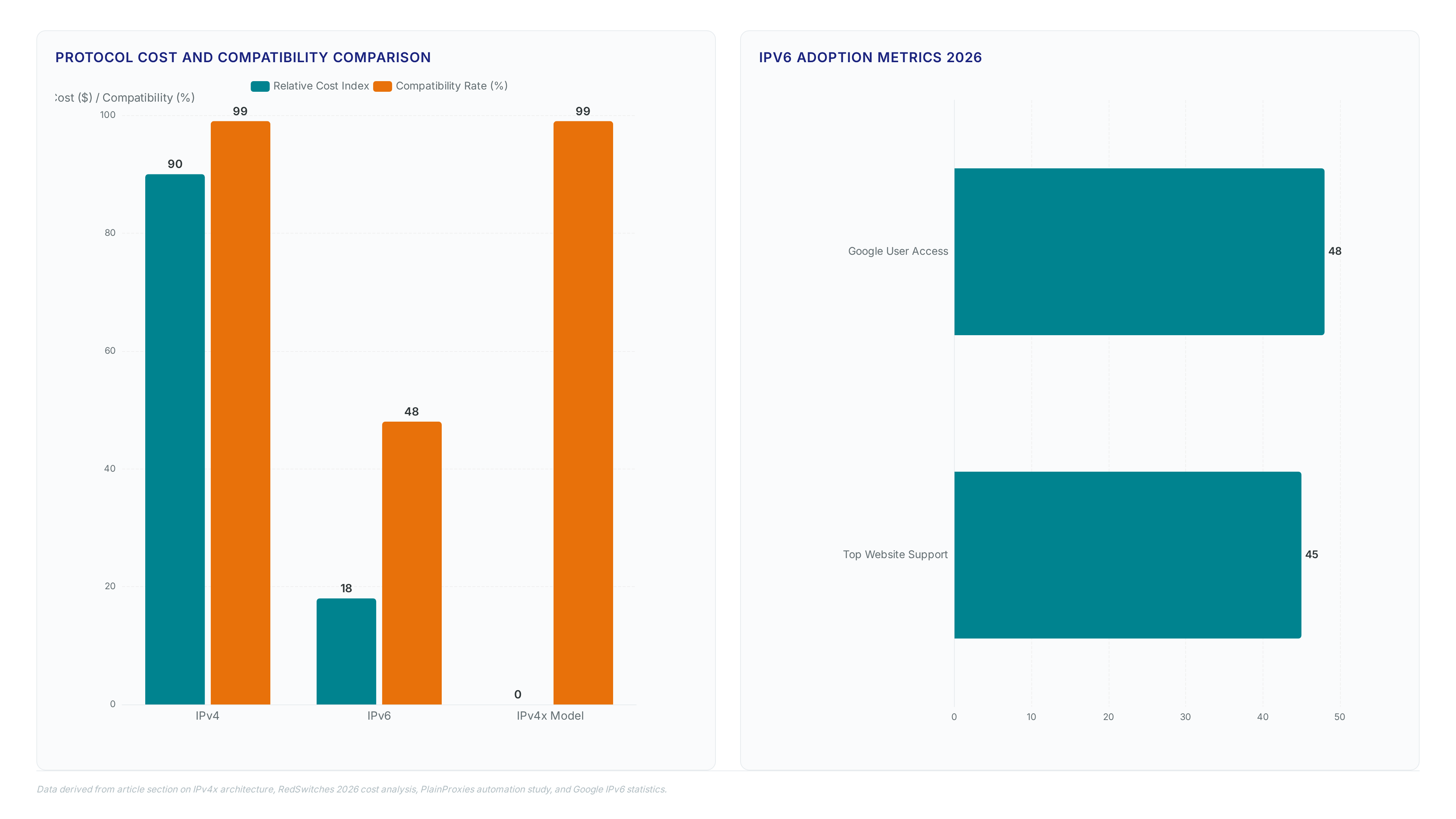
Realworld IPv4 leasing costs reach $90 monthly for a /24 block. The hypothetical IPv4x model monetized dedicated subspace access directly. ISPs in this alternate timeline sold permanent ownership of the 96-bit extension rather than renting temporary compatibility shims like Carrier-Grade NAT. The IPv4x Packet Structure let operators treat the subspace as private property. This move eliminated recurring fees tied to shared address pools. Actual market data shows single address prices fluctuating between a modest fee and a slightly higher cost, driving enterprises toward bulk leasing strategies despite the high capital expenditure.
Operators often choose CGNAT to avoid immediate hardware refresh cycles. They accept the long-term technical debt of broken end-to-end connectivity. Shipping new code to every network element stalled universal rollout despite the theoretical ease of transition. Businesses often adopted hybrid strategies. They utilized cheaper protocols for high-volume tasks while reserving expensive IPv4 for critical applications. Cost disparity drives some operators to maintain dual stacks rather than committing fully to one addressing scheme.
The clean break architecture of IPv6 eliminates technical debt but creates immediate connectivity gaps for users relying on older infrastructure. A hybrid approach often emerges where businesses reserve expensive IPv4 resources for public-facing services while offloading internal traffic to cheaper alternatives. IPv6 proxies cost 60% to 80% less than IPv4 equivalents, yet this savings vanishes if the target application fails to resolve. The transition timeline extends further than initial projections suggested, with only 48% of users on substantial platforms using the newer protocol. Slow adoption means universal reach remains a primary constraint for any organization requiring guaranteed delivery. Deploying a new extension like IPv4x would require shipping code to every network element. This replicates the friction seen during the original IPv6 rollout. Operators face a choice between paying premiums for guaranteed compatibility or accepting reduced coverage for lower operational costs.
The decision matrix favors sticking with established protocols until the installed base shifts decisively.
Deploying IPv4x Through DNS Updates and DHCP Configuration Steps
DHCP Capability Flags for 32-Bit vs 128-Bit Address Distribution
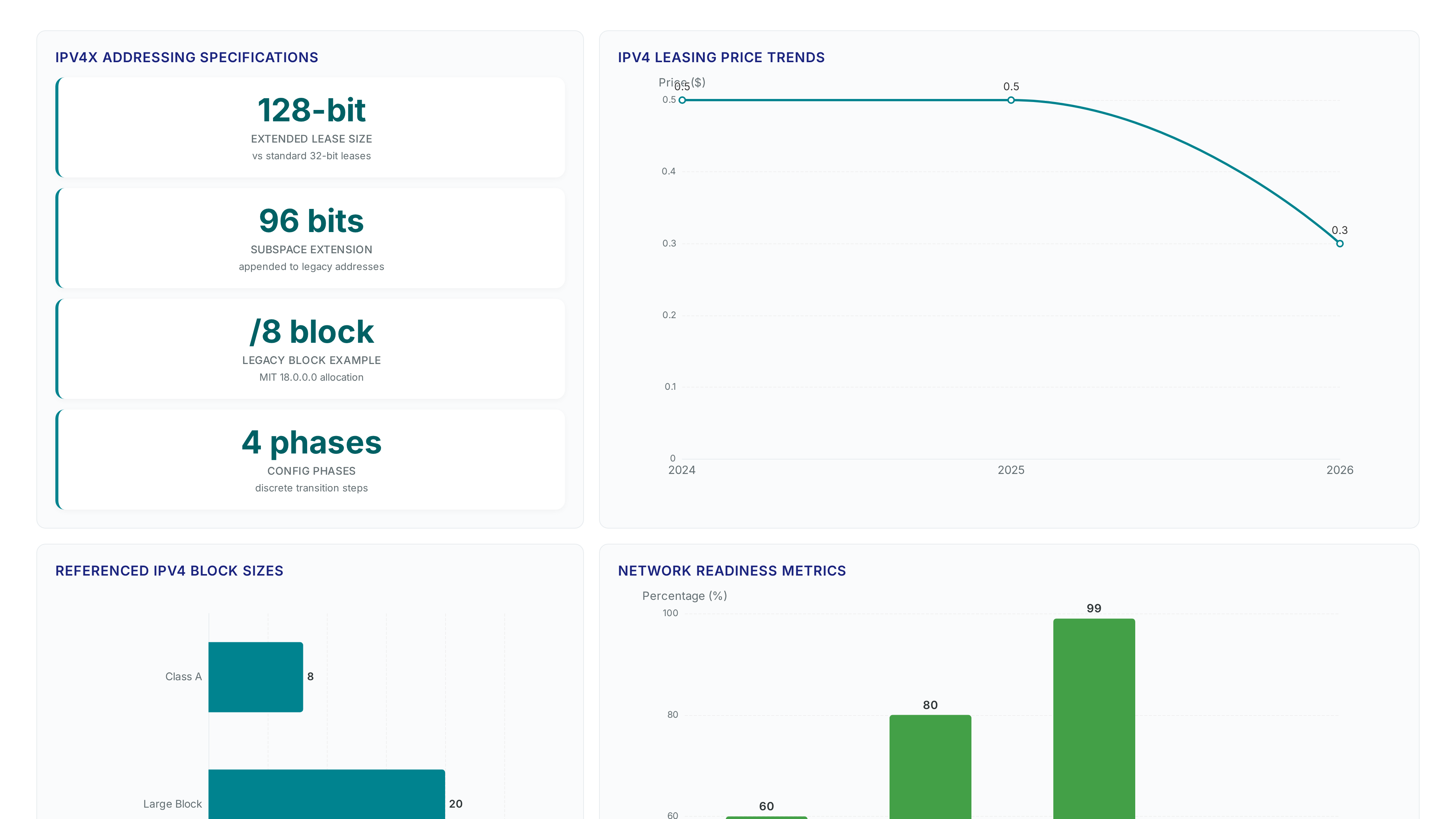
DHCP servers distribute 32-bit or 128-bit leases by inspecting a specific client capability flag during the initial handshake. The mechanism functions by extending the option field to signal support for the extended address space without altering the core protocol version. Legacy clients omit this flag, triggering a standard IPv4 response that ignores the subspace entirely. Modern stacks include the marker, allowing the server to append the extra 96 bits required for full routing. This dual-path logic ensures backward compatibility while enabling the IPv4x packet structure where subspace data hides within the payload. Operators must configure their pools to recognize this distinction or risk breaking connectivity for older devices.
A critical limitation exists in the reliance on client software to correctly set the capability bit. Misconfigured stacks request standard addresses even when the network supports extensions, forcing traffic through constrained legacy paths. The cost of this failure is silent degradation rather than explicit connection drops. Without active monitoring, the extended address space remains unused despite server readiness.
MIT Campus Backbone Deployment Using the 18.0.0.0/8 Block
MIT used its historic 18.0.0.0/8 allocation to treat every legacy address as the root of a 96-bit subspace without service interruption. Operators executed this transition through four discrete configuration phases that preserved forward compatibility while enabling extended routing logic:
- Upgrade border routers to parse the subspace header extension before processing payload data.
- Configure DNS servers to return 128-bit records only when clients present the specific capability flag.
- Enable DHCP scopes to issue 128-bit leases alongside standard 32-bit assignments based on client requests.
- Verify that intermediate legacy hops forward traffic using only the top 32 bits of the destination address.
This deployment strategy proved that networks could avoid a disruptive flag day by relying on the top 32 bits for basic connectivity while using the extended range for internal segmentation. The approach contrasts sharply with modern deployment requirements that often demand simultaneous code updates across every network element to function correctly. MIT's success demonstrated that holding large legacy blocks provides a unique advantage in implementing backward-compatible extensions that newer allocates cannot easily replicate.
However, the financial burden of maintaining such vast address holdings remains prohibitive for most organizations in 2026. Large entities currently pay millions annually simply to retain these blocks, creating a barrier where only historical beneficiaries can afford this specific migration path. The no flag day philosophy succeeds technically but fails economically for operators lacking pre-existing /8 resources.
RFC stabilization in 1996 mandated new resource records because the standard A record remains hard-coded to 32 bits. (RFC's draft thain ipv8 00) Administrators must execute four specific configuration steps to enable dual-stack resolution without breaking legacy clients:
- Define a new resource record type in the zone file to store the full 128-bit subspace data.
- Configure authoritative servers to inspect query flags before appending extended address data to responses.
- Validate that legacy resolvers ignore the new record type while capable clients parse the full address.
- Update caching logic to handle variable-length responses without truncating the subspace header extensions.
| Record Type | Address Width | Client Requirement |
|---|---|---|
| A | 32-bit | None (Default) |
| IPv4x | 128-bit | Capability Flag Set |
The operational cost involves shipping new code to every network element, a hurdle similar to challenges faced during the IPv6 transition. Unlike simple address additions, this process requires updating DNS resource records across all authoritative zones to prevent resolution failures for capable hosts. A critical limitation exists where intermediate routers lacking the extension logic will forward packets based solely on the top 32 bits, effectively ignoring the subspace routing intent. This behavior creates a tension between immediate deployability and end-to-end path optimization, as traffic may traverse suboptimal legacy hops despite the presence of extended addressing information. InterLIR recommends auditing zone files for hard-coded 32-bit assumptions before enabling the new record types in production environments.
About
Vladislava Shadrina serves as a Customer Account Manager at InterLIR, placing her at the forefront of the global IPv4 resource market. Her daily work involves directly assisting organizations navigating the critical challenges of IP address exhaustion, the very subject explored in this article. While the industry once feared total depletion by 2027, Shadrina's role at InterLIR demonstrates how strategic redistribution and leasing have extended the viability of the original 4.3 billion addresses. Unlike theoretical architects, she manages real-world transactions that allow companies to bypass restrictive NAT limitations and secure clean, routed IPv4 blocks immediately. Through her expertise in client relations at InterLIR, a Berlin-based marketplace specializing in transparent IP transfers, she witnesses firsthand how efficient resource allocation solves modern connectivity crises. This practical experience ensures her analysis of the "road not taken" is grounded in current market realities rather than mere speculation.
Conclusion
Scaling IPv4x introduces a hidden operational tax that leasing markets currently mask. While single-address prices stabilize between $0.38 and $0.45 through 2026, the cumulative cost of maintaining dual-stack DNS logic grows linearly with network complexity. Intermediate routers ignoring subspace headers create silent path degradation, forcing engineers to choose between optimal routing and universal compatibility. This friction proves that extending a depleted protocol is merely a stopgap measure, not a sustainable architecture for high-throughput environments.
Organizations should treat IPv4x as a transitional bridge strictly limited to legacy support windows ending in 2028. Do not build new core infrastructure on these extended records; instead, reserve them exclusively for maintaining connectivity with a significant share of top sites still lacking native modern protocol support. The economic model favors aggressive migration to cheaper alternatives once critical mass shifts, rather than investing in permanent patches for a 32-bit foundation.
Start by auditing your authoritative zone files this week to identify hard-coded 32-bit assumptions before enabling new record types in production. Map every dependency on legacy resolution logic to establish a concrete baseline for your migration timeline. This immediate inventory prevents resolution failures when you eventually toggle extended addressing features for capable clients.
Frequently Asked Questions
IPv4x keeps the Version field as 4 to ensure legacy routers forward packets normally. This design allows the protocol to function across existing infrastructure while supporting a massive 4.3 billion address space expansion.
Ownership of a single IPv4 address automatically grants control over the entire subspace beneath it. This structure creates a vast tree from one root, effectively managing the 3 billion address illusion for network operators.
IPv4 traffic continues to command 60% of global volume because full migration remains stalled. This high persistence rate proves that financial incentives alone cannot break the current deployment stalemate effectively.
Replacing IPv4 outright would have required upgrading dial-up modems and corporate backbones simultaneously. The extension approach avoids this logistical impossibility while serving the 48% of users who do not yet utilize IPv6.
The protocol embeds 96 bits of subspace data within the first 24 bytes of the IPv4 body. Legacy systems treat this extra information as opaque data while capable devices parse the full address.