IPv6 resolution risks: APNIC data shows 40% loss
Can we rely on IPv6-only DNS today? Current advertising-based experiments by APNIC reveal critical gaps in global resolution reliability that normative standards cannot yet ignore. (APNIC's podcast measuring the use of dns over ipv6)
The central thesis argues that defining IPv6-only DNS as a Best Current Practice is premature without empirical proof of universal operational stability. Geoff Huston and George Michaelson demonstrate that premature standardization risks breaking resolution chains where glueless DNS models expose hidden fragmentation risks. The article dissects how authoritative servers and resolvers fail to coordinate when forced into IPv6-only exchanges without fallback mechanisms.
Readers will learn how glueless DNS architectures strip away safety nets to test pure protocol adherence under real-world conditions. The analysis covers the specific mechanics of IPv6-only DNS resolution, highlighting where packet fragmentation destroys query success rates across different origin-AS regions. Finally, the text details the methodology behind advertising-based experiments that measure adoption without the noise of user session drops or browser timeouts. These data-driven insights from APNIC challenge the industry to pause before codifying fragile dependencies into binding RFC guidance.
The Role of Glueless DNS Models in Modern Protocol Verification
Defining Glueless DNS Mechanics and IPv6 BCP Status
Glueless DNS mechanics force resolvers to perform independent lookups by withholding address records from authority responses. Traditional glue records embed IP addresses within delegation responses to prevent circular dependencies during resolution. The glueless model removes this safety net, requiring the resolver to query the parent zone again using only the name server hostname. This constraint isolates IPv6 transport failures from client-side browser artifacts or user abandonment. Operators measuring a 40% failure rate on fragmented packets must distinguish between protocol limits and measurement noise. The Internet Engineering Task Force defines a Best Current Practice document to codify operational norms rather than mandate protocol changes.
Elevating these findings to an RFC requires proof that fragmentation losses are systemic rather than transient. The cost of standardizing premature IPv6 enforcement is measurable in lost resolution availability for legacy stacks.
IPv6-only DNS demands independent resolver queries when authoritative servers withhold address glue records. Traditional models embed IP addresses in delegation responses to prevent circular dependencies, whereas the glueless approach forces a fresh lookup using only the name server hostname. This constraint isolates transport failures from client-side browser artifacts or user abandonment during advertising-based experiments php/2020/07/16/ipv6-and-the-dns-2/). DNS fundamentally requires cooperation between end users, their chosen resolver provider, and authoritative servers to answer queries over IP protocols. The ER-DNS testbed deployment simulates these pure IPv6 architectures to evaluate query success rates without dual-stack fallbacks. Mobile devices account for 79% of internet access, making their resolver behavior critical for protocol validation.
| Model Type | Glue Record Presence | Resolver Action | Failure Isolation |
|---|---|---|---|
| Traditional | Embedded in response | Uses provided IP | Low |
| Glueless | Withheld | Performs new lookup | High |
However, restricting maximum unfragmented packet sizes to 1,280 bytes limits response complexity. Large responses exceeding this threshold trigger fragmentation, introducing measurable reliability gaps in production environments. Analysis of protocol feature support 1007/978-3-032-18268-5_10) across thousands of resolvers reveals inconsistent session resumption capabilities. Operators must weigh the purity of IPv6-only testing against the reality of fragmented packet loss. This hard limit forces operators to choose between truncating DNSSEC signatures or risking total resolution timeouts. Traditional DNS models rely on glue records to bypass extra lookups, yet the glueless DNS model deliberately omits these records to isolate transport layer failures from application artifacts. Removing glue forces the resolver to perform independent queries, exposing the underlying IPv6 path to strict MTU constraints without the buffer of cached address data.
| Model Type | Glue Record Presence | Failure Trigger | Operational Risk |
|---|---|---|---|
| Traditional DNS | Embedded in response | None ( | Low latency, hidden path errors |
| Glueless DNS | Withheld by authority | IPv6 fragmentation | High visible failure rate |
The cost of ignoring this threshold is measurable: large responses shatter into fragments that middleboxes frequently drop, causing the entire transaction to vanish. Unlike TCP, UDP offers no retransmission for lost fragments, making the fragmentation trap a binary failure mode rather than a performance degradation. Operators must verify that EDNS0 buffer sizes do not encourage responders to exceed the safe limit on IPv6 paths.
Inside the Architecture of IPv6-Only DNS Resolution and Fragmentation Risks
Normative Binding Terms in IPv6 DNS Query Encoding
Normative RFC definitions mandate specific query encoding behaviors that override implementation preferences when IPv6 transport is active. Protocol specifications define the expected behavior in strongly binding terms, forcing resolvers to adhere to strict formatting rules regardless of network conditions. These constraints shape deployment decisions by eliminating optional fallback mechanisms that previously masked fragmentation issues. The encoding process follows a rigid sequence:
- The resolver constructs the query header with the recursion desired flag set.
- The system calculates the total packet size against the 1,280-byte IPv6 minimum MTU.
- Transmission occurs only if the frame fits within the unfragmented limit.
Operators face a tension between strict protocol compliance and practical reliability. Studies suggest negative impacts are negligible in worst-case scenarios, challenging prior assumptions about MTU barriers. However, the centralization of infrastructure means a single operator enabling IPv6 resolution influences readiness for many zones.
| Constraint Type | Impact on Encoding | Operational Result |
|---|---|---|
| Normative Binding | Forces strict adherence | Eliminates silent failures |
| Strongly Binding | Prevents local overrides | Standardizes error handling |
| Expected Behavior | Defines fallback logic | Reduces ambiguity |
Future Best Current Practice (BCP) documents will likely codify these encoding requirements to ensure consistent behavior across the global system. The cost of non-compliance is measurable resolution failure rather than performance degradation.
Constraining resolver queries to IPv6 requires authoritative servers to withhold glue records, forcing resolvers to perform independent lookups using only hostnames. This glueless DNS technique isolates transport reliability from client-side artifacts by eliminating cached address shortcuts. Operators configure dual-stack authoritative setups to observe resolver preferences, noting that a small number of large providers disproportionately influence IPv6 readiness. The mechanism forces a fresh query path, exposing fragmentation risks that standard glue records typically mask. Measurement data reveals significant variances when analyzing traffic by geographic region and origin autonomous system. Deployments relying on advertising-based experiments php/2020/07/16/ipv6-and-the-dns-2/) must account for user behavior drift, whereas glueless models capture pure protocol failure rates. The limitation of this approach is the dependency on recursive resolvers strictly adhering to normative query procedures without falling back to cached IPv4 data prematurely.
| Configuration Mode | Glue Record Presence | Query Path Constraint | Failure Visibility |
|---|---|---|---|
| Standard Delegation | Included | Mixed IPv4/IPv6 | Low |
| Glueless Experiment | Omitted | IPv6 Forced | High |
The implication for network engineering is clear: relying on IPv6-only DNS in production demands verification that upstream resolvers do not bypass intended transport constraints. While. Tial application data often lags behind simple query traffic. The cost of skipping this validation is hidden resolution failures during large response transmissions. Elevating this guidance to an RFC status now risks standardizing a broken transport model before empirical data confirms reliability. Historical precedents like RFC 3901 originated in a different internet epoch, rendering their assumptions obsolete for modern high-volume traffic. Recent studies challenge prior work by demonstrating negligible impact in worst-case scenarios, yet these findings conflict with operational reality where packet loss remains high. And the practical constraints of diverse global networks.
| Risk Factor | Consequence of Premature BCP |
|---|---|
| Fragmentation Loss | Widespread resolution timeouts for large responses |
| Implementation Rigidity | Vendors remove IPv4 fallbacks before stability is proven |
| Measurement Gaps | Glueless models hide user-side abandonment artifacts |
Operators must recognize that normative definitions shape deployment decisions more than raw performance metrics do. Locking in IPv6-only requirements forces resolvers to adhere to strict formatting rules regardless of local network conditions. This rigidity eliminates optional fallback mechanisms that currently mask underlying infrastructure weaknesses. The cost of such standardization is measurable: widespread service degradation for users behind restrictive firewalls or on links with low MTU. Standardization should follow proven stability, not drive.
Executing Advertising-Based Experiments to Measure Global DNS Over IPv6 Adoption
Application: Glueless DNS Model Mechanics for IPv6 Measurement
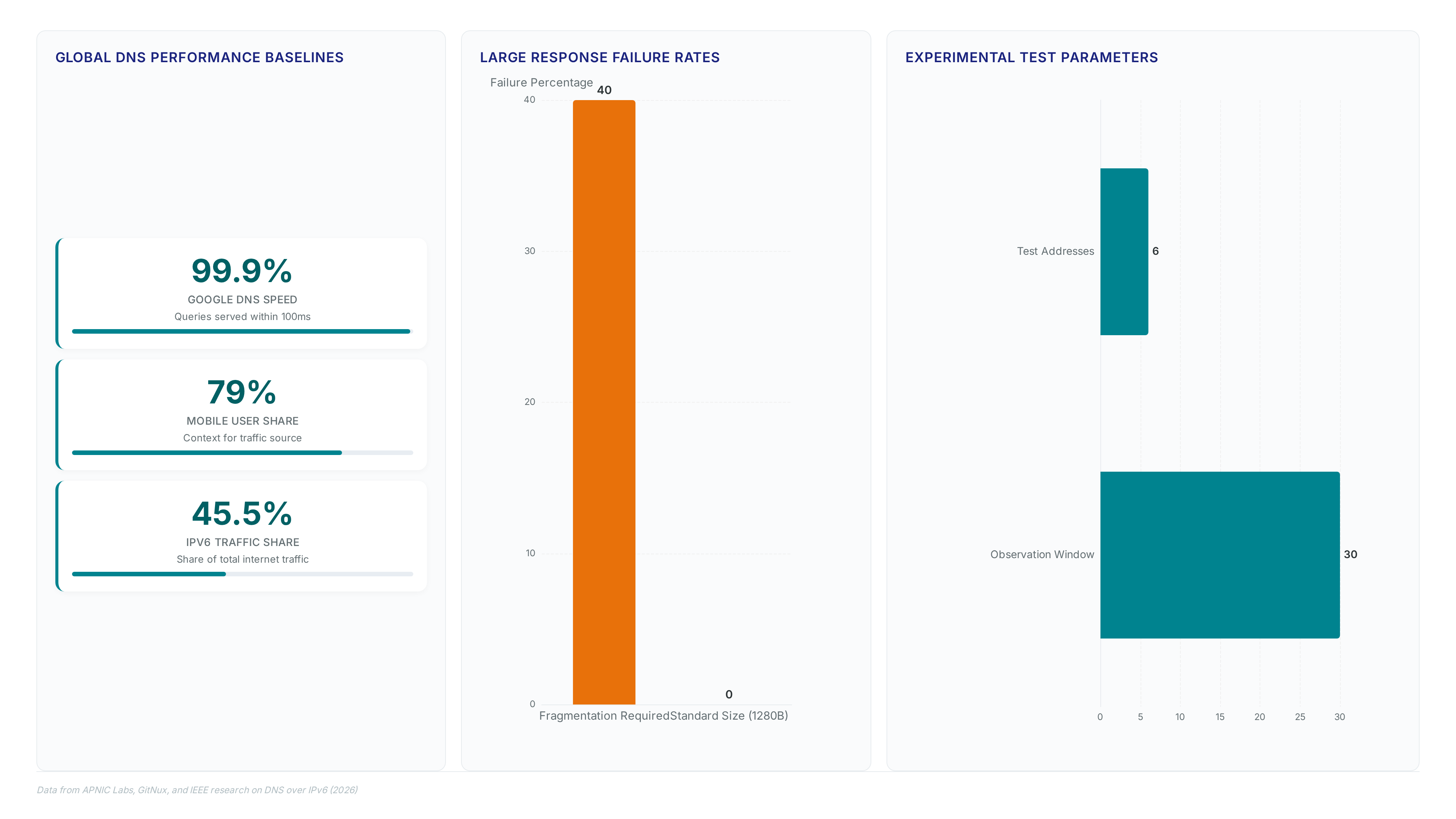
The glueless model forces resolvers to issue independent IPv6 queries by withholding standard address records from authoritative responses. This technique eliminates measurement noise caused by premature browser closures or user attention drift during ad-based tests. In a standard dual-stack authoritative php/2020/07/16/ipv6-and-the-dns-2/) setup, servers provide both IPv4 and IPv6 addresses to mask transport failures. The glueless approach strips this safety net, requiring the resolver to perform a fresh lookup strictly over IPv6.
Operators configure these tests to observe resolver behavior without the buffer of cached data. Analysis of Netflow records often reveals that apparent IPv6 growth consists merely of DNS queries rather than substantive application traffic. The glueless method validates whether this traffic survives full resolution cycles. Google DNS serves nearly all of its queries within a 100-millisecond window, setting a high baseline for performance expectations. However, forcing independent lookups increases latency slightly due to the extra round trip. This trade-off is necessary to distinguish between resolver capability and network path instability.
Segmenting glueless measurement results by Origin-AS reveals geographic variances that aggregate global averages obscure. Operators execute these advertising-based experiments by scripting unique DNS names into served ads, forcing resolvers to perform fresh lookups without cached glue records. The authoritative server configuration omits A and AAAA records, strong the resolver to issue a secondary query strictly over IPv6 to resolve the name server address. This method isolates transport failures from client-side artifacts like premature browser closures. Data aggregation requires mapping source IPs to their originating Autonomous Systems to identify specific network readiness gaps. Regional analysis highlights disparities where mobile-heavy markets exhibit different failure modes compared to fixed-line dominant zones. A related APNIC Blog post details the methodology for correlating these query failures with specific geographic clusters. Longitudinal tracking over a standard 30-day window smooths transient routing anomalies to show persistent structural deficits.
| Analysis Dimension | Operational Insight |
|---|---|
| Origin-AS Granularity | Identifies single providers causing disproportionate resolution failures |
| Geographic Clustering | Exposes regional infrastructure gaps masked by global averages |
| Temporal Trends | Distinguishes transient routing leaks from chronic configuration errors |
The limitation of this approach involves the reliance on voluntary user participation in ad networks, which may skew samples toward specific demographic profiles. Apnic.net/index. Php/2020/07/16/ipv6-and-the-dns-2/) baseline data to validate observed failure rates. Isolating the resolver path exposes whether fragmentation issues stem from the access network or the upstream transit provider. Operators must distinguish between localized peering failures and systemic protocol incompatibilities before adjusting BCP guidance. This divergence creates a security gap where the primary access medium lacks cryptographic validation. Advertising-based experiments force resolvers to issue fresh queries, exposing whether the mobile network stack handles fragmented DNSSEC responses correctly. Operators must configure EDNS0 buffer sizes to 4096 bytes using commands like `dig AAAA example. Com +bufsize=4096` to prevent silent truncation during these tests. The cost of ignoring this trend is measurable: validation failures increase as mobile carriers deploy IPv6 without updating resolver software to handle larger signed payloads.
| Risk Factor | Impact on Mobile Users |
|---|---|
| Declining DNSSEC support | Loss of origin authentication |
| Increased port randomization | False sense of transport security |
| Fragmented IPv6 packets | High query failure rates |
Most mobile networks currently prioritize connectivity speed over protocol robustness, leaving users vulnerable to spoofing attacks. The limitation here is that source port randomization protects against cache poisoning but offers zero defense against man-in-the-middle modifications if DNSSEC is absent. Without this verification, the shift to mobile-first internet access undermines the very security standards the protocol suite aims to enforce.
Strategic Implications for Standardizing IPv6-Only DNS in Production Environments
Lessons: Normative Binding Terms Shaping IPv6 DNS Deployment
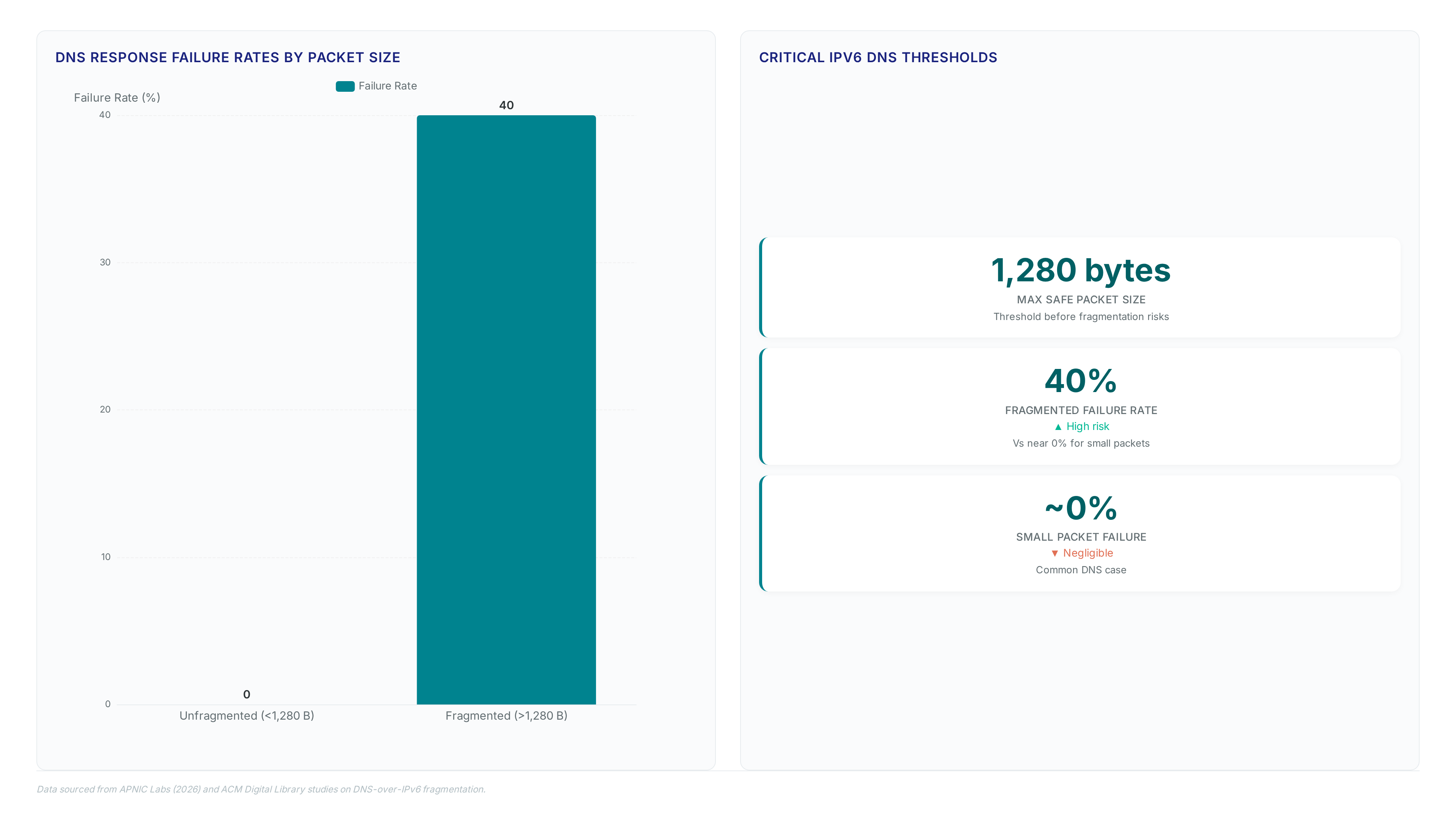
Codifying IPv6-only DNS as a Best Current Practice now risks locking in a transport layer that collapses under fragmentation stress. Protocol definitions described in normative and strongly binding terms determine whether resolvers retry over IPv4 or drop queries when packets exceed the 1,280-byte limit. This distinction separates theoretical capability from required operational behavior. Elevating current guidance to BCP status without resolving these ambiguities forces implementers to guess at failure modes. Speed of standardization clashes with the need for empirical validation. Glueless measurement models remove cached records to expose pure transport reliability, yet large-scale empirical analysis 1007/978-3-032-18268-5_10) reveals that modern protocols like DNS-over-QUIC often lack the session resumption features needed to mitigate latency penalties during these forced re-queries. Operators relying on default configurations face unpredictable timeouts when IPv6 paths fragment.
| Constraint Type | Impact on BCP Viability |
|---|---|
| Packet Fragmentation | High drop rate without explicit retry logic |
| Glue Record Absence | Forces fresh lookups, exposing stack bugs |
| Normative Ambiguity | Leaves implementation behavior undefined |
One critical caveat remains: HTTP keyword block-lists demonstrate that IPv6 traffic sometimes bypasses filtering mechanisms designed for IPv4, creating inconsistent enforcement zones that normative text must address. Standardization cannot proceed while such variances exist between protocol layers. Defining expected behavior strictly prevents vendors from optimizing for success rates that ignore edge-case failures. Operators adopting IPv6-only DNS in production must match this baseline to prevent user abandonment on latency-sensitive devices. Researchgate. This concentration means a Tier-1 resolver enabling IPv6 transport instantly shifts the operational baseline for millions of downstream clients without local coordination. Mobile access dominates the user environment, yet network stacks frequently mishandle fragmented packets required for larger DNS responses. Testing requires scripting unique names into advertisements to force fresh lookups, as described in advertisement-based experiments that isolate transport failures from cache artifacts. Standard dual-stack configurations mask these errors by providing fallback A records, hiding the true failure rate of AAAA-only paths.
The limitation of relying on centralized baselines is the loss of granular visibility into specific Origin-AS failures. Without this step, operators risk breaking resolution for the majority of mobile users who lack IPv4 fallback paths. Tension persists between standardizing protocol behavior and accommodating the fragmented reality of last-mile mobile networks.
Declining DNSSEC Capability Trends Amid Rising Source Port Randomization
Elevating IPv6-only DNS to a Best Current Practice now conflicts with falling DNSSEC-capable client fractions despite improved source port randomization. This divergence creates a vulnerability gap where transport security rises while cryptographic validation declines. Operators face a scenario where fragmented responses trigger failures more often than spoofing attempts succeed. The EDNS0 buffer configuration becomes the single point of failure for validation chains. Large providers influence readiness disproportionately, meaning one resolver change alters the security posture for millions.
| Security Mechanism | Trend Direction | Operational Impact |
|---|---|---|
| Source Port Randomization | Increasing | Reduces cache poisoning success |
| DNSSEC Validation | Decreasing | Increases unsigned answer acceptance |
| IPv6 Fragmentation | High Failure | Drops large signed responses |
InterLIR recommends delaying BCP elevation until validation rates stabilize above transport reliability thresholds. The cost of premature standardization is measurable in lost authentication guarantees for mobile users. Glueless measurements reveal that resolver behavior varies notably by origin-AS, complicating uniform policy enforcement. A single operator enabling IPv6 DNS resolution can impact a large number of zones without corresponding validation support. This asymmetry forces network engineers to choose between transport modernization and data integrity. The protocol definition must account for this misalignment before becoming normative. Ignoring the trend risks codifying a broken security model into global infrastructure.
About
Alexander Timokhin, CEO of InterLIR, brings a unique strategic perspective to the complex discussion surrounding DNS queries and IPv6 adoption. While his daily work focuses on optimizing IPv4 resource distribution through a transparent marketplace, this operational reality makes him uniquely qualified to analyze the transition pressures facing modern internet infrastructure. At InterLIR, Timokhin manages critical network availability challenges, giving him direct insight into why reliable DNS resolution across both IPv4 and IPv6 protocols is vital for global connectivity. His expertise in IT infrastructure and international policy allows him to contextualize technical measurements, such as those discussed by APNIC scientists, within the broader business need for smooth network evolution. By bridging the gap between scarce IPv4 resources and emerging IPv6 standards, Timokhin highlights how reliable DNS ecosystems underpin the stability required for efficient IP address leasing and long-term network growth.
Conclusion
The current trajectory creates a brittle infrastructure where transport modernization actively degrades cryptographic integrity. As mobile dominance grows, the reliance on large EDNS0 buffers for DNSSEC signatures triggers packet loss that no amount of source port randomization can fix. This friction means that pushing IPv6-only resolution today sacrifices data authenticity for connectivity, leaving enterprises exposed to unsigned answers while believing they are secure. The operational cost downtime, but a silent erosion of trust in the naming system that compounds over every 30-day measurement window.
Organizations must pause any mandate for IPv6-only DNS until validation success rates consistently exceed a high threshold across diverse mobile carriers. Do not treat transport speed as a proxy for security readiness; these metrics have decoupled. Wait for the projected 2026 stabilization of disaggregated switching architectures like SONiC to provide the telemetry depth needed to monitor these fragmented flows accurately before locking in new standards. Premature adoption now locks in technical debt that will require expensive retrofitting later.
Start by auditing your EDNS0 buffer sizes against actual mobile path MTUs within your primary resolver cluster this week. Adjust these values downward immediately if you observe correlation between buffer size and query timeout rates on cellular links. This specific tuning prevents fragmentation at the source rather than reacting to failures after they alter user sessions.
Frequently Asked Questions
Operators measure a 40% failure rate when fragmented packets disrupt resolution cycles. This high error percentage forces engineers to distinguish between actual protocol limits and temporary measurement noise during testing.
Mobile devices account for 79% of all internet access globally today. Their dominant market share makes resolver behavior on these specific platforms absolutely critical for accurate protocol validation and success.
Glueless DNS removes safety nets to isolate transport failures from user abandonment artifacts. This approach eliminates noise caused by users closing browser sessions prematurely during standard advertising-based experiments.
Large responses exceeding size limits trigger fragmentation that introduces measurable reliability gaps. These fragmentation events destroy query success rates across different origin-AS regions without proper fallback mechanisms.
Current data shows systemic fragmentation losses that prevent universal operational stability today. Standardizing now would bind implementers to fragile dependencies before proving reliable resolution chains exist globally.