IPv6 skills gap: Why 50% access isn't enough
Global native IPv6 access hit exactly 50.10% on March 28, 2026. We crossed the threshold. Basic connectivity is no longer the challenge. The RIPE NCC Academy identifies the real bottleneck: a severe deficit in advanced infrastructure design skills. Adoption growth has decelerated to just 2–3% annually, a sharp drop from the 8% surge between 2015 and 2018. Basic "turn it on" strategies fail here. Cisco Live EMEA 2026 revealed that over 99% of detected malicious URLs and crypto miners now use IPv6. Security teams ignoring this shift are flying blind.
The RIPE Network Coordination Center launched this curriculum to bridge the gap between access and reliable implementation. France sits at 86% penetration while others stagnate near the 50% mark. The differentiator now is the ability to troubleshoot and monitor these networks. This is engineering, not feature activation. We are building a resilient foundation for the next decade of internet traffic.
The Strategic Role of Advanced IPv6 Training in Modern Network Infrastructure
The RIPE NCC IPv6 Advanced course defines a strategic framework for designing infrastructure across diverse network architectures. Launched on 10 Feb 2026 by the RIPE Network Coordination Center, this curriculum moves beyond basic connectivity to address complex deployment scenarios. Operators learn to select the correct IPv6 transition mechanism for specific environments rather than applying generic dual-stack configurations. Native traffic volume now demands architectural precision instead of experimental tunneling. Global native access reached 50.10% on March 28, 2026, marking a tipping point where legacy IPv4 strategies become liabilities. The course scope includes backbone design, data center integration, and security monitoring for high-volume flows. Free access through the RIPE NCC Academy removes cost barriers that typically delay skill acquisition in smaller enterprises. Vendor-neutral instruction prevents lock-in to proprietary tools while covering universal routing protocols.
Operational teams rarely find deliberate study time during daily incidents. Self-paced e-learning cannot replicate live troubleshooting under production pressure without supplemental lab work. Organizations ignoring this gap risk misconfiguring addressing plans during rapid expansion phases. Strategic definition here means aligning personnel capabilities with the reality of majority-IPv6 networks. Enterprise IPv6 deployment becomes financially mandatory when address costs reach $85 per IP by 2030. Operators must replace expensive NAT expansions with native IPv6 addressing to eliminate per-unit charges. The shift eliminates broadcast congestion through efficient Multicast, reducing backbone overhead notably. Becoming a Local Internet Registry requires a €1,000 sign-up fee plus annual dues, creating a barrier for smaller entities. This cost structure favors consolidation or shared ASN models over individual LIR status for mid-sized firms.
Organizations should enroll in the free RIPE NCC Academy course to master addressing plans before committing capital. Vendor-neutral training prevents costly architectural errors during the transition from dual-stack to IPv6-only environments. Cloud providers offer instances at $2.50/month with included addresses, yet misconfigured enterprise backbones negate these savings. Appreciating asset prices make delay more expensive than retooling.
Vendor-neutral RIPE NCC Academy training eliminates the $300–$330 barrier inherent to Cisco CCNA certification exams. Vendor-specific credentials often expire after three years, forcing recurring recertification fees that compound operational budgets without expanding architectural scope. The IPv6 Advanced course focuses on multi-vendor infrastructure design rather than single-OS command syntax, addressing the reality that modern backbones mix hardware from multiple suppliers. Vendor tracks remain narrow in their focus on proprietary Junos OS or IOS environments, leaving gaps in generic transition mechanism selection. Operators managing heterogeneous fleets risk deploying suboptimal tunnels if trained solely on one vendor's default behaviors. This approach secures expertise against the shifting IPv6-only market without incurring recurring licensing debts.
Architecting Scalable IPv6 Addressing Plans for Backbone and Data Centre Environments
Defining the IPv6 Addressing Plan with /32 Prefix Allocation
Registry authorities assign a /32 prefix length to establish the boundary for enterprise subnetting hierarchies. This allocation size uses the massive 128-bit address space, which provides approximately 3.4 x 10^38 unique identifiers to prevent exhaustion constraints seen in legacy protocols. Operators must align their addressing planning activities by March 2026 to coincide with recommended transition timelines for backbone integration. The mechanism divides the 128 bits into a 32-bit global routing prefix and a 96-bit identifier for site-level aggregation and interface addressing.
| Component | Bit Length | Function |
|---|---|---|
| Global Routing Prefix | 32 | Aggregation point for ISP routing tables |
| Site-Level Aggregator | 16 | Internal topology segmentation |
| Interface Identifier | 64 | Unique host addressing via SLAAC |
Free Advanced IPv6 Training Courses A rigid /32 start limits immediate site flexibility compared to larger requests, forcing careful internal planning before expansion. The cost implication involves the annual service fee rather than per-address charges, fundamentally changing budget models. This structural discipline prevents route table bloat while ensuring sufficient entropy for future growth.
Optimizing Backbone Routing by Eliminating Broadcast Traffic
IPv6 deployment in backbone networks removes broadcast traffic entirely, replacing it with efficient Multicast and Anycast protocols to prevent congestion. Legacy IPv4 architectures rely on broadcast frames that flood every node in a segment, wasting bandwidth and forcing unnecessary CPU interrupts on uninvolved devices. This inefficiency vanishes when operators adopt the traffic efficiency model inherent to modern protocol design. Routers process headers quicker because the elimination of broadcast logic simplifies forwarding decisions across the core.
The mechanism shifts group communication from "send to all" to "send to interested listeners" via scoped multicast addresses. Anycast further optimizes routing by directing packets to the nearest topological instance of a service, reducing latency without complex load-balancing hardware.
| Traffic Type | IPv4 Behavior | IPv6 Behavior |
|---|---|---|
| Group Comms | Broadcast floods all ports | Multicast targets specific groups |
| Service Discovery | ARP broadcasts everywhere | Neighbor Discovery uses Multicast |
| Path Selection | Unicast or complex ECMP | Anycast routes to nearest node |
Global adoption trajectories suggest IPv6 will soon command the majority of traffic, relegating IPv4 to legacy status as dual-stack burdens increase operational costs. Removing broadcast removes a critical failure detection tool used in legacy monitoring systems. Operators lose the ability to passively hear all local chatter, requiring active polling or specific multicast group joins for visibility. This constraint demands updated tooling rather than simple configuration flips.
Data centre automation scripts fail when SLAAC generates non-deterministic interface identifiers, breaking firewall rule sets that require static IP assignments. Operators must choose between stateless simplicity and stateful control based on audit requirements rather than default vendor behaviors. The Neighbor Discovery protocol replaces legacy ARP logic by using multicast addresses for all router solicitations, removing broadcast noise but introducing dependency on ICMPv6 reachability.
| Feature | SLAAC | DHCPv6 |
|---|---|---|
| State Tracking | None (Router only) | Full Lease Database |
| DNS Delivery | RDNSS Extension (Optional) | Mandatory Option |
| Audit Trail | None | Centralized Logs |
| Complexity | Low | High |
Stateless autoconfiguration functions regardless of the presence of a DHCP server, allowing immediate connectivity but offering no central record of active hosts. This lack of visibility conflicts with security policies demanding precise asset inventory and lease expiration tracking. The cost of implementing stateful management is measurable in added infrastructure overhead, yet it remains necessary for compliance-driven environments. Pure SLAAC suits ephemeral container workloads where speed outweighs the need for persistent identity mapping. The limitation lies in DNS integration, as stateless hosts often struggle to register records without additional daemon support.
Executing Enterprise IPv6 Deployment Through Structured Project Planning
Structuring the IPv6 Project Plan with LIR and ASN Requirements
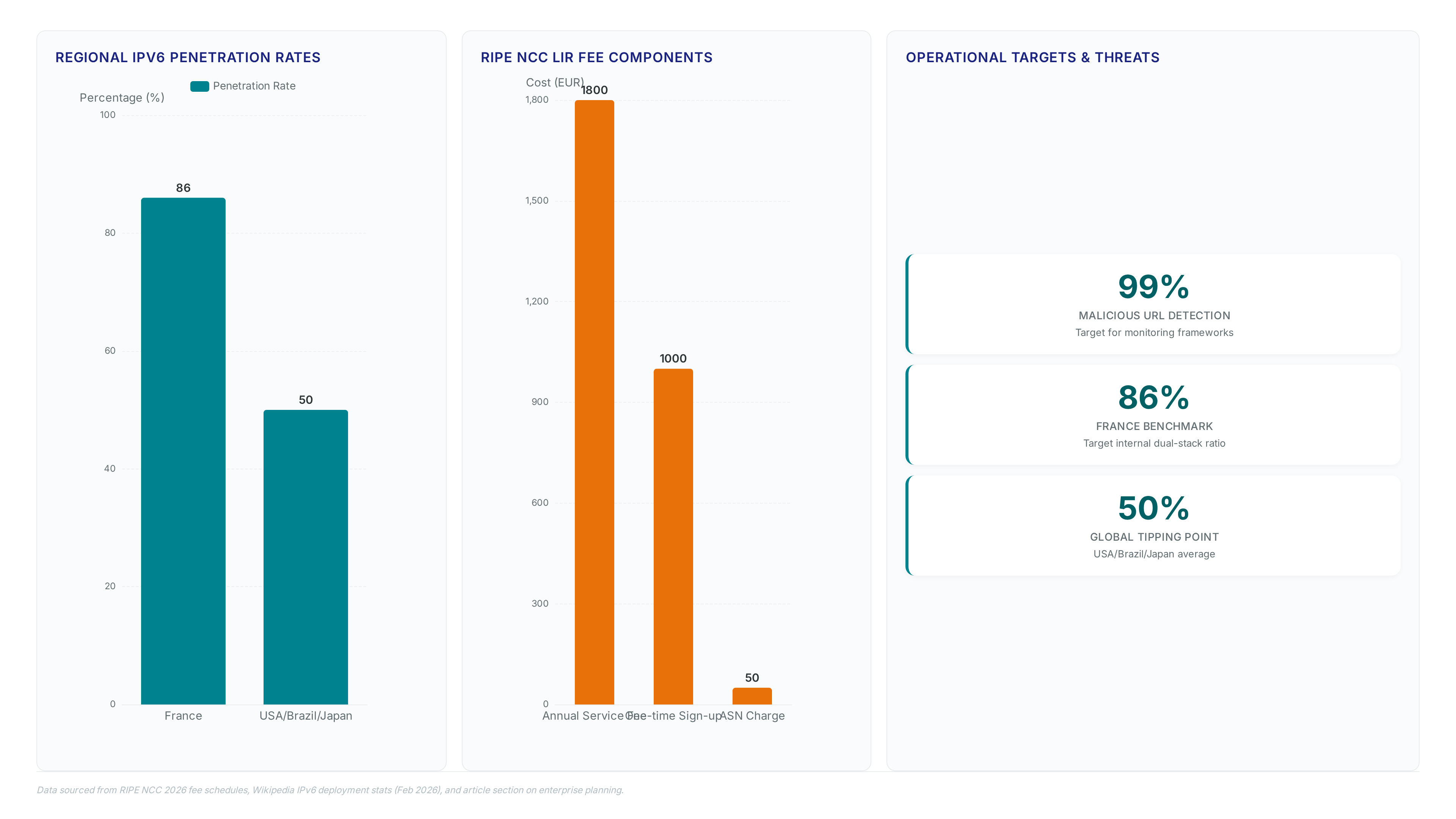
This administrative step grants direct access to address space but introduces recurring operational costs that cloud-only models avoid. The LIR status shifts responsibility for resource management entirely to the enterprise, demanding internal expertise for maintenance and compliance. Securing an Autonomous System Number adds a separate €50 one-time charge, enabling independent routing policy control beyond simple connectivity. Operators gain the ability to implement traffic engineering and multi-homing strategies that single-homed sites cannot execute effectively. The financial barrier remains low compared to certification costs, yet the procedural overhead often delays deployment schedules notably.
| Requirement | One-Time Cost | Recurring Obligation |
|---|---|---|
| LIR Account | €1,000 | Annual Service Fee |
| ASN | €50 | None |
Project timelines must align assessment phases with training completion. The drawback involves waiting periods for registry processing, which can extend project critical paths by weeks if documentation contains errors. Track deployment velocity by comparing internal dual-stack ratios against the 86% penetration rate observed in France. Operators monitor Google traffic metrics to validate that native IPv6 access exceeds legacy IPv4 volumes on edge routers. This external benchmark provides an immediate signal when internal configuration errors suppress adoption below regional norms. Linking internal telemetry to global adoption statistics reveals whether packet loss stems from local policy or upstream provider limitations. Regional variance dictates acceptable progression timelines for enterprise rollouts. North America is forecasted to dominate the market with over 42% share by 2035, setting a lower initial bar for early-stage deployments. French mobile operators achieved near-universal coverage, creating a high-water mark that pressures European enterprises to accelerate migration schedules. Ignoring these regional benchmarks leads to misaligned project milestones and unnecessary escalation of vendor support tickets.
| Metric Source | Data Type | Operational Use Case |
|---|---|---|
| Google User Traffic | Real-time Ratio | Detects local breakage vs global trends |
| France National Rate | Saturation Ceiling | Sets aggressive targets for mature markets |
| North America Forecast | Long-term Share | Validates slow-start strategies for legacy sites |
Relying solely on internal success rates masks stagnation when the entire industry shifts simultaneously. A static moderate internal adoption rate might appear stable until contrasted with a rapidly climbing external baseline. Blind trust in local monitoring tools without external context invites prolonged exposure to unpatched transition vulnerabilities.
Mitigating Security Threats from Malicious IPv6 URLs and Crypto Miners
Monitoring frameworks must detect that 99% of malicious URLs and crypto miners utilized IPv6 during recent large-scale events. This statistic indicates attackers exploit dual-stack blind spots where legacy tools ignore the newer protocol stack entirely. Operators cannot rely on default configurations because threat actors use the vast 128-bit address space to hide command-and-control traffic within unused subnets. The Cisco Live EMEA 2026 Security Incident demonstrates how quickly adversaries pivot to unmonitored addresses when IPv4 visibility improves. Security teams face a specific tension between enabling native connectivity and maintaining strict perimeter controls. While the protocol includes built-in IPsec for data integrity, this feature does not automatically block unauthorized outbound mining streams. Project planners must integrate flow telemetry that parses extension headers rather than dropping them as fragmentation errors. Failure to adjust detection logic leaves the network exposed even as adoption becomes a strategic imperative. The cost of ignoring these vectors exceeds the operational effort required to instrument full-stack visibility.
Diagnosing and Resolving Complex IPv6 Network Operational Issues
Defining IPv6 Troubleshooting Scope with 128-Bit Address Constraints
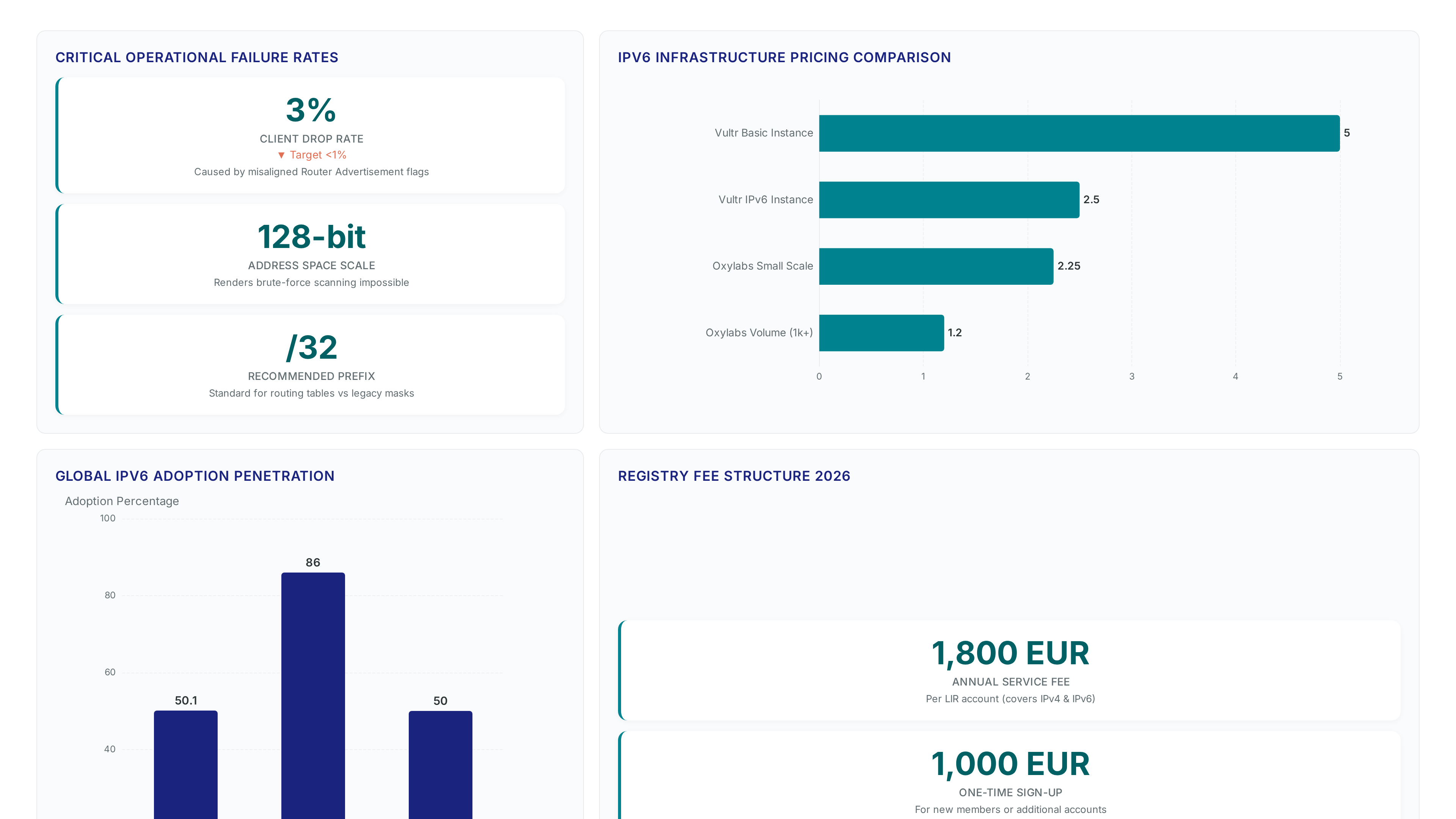
Proven diagnosis requires abandoning IPv4 scanning habits because the 128-bit address space renders brute-force discovery impossible. Operators must shift focus to structured prefix analysis and strict validation of hexadecimal compression rules.
- Verify that the longest sequence of zero fields uses the double-colon syntax exactly once per address to prevent parsing ambiguity.
- Confirm routing tables use the recommended /32 prefix length rather than legacy subnet masks that truncate valid host ranges.
- Inspect neighbor discovery logs for missing Multicast listener reports, which indicate broken stateless autoconfiguration paths.
The sheer scale of available addresses means a single misconfigured bit creates a routing blackhole indistinguishable from packet loss without deep packet inspection. Unlike IPv4, where scope is limited, errors here propagate silently across vast subnets until critical services fail.
Backbone fault isolation requires replacing legacy broadcast pings with targeted Multicast traces to avoid packet storms.
- Disable IPv4-style ARP scans because the Neighbor Discovery Protocol handles reachability via multicast groups instead.
- Inject test traffic into specific all-routers addresses to map forwarding paths without congesting the link.
- Analyze header simplification to confirm routers make quicker decisions than IPv4 counterparts allow.
This approach eliminates the broadcast noise that historically obscured latency spikes in core segments. Operators gain visibility into traffic efficiency gains by removing unnecessary replication overhead from every diagnostic cycle. The shift demands precise filter configuration since wildcard captures now miss critical control-plane signals hidden in multicast streams. A SOHO case study achieved an 80% native ratio by identifying residual IPv4 dependencies through similar flow analysis techniques. The limitation lies in tooling maturity; many legacy monitors still default to broadcast listening modes. Teams must manually reconfigure sensors to subscribe to the multicast groups before data becomes visible. Failure to adjust results in blind spots where routing loops persist undetected beneath the noise floor.
Validating Transition Mechanism Configurations for SLAAC and DHCPv6
Misaligned Router Advertisement flags cause 3% of clients to drop connectivity during dual-stack handshakes. Operators must verify the Managed (M) and Other (O) bits to prevent address assignment conflicts between SLAAC and DHCPv6.
- Inspect interface configurations to ensure the M-bit matches the intended stateful or stateless address autoconfiguration mode.
- Confirm that DNS server addresses are pushed via the O-bit when using stateless addressing, as SLAAC does not natively deliver resolver information.
- Validate that the Neighbor Discovery Protocol replaces legacy ARP functions without introducing latency in segment discovery.
| Mechanism | M-Bit | O-Bit | Address Source |
|---|---|---|---|
| Pure SLAAC | 0 | 0 | Router Advertisement |
| SLAAC + DNS | 0 | 1 | RA + DHCPv6 Info |
| Stateful DHCPv6 | 1 | 1 | DHCPv6 Server |
| Mixed Mode | 1 | 0 | DHCPv6 Address Only |
The limitation of this approach involves client OS behavior; some systems ignore the O-bit if the M-bit is unset, leaving them without DNS resolution. This forces operators to choose between full stateful management or accepting inconsistent resolver provisioning across device types. InterLIR recommends auditing these flags before scaling deployments to avoid silent failures in user connectivity.
About
Vladislava Shadrina serves as a Customer Account Manager at InterLIR, where she specializes in managing client relations within the complex domain of IP resources. While her daily work focuses on facilitating IPv4 address redistribution, this role provides her with unique, frontline insights into the global transition toward IPv6 infrastructure. By helping organizations secure critical network addresses, she directly observes the scarcity driving the urgent need for advanced IPv6 adoption and design. Her expertise in navigating IP market dynamics allows her to effectively contextualize the RIPE NCC Academy's new advanced course for professionals facing similar infrastructure challenges. The real breaking point is not address exhaustion but the hidden cost of maintaining dual-stack parity as legacy monitoring tools fail to interpret multicast traffic correctly. Relying on static internal targets ignores the shifting threat environment where malicious actors increasingly exploit IPv6-only blind spots. Organizations must stop treating IPv6 as a future compliance checkbox and start viewing it as an immediate security perimeter expansion that demands active management rather than passive enablement.
Teams should commit to a full tooling audit by Q3 to ensure sensors subscribe to necessary multicast groups before expanding native deployment beyond pilot zones. Do not attempt to scale stateless configurations until you verify that every client OS correctly processes the O-bit for DNS resolution; otherwise, you guarantee intermittent connectivity failures that degrade user trust. The window for gradual migration is closing as the operational burden of supporting two protocols begins to outweigh the benefits of delayed transition.
Start this week by scripting a scan of all Router Advertisement flags across your core edge routers to identify any M-bit and O-bit mismatches that currently leave devices without valid DNS resolvers.
Frequently Asked Questions
RIPE NCC Academy courses are completely free for all network operators to enroll. This eliminates the $300 to $330 barrier inherent to Cisco CCNA certification exams while providing vendor-neutral instruction.
Major cloud providers offer instances with included addresses for just $2.50 per month. However, misconfigured enterprise backbones often negate these significant savings through poor architectural design choices.
Delaying migration exposes organizations to future address costs reaching $85 per IP by 2030. Replacing expensive NAT expansions with native addressing now eliminates these looming per-unit charges effectively.
Annual adoption growth has decelerated to just 2–3%, contrasting sharply with the previous 8% surge. This shift demands architectural precision rather than experimental tunneling for successful network operations.
Over 99% of detected malicious URLs and crypto miners now leverage IPv6 protocols. This statistic highlights the urgent need for robust security monitoring within modern network infrastructures.