IPv6 training shifts to physical labs for real skills
Over 75% of global enterprises plan infrastructure modernization by 2027, making the refreshed IPv6 Deployment Workshop at APRICOT a critical intervention. (Apnic academy 2024 in review) This event marks the operational debut of APNIC's redesigned training architecture and updated curriculum, directly addressing the industry's shortage of 1.2 million certified engineers. The workshop moves beyond theoretical dual-stack concepts to enforce IPv6-first planning and automated validation in live environments.
Readers will examine how APNIC replaced volatile cloud-based models with dedicated physical sites to eliminate unpredictable egress fees while optimizing latency across the Asia-Pacific region. The analysis details the shift from manual device verification to automated backend checks, a change that allows trainers to focus on complex troubleshooting rather than configuration auditing. The article dissects the fifteen redesigned labs, including new modules for IPv6-mostly transitions that mirror current ISP and data center realities.
As inference workloads prepare to dominate data centers by 2030 per McKinsey data, the ability to deploy reliable IPv6 security and core implementations becomes non-negotiable. This update ensures network operators gain the specific, high-fidelity skills required to manage modern traffic loads without relying on outdated legacy frameworks. The result is a measurable increase in deployment competency for the region's most vital network personnel.
The Strategic Role of Updated IPv6 Training in Regional Network Modernization
An IPv6-first strategy mandates native protocol deployment as the default state, relegating IPv4 to a translated legacy service. This architectural shift eliminates the operational drag of maintaining two parallel control planes while accelerating infrastructure modernization for the over 75% of global enterprises planning updates by 2027. Traditional dual-stack approaches often stall deployment due to configuration complexity and the global shortfall of 1.2 million certified network engineers by 2027. Updated curricula now prioritize IPv6-only models that remove legacy dependencies entirely, contrasting with hybrid approaches that allow mixed transition mechanisms to fit specific environment characteristics.
Practical validation of this model occurred when an ISP supported IPv6 exclusively inside the network while customers operated nodes with varying configurations to test application compatibility. Such experiments reveal that maintaining dual stacks frequently introduces subtle routing policies that degrade performance rather than ensuring continuity. The cost of delayed transition is measurable: operators clinging to legacy planning face escalating technical debt as inference workloads dominate future data center traffic. Training programs must therefore enforce strict deployment planning modules that simulate these constrained environments. Without this focused pedagogical shift, the industry risks leaving critical infrastructure gaps unfilled despite available automation tools. The limitation remains that few organizations possess the internal expertise to execute clean breaks from IPv4 without external guidance.
Ten new IPv6-specific labs debuted at APRICOT 2026 to address the shift toward inference workloads dominating data center traffic by 2030. This updated IPv6 curriculum integrates realistic topologies where SONiC-based switching revenue is forecast to surge past a multi-billion dollar threshold in 2026, forcing operators to master dis-aggregated hardware control planes. Traditional training often ignores the specific configuration nuances required for high-throughput AI inference, creating a skills gap just as demand peaks. The new Brisbane and Singapore lab sites reduce latency for regional participants, ensuring that packet capture analysis matches production timing constraints found in live ISP cores. Operators must decide when to apply these regional facilities versus local simulations based on topology complexity and hardware fidelity requirements.
| Feature | Regional Physical Labs | Local Virtual Simulations |
|---|---|---|
| Hardware Fidelity | Native SONiC switches | Emulated ASIC behavior |
| Latency Profile | Real-world WAN propagation | Near-zero artificial delay |
| Cost Model | Subsidized by APNIC | Full cloud compute fees |
| Scalability | Fixed rack capacity | Elastic instance cloning |
The limitation of this model remains physical seat count, which caps attendance despite expanding demand from the 56% of participants representing ISPs and data centers. Automation via the Lab Manager portal now handles provisioning checks that previously consumed instructor time, allowing deeper dives into IPv6-mostly transition scenarios. When physical sites reach capacity. The true value lies in validating filtering policies against live traffic patterns rather than static scripts. Validating regional readiness requires tracking 98% course satisfaction ratings alongside physical infrastructure expansion. The APNIC Academy maintains this high learner approval while delivering cloud-based virtual labs that simulate complex multi-vendor topologies without travel overhead.
Meanwhile, the 43,625 learning hours recorded in 2024 indicate strong demand, yet only 19% of recent workshop attendees were women, highlighting a persistent diversity gap in operational roles. Relying solely on satisfaction scores masks the risk that successful labs may not translate to production confidence if vendor specificity remains narrow. True readiness emerges when automated checks replace manual verification, allowing engineers to focus on protocol behavior rather than environment stability.
Inside the Redesigned Lab Infrastructure and Automation Architecture
The Lab Manager portal eliminates manual configuration checks by automating device provisioning across the mid‑2025 infrastructure update. Trainers previously logged into every participant node to verify state, a process that consumed significant instructional time and introduced human error. The new system executes these validations programmatically, allowing instructors to focus on protocol behavior rather than connectivity troubleshooting. This shift supports a multi-vendor environment including Cisco, Juniper, and Huawei hardware, contrasting with single-vendor courses like the BGP Deployment Operations Workshop at THNIC that rely exclusively on Cisco IOS syntax. Automated provisioning follows a strict sequence to ensure lab readiness before participant access:
- The system allocates virtual resources from the Brisbane or Singapore site based on regional latency requirements.
- Base configurations are pushed to all devices using vendor-neutral templates.
- Validation scripts verify AS path integrity and interface states against expected topologies.
- Participants receive credentials only after the system confirms full topology convergence.
Cloud-based models often promise cost reductions, yet research indicates that cloud computing does not always save money when egress fees accumulate. Dedicated infrastructure avoids this financial volatility while maintaining consistent performance for complex IPv6 scenarios. A limitation exists in the initial setup complexity; operators must define precise validation rules to prevent false-positive failures during the automated check phase.
The Singapore site delivers low latency for South Asia training, while Brisbane serves the Pacific. This geographic distribution fixes inconsistent lab performance caused by single-region bottlenecks. Manual configuration checks previously created delays as trainers logged into every device to verify state. The new Lab Manager automates these validations, removing human error from the provisioning cycle. Cloud models often charge for data transfer per gigabyte, creating unpredictable costs that dedicated infrastructure avoids egress fees . Physical sites provide stable throughput necessary for protocol analysis without variable billing shocks. Many providers offer generous free tiers for testing, yet production training requires consistent hardware access testing and staging.
| Site Location | Primary Coverage Region | Latency Impact |
|---|---|---|
| Singapore | South Asia | Low |
| Brisbane | Pacific | Strong |
Operators face a tension between cost flexibility and performance predictability. Virtual labs allow rapid scaling but introduce jitter that masks real-world timing issues. Physical anchors in Brisbane and Singapore ensure packet captures reflect actual network behavior. This hybrid approach supports the IPv6 curriculum by guaranteeing that troubleshooting exercises target protocol logic rather than connectivity noise.
APNIC's dedicated infrastructure eliminates unpredictable egress fees that plague cloud-native lab models. Hyperscalers charge for data transfer per gigabyte, creating unpredictable egress fees that erode margins during intensive packet capture exercises. Fixed pricing offers predictability for stable training environments, whereas usage-based models penalize consistent high-throughput workloads. The cost is measurable: organizations adopting cloud computing often find that cost alone should not form the basis of a cloud strategy
| Cost Factor | Dedicated Infrastructure | Cloud Model |
|---|---|---|
| Billing Basis | Fixed OpEx | Variable Usage |
| Data Transfer | Unlimited Internal | Per Gigabyte |
| Performance | Consistent Low Latency | Variable Jitter |
| Budget Risk | Zero Variance | High Uncertainty |
Dedicated hardware ensures consistent lab performance by removing billing thresholds that throttle bandwidth. Operators fix inconsistent lab performance by isolating training traffic from public internet pricing tiers. While cloud platforms allow payment only for compute and storage used, this OpEx model fails when data gravity increases during multi-day workshops. The limitation is clear: variable billing shocks alter long-term curriculum planning.
OSPFv3 and BGP Configuration Distinct from IPv4 Implementations
OSPFv3 handles flexible intra-domain routing using link-local addresses, forcing operators to configure router IDs explicitly rather than deriving them from interface IPs. This mechanism breaks legacy automation scripts that assume IPv4-style address inheritance. The limitation is measurable: research indicates not even 1% of networks currently reject invalid routes via RPKI Route Origin Validation, leaving BGP sessions vulnerable despite available security tools. Inter-domain traffic relies on BGP peering that validates next-hop reachability through separate IPv6 global unicast prefixes, not the interface address itself.
| Feature | IPv4 Implementation | IPv6 Implementation |
|---|---|---|
| Neighbor Discovery | ARP broadcasts | ICMPv6 Neighbor Solicitation |
| Addressing | Interface IP based | Link-local + Router ID |
| Security Gap | Optional filtering | Widespread validation failure |
Operators must retrain staff because OSPFv3 decouples the protocol from the network layer, requiring distinct configuration knowledge for adjacency formation. The cost is operational friction during migration windows where dual-stack inconsistencies cause silent packet drops. Fifteen redesigned labs now simulate these specific failure modes to bridge the skills gap. The IPv6‑mostly module defines a phased withdrawal of IPv4 default routes to force IPv6‑first traffic engineering. This structured guidance moves beyond theoretical dual‑stack coexistence by requiring operators to disable IPv4 forwarding on core interfaces while maintaining translation gateways for legacy applications.
Successful migration requires treating IPv6 as the primary transport rather than an overlay. This statistic exposes a severe vulnerability where BGP accepts forged origin claims by default. The mechanism requires operators to configure routers to drop packets with invalid RPKI states, yet most deployments stop at generating ROAs without enforcing rejection policies. However, the limitation is operational inertia; engineers fear breaking connectivity more than they desire security.
| Validation State | Default Action | Required Action |
|---|---|---|
| Valid | Accept | Accept |
| Unknown | Accept | Accept |
| Invalid | Accept | Reject |
Enforcing rejection transforms the routing table from a trust-based list into a verified asset registry. Without this step, filtering mechanisms remain theoretical rather than functional defenses. The refreshed curriculum addresses this by teaching specific configuration steps for invalid route rejection in production environments. Participants now plan to apply this knowledge by improving IPv6 security controls in operational networks. Failure to execute this shift leaves the global routing system exposed to preventable hijacks.
Measurable Outcomes from the Hybrid Training Methodology
Defining Lab Automation in Network Training via APNIC's Hybrid Model
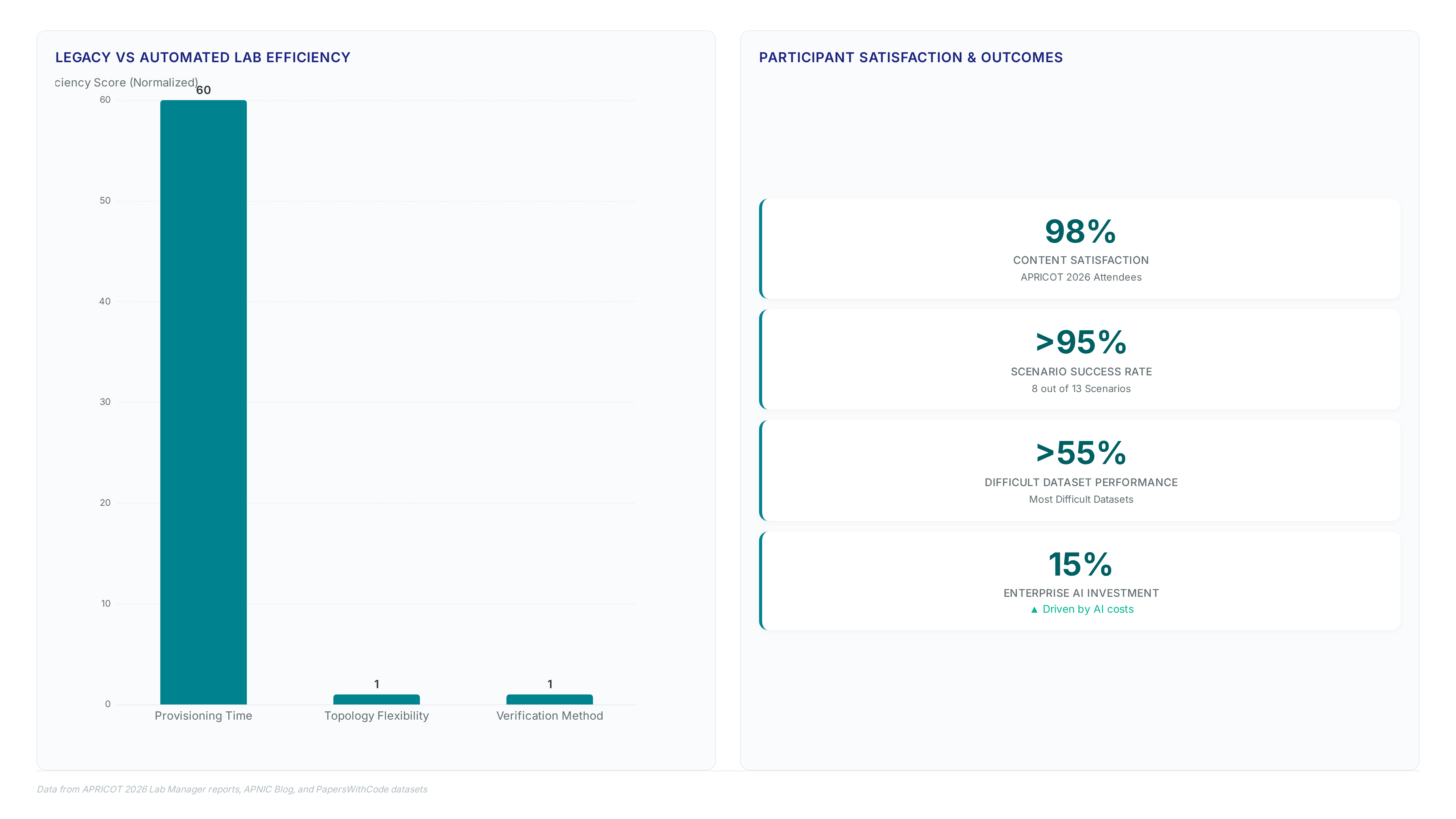
The Lab Manager tool at APRICOT 2026 provisions virtual topologies without manual device intervention. This system replaces traditional face-to-face workshops requiring physical hardware with a scalable cloud-based virtual labs architecture. The mechanism instantiates multiple VM instances on demand so trainers verify configurations programmatically rather than logging into individual nodes.
| Feature | Legacy Physical Labs | Automated Hybrid Model |
|---|---|---|
| Provisioning Time | Hours per session | Minutes via API |
| Topology Flexibility | Fixed cabling | Flexible software definition |
| Verification Method | Manual inspection | Automated status checks |
Hybrid deployment models permit any combination of transition mechanisms to fit specific environment constraints while adapting to existing network characteristics unlike rigid IPv6-only builds. A cost is maintaining synchronization between the automated provisioner and the underlying hypervisor state during high-concurrency exercises. Operations teams must treat the provisioning layer as a distinct control plane requiring its own monitoring and fallback procedures. This separation prevents a script error from corrupting the entire training delivery
Applying IPv6 Security Controls and Filtering in Operational Networks
One ISP attendee gained confidence to implement IPv6 in their core layer after the APRICOT 2026 Mechanisms like prefix filtering and maximum prefix limits block malformed announcements before they propagate. Evidence shows participants plan to apply this knowledge by improving security controls and implementing proper filtering mechanisms. Enforcing strict validation risks dropping legitimate traffic if ROA coverage remains incomplete.
| Prefix Filter | Blocks unauthorized ranges | Missed allocations |
|---|---|---|
| Max Prefix | Limits advertisement volume | Legitimate burst drops |
| ROV Reject | Drops invalid origins | Connectivity loss |
Network engineers must translate theoretical knowledge to router configuration to mitigate BGP hijacks. Networks accept all peer claims by default without active filtering. This passive stance leaves infrastructure exposed to route leaks and origin spoofing. Operators must move beyond generating ROAs to actively enforcing validation states on border routers. Tension exists between maintaining absolute uptime and enforcing security posture. Only active rejection policies close the vulnerability window exposed by current deployment statistics. Achieving this mix demands recruitment strategies extending past typical telecom channels to include facility managers and application owners. Organizations must prioritize project managers like Dhruv Dhody and Nalini Elkins who have previously led enterprise deployment projects to guide curriculum relevance. These leaders ensure training modules address specific business constraints rather than abstract protocol theory.
| Recruitment Target | Standard Approach | Required Adjustment |
|---|---|---|
| Enterprise Staff | Ignore or invite generically | Target facility operations leads |
| Curriculum Lead | Protocol expert only | Deploy ex-enterprise project managers |
| Lab Topology | ISP core focus | Include campus distribution layers |
Updating course content necessitates replacing legacy dual-stack examples with IPv6-first scenarios found in refreshed materials A constraint lies in instructor familiarity since many trainers lack recent experience with pure IPv6 production environments. InterLIR recommends auditing lab topologies so they reflect modern multi-vendor infrastructure rather than single-vendor simulators. Failure to diversify hardware exposure leaves graduates unprepared for heterogeneous real-world networks. Successful replication hinges on balancing theoretical depth with the operational reality of mixed vendor deployments.
About
Nikita Sinitsyn serves as a Customer Service Specialist at InterLIR, where his eight years of telecommunications experience directly inform the critical need for reliable IP infrastructure management. While the article highlights APNIC's advanced IPv6 deployment workshop at APRICOT 2026, Sinitsyn's daily work managing RIPE database operations and ensuring IP reputation provides a practical counterpart to these technical advancements. At InterLIR, a Berlin-based marketplace specializing in IPv4 resources, he navigates the complexities of address transfers and compliance, giving him unique insight into why modernizing networks through IPv6 is necessary for long-term scalability. His expertise in KYC procedures and spam control highlights the security challenges that proper protocol deployment addresses. By connecting hands-on customer support realities with high-level training initiatives, Sinitsyn illustrates how operational excellence in IP management supports the global transition toward next-generation internet standards.
Conclusion
Current workshop models fracture when scaling beyond pilot groups because they ignore the operational drag of mixed-stack maintenance. As inference workloads surge to dominate data center traffic by 2030, networks relying on legacy dual-stack training will face unmanageable latency overheads and complex debugging bottlenecks. The industry cannot afford to train engineers on abstract theory while production environments shift toward IPv6-native AI clusters. You must mandate a curriculum pivot immediately, requiring all new training modules to simulate pure IPv6 inference paths by the end of next quarter. This transition demands replacing generalist protocol instructors with facility operations leads who understand the specific thermal and power constraints of modern GPU racks.
Stop waiting for perfect vendor support before updating your labs. Start by auditing your current lab topology against multi-vendor inference scenarios this week. Identify every instance where legacy IPv4 simulation masks real-world packet loss or routing inefficiencies that will cripple future AI workloads. Replace at least one single-vendor simulator node with heterogeneous hardware that reflects actual campus distribution layers. This concrete step exposes gaps in your team's readiness before they impact critical production inference services. Prioritize hiring project managers with enterprise deployment history over pure academic theorists to ensure your training addresses business continuity rather than just protocol compliance.
Frequently Asked Questions
Over half the participants come from ISPs, telcos, and data centers. Specifically, 56% of the sixteen attendees represented these critical infrastructure operators during the recent APRICOT training event.
Ten new labs focusing specifically on IPv6 were delivered for the first time. These modules complement the fifteen total redesigned training labs that utilize new topologies and instructions.
Women made up a distinct minority of the group attending this technical session. The data shows that 19% of the participants were women, highlighting ongoing diversity gaps in network engineering roles.
Enterprises represented a significant segment of the professionals attending this specialized training. Exactly 31% of the participants came from enterprise backgrounds, seeking to modernize their internal network infrastructure.
A small fraction of the group represented vendors and solution providers. Specifically, 12% of the participants belonged to this category, while the majority were operational network staff.