IPv6 traffic jumps: How one binding fix hit 79%
A single application binding change lifted a SOHO network from 67% to 79.2% native IPv6 in just 16 days.
Passive dual-stack coexistence is dead. Real IPv6-first performance demands aggressive, data-driven remediation of specific application fallbacks, not broad infrastructure overhauls. Terry Sweetser's case study at APRICOT 2026 proves the remaining IPv4 floor isn't an unavoidable tax; it's a configurable inefficiency waiting to be sliced away.
NetFlow analysis exposes the hidden drag of protocols like BitTorrent, which often languish below 50% IPv6 adoption despite reliable network foundations. Quantifying the ROI from targeted binding shows how forcing specific services onto the IPv6 interface pushes local environments past the 80% deployment threshold recently mirrored by giants like Deutsche Telekom. With Google confirming global traffic crossed the 50% milestone in March 2026, treating IPv6 as optional is no longer an option.
The Role of Data-Driven Analysis in Modern IPv6 Deployment
Defining IPv6-first Networking via NetFlow Baselines
Stop treating IPv6-first as a binary switch. It's a measurable traffic ratio exceeding 67%. This metric separates active optimization from the passive dual-stack assumptions where legacy fallback dominates. NetFlow analysis visualizes the precise split between native IPv6 and IPv4 traffic across specific applications. The methodology relies on RouterOS producing flow records that an analyzer like Akvorado ingests for granular visibility. Operators identify residual IPv4 paths by filtering for high-volume services with low IPv6 ratios. BitTorrent often acts as a primary drag, operating at only 44% IPv6 due to default interface binding. Surgical exclusion of the IPv4 stack forces traffic onto the superior native path.
Dual-stack operations sustain a persistent IPv4 floor despite theoretical IPv6-only goals, often masking inefficient fallback paths. The assumption that enabling both protocols yields balanced traffic ignores how application defaults drive residual IPv4 usage. Empirical studies across diverse backbones confirm native IPv6 delivers comparable performance with only minor throughput reduction under load. Yet, without enforced binding, clients preferentially select IPv4 peers due to legacy tracker behaviors. This creates an asymmetric state where inbound connectivity remains IPv4-limited while outbound flows saturate the older stack.
| Metric | Dual-Stack Default | Enforced IPv6 Binding |
|---|---|---|
| Protocol Preference | Automatic (Often IPv4) | Explicit (IPv6 Only) |
| Peer Quality | Mixed/Legacy Heavy | High-Performance Native |
| Traffic Efficiency | Suboptimal NAT Traversal | Direct End-to-End |
| Operational Overhead | High (Debugging Fallback) | Low (Single Stack Logic) |
Eliminating IPv4 dependency requires surgical exclusion, not passive preference settings. Data indicates that targeting specific laggard applications yields a 448% increase in native flow volume alongside a 65% decrease in legacy traffic. Operators relying on standard dual-stack configurations miss this optimization because Happy Eyeballs prioritizes connectivity speed over protocol efficiency. The cost of inaction is measurable: unoptimized P2P traffic drags the entire network ratio down, preventing the realization of true IPv6-first architecture. Four Ring cameras were confirmed to be IPv4-only, contributing a constant stream of video upload traffic that no routing policy can eliminate. Major web services compound this constraint; Amazon.com and CloudFront distributions used by third parties lack AAAA records, forcing clients into IPv4 fallback regardless of local configuration. This creates a hard ceiling where dual-stack fallback becomes mandatory rather than optional for basic functionality.
| Constraint Category | Specific Failure Mode | Mitigation Viability |
|---|---|---|
| Legacy IoT Hardware | No IPv6 firmware support | Zero (Vendor lock-in) |
| Web Services | Missing AAAA records | Low (External dependency) |
| ISP Infrastructure | IPv4-only caching proxies | None (Upstream limitation) |
Operators attempting to exceed this floor encounter transition protocol specifications that introduce complexity without guaranteeing compatibility for these specific hardcoded endpoints. The limitation is structural: application binding fixes software clients, but cannot retrofit silicon designed exclusively for IPv4. Consequently, the remaining residual IPv4 traffic persists.
Default qBittorrent binding to 'Any' interface forces outbound IPv4 NAT traversal despite active IPv6 port forwarding. The client receives peer lists containing mixed protocol addresses, yet frequently initiates connections over IPv4 due to legacy tracker behaviors. This creates an asymmetric connectivity state where inbound IPv6 traffic flows freely while IPv4 remains strictly outbound-only. Such configuration ignores empirical data showing native IPv6 offers superior connectivity reliability with lower packet loss than IPv4 paths. Operators observing a 44.3% ratio often miss that the application simply defaults to the path of least resistance rather than optimal performance.
The Happy Eyeballs algorithm exacerbates this by preferring IPv4 if IPv6 handshakes exhibit even minor latency spikes. Comparative studies indicate IPv6 suffers only a modest throughput reduction of nearly half under load. Dual-stack environments consequently incur higher operational complexity without delivering proportional reliability gains when fallback logic remains un tuned.
| State Type | Inbound Capability | Outbound Path |
|---|---|---|
| Native IPv6 | Full | Direct |
| Fallback IPv4 | Blocked | NAT Translation |
Binding the network interface exclusively to IPv6 eliminates the suboptimal NAT path entirely. This surgical exclusion forces the client to discard IPv4 peer addresses that cannot establish bidirectional sessions. The resulting peer pool shifts toward high-performance seedboxes residing in well-connected data centers.
Aussie Broadband third-party caching proxies running Apache Traffic Server force IPv4 egress regardless of client dual-stack capability. This infrastructure intercepts requests for popular content and serves them from an internal IPv4-only cache, bypassing native IPv6 paths entirely. Such hidden dependencies create an invisible IPv4 floor that NetFlow analysis often misattributes to client misconfiguration rather than upstream interception. Operators attempting to fix IPv4-only IoT devices frequently overlook these ISP-level accelerators, which inject traffic before the customer edge router sees the initial request.
| Traffic Source | Protocol Enforcement | Visibility in NetFlow |
|---|---|---|
| Client Application | Configurable via binding | High (source IP matches LAN) |
| ISP Caching Proxy | Hard-coded IPv4 | Low ( |
| Legacy Web Service | DNS AAAA absence | Medium ( |
Even when local networks achieve high adoption rates, external caching layers reintroduce IPv4 fallback mechanisms transparently. Performance metrics suggest IPv6 paths often suffer higher latency in specific transit configurations, prompting ISPs to optimize for speed via IPv4 caches. This creates a tension where improving user experience locally degrades the overall protocol ratio globally. Without this distinction, efforts to eliminate the irreducible floor will fail against invisible external dependencies.
Measurable ROI from Targeted Application Binding and DNS Configuration
Asymmetric NAT States in Default qBittorrent Bindings
Default "Any" interface binding in qBittorrent forces outbound IPv4 NAT traversal despite active IPv6 port forwarding. The client receives mixed peer lists yet initiates connections over IPv4 due to legacy tracker behaviors and fallback behavior algorithms prioritizing established paths. Operators observing low ratios often miss that the application defaults to the path of least resistance rather than optimal performance. Empirical analysis of dual-stack sites confirms native IPv6 offers superior connectivity reliability.
The cost of this default configuration is measurable traffic inefficiency. Average IPv4 traffic stood at 1.08Mb while IPv6 lingered at 0.86Mb before intervention. Binding the application exclusively to the IPv6 interface surgically removed the ability to use the IPv4 stack. This action eliminated the suboptimal, outbound-only NAT path entirely.
Forcing IPv6-only binding shifts peer selection toward high-performance seedboxes in well-connected data centres. The limitation involves potential loss of peer diversity if the IPv6 swarm lacks sufficient seeders for rare content. Network operators must disable IPv4 in applications when the IPv4 path provides only outbound connectivity while inbound ports remain closed. This specific constraint defines the precise moment to enforce interface binding over dual-stack tolerance.
Binding the qBittorrent network interface to a specific IPv6 address eliminates the default "Any" setting that permits outbound-only IPv4 NAT traversal. This configuration change surgically removes the ability to initiate suboptimal connections via the gateway's Network Address Translation function, forcing the client to rely exclusively on native bidirectional connectivity. Without this explicit binding, the application accepts IPv4 peer addresses from trackers despite having a functional IPv6 port forward, creating an asymmetric connection state.
Operators must recognize that dual-stack environments inherently increase operational complexity by maintaining two active protocol stacks in end hosts and routers. The Happy Eyeballs algorithm often exacerbates this by selecting IPv4 paths when IPv6 latency appears marginally higher, even if the IPv4 path lacks inbound reachability. Removing the IPv4 stack from the application scope simplifies the network edge and prevents the client from falling back to blocked ports.
| Configuration State | Inbound Connectivity | Outbound Path |
|---|---|---|
| Default "Any" Interface | IPv6 Only | IPv4 NAT + IPv6 Native |
| Bound to IPv6 Interface | IPv6 Native | IPv6 Native Only |
The cost of this transition includes measurable engineering time required to validate that no essential services break under IPv6-only constraints. While some legacy peers remain unreachable without IPv4, the shift prioritizes connection quality over quantity by filtering out NAT-bound nodes. This approach ensures the application uses the full capacity of the delegated /48 prefix rather than hiding behind carrier-grade NAT. Operators must validate this shift against the 16-day project duration.
| Validation Metric | Pre-Intervention Baseline | Post-Intervention Target |
|---|---|---|
| Total IPv6 Throughput | 4.82Mbps | 7.08Mbps |
| Total IPv4 Throughput | 2.30Mbps | 1.86Mbps |
| Peak Activity Ratio | 90% | |
| Stability Window | N/A | 48 hours |
Application binding eliminates the asymmetric connection state where IPv4 remains outbound-only despite functional IPv6 port forwarding. However, the Happy Eyeballs algorithm forces fallback if IPv6 latency exceeds IPv4 thresholds, requiring performance parity to maintain the new baseline. This creates a tension between strict interface binding and user experience, as forced IPv6 paths may degrade performance if upstream peering is suboptimal. Operators should reject "IPv6-only" deployment plans until NetFlow confirms the IPv4 floor consists exclusively of external dependencies rather than local misconfiguration.
Migrating to High-Ratio IPv6 in Five Strategic Steps
SLAAC with RDNSS and Pure IPv6 DNS Infrastructure
The foundation relies on Router Advertisements containing RDNSS options to distribute IPv6-only resolver addresses via SLAAC.
- Configure the MikroTik gateway to emit RA messages that omit all IPv4 DNS server entries.
- Deploy Pi-hole alongside Unbound to handle recursive resolution strictly over the native IPv6 transport.
- Disable any local DHCPv4 services to prevent clients from caching legacy resolver configurations.
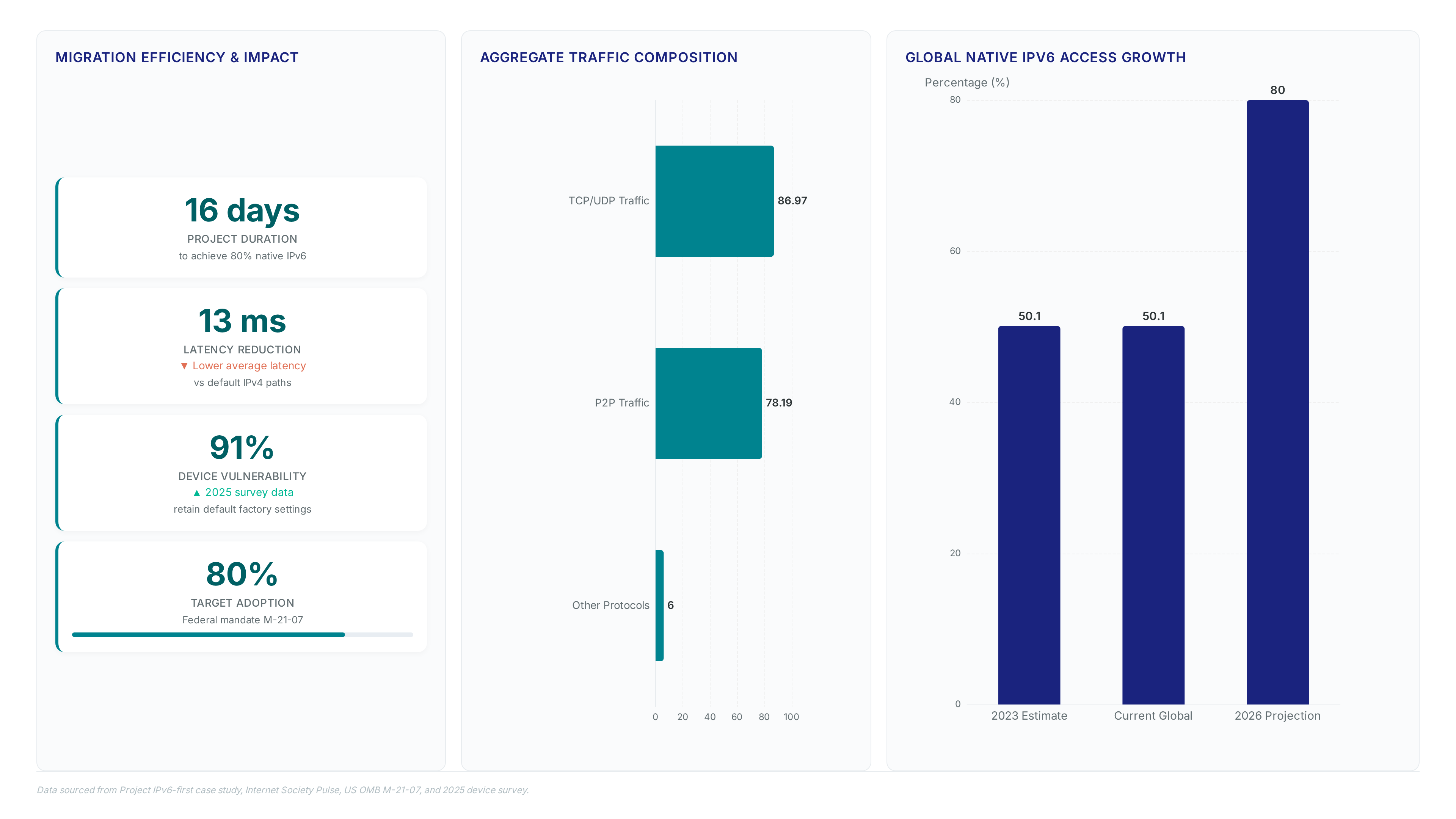
This architecture eliminates the dual-stack complexity that typically inflates operational costs for SOHO routers. A 2025 survey indicates 91% of such devices retain default factory settings, creating a massive attack surface for DNS spoofing attacks. Pure IPv6 DNS infrastructure removes the IPv4 fallback path entirely, forcing applications to fail fast rather than degrade silently. The trade-off involves strict firewall policies that must accept ICMPv6 while dropping unauthorized forward traffic to maintain stateful security without NAT66.
Operators ignoring this step often observe high latency because clients default to IPv4 paths that exhibit roughly 13ms higher average latency in certain transit scenarios. The resulting network enforces a clean separation where DNS resolution capability directly dictates IP version selection.
Configuring MikroTik rb5009 for NetFlow Export to Akvorado
Enable IP flow export on the MikroTik rb5009 by directing UDP port 2055 traffic to the local Akvorado.
- Define the collector target within the RouterOS IP accounting menu to establish the data stream.
- Activate flow generation on all bridge interfaces to capture both ingress and egress packets.
- Set the active flow timeout to 60 seconds for near real-time visibility into session states.
- Verify packet counters increment on the receiving server to confirm successful telemetry ingestion.
This configuration transforms the gateway into a telemetry source for the Project IPv6-first. Storage requirements remain minimal since SOHO environments generate only modest data growth over time. The NetFlow architecture reveals that a small subset of port numbers drives the majority of aggregate volume, focusing remediation efforts effectively. Operators must balance export frequency against CPU utilization, as aggressive timeouts increase processor load on the router. High-frequency sampling provides sharper data but risks dropping packets during peak throughput events on constrained silicon. This tension dictates that production deployments prioritize stability over granular second-by-second updates. The resulting dataset enables surgical exclusion of legacy protocols based on observed behavior rather than theoretical preferences.
Checklist for Isolating Slow Movers and Enforcing IPv6 Preferences
Filter NetFlow streams to isolate applications exhibiting the lowest IPv6 ratios and highest IPv4 bandwidth consumption.
- Query the Akvorado.
- Identify laggard services where traffic originates from a minority of port numbers yet dominates volume.
- Apply interface binding constraints on client software to surgically exclude legacy protocol stacks.
- Validate the shift by confirming total throughput metrics align with the target native ratio.
| Intervention Target | Default Behavior | Enforced State |
|---|---|---|
| P2P Client Interface | Any (Dual-Stack) | IPv6 Only |
| DNS Resolution | Mixed Fallback | Pure IPv6 |
| Firewall Policy | Permissive NAT | Stateful Drop |
Force specific daemons like qBittorrent to ignore IPv4 peer lists by binding the network interface explicitly. This configuration prevents the asymmetric connection state where outbound NAT masks inbound connectivity failures. InterLIR recommends documenting these exceptions rather than attempting futile translation fixes for every anomaly.
About
Vladislava Shadrina serves as a Customer Account Manager at InterLIR, where she specializes in managing client relations within the critical domain of IP resources. Although her background includes architecture, her daily work focuses on facilitating access to necessary network assets, making her uniquely qualified to discuss the complexities of SOHO network evolution. At InterLIR, a Berlin-based marketplace dedicated to solving network availability through IPv4 redistribution, Shadrina directly observes the industry's urgent shift toward IPv6 adoption. Her role involves guiding clients through resource constraints, providing a practical perspective on why initiatives like "Project IPv6-first" are vital for modern small office infrastructures. By connecting her frontline experience with IP resource management to the technical challenges of achieving native IPv6 connectivity, she bridges the gap between market realities and engineering solutions. This article uses her insights into how efficient resource allocation supports the broader goal of sustainable network growth and global connectivity.
Conclusion
Scaling this approach reveals that interface binding alone cannot sustain momentum if underlying IoT firmware ignores dual-stack preferences. The operational drag shifts from configuration to continuous monitoring, as unmanaged devices silently revert to IPv4 paths, eroding your hard-won ratios. You will face a persistent baseline of legacy traffic that no amount of router tuning can eliminate without replacing hardware. This reality demands a shift from hoping for automatic adoption to actively managing application-specific exceptions.
Commit to a strict six-month timeline where any service failing to maintain a 90% IPv6 ratio undergoes mandatory architectural review or replacement. Do not accept "mixed fallback" as a permanent state for critical infrastructure. Start by auditing your top five bandwidth-consuming applications this week to verify their specific interface bindings against your firewall logs. If a single daemon still resolves via mixed DNS or accepts IPv4 peer lists, force a stateful drop policy immediately rather than waiting for a future firmware update. This surgical enforcement creates the necessary pressure to retire legacy stacks, transforming your network from a passive conduit into an active driver of protocol evolution.
Frequently Asked Questions
BitTorrent often acts as the primary drag on network performance. It typically operates at only 44% IPv6 due to default interface binding behaviors that favor legacy fallback protocols.
Surgical exclusion of the IPv4 stack forces traffic onto the superior native path immediately. This targeted change yields a 448% increase in native flow volume alongside improved connection quality.
A single application binding change lifted the test network to a stable average quickly. The specific result was a 79.2% average native IPv6 ratio across the entire SOHO environment.
A hard floor of 20% IPv4 traffic frequently remains due to external constraints. Legacy IoT hardware often lacks IPv6 support, preventing total elimination of the older protocol.
Traffic originating from only 17% of port numbers constitutes the majority of aggregate flow. This makes port-level filtering essential for rapid diagnosis of protocol inefficiencies.