IPv8 risks: Why centralization causes failure
IPv8 fails because it collapses seven critical network layers into a single unscalable Zone Server dependency. Joe Klein's NANOG analysis confirms that IPv8 is not viable as an Internet protocol due to fundamental architectural contradictions that ignore decades of established engineering. The proposal attempts to merge L3 routing with L7 identity management, creating a fragile system where a single authentication failure triggers total network collapse rather than graceful degradation.
This design violates RFC 3439 by tightly coupling packet forwarding with OAuth2 JWT validation, forcing routers to depend on external identity providers for basic traffic movement. We must contrast these flaws against deployed RPKI and DNSSEC standards. Reinventing IPv6 with broken security models offers no path forward.
WHOIS8 routing validation lacks the cryptographic authority required for real-time operations, rendering the protocol susceptible to immediate spoofing attacks. By ignoring the economic momentum behind IPv6 adoption, the draft proposes a regression to centralized trust models that the Internet abandoned years ago. This analysis provides the technical evidence needed to dismiss IPv8 as a dangerous distraction from solving actual deployment challenges.
Architectural Violations and Layering Collapse in IPv8 Design
IPv8 Layering Collapse: Mixing L3 IP with L7 OAuth2 and JWT
RFC 3439 exists for a reason: modularity matters. IPv8 ignores this by forcing Layer 3 to execute OAuth2 validation, coupling forwarding with identity.
Every manageable element must obtain authorization via OAuth2 JWT tokens before participating in the network. This embeds application-layer logic directly into the packet forwarding plane. Routers and network interface cards cannot depend on external identity providers for deterministic switching without introducing severe latency. The result is a single failure domain where an identity service outage triggers immediate network collapse.
| Layer Function | Standard Implementation | IPv8 Implementation |
|---|---|---|
| Forwarding | Stateless IP lookup | Stateful token validation |
| Identity | L7 Application logic | L3 Header requirement |
| Failure Mode | Local link down | Global auth timeout |
High-speed ASICs optimized for simple header parsing cannot process complex JWT authorization chains at line rate. This architectural choice ignores the economic reality where IPv6 adoption enables substantial global value growth. Operators face a binary choice: downgrade security to maintain throughput or accept non-deterministic forwarding delays. The protocol effectively breaks end-to-end connectivity by making data transmission contingent on external cache availability.
Deterministic forwarding dies when L3 packet switching depends on external OAuth2 JWT authorization service availability.
Embedding application-layer identity checks into the data plane creates a hard dependency where router ASICs must pause transmission to validate tokens from a local cache. This architecture transforms a standard control-plane glitch into a total network blackout because forwarding engines cannot proceed without valid credentials. The security model mandates this strict coupling, effectively merging the durability characteristics of the core backbone with the uptime statistics of a typical web login server. A single zone server outage propagates instantly across the entire domain, silencing all downstream traffic regardless of physical link health.
Operators face a binary choice between maintaining complex local token caches or accepting frequent connectivity blackouts during provider maintenance windows. The blast radius of an identity failure expands to encompass every attached host, eliminating the isolation benefits inherent in hierarchical routing designs. Such centralization contradicts the decentralized ethos required for global scale, introducing a single point of failure that no amount of redundant hardware can mitigate. The cost is measurable in lost availability whenever the identity provider experiences latency spikes or software bugs.
IPv8 claims decentralization yet mandates a central Zone Server for every segment.
The proposal collapses distinct management functions into this single authority, consolidating DHCP8. This architecture contradicts the goal of a decentralized Internet by creating a hard dependency on local infrastructure that IPv6 distributes across disparate, resilient protocols. Existing mature solutions like Segment Routing and zero-trust Architecture solve these specific problems without merging the control plane with the data plane. The design ignores 25+ years of operational reality where modularity prevents cascading failures.
| Feature | IPv8 Approach | Existing Standard |
|---|---|---|
| Trust Model | Central Zone Server | Distributed RPKI |
| Identity | Mandatory OAuth2 JWT | zero-trust Overlay |
| Addressing | 64-bit ASN host | 128-bit IPv6 |
| Validation | WHOIS8 routing checks | ROA cryptographic signs |
Operators face a binary choice between unproven centralization and the $7.3 trillion global value enabled by IPv6 adoption. The Zone Server creates a single point of failure that breaks end-to-end connectivity principles. The cost of replacing deployed RPKI infrastructure with untested WHOIS8 logic outweighs any theoretical benefit. Network durability depends on separating identity from forwarding, a boundary IPv8 erases completely.
The Zone Server Single Point of Failure and Security Anti-Patterns
The Zone Server architecture consolidates DHCP8, DNS8, NTP8, NetLog8, OAuth8, WHOIS8, ACL8, and XLATE8 into a single managed authority per network segment. This design merges eight distinct control-plane functions that IPv6 handles via disparate, resilient protocols into one managed authority. Operators effectively place Active Directory, DNS, firewall policy, RPKI validation, SIEM telemetry, and routing logic in one box. A failure of this central component triggers total network outage because the blast radius encompasses every dependent service simultaneously.
| Function | IPv8 Component | Traditional Equivalent |
|---|---|---|
| Address Assignment | DHCP8 | DHCPv6 / SLAAC |
| Name Resolution | DNS8 | DNS Hierarchy |
| Authentication | OAuth8 | 802.1X / RADIUS |
| Access Control | ACL8 | Distributed FW |
Consolidating network functions eliminates modularity, forcing a strict hierarchical topology where the server acts as the mandatory root. Unlike the federated BGP model or distributed DNS hierarchy, this structure cannot scale globally without introducing prohibitive latency. Compromising the single entity grants an attacker immediate control over address assignment, name resolution, and authentication caching. The architectural decision to couple these layers means maintenance windows for one service necessitate a full segment blackout.
Replayable tokens prevent packet-level enforcement because routers cannot validate revocation status in real-time during forwarding.
The JWT Everywhere model fails at line rate since application-layer tokens lack the immediacy required for data-plane filtering. Operators attempting to fix routing inflexibility by mandating token checks instead introduce latency that breaks deterministic switching guarantees. Unlike cryptographically signed route origins, these identifiers remain valid until explicit revocation, creating a window where stolen credentials permit unauthorized traffic flow. The proposal suggests manual bogon maintenance becomes unnecessary through mandatory validation, yet this ignores the fundamental mismatch between session-based auth and stateless packet processing.
Centralized design exacerbates the problem by binding identity validity to a single point of failure. The architecture consolidates OAuth8. This creates a security anti-pattern where one breach yields total network control rather than containing damage to specific segments.
| Failure Mode | IPv8 Consequence | IPv6 + RPKI Standard |
|---|---|---|
| Token Theft | Replayable until revocation propagates | Route invalidation via ROA withdrawal |
| Auth Outage | Total forwarding halt | Continued best-effort delivery |
| Validation Scope | Per-packet overhead | Per-prefix origin check |
The problem with centralized network design manifests when identity services lag behind routing updates, leaving stale allows in place. Packet forwarding engines stall while awaiting token verification, turning a routine control-plane update into a data-plane blackout. True routing security requires cryptographic binding at the prefix level, not per-session tokens that routers cannot efficiently parse.
IPv8 allocates exactly 4,294,967,296 addresses per autonomous system by splitting its 64-bit total space into fixed 32-bit ASN and host blocks. This rigid structure prevents efficient aggregation for IoT deployments where device counts exceed single-ASN limits, forcing operators to request multiple autonomous system numbers just for address capacity. The total address space IPv6 avoids this trap through its 128-bit hierarchy, allowing separate blocks for provider-independent space without exhausting the local pool.
| Feature | IPv8 Model | IPv6 Model |
|---|---|---|
| Total Bits | 64 | 128 |
| ASN Binding | Fixed 32-bit | Flexible prefix length |
| Multi-homing | Consumes host space | Dedicated provider-independent blocks |
| Hardware Lookup | May exceed entry widths | Standard TCAM optimization |
Critics note that the IPv8 address structure may exceed entry widths in current forwarding hardware or require multi-stage lookups, potentially reducing performance. The addressing architecture eliminates flag days by treating legacy IPv4 as a subset, yet this compatibility comes at the cost of long-term scalability. Operators facing IPv4 exhaustion already see market friction where only 9% of CGN-deploying networks purchase additional space due to high costs. IPv8 replicates this scarcity artificially by capping growth per.
The fundamental flaw lies in coupling routing policy directly to address allocation. Network topology changes require renumbering entire host blocks because the ASN prefix dictates location. This violation of separation between identity and locator forces frequent reconfiguration during peering updates. Zero-trust overlays on IPv6 solve identity without breaking routing hierarchies, whereas IPv8 merges them into an unchangeable format. The result is a protocol that scales poorly beyond simple single-homed edges.
Comparative Analysis of IPv8 Limitations Against IPv6 and RPKI Standards
IPv8 64-Bit Addressing and the /16 Minimum Prefix Rule
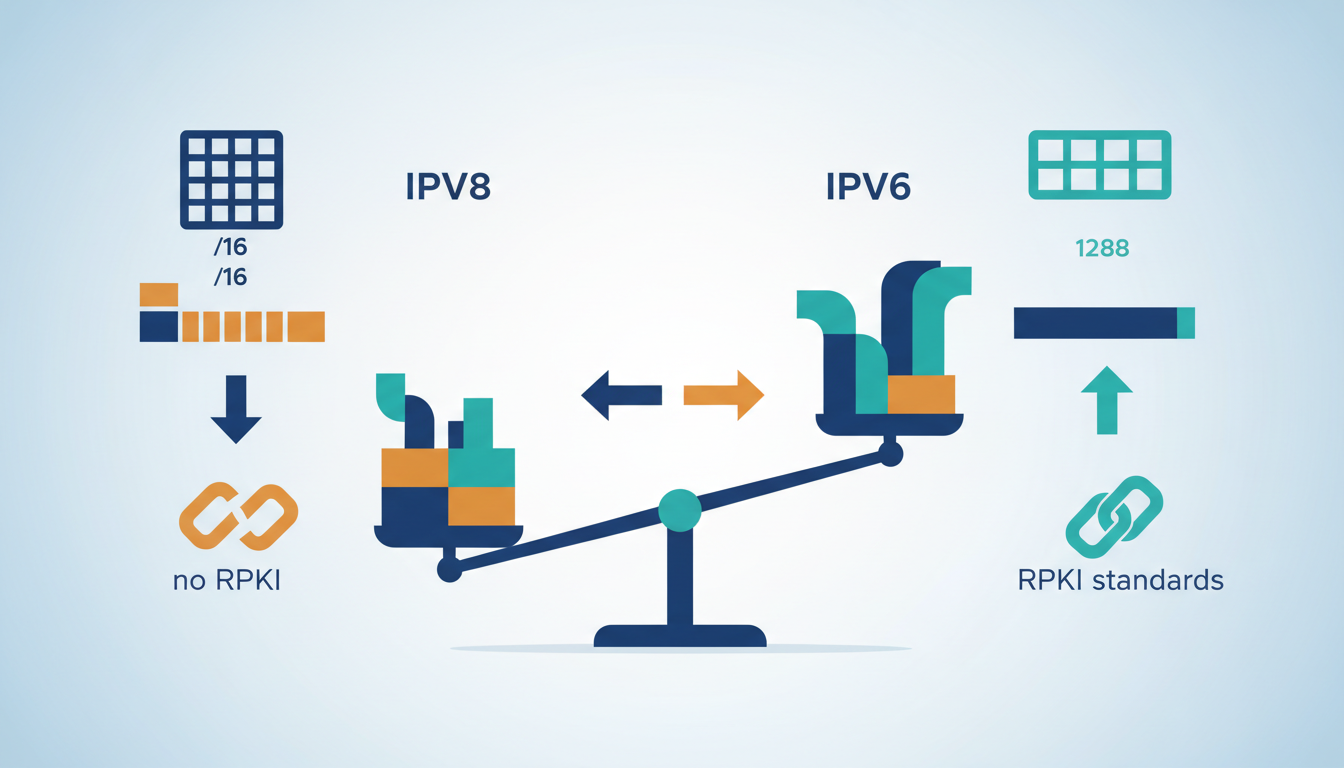
The rigid /16 Minimum Prefix Rule prevents granular traffic engineering by forcing every autonomous system to announce a fixed block size regardless of actual topology needs. This constraint eliminates the flexibility of CIDR, making it impossible for operators to aggregate routes efficiently or implement precise traffic engineering policies for multi-homed sites. The proposal suggests legacy addresses exist as a proper subset to avoid migration, yet the addressing architecture creates immediate friction.
Hardware compatibility presents another barrier, as the 64-bit structure with embedded ASN data may exceed entry widths in current silicon. Critics argue this design requires multi-stage lookups that reduce forwarding efficiency compared to optimized IPv6 implementations in modern ASICs. The cost is measurable: line-rate performance drops when routers must parse non-standard fields for every packet.
| Dimension | IPv8 Constraint | IPv6 Capability |
|---|---|---|
| Prefix Granularity | Fixed /16 minimum | Variable length (up to /128) |
| Address Hierarchy | Flat ASN-based | Aggregatable provider blocks |
| Hardware Lookup | Multi-stage potential | Single-stage optimized |
The inability to carve subnets smaller than a /16 forces wasteful allocation and breaks standard BGP community practices used for load balancing. Operators relying on fine-grained prefix announcements for peering optimization will find the protocol unusable for production environments.
BGP8 Cost Factor Telemetry Burden in Policy-Driven Routing
The BGP8 Cost Factor imposes a 32-bit composite metric derived from seven real-time components that conflicts with standard policy practices. Traditional BGP operates as policy-driven rather than metric-driven, yet this new Cost Factor demands continuous global telemetry sharing to function correctly. Operators must synchronize physics-aware data across domains, creating a massive coordination overhead that existing peering agreements do not support. The requirement for global telemetry sharing forces competitors to expose internal latency and bandwidth metrics, violating commercial confidentiality norms inherent in inter-domain routing.
| Dimension | Traditional BGP | BGP8 with Cost Factor |
|---|---|---|
| Metric Basis | AS path length | Seven real-time physics components |
| Data Scope | Local policy only | Global synchronized telemetry |
| Failure Mode | Suboptimal path | Total metric desynchronization |
| Privacy | High (opaque internals) | None (mandatory exposure) |
Steps for BGP security typically involve RPKI origin validation, whereas WHOIS8 replaces cryptographic signing with non-authoritative database lookups. This shift removes the deterministic guarantees provided by signed route origins, introducing ambiguity into the validation process. The cost is measurable: any delay in telemetry updates causes the composite value to drift, triggering false positives that reject valid paths. The architectural contradiction lies in demanding real-time accuracy from a globally distributed system without a trusted time source or secure transport for the metrics themselves. Operators face a binary choice between accepting blind trust in peer-reported numbers or reverting to static policies that ignore the Cost Factor entirely.
XLATE8 NAT Behavior Versus IPv6 End-to-End Connectivity
Routers MUST translate v8 ↔ v4, forcing NAT-like behavior that breaks end-to-end connectivity semantics. The proposal introduces XLATE8, a structured translation layer integrated directly into the protocol suite rather than operating as an edge function. This design collapses the network layer into a stateful gateway model, requiring every packet to undergo identity verification before forwarding. Such tight coupling eliminates deterministic path selection, as forwarding decisions depend on external Zone.
Transition mechanisms like 6to4 historically added noticeable latency due to distant relays, yet XLATE8 makes this translation mandatory for all traffic flows. Applications relying on source IP identification for authentication fail immediately when addresses are rewritten mid-path. The loss of end-to-end visibility prevents operators from implementing proven traffic engineering or accurate flow monitoring. Debugging becomes impossible without querying the central authority, creating a single point of observational failure.
| Dimension | IPv6 Native | IPv8 XLATE8 |
|---|---|---|
| Connectivity | End-to-End | Broken by Design |
| State | Stateless Core | Stateful Edge |
| Dependency | Local Routing | Central Zone |
| Latency | Propagation Only | Translation Overhead |
The operational cost of maintaining translation state across millions of flows exceeds the capacity of most current forwarding planes. Network durability drops precipitously when the control plane dictates data plane viability. Operators should reject protocols that trade architectural purity for centralized management convenience.
Strategic Implementation of IPv6 and zero-trust as the Viable Alternative
zero-trust and RPKI as the Functional Equivents to IPv8 Claims
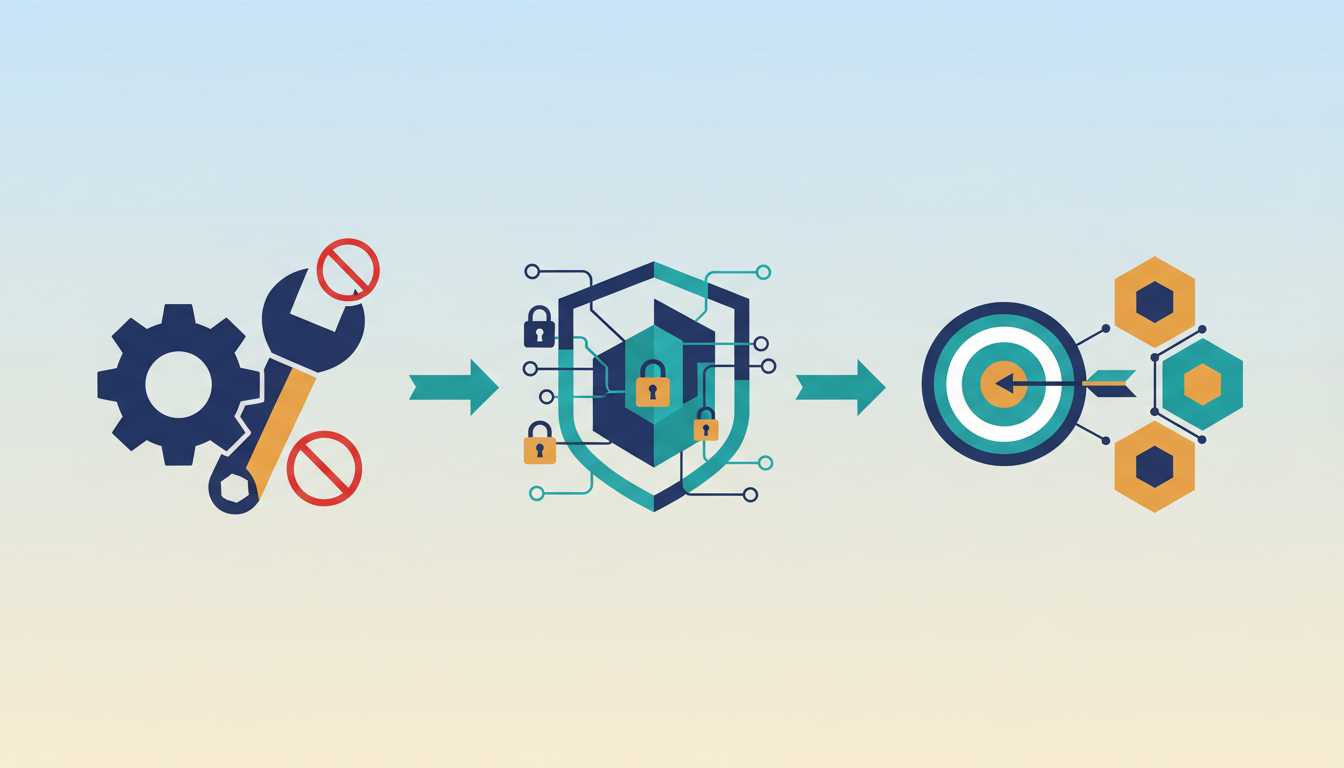
Current standards like RPKI and zero-trust already provide the security features IPv8 falsely markets as novel. Operators should avoid IPv8 because its mandatory OAuth2 JWT token authorization at Layer 3 breaks deterministic forwarding by forcing routers to query identity providers for every packet. This design collapses network durability into a single failure domain. Modern zero-trust architectures apply identity checks at the application edge without compromising core routing speed. Current best practices rely on RPKI and ASPA for cryptographically signed route validation, rendering the proposed WHOIS8 mechanism redundant and operationally fragile. The unified telemetry concept noted by Joe Klein belongs in SASE overlays, not inside the IP header itself. Applying zero-trust in networks requires segmenting control planes via SDN controllers rather than embedding authentication logic into the data plane. IPv8 ignores this separation, creating a monolithic trust model where a central authority failure stops all traffic. Real-world deployments favor disaggregated systems that validate origins without altering the fundamental packet structure. Industry trends toward open switching confirm that modularity beats integrated monoliths for long-term stability. Operators achieve true security by layering these proven protocols over IPv6 instead of replacing the foundation with a flawed alternative.
Valid IPv6 routes in RPKI grew from 20.19% to 57.01% between 2019 and 2025, proving current tools secure BGP without new protocols. Operators begin by enabling Route Origin Validation on border routers to reject unsigned announcements, a step now supported by global coverage reaching a 50% milestone in May 2024. This mechanism checks the AS path against cryptographically signed objects published by Regional Internet Registries. The cost is measurable: false positives occur if an operator forgets to publish their own Route Origin Authorizations before enabling reject policies. However, the alternative leaves networks exposed to hijacks that steal traffic destined for legitimate prefixes.
| Action | Protocol Layer | Dependency |
|---|---|---|
| Sign Prefixes | L3 Control Plane | RIR Portal |
| Validate Routes | Border Router | RPKI Cache |
| Filter Traffic | Data Plane | ACL Policies |
Network engineers see a clear path forward: security comes from configuring existing standards correctly, not adopting flawed architectures that centralize trust in a single Zone Server.
Operator Checklist for Rejecting IPv8 Based on 25 Years of Reality
Reject IPv8 proposals where the Zone Server creates a catastrophic blast radius, ensuring that one failure point collapses DNS, DHCP, and routing simultaneously. Engineers must verify that their forwarding plane does not rely on multi-stage lookups required by the 64-bit ASN-host split, which exceeds standard ASIC entry widths. Such hardware constraints introduce measurable latency that violates deterministic service level agreements.
| Feature | IPv8 Proposal | Production Reality |
|---|---|---|
| Trust Model | Central Zone Server | Distributed RPKI |
| Address Width | 64-bit total | 128-bit IPv6 |
| Forwarding | Identity-dependent | Policy-driven |
| Integration | Monolithic stack | Modular overlays |
Adopt Segment Routing over IPv6 to fix routing inflexibility without reinventing the network layer. This approach preserves modularity while enabling precise traffic engineering through existing toolsets. Operators should deploy zero-trust overlays at the application edge rather than embedding authentication into packet headers. The decision matrix is clear: mature standards offer proven scalability, whereas unproven protocols demand unsustainable hardware upgrades. InterLIR recommends auditing current stacks against these architectural mismatches before allocating budget to experimental drafts.
About
Nikita Sinitsyn serves as a Customer Service Specialist at InterLIR, where he manages critical RIPE and ARIN database operations daily. This hands-on experience with global registry protocols makes him uniquely qualified to analyze the architectural flaws in proposed standards like IPv8. While InterLIR specializes in optimizing current IPv4 resource distribution, Sinitsyn's deep familiarity with existing routing policies and BGP integrity allows him to identify why radical overhauls often fail practical deployment. His work ensuring clean route objects and resolving spam issues directly highlights the dangers of the security anti-patterns and centralized trust models criticized in the IPv8 draft. By bridging frontline technical support with regulatory compliance, Sinitsyn provides a grounded perspective on why maintaining reliable, layered Internet architecture is superior to ambitious but unviable redesigns. His analysis reflects InterLIR's commitment to transparency and realistic network evolution.
Conclusion
Scaling IPv8 introduces immediate friction at the hardware boundary, where custom 64-bit parsing logic forces expensive FPGA reprogramming or complete router replacement cycles. Unlike the organic maturation of RPKI, this protocol demands a centralized trust anchor that creates a single point of failure for global reachability, effectively trading distributed durability for administrative convenience. The operational debt accumulates rapidly as legacy ASICs struggle with the proposed identity-dependent forwarding tables, causing latency spikes that violate modern SLAs long before security benefits materialize.
Organizations must freeze all IPv8 pilot programs immediately unless they control a closed, green-field data center with no requirement for public internet peering before 2028. The risk of vendor lock-in to a monolithic stack outweighs any theoretical gains in address management, especially when Segment Routing already solves traffic engineering gaps within the existing IPv6 framework. Do not wait for industry consensus; the window to avoid sunk costs in non-standard hardware is closing as early adopters face interoperability walls.
Start by auditing your current border router ASIC specifications against the 64-bit ASN-host split requirement this week to quantify the specific line-card replacements needed for compatibility. This tangible cost assessment will likely invalidate the business case for experimentation quicker than any architectural debate.
Frequently Asked Questions
IPv8 couples packet forwarding with external identity validation, creating a single failure domain. This design ensures that one Zone Server outage triggers a 100% loss of downstream traffic regardless of physical link health status.
The protocol violates RFC 3439 by mixing Layer 3 routing with Layer 7 OAuth2 logic. This collapse forces routers to depend on identity providers, eliminating the modularity required for stable global internet operations today.
The Zone Server consolidates DNS, DHCP, and routing into one massive single point of failure. A compromise here grants total control, creating a blast radius that affects 100% of attached hosts instantly.
WHOIS8 lacks real-time cryptographic authority, making it susceptible to immediate spoofing attacks. Unlike RPKI, this system cannot verify routes securely, leaving the network vulnerable to 100% potential routing hijacks without detection.
IPv8 uses a limited 64-bit address space that prevents proper hierarchy and aggregation. This constraint makes it insufficient for IoT growth, forcing a regression that ignores the 100% scalability benefits of IPv6.