Peering costs revealed: The new $0.01 reality
Transferring 500 GB across Availability Zones now costs exactly $10.00. AWS finally isolated this specific line item in April 2025. The billing schema shifted from aggregated regional buckets to explicit `USE1-VpcPeering-In-Bytes` identifiers, exposing the true cost of multi-hop routing architectures.
We are moving beyond the free intra-AZ traffic model solidified in May 2021. The current reality is a $0.01 per GB levy on inter-zone flows. AWS Cost Explorer and Athena queries must now filter for specific charge type usage parameters to distinguish peering traffic from standard regional data movement. This separation allows architects to identify inefficient patterns that previously hid behind generic line items.
Workflows for monitoring these costs now rely on the updated AWS Billing console. Teams can audit their networks against the nominal fee per GB round-trip reality using the distinct `VpcPeering-Out-Bytes` metrics introduced in early 2025. Ignoring these specific usage codes in 2026 means willingly accepting inflated bills for traffic that stays within your own region.
The Evolution of VPC Peering Billing Transparency and Usage Definitions
Defining DataTransfer-Regional-Bytes and Legacy VpcPeering-In-Bytes
Before AWS introduced granular inter-AZ VPC Peering usage types in April 2025, DataTransfer-Regional-Bytes represented bundled intra-region traffic. This legacy metric obscured specific peering costs within broader data transfer charges, forcing operators to estimate expenses rather than track exact consumption. Prior to May 2021, bundled intra-regional data transfer usage created ambiguity regarding same-AZ traffic pricing across different accounts. The legacy VpcPeering-In-Bytes identifier now applies strictly to cross-AZ flows, separating them from general regional transfer.
Traffic remaining within a single Availability Zone incurs $0.00 charges. AWS solidified this policy to treat same-AZ-ID communication as regular intra-AZ traffic regardless of account ownership. Cross-AZ peering now generates distinct line items priced at $0.01 per GB in each direction. This separation addresses customer difficulty in understanding aggregated billing statements that previously hid peering-specific volume. Operators must update Athena CUR queries to filter for the new Region-Name-VpcPeering-In-Bytes schema instead of the generic regional descriptor. Round-trip costs of $0.02 per GB were previously hidden inside aggregate totals. Precise identification prevents budget shocks when monitoring current usage becomes mandatory for financial operations.
Locating VPC Peering Charges in AWS Billing Console Before and After April 2025
For pre-April 2025 bills, operators had to navigate the Data Transfer section to find regional peering costs obscured within aggregate bandwidth line items. Before the April 2025 shift, invoices listed charges under descriptions like "regional data transfer in/out/between EC2 AZs," forcing engineers to manually isolate peering traffic from general EC2 data flows. This bundling prevented precise cost attribution without complex Athena CUR queries filtering by operation type. Post-update, the Virtual Private Cloud section hosts dedicated line items such as "Amazon Virtual Private Cloud APS1-VpcPeering-In-Bytes," enabling direct visibility into inter-AZ consumption. The change reflects a broader industry push where providers increase billing transparency to resolve customer confusion over bundled usage metrics.
| Feature | Pre-April 2025 | Post-April 2025 |
|---|---|---|
| Console Section | Data Transfer | Virtual Private Cloud |
| Usage Type | DataTransfer-Regional-Bytes | Region-VpcPeering-In-Bytes |
| Service Code | AWSDataTransfer | AmazonVPC |
| Visibility | Bundled with EC2 traffic | Separated line item |
Legacy reporting required operators to assume peering volumes based on total regional egress, often leading to budget variances when inter-AZ VPC Peering usage spiked. Granular separation now allows finance teams to assign exact costs to specific VPC pairs without estimation. However, historical comparison remains difficult because the new usage types break continuity with prior month data structures. Operators analyzing year-over-year trends must normalize legacy DataTransfer-Regional-Bytes figures against the new explicit peering identifiers to avoid false variance alerts. This structural discontinuity demands updated dashboard logic for any automated cost monitoring tools relying on consistent usage type strings.
Internal Mechanics of AWS Cost Data Aggregation and Usage Type Classification
The April 2025 update replaces `USW2-DataTransfer-Regional-Bytes` with `USW2-VpcPeering-In-Bytes` to isolate peering costs. Legacy records previously mapped `IntraRegion` transfers to the `AWSDataTransfer` service code, burying specific traffic flows within aggregate regional data transfer line items. This schema shift forces `product_transfer_type` values to change from generic `IntraRegion` to explicit `Intra Region Peering Inbound` descriptors. Operators parsing old logs now face broken joins unless queries account for the new `AmazonVPC` product family.
| Field | Pre-April 2025 Value | Post-April 2025 Value |
|---|---|---|
| `line_item_usage_type` | `USW2-DataTransfer-Regional-Bytes` | `USW2-VpcPeering-In-Bytes` |
| `product_transfer_type` | `IntraRegion` | `Intra Region Peering Inbound` |
| `product_product_family` | `Data Transfer` | `VPC Peering` |
| `product_servicecode` | `AWSDataTransfer` | `AmazonVPC` |
Athena scripts filtering strictly on `Data Transfer` families now return zero rows for current peering traffic. The separation resolves historical ambiguity where bundled intra-regional data obscured account-specific consumption patterns. Failure to adjust filters results in complete visibility loss for inter-VPC flows. This structural change mandates a dual-query strategy during the transition period.
Querying Legacy CUR Exports for Pre-April 2025 IntraRegion Charges
Direct SQL filtering against `product_transfer_type` equals IntraRegion isolates buried peering costs in legacy datasets. The AWS Legacy CUR artifact retains these records under the AWSDataTransfer service code rather than a dedicated VPC family.
Manual verification requires filtering for Amazon Virtual Private Cloud descriptions matching the `APS1-` region prefix to confirm correct classification. Operators must reject legacy bandwidth text in favor of these specific identifiers to avoid misattributing inter-AZ costs.
- Access the Bills section and expand the Virtual Private Cloud category.
- Isolate line items containing `VpcPeering` usage types rather than generic regional transfer labels.
- Cross-reference descriptions against billing transparency.
- Validate that no `DataTransfer-Regional-Bytes` entries remain for peering flows after the April 2025 cutoff.
Missing VPC peering charges in reports often stem from failing to switch views from the legacy `AWSDataTransfer` service code to the new `AmazonVPC` family. This schema shift supports simplify Amazon VPC peering billing. A common oversight involves ignoring the new `Intra Region Peering Inbound` transfer type, leading to under-reported expenses.
Defining Usage Type Filters for VPC Peering In and Out Bytes
Cost Explorer filters must target `USE1-VpcPeering-In-Bytes` and `USE1-VpcPeering-Out-Bytes` to isolate intra-region flows introduced in April 2025. Legacy queries relying on `DataTransfer-Regional-Bytes` now return incomplete datasets because AWS separated these charges to improve cost visibility. Operators configuring Usage type groups see distinct line items for `Region-Name-VpcPeering-In/Out-Bytes` that did not exist in previous billing cycles. This schema shift enables precise attribution but breaks historical trend analysis unless engineers map old aggregate values to new specific identifiers manually. The new usage.
| Filter Scope | Pre-2025 Usage String | Post-2025 Usage String |
|---|---|---|
| Inbound Traffic | `DataTransfer-Regional-Bytes` | `USE1-VpcPeering-In-Bytes` |
| Outbound Traffic | `DataTransfer-Regional-Bytes` | `USE1-VpcPeering-Out-Bytes` |
Monitoring these newly set metrics is critical. A failure to update Athena queries results in zero-valued reports for current months while legacy data remains accessible under old codes. The limitation is operational friction: teams maintaining dashboards must dual-track both usage strings during the migration window to ensure continuity. Ignoring this split risks underestimating active peering costs by excluding the dedicated VPC family entirely.
Configuring Cost Explorer Views with Monthly Granularity and Region Filters
Setting the Date range from 2025-03-01 to 2025-04-30 with Monthly granularity captures the exact schema transition for VPC peering line items. Operators must select Standard time type and group by Usage type to separate legacy aggregate charges from new specific identifiers. Filtering the Region to US East (N. Virginia) isolates geographic variance while targeting usage strings containing `VpcPeering-In-Bytes`. This configuration reveals how inter-AZ VPC Peering usage behaves. Saving this view as a custom report prevents manual reconfiguration during monthly audits.
The limitation of this visual approach is the inability to join historical `DataTransfer-Regional-Bytes` with new `AmazonVPC` service codes without external mapping. Teams relying solely on the console miss the architectural context provided by manual route table updates that drive these specific charges. Unlike peering, centralized routing via Transit Gateway alters the cost attribution model entirely, making direct comparison difficult without normalized datasets. Operators observing high costs should verify if traffic patterns match the Cross-Account Peering requirements. Failure to apply these specific filters results in inflated budget forecasts due to unseparated regional noise.
Athena queries targeting `product_servicecode` values must shift from AWSDataTransfer to AmazonVPC to capture post-April 2025 line items accurately. Legacy schemas recorded `line_item_usage_type` as `USW2-DataTransfer-Regional-Bytes` with a `product_transfer_type` of `IntraRegion`, masking specific peering flows within aggregate data transfer buckets. The April 2025 update introduced dedicated line items. Operators relying on old filters now miss charges because the `product_product_family` attribute no longer equals `Data Transfer` for these specific flows.
Cost Explorer remains viable for high-level trend analysis, yet Athena provides the necessary schema flexibility to join these new attributes with resource tags for granular attribution. This separation supports broader billing transparency. The limitation is measurable: scripts filtering strictly for `AWSDataTransfer` return zero rows for current peering traffic, creating blind spots in cost allocation reports. Failure to update `WHERE` clauses results in significant underreporting of inter-AZ peering costs.
Strategic Cost Optimization Through Comparative Analysis of AWS Networking Services
AWS Transit Gateway Hourly Attachment Fees Versus VPC Peering Data Rates
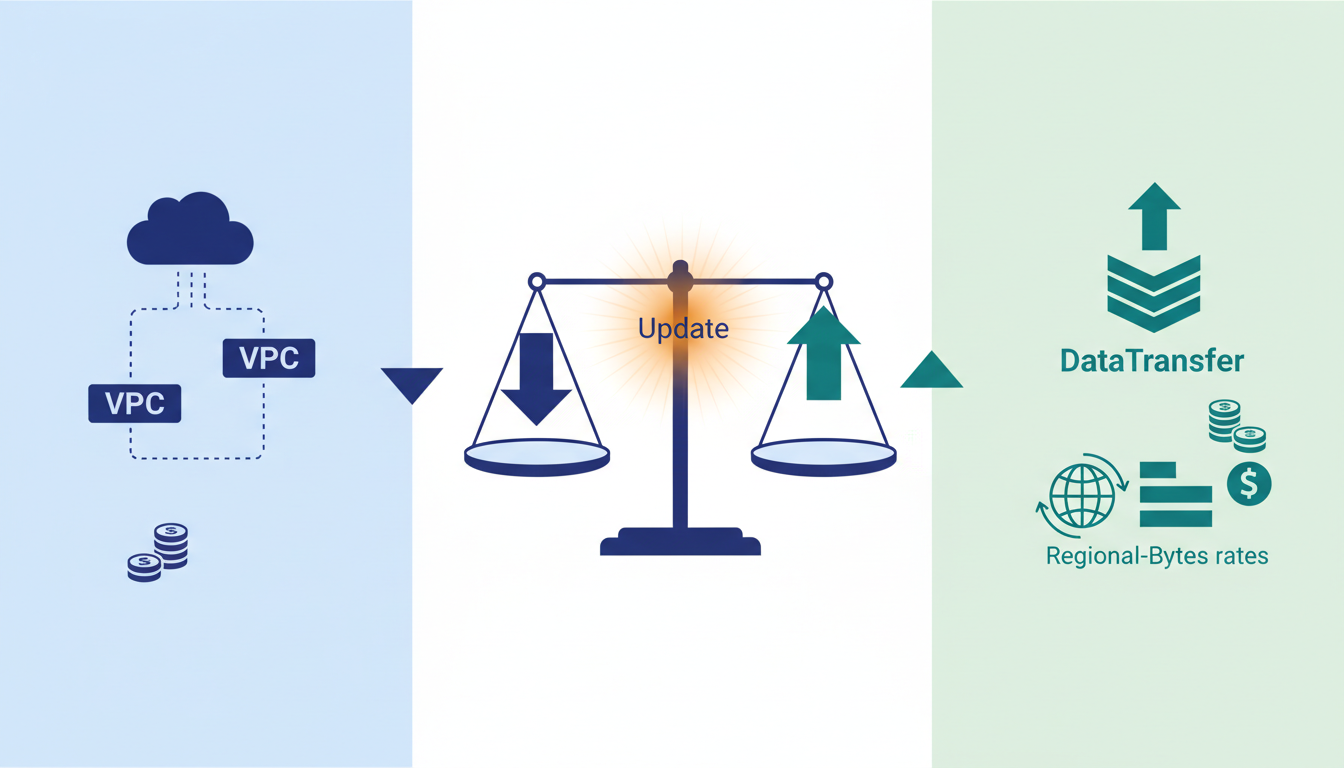
Transit Gateway imposes an hourly attachment cost per VPC alongside data processing fees, contrasting sharply with the pure per-GB model of VPC peering. This fixed overhead creates a financial breakpoint where simple peering remains dramatically cheaper for architectures connecting only two to five VPCs. Operators must calculate total expenditure by summing the recurring hourly charge against variable traffic volume, as Transit Gateway is designed for interconnecting hundreds of VPCs rather than minimal setups. The hourly fee accumulates continuously regardless of packet flow, whereas peering charges trigger only during active cross-AZ transmission. Scaling Transit Gateway for trivial topologies inflates bills without providing proportional routing benefits. High-volume bulk transfers suffer most under this dual-charge structure compared to the flat per-gigabyte rate of direct peering links.
Cost Scenarios for High-Volume Bulk Data Transfer Using AWS PrivateLink
AWS PrivateLink imposes a $0.05/hour endpoint fee that renders it economical only for specific low-volume use cases, not bulk data replication. The hourly attachment cost accumulates continuously across Availability Zones, creating a fixed overhead absent in pure volume-based models. This dual-charge structure suits low-volume service sharing but penalizes high-throughput workflows where peering offers superior marginal costs. Peering remains the dominant choice for bulk transfers because it eliminates hourly rents entirely. High-volume scenarios demand architectures that decouple time-based charges from data velocity. Both providers bill symmetric rates for regional data movement, but AWS imposes charges on every byte crossing Availability Zone boundaries without exception. Google Cloud Platform typically bundles higher free egress limits. This structural difference means identical architectures yield different invoices depending on read-write ratios and service placement. The lack of bundled free tiers in AWS penalizes chatty microservices architectures that generate substantial return traffic. InterLIR recommends auditing Availability Zone affinity before deployment since architectural localization eliminates these variable costs entirely. Failure to align compute and storage within a single zone renders base rate comparisons irrelevant as optimal design avoids the charge altogether.
About
Vladislava Shadrina serves as a Customer Account Manager at InterLIR, where she specializes in client relations within the IP resources domain. Her daily work involves guiding customers through complex networking challenges, making her uniquely qualified to explain the nuances of Amazon VPC peering charges. While InterLIR primarily focuses on IPv4 address redistribution, Shadrina's role requires a deep understanding of how IP infrastructure impacts overall network architecture and cost efficiency. She regularly assists clients in optimizing their cloud setups, ensuring that data transfer strategies align with budgetary constraints. This article connects her practical experience in networking support to the specific financial implications of cross-AZ and cross-region traffic. By using her background in customer service and technical communication, Shadrina clarifies how organizations can navigate AWS billing policies effectively. Her insights bridge the gap between raw IP resource management and the broader operational realities of maintaining cost-effective, private cloud connections in a multi-account environment.
Conclusion
Scaling VPC peering without strict topology governance triggers a hidden operational tax where manual route engineering becomes unsustainable. The real breaking point occurs when teams treat cross-AZ traffic as an inevitable utility cost rather than an architectural flaw. Relying on reactive billing alerts instead of proactive design guarantees that transfer fees will outpace compute spend within eighteen months. You must mandate single-AZ colocation for all high-throughput data pipelines immediately, reserving cross-zone peering strictly for failover scenarios. This shift reduces variable costs to zero for primary workloads and forces engineers to confront latency trade-offs early. Do not wait for the next quarterly review to address this; the financial bleed starts with the first gigabyte. Start by auditing your top five data-heavy subnets this week to verify their Availability Zone alignment against their primary data sources. If any critical path crosses zone boundaries without a documented disaster recovery requirement, refactor the placement before the next billing cycle closes.
Frequently Asked Questions
Traffic staying within a single Availability Zone incurs absolutely no costs for users. This policy solidified in May 2021 ensures same-AZ communication remains free at $0.00 regardless of account ownership.
Cross-Availability Zone data transfer generates distinct line items priced at $0.01 per GB. This charge applies in each direction, creating a total round-trip penalty of $0.02 for full communication cycles.
Transferring 500 GB across Availability Zones now costs exactly $10.00 under the new billing schema. This specific line item was isolated in April 2025 to expose true multi-hop routing expenses.
There is no charge to create a VPC peering connection itself for any user. Costs are incurred solely based on data transfer volume and the specific path taken between zones.
Post-April 2025, dedicated line items now appear in the Virtual Private Cloud section instead of Data Transfer. This shift separates peering traffic from generic regional data movement for clearer visibility.