Quantum threats mean 2029 is the new deadline
The math has changed. P-256 breaking now requires only 10,000 qubits per Oratomic. That single number collapses the migration window we thought we had. "Harvest now, decrypt later" is no longer a theoretical risk discussed in whitepapers; it is an active operation running against your network right now.
Cloudflare isn't waiting. They accelerated their roadmap to hit full post-quantum security by 2029, a pace that shadows Google's internal sprint but still trails the NSA's 2030 mandate for national security systems. (Cloudflare announces first quarter 2026 financial results) Here is the disconnect: while Cloudflare reports that over 65% of human traffic is currently post-quantum encrypted, the rest of the internet is lagging dangerously. Only 6% of 186 million SSH servers utilized quantum-safe encryption as of October 2024. Adversaries are harvesting that remaining 94% today, banking on the fact that you won't rotate keys before their machines wake up on Q-Day.
We need to stop treating this as a future compliance problem. Recent quantum hardware breakthroughs are eroding elliptic curve cryptography faster than the standards bodies can publish updates. The strategy for 2026 must shift: hybrid approaches combining classical and post-quantum algorithms are no longer optional experiments-they are the only viable defense for enterprise implementations.
Defining Q-Day and the Harvest-Now-Decrypt-Later Threat Vector
Q-Day Definition and Cryptographically The Quantum Computers
Q-Day is the moment cryptographically the quantum computers break the cryptography protecting your data and access. When that switch flips, the harvest now, decrypt later threat vector turns stored communications into open books. This isn't happening on a single front. It is a convergence of quantum hardware scaling, error correction breakthroughs, and optimized quantum software.
Hardware scalability is the wild card. Neutral atom machines are demonstrating superior efficiency over superconducting qubits, changing the physics of the race. While error correction overhead typically demands around 10,000 physical qubits per logical qubit, reconfigurable designs are slashing that ratio. The old models of "decades away" assumed static hardware constraints. Those assumptions are dead.
Harvest-Now-Decrypt-Later Mechanics and Legacy System Vulnerabilities
Adversaries do not need a quantum computer today to compromise your secrets. Harvest-now-decrypt-later attacks involve storing encrypted traffic now for future decryption once cryptographically the quantum computers exist. State-level actors exploit the latency between data capture and cryptographic obsolescence. If you are using elliptic-curve cryptography, you are already exposed because P-256 breaking algorithms now require shockingly low qubit counts.
The numbers are stark. Only 6% of global SSH servers were quantum-safe in Oct 2024. The vast majority of remote access channels are vulnerable to retroactive compromise. Fixing this is expensive. Complex enterprise cybersecurity infrastructures supporting real-time detection can cost between $400,000 and a substantial sum, with full ecosystems reaching $2,000,000+. Yet, the cost of inaction is total loss of confidentiality. Hybrid approaches combining classical and post-quantum algorithms are predicted to dominate enterprise implementations in 2026 to mitigate these specific risks. You cannot wait for a perfect replacement. State-level actors are not waiting.
Neutral Atom Qubit Efficiency and Logical Qubit Ratios
Hardware viability comes down to error correction efficiency. Superconducting systems need roughly 10,000 physical qubits per logical unit. That is a massive barrier. Neutral atom architectures reduce this overhead drastically to just 3-4 physical qubits for the same logical output. This disparity fundamentally alters the timeline for achieving cryptographically the scale.
Superconducting approaches suffer from noise constraints that demand massive redundancy for fault tolerance. Reconfigurable qubit connectivity enables superior code performance without exponential hardware scaling. Operators ignoring this efficiency gap face delayed migration windows against state-level actors. Hybrid implementations combining classical and post-quantum algorithms dominate early enterprise implementations to mitigate risk during transition. The catch? Neutral atom control systems require distinct operational expertise not yet widespread in data centers.
Oratomic demonstrated that breaking P-256 encryption requires only 10,000 physical qubits using neutral atom architecture. This efficiency stems from reconfigurable connectivity, which enables superior error-correcting codes compared to fixed neighbor models. Superconducting systems typically demand 10,000 physical units per logical qubit, creating a massive scaling barrier for large-scale cryptanalysis. Neutral atoms reduce this ratio to merely 3-4 physical qubits, drastically lowering the hardware threshold for Q-Day.
This forces a hard pivot: operators must prioritize inventory of vulnerable algorithms immediately rather than waiting for hardware maturity. Hybrid approaches combining classical and post-quantum methods double overhead, yet this cost remains necessary during migration. The limitation of neutral atom dominance is the sudden collapse of safety margins; previous estimates assuming high qubit counts are now obsolete. Network engineers must treat the 10,000-qubit figure as an imminent capability rather than a theoretical distant future. Accelerated timelines from bodies like the NCSC reflect this tightened window for defensive upgrades.
Cloudflare targets full post-quantum security by 2029, prioritizing authentication upgrades over existing encryption layers. Over 65% of human traffic now uses post-quantum encryption, yet identity verification remains the critical gap for preventing unauthorized access during Q-Day. Quantum-secure authentication validates user identity using algorithms resistant to quantum decryption, distinct from PQ encryption which only protects data confidentiality in transit. The distinction matters because harvesting encrypted sessions provides no value if the attacker cannot spoof the identity required to initiate new sessions.
Hybrid deployment models combine classical ECDSA signatures with post-quantum digital signatures to maintain compatibility during migration, though this approach doubles cryptographic overhead on edge servers. Google's internal deadline shift to 2029 validates the urgency, signaling that algorithmic breakthroughs have compressed the safe migration window notably. Operators must execute high-priority upgrades between 2028 and 2031 per the NCSC roadmap to avoid compliance failures.
The limitation of current implementations is the lack of standardized post-quantum certificates for widespread identity proofing. Delaying authentication upgrades while focusing solely on encryption leaves networks exposed to identity spoofing attacks even if data remains temporarily secure.
Google shifted its internal migration timeline. The NSA enforces a strict 2030 compliance deadline for national security systems, lagging behind private sector urgency. This divergence forces operators to choose between early adoption risks or waiting for standardized government guidance. Private entities prioritize neutral atom efficiency to mitigate immediate algorithmic breakthroughs. Superconducting architectures remain burdened by high physical qubit overheads that delay practical deployment. Balancing rapid commercial innovation against the stability of federal certification processes is the real challenge. Operators adopting Google's aggressive schedule face untested interoperability with legacy infrastructure. Those waiting for the 2030 window risk exposure to harvest-now/decrypt-later attacks during the interim. The cost of delay exceeds the expense of premature migration for high-value data assets.
Delaying action until the federal deadline ignores the accelerated hardware progress in neutral atom systems. The one-year difference represents a critical window where unprotected authentication signals become vulnerable. Network engineers must treat the 2029 date as the proven hard stop for legacy protocols. Waiting for perfect standards guarantees failure against adversaries using current qubit efficiency gains.
Strategic Migration Steps for Quantum-Safe Authentication and Encryption
Why Authentication Takes Priority Over Encryption for Q-Day
Broken authentication allows adversaries to impersonate servers or forge credentials before Q-Day arrives. Historical defense strategies focused on PQ encryption to stop harvest-now/decrypt-later attacks, yet an imminent timeline shifts priority to identity integrity. This transition requires operators to validate live 4G/5G infrastructure performance while upgrading signature schemes. Google moved its internal migration timeline.
- Replace static keys with quantum-secure authentication tokens immediately.
- Deploy hybrid encryption stacks across all edge nodes.
- Automate certificate rotation to prevent manual.
The cost of delaying identity upgrades exceeds the risk of encrypted data harvesting. Operators ignoring this shift face total system compromise once logical qubit thresholds drop.
Cloudflare One enabled SAML assertion encryption in June 2026, using managed certificates for automatic lifecycle management. This implementation shifts the operational burden from manual key rotation to automated policy enforcement within Access identity provider integrations. Operators must configure the identity provider to trust the Cloudflare-managed public key while ensuring the private key remains isolated within the zero-trust edge.
- Enable SAML assertion encryption within the Cloudflare One dashboard for the specific Access application.
- Upload the identity provider's public certificate to encrypt assertions before transmission.
- Verify that the automatic lifecycle management system rotates signing certificates before expiration windows close.
Procurement contracts must mandate post-quantum algorithm support by 2028 to align with the UK's NCSC roadmap for high-priority upgrades. Operators cannot rely on vendor promises alone; specific configuration flags for hybrid key exchange require validation during the sourcing phase. The cost of delay exceeds the price of early adoption, as adversaries currently harvest traffic for future decryption.
- Require vendors to demonstrate automated certificate issuance compatible with lattice-based signatures before contract signature.
- Assess critical supply chain partners against the 2029 deadline rather than waiting for federal mandates.
- Enforce software update clauses that guarantee patches for quantum-vulnerable authentication within 48 hours of disclosure.
- Verify that identity providers support SAML assertion encryption to prevent credential forgery during transitional periods.
| Assessment Criteria | Immediate Action | Compliance Target |
|---|---|---|
| Algorithm Support | Enable hybrid mode | Full PQC by 2029 |
| Certificate Lifecycle | Automate rotation | Zero manual intervention |
| Vendor SLA | 48-hour patch window | Real-time mitigation |
| Identity Protocol | SAML encryption | Quantum-safe tokens |
Org/html/2503.12952v1) trials as the baseline for performance expectations during migration. Organizations ignoring these steps face total identity compromise once cryptographically the quantum computers emerge. The window for strategic vendor negotiation closes as industry standards solidify around 2026 implementations.
Critical Decision Frameworks for Accelerating Post-Quantum Adoption Timelines
Defining the 2029 Post-Quantum Security Target Scope
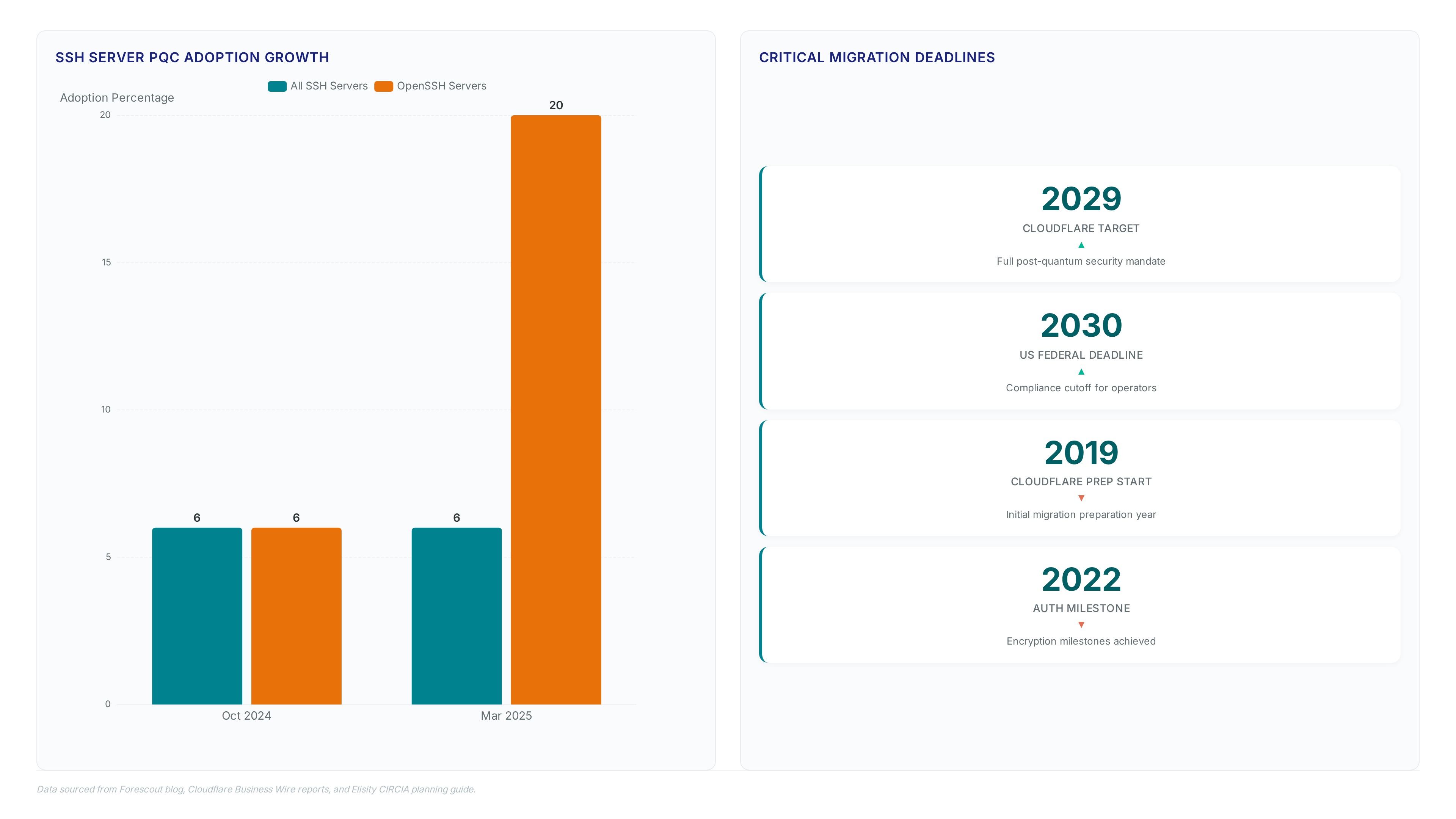
Full post-quantum security by 2029 mandates authentication upgrades alongside the encryption milestones achieved in 2022. Cloudflare began preparing for this migration in 2019, yet recent algorithmic breakthroughs force a distinction between protecting data at rest and verifying identity in real-time. The definition of "secure" shifts when adversaries can forge credentials before Q-Day arrives.
Google accelerated its internal migration timeline. This pace exceeds the 2030 compliance deadline. Operators face a gap where encryption is default but authentication remains classical. The limitation is that hybrid key exchanges do not validate the peer without post-quantum signatures. Procurement must require hybrid key exchange support and automated certificate issuance immediately.
Google moved its internal migration ahead of the US federal government to mitigate these exact timing risks. Delaying action forces organizations into a reactive posture where credential forgery becomes possible before defensive measures deploy. The cost of waiting exceeds early adoption because adversaries actively store encrypted sessions for future key extraction. InterLIR recommends assessing critical vendors immediately rather than awaiting regulatory pressure.
- Mandate hybrid key exchange support in all new procurement contracts before 2028.
- Validate vendor roadmaps against the accelerated 2029 industry standard.
- Automate certificate lifecycles to handle rapid algorithm transitions without manual intervention.
- Prioritize authentication upgrades over pure encryption defenses to stop impersonation attacks.
The operational burden of late migration involves emergency patching under active exploit conditions. Early movers avoid the resource contention that plagues networks scrambling to meet the 2030 cutoff.
About
Alexei Krylov serves as the Head of Sales at InterLIR, a specialized marketplace for IPv4 resources based in Berlin. While his primary expertise lies in B2B sales and managing relationships with Regional Internet Registries, his background in cybersecurity and IT consulting provides a unique vantage point on emerging network threats like post-quantum cryptography. At InterLIR, Krylov daily navigates the complexities of IP reputation and secure BGP routing, understanding that the integrity of digital assets relies heavily on reliable encryption standards. As the industry accelerates toward 2029 for full post-quantum readiness, Krylov connects these high-level cryptographic shifts to the practical reality of securing valuable IPv4 addresses. His experience ensures that discussions around migration timelines are grounded in the operational needs of businesses protecting their critical network infrastructure against future quantum vulnerabilities.
Conclusion
Manual oversight of certificate lifecycle management will fail during rapid algorithm transitions. As you layer new protocols over legacy stacks, the operational drag of maintaining dual-key infrastructures will spike support costs beyond initial budget projections. The bottleneck is not mathematical complexity; it is the sheer volume of endpoints requiring simultaneous updates without service interruption. Treat this as an immediate infrastructure overhaul, not a compliance checkbox.
Commit to a hybrid deployment strategy by Q3 2026, specifically targeting high-value identity providers before expanding to general data channels. This timeline ensures you neutralize "harvest now" threats before adversaries refine their storage capabilities. Do not wait for finalized NIST standards to solidify; the window for proactive integration closes as vendor roadmaps lock in next year.
Start by auditing your certificate authority inventory this week to identify every static key pair with a validity period extending past 2029. Tag these assets for immediate rotation planning and demand written PQC migration schedules from your top five security vendors within ten business days. This specific audit creates the visibility required to prevent credential forgery during the transition phase.
Frequently Asked Questions
Only 6% of global SSH servers currently utilize quantum-safe encryption protocols. This leaves 186 million servers exposed to harvest-now-decrypt-later attacks by adversaries storing data for future compromise.
Over 65% of human traffic now utilizes post-quantum encryption on major platforms. However, most legacy systems still rely on vulnerable elliptic-curve cryptography that requires immediate migration to prevent data loss.
Implementing realtime detection systems can cost between $400,000 and $900,000 for basic coverage. Full ecosystem upgrades supporting comprehensive quantum-safe authentication often reach expenditures of $2,000,000 or higher annually.
With only 6% of servers protected, the vast majority face retroactive compromise risks. Attackers are actively harvesting ciphertext from these unprotected channels to decrypt once capable quantum machines become available soon.
Breaking P-256 now requires shockingly low qubit counts, accelerating the threat timeline significantly. This reduces the window for secure migration, forcing organizations to adopt hybrid approaches immediately rather than waiting for later dates.