RDAP shift: Handling 65B queries without WHOIS
With 374 gTLDs killing WHOIS by September 2025, the Registration Data Access Protocol is now the sole authority for domain data. The industry has moved past theoretical migration to enforce a complete protocol replacement, targeting total WHOIS decommissioning for generic extensions by 2029. This shift marks the end of an era where unstructured text queries ruled, replacing them with a standardized, machine-readable framework mandated by global governance bodies.
Readers will examine the strategic shift driven by ICANN's January 2025 sunset clause, which triggered a 60% drop in legacy queries according to ICANN monthly registry activity reports. Finally, the analysis covers enforcement realities, highlighting how 74 registries shuttered services in February 2025 alone, forcing operators to navigate new compliance risks or face deprecation.
The transition is no longer optional; it is a hardened baseline for internet infrastructure. As ARIN reports consistent query rates and ccTLD adoption climbs to 60%, the technical debt of maintaining dual systems has become untenable. This article strips away the nostalgia for port 43 to reveal the stark operational environment of 2026.
The Strategic Shift from WHOIS to RDAP in Global Internet Governance
RDAP Ratification and the 2025 WHOIS Sunset Mandate
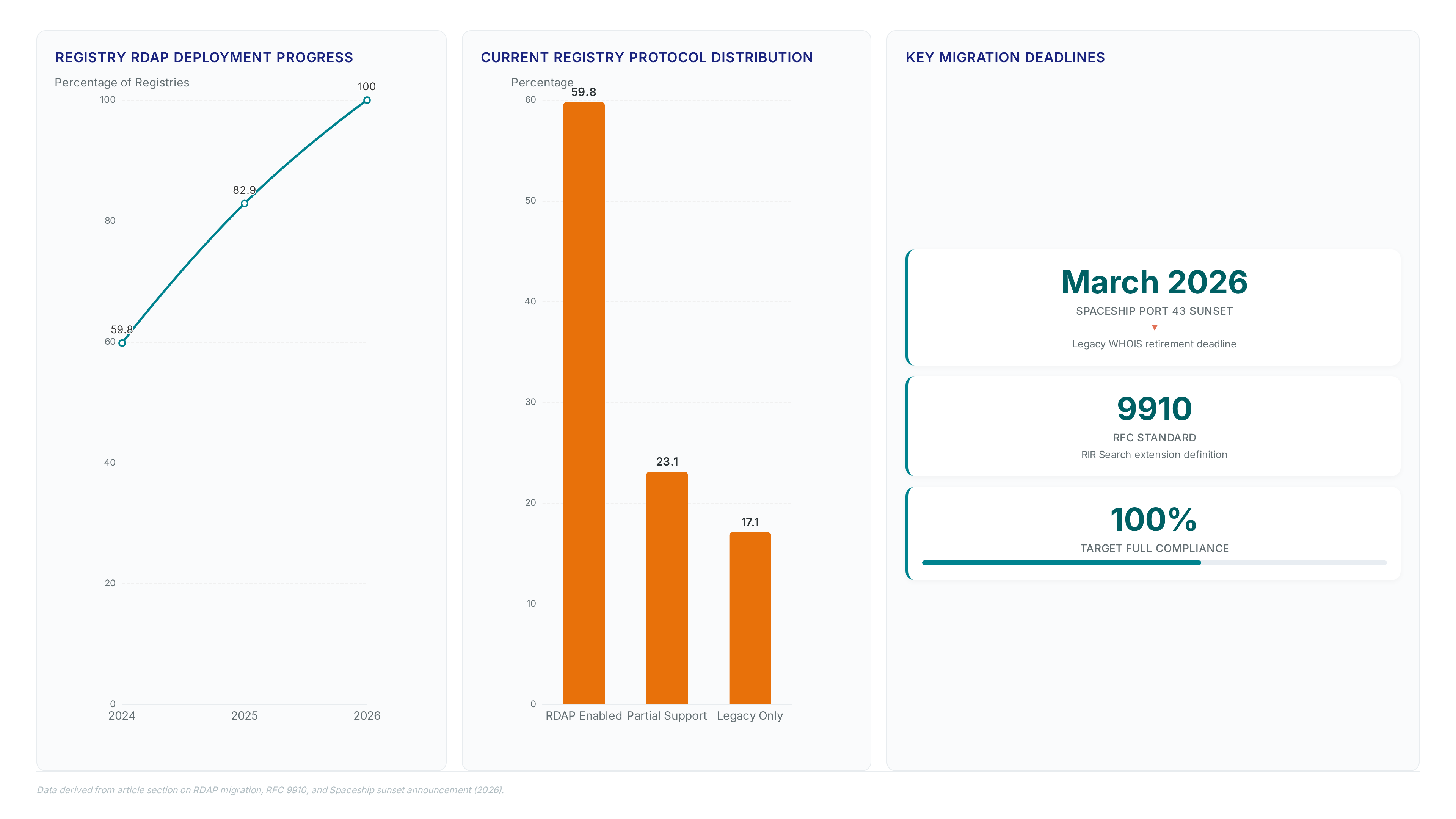
The Registration Data Access Protocol became the ratified standard in March 2015 to replace aging directory services. Development work commenced in 2012 addressing structural limitations within the legacy infrastructure. This protocol shift moved query handling from unstructured text streams to structured JSON objects over HTTPS. ICANN removed the contractual obligation for gTLD operators to maintain whois That date marked the definitive end of port 43 as a mandatory access vector for registration data. Operators now face a fragmented environment where 59.8% of domains support both protocols simultaneously. Another 23.1% support only the modern standard while 17.1% rely solely on legacy systems. The RIR Search extension further standardizes resource lookups across regional databases. Migration requires updating automation scripts to parse JSON responses instead of fixed-width text fields. Failure to adapt results in total loss of visibility into domain ownership records. The cost of maintaining dual-stack parsers remains high for large-scale infrastructure teams.
Operators must adopt RDAP immediately because 374 gTLDs severed port 43 connectivity by September 2025. This infrastructure shift forced a total migration of query traffic from legacy text streams to structured JSON objects. The transition deadline is absolute for any entity requiring accurate registration data. Compliance failures now trigger immediate service termination rather than grace periods. ICANN Network teams relying on cached whois outputs now face stale data risks that jeopardize abuse response workflows. The technical cost involves updating client libraries to handle HTTPS authentication and rate limiting headers. Automation scripts failing to parse JSON responses will return empty results against modern registries. Migration timing depends on whether the operator manages enterprise assets or provides public lookup tools. Enterprise security stacks require immediate updates to maintain threat intelligence fidelity. Public tools face user experience degradation if they fallback to error messages instead of protocol switching. The window for gradual transition closed when the majority of generic namespaces disabled legacy access.
Legacy systems processed 122 billion monthly queries before the 2025 mandate forced a structural migration to modern endpoints. The query volume shift represents a fundamental change in how network operators retrieve registration data, moving from unauthenticated text streams to structured JSON objects.
| Metric | Legacy WHOIS | Modern RDAP |
|---|---|---|
| Transport | Port 43 (TCP) | Port 443 (HTTPS) |
| Data Format | Unstructured Text | Structured JSON |
| Authentication | None | Token-based |
| Status | Deprecated | Mandatory |
A significant traffic shift occurred as legacy volumes plummeted, forcing reliance on HTTPS-based lookups for critical path validation. While generic domains achieved near-universal coverage, country-code namespaces exhibit an adoption disparity that complicates global policy enforcement. This fragmentation creates a dual-stack burden where engineers must maintain fallback logic for non-compliant zones. The cost of this transition is measurable in increased parser complexity and latency during timeout events. Operators cannot assume uniform data availability across all top-level domains.
JSContact and RFC 9910: The Mechanics of RIR Search Extensions
RFC 9910 formalizes the RIR Search extension to replace legacy text parsing with structured queries. (RFC's current state of rdap) This standard enables operators to retrieve RPKI data and resource holdings through a unified HTTPS endpoint rather than scraping disparate web interfaces. ARIN has already deployed this extension, while other registries prepare similar rollouts to close functional gaps. The shift from jCard to JSContact resolves long-standing friction in representing contact objects within JSON payloads. Unlike the difficult-to-parse jCard format, JSContact offers a modern schema that aligns with current application development practices.
| Feature | Legacy Approach | RDAP Extension |
|---|---|---|
| Data Structure | Unstructured text | Standardized JSON |
| Contact Format | jCard | JSContact |
| Access Control | None | Tiered via OAuth2 |
| Error Handling | Ambiguous messages | HTTP status codes |
Automation scripts now use authentication tokens to receive filtered or full data sets based on requester identity. This tiered access capability allows public users to see redacted details while verified entities like law enforcement retrieve complete records. Servers also return specific HTTP status codes to signal rate limiting or missing objects, eliminating guesswork in error handling logic. The architectural trade-off requires clients to implement OAuth2 flows, adding complexity compared to stateless port 43 connections. ### Operational Scale: ARIN Query Rates and rdap.
ARIN sustains monthly query rates between 250 and 300 million, proving regional registry capacity under full production load. This volume excludes the close to 56 million requests handled monthly by rdap. Org a critical bootstrapping service that resolves authoritative server URLs for clients. The mechanism eliminates hardcoded referral chains that frequently break in legacy systems. Automation drives these numbers, yet a structural gap persists where a significant share of ccTLDs lack compliant endpoints. Operators querying these zones face silent failures rather than explicit errors, complicating troubleshooting scripts. The reliance on central bootstrap files creates a single point of latency unlike the distributed nature of legacy port 43 lookups.
| Component | Function | Scale Impact |
|---|---|---|
| ARIN RDAP | Resource Data | High Volume |
| rdap.org | URL Discovery | Moderate Load |
| Missing ccTLDs | Data Gaps | Query Failures |
Blind reliance on real-time discovery introduces unacceptable delay for high-frequency polling applications. The cost of missing ccTLD data is measurable in incomplete network topology maps.
Unencrypted TCP vs HTTPS: Data Handling Differences in gTLDs and ccTLDs
Legacy WHOIS exposes registration data via unencrypted TCP on port 43, creating immediate interception risks for operators querying sensitive domains. Modern RDAP mandates HTTPS transport, embedding encryption directly into the request-response cycle to secure payloads in transit. This architectural shift enables tiered access , allowing registries to serve redacted JSON to anonymous users while granting full details to authenticated parties like law enforcement. Such granularity directly mitigates the real liability risk registrars faced under GDPR when forced to dump all data indiscriminately. The disparity forces network engineers to maintain dual-stack tooling, parsing structured JSON for some zones whileFallback to legacy text streams for others.
Migration to standard web ports resolves long-standing firewall traversal issues, yet the lack of a ccTLD mandate creates operational friction. Operators cannot assume uniform security postures across the global DNS root. The cost of this inconsistency is measurable in increased client-side complexity and parsing logic.
Accreditation Revocation vs Fines: The New ICANN Enforcement Standard
ICANN terminated Brennercom accreditation on January 13, 2026, permanently ending operations due to missing RDAP implementation. This action establishes a precedent where accreditation revocation replaces financial penalties as the primary enforcement mechanism for technical non-compliance. Operators asking when to transition face an immediate deadline, as retaining TCP WHOIS alone now constitutes an existential business risk rather than a manageable fine. The cost of delay includes total loss of revenue streams, not regulatory fees. Hidden operational costs of resisting migration include:
- Complete forfeiture of existing domain portfolios under management. * Immediate invalidation of all active registrar agreements. * Legal exposure from breached service-level contracts with downstream clients. * Irreversible damage to brand reputation within the global naming system.
Critics argue that legacy systems suffice for low-volume queries, yet this view ignores the binary nature of modern compliance checks. The termination event proves that partial implementation offers no protection against contract cancellation. While previous years allowed grace periods for port 43 retirement, the current standard demands full JSON-based capability before any audit occurs. The window for gradual adoption has closed, leaving only immediate deployment or market exit as viable paths forward.
Legacy System Retirement Deadlines: The Spaceship Port 43 Shutdown
Spaceship enforces a hard cutoff for legacy access on March 18, 2026, terminating all TCP WHOIS traffic. This deadline forces immediate backend rewrites because port 43 responses lack the structured JSON schema required by modern automation. Operators relying on plain-text parsing face total service interruption once the switch flips. The migration cost extends beyond simple protocol swaps; teams must refactor logic to handle HTTP status codes and rate limiting headers absent in the legacy model. Hidden expenses of delayed transition include:
- Complete failure of security monitoring tools hardcoded to port 43. * Manual labor hours spent debugging silent RDAP query failures. * Loss of automated compliance auditing during the cutover window.
Critics argue that maintaining dual-stack systems offers safety, yet this approach increases attack surface area without guaranteeing continuity. The real tension lies between preserving existing shell scripts and adopting HTTPS transport standards. Failure to update integrations before the March 18, 2026 deadline results in irreversible data blindness. The operational reality dictates that backend integrations must support RDAP exclusively to survive enforcement waves.
Operational Dangers of Cached Data and Unreliable Legacy Connections
Cached registration data causes immediate query failures as substantial registrars enforce hard deadlines for legacy system retirement. Operators attempting to fix RDAP query failures by retaining plain-text parsers face total service interruption when upstream providers disable port 43. The reliance on stale caches creates a false sense of security while TCP WHOIS endpoints silently drop connections. Teams must rewrite backend integrations to consume JSON responses, a mandatory shift that plain-text tools cannot emulate. Delaying this migration invites existential risk, as ICANN now pursues accreditation revocation rather than issuing fines for non-compliance. The question of whether to adopt RDAP now is irrelevant; the protocol is the only surviving path for valid data retrieval. Hidden costs of maintaining legacy connections include:
- Total loss of automated threat intelligence feeds dependent on real-time lookups
- Inability to parse structured error codes returned by modern HTTPS endpoints
- Complete forfeiture of accredited status following the next compliance audit cycle
Executing the Migration to RDAP for Modern Infrastructure
HTTPS Encryption and JSON Standardization in RDAP Architecture
Deploying an RDAP server requires binding the service to HTTPS ports to enforce encryption, replacing the unencrypted TCP connections of whois. This transport layer shift eliminates the need for complex text parsing logic by delivering standardized JSON objects that enable immediate machine readability. Operators must configure their servers to accept authentication tokens, as this capability underpins the tiered access model required for modern privacy compliance. Unlike the stateless legacy protocol, this architecture allows the system to evaluate requester credentials and return filtered data sets dynamically.
RFC 9910 defines the RIR Search extension to replace legacy plain-text queries with structured lookups.
- Validate that the target registry supports the new search parameters before rewriting client logic.
- Configure the application to parse JSON objects returned over HTTPS instead of unencrypted streams.
- Implement error handling for HTTP status codes that indicate rate limiting or authentication failures.
ARIN serves as the primary reference model, having already deployed these capabilities for production traffic. Other registries follow this pattern closely, expecting similar query volumes soon. Operators must update software to handle internationalized domain names correctly, a task where legacy tools frequently fail due to character encoding limitations. The shift requires abandoning custom text parsers in favor of standard JSON libraries. Migration costs escalate when teams delay updating monitoring tools ahead of hard provider deadlines. Hardcoded dependencies on port 43 cause total service interruption once upstream providers disable the legacy interface. The limitation of this approach involves the initial development overhead required to map old field names to the new schema. Failure to adapt results in immediate data blindness as the system fully transitions away from unstructured responses.
Planning for Full WHOIS Decommissioning Between 2027 and 2029
Industry projections indicate whois becomes optional at substantial registries between 2027 and 2028 before full gTLD decommissioning in 2029. Operators must execute a phased migration to avoid service collapse when legacy ports close permanently.
- Audit all backend integrations relying on port 43 before providers enforce hard deadlines for TCP retirement.
- Refactor parsing logic to consume standardized JSON objects rather than unstructured plain text streams.
- Update monitoring tools to handle HTTPS status codes and authentication tokens required for tiered access.
Delaying this transition creates a single point of failure as cached data grows stale and connections drop silently. The cost of inaction exceeds development expenses because accreditation revocation now targets non-compliant entities directly. InterLIR recommends treating the 2027 window as a critical cutoff rather than a soft target. Most operators underestimate the complexity of shifting from stateless queries to authenticated sessions. Failure to adapt before the optional status phase ends results in total loss of registration data visibility. The system growth demands immediate architectural changes to support automated scaling.
About
Georgy Masterov, a Customer Support Specialist at InterLIR and Computational Business Analytics student, offers a unique perspective on the Registration Data Access Protocol (RDAP). His daily work managing IP resource transactions and ensuring BGP security at InterLIR, a specialized IPv4 marketplace, requires precise verification of ownership data. This practical experience directly connects to RDAP's evolution from the legacy whois protocol, as accurate registration data is critical for preventing financial crime and maintaining network integrity. Masterov's background in finance and IT allows him to analyze how RDAP's structured data access improves transparency in the IP address market. As ICANN mandates drive wider adoption, his insights reflect the real-world impact of these protocols on companies like InterLIR that rely on clean, accessible registration records to enable secure and efficient IPv4 redistribution globally.
Conclusion
The coexistence phase creates a deceptive stability that masks the operational fragility of maintaining dual-stack systems. As legacy volume contracts, the cost of supporting redundant parsers outweighs the benefit of backward compatibility, especially when a substantial portion of ccTLDs already lack compliant endpoints for hybrid querying. Teams relying on text-stream heuristics will face silent data corruption long before hard shutdowns occur, as registry implementations diverge in their handling of mixed-protocol requests. The real bottleneck is not the protocol syntax but the authentication architecture required for tiered access, which most current monitoring stacks cannot support without significant refactoring.
Organizations must mandate a complete WHOIS code path removal by Q4 2026 to ensure readiness for the 2027 optional status window. Treat any integration still depending on port 43 as technical debt requiring immediate retirement, not maintenance. This timeline accounts for the lag in updating third-party vendor libraries and prevents accreditation risks during the final gTLD transition. Start by auditing your error logs this week specifically for TCP timeout spikes or unstructured parse failures, then map those specific domains to their RDAP compliance status to prioritize your refactor queue.
Frequently Asked Questions
Only 17.1% of domains currently rely solely on legacy systems today. The remaining infrastructure has largely migrated to support modern standards or dual-protocol configurations for better data access.
Legacy query volume contracted sharply by 60% following the removal of contractual obligations. This massive shift forced operators to redirect traffic toward structured JSON endpoints for registration data.
RDAP endpoints now handle 65 billion monthly queries, surpassing the declining legacy traffic. This surge represents a complete reversal from the earlier seven billion queries seen in January 2025.
Adoption among ccTLDs has grown robustly by 12% since January 2025 without a collective mandate. Approximately 60% of these extensions now deploy compliant endpoints for secure data access.
Non-compliance triggers immediate service termination rather than grace periods for lagging operators. The landscape now shows 23.1% support only the modern standard while legacy access disappears rapidly.