IPv4 Waiting List: 773 LIRs Stuck After 472 Days
With 773 LIRs stuck on the IPv4 Waiting List and the first applicant waiting 472 days, the era of free IPv4 allocation is definitively over. (RIPE's general meeting may 2026 results) The RIPE NCC's February 2026 update confirms that global resource exhaustion has forced a permanent shift toward market-based transfers and aggressive IPv6 migration strategies. While data center spending surges past $650 billion, the underlying infrastructure relies on a finite pool of billions of addresses that can no longer meet demand through traditional allocation.
Readers will examine the stark reality of registry governance, where January saw only 908,800 addresses transferred despite intense pressure from AI and IoT sectors. The analysis details the technical mechanics of securing this fragile system, noting that while 76% of IPv4 space now uses RPKI for route validation, IPv6 coverage lags significantly at just 43%. The removal of MD5 passwords from the RIPE Database marks a critical, non-negotiable upgrade to authentication security protocols.
Finally, the discussion explores strategic deployment pathways, highlighting that only 15,692 LIRs have successfully adopted IPv6 out of over 20,000 total accounts. As leasing prices hold firm above $0.38 per address, the community must navigate a environment where digital cooperation moves from policy adoption to hard implementation. Ignoring these metrics invites route leaks and operational stagnation in an increasingly congested network environment.
The State of Global IP Resource Management and Governance
IPv4 Waiting List Mechanics and Global Address Exhaustion
The IPv4 Waiting List holds 773 LIRs, with the first entity queuing for 472 days due to total pool exhaustion. Global exhaustion drives this backlog because the address space contains only a finite number of unique identifiers. North America consumes 39.5% of these allocations, while Europe accounts for 23.9%. No unassigned blocks remain for new requests. An Activity Reporting Certificate (ARC) validates that a requesting Local Internet Registry maintains accurate registration data before entering this queue. Operators often bypass the wait by purchasing addresses on the secondary market, where leasing prices start at $0.38 per address depending on block size. The RIPE NCC transfer market enables these transactions, allowing organizations to buy or lease space rather than wait indefinitely for free allocations. Transfers introduce cost volatility absent in the original allocation model. Delayed validation removes an LIR from the list, resetting their position and extending the already multi-year wait time.
ROA Coverage Disparities Between IPv4 and IPv6 Deployments
Route Origin Authorization protects 76% of IPv4 space but only 43% of IPv6 prefixes, creating asymmetric validation risks. This ROA coverage gap leaves newer IPv6 deployments vulnerable to origin spoofing despite available security tooling. Operators prioritizing IPv4 signing while delaying IPv6 attestation face a widening security debt as traffic shifts. Dual-stack operation remains the normal state of infrastructure through at least 2040 due to the slow pace of full IPv6 migration, yet security policies frequently lag behind connectivity requirements. With a majority of websites globally not supporting IPv6, many network engineers treat the protocol as secondary, inadvertently deprioritizing route security for future traffic flows. The cost is measurable: unvalidated IPv6 paths allow attackers to hijack prefixes that lack cryptographic origin proofs. Ignoring this synchronization invites route leaks specifically targeting the less-monitored IPv6 address family.
New members attain Local Internet Registry status by paying a one-time sign-up fee alongside the standard annual charge. The pro-rated annual fee structure ensures operators only cover remaining calendar months upon joining, reducing initial capital outlay. Becoming a certified entity requires navigating the RIPE NCC Academy training schedule, which features intensive sessions from 12–27 March 2026. Specific modules include IPv6 Security Myths on March 12 and BGP Routing Security on March 27.
| Date | Course Topic | Location |
|---|---|---|
| 12 Mar | IPv6 Security Myths | Online |
| 25 Mar | RIPE Database Training | Yerevan |
| 27 Mar | BGP Routing Security | Bern |
Operational readiness depends on completing these modules before the General Meeting in May. The democratic process governing fee adjustments means costs fluctuate based on community consensus rather than fixed statutes. Skipping this validation step leaves new allocations vulnerable to routing policy rejection by upstream peers enforcing strict origin checks.
Technical Mechanics of Routing Security and Database Access
MD5 Password Removal and Whois 1.121 Architecture Shift
The RIPE Database deleted all stored passwords on 14 January, forcing immediate migration to SSO or API keys. This action targets the fix MD5 password removal issue by eliminating weak cryptographic hashes that previously authenticated updates. Legacy scripts relying on the `password:` attribute in update messages now fail authentication against the live service. The Whois 1.121 release on 4 March completes this transition by removing the code path entirely, rendering old clients unusable. Operators must reconfigure automation to use the LIR Portal for credential management before the software deprecation date. The architectural shift moves authority from object-level secrets to account-level tokens managed by the RIPE NCC. This change aligns database access with broader technical services like RPKI, which already require strong identity binding. Automation breakage occurs when update tools cache legacy credentials or fail to rotate to OAuth flows.
| Authentication Method | Status Pre-14 Jan | Status Post-4 Mar |
|---|---|---|
| MD5 Password | Active | Blocked |
| SSO Token | Active | Required |
| API Key | Active | Required |
| PGP Signature | Active | Active |
Meanwhile, the cost of delay is total loss of RIPE Database write access for affected objects. No fallback mechanism exists once the Whois 1.121 binary removes the parser logic. ### RPKI Implementation for Routing Security in RIPEstat and RIS
Route origin validation fails without cryptographically signed Route Origin Authorizations published to the global Resource Public Key Infrastructure. The RIPE NCC integrates this framework directly into RIPEstat and the Routing Information Service to automate path verification. Operators query these tools to confirm whether an announcing AS holds valid rights for a specific prefix before accepting traffic. This process rejects unauthorized announcements at the edge, preventing hijacks before they propagate across the transit backbone.
| Validation State | Action | Risk Level |
|---|---|---|
| Valid | Accept | Low |
| Invalid | Reject | Critical |
| NotFound | Accept | Moderate |
The mechanism relies on the Internet Routing Registry to cross-reference policy data with cryptographic proofs. A significant limitation exists where legacy IRR entries lack corresponding RPKI signatures, creating false negatives during strict filtering. Networks enforcing hard-reject policies on NotFound states risk dropping legitimate traffic from non-compliant peers. This tension forces a choice between maximum security posture and maintaining connectivity with unprepared neighbors. Most operators initially deploy a "warn-only" mode to audit coverage gaps before enabling active rejection. The cost of delayed enforcement is measurable in increased exposure to route leaks during the transition window.
In practice, the fix MD5 password removal issue requires re-engineering update workflows to apply the LIR Portal for generating valid session tokens. This architectural shift aligns database access with broader security-first Managed Service Provider expectations dominating the 2026 market. Failure to adapt results in silent update rejections rather than explicit error messages, causing database integrity drift as intended changes never apply. The Internet Routing Registry depends on this synchronized data; stale records here propagate invalid route origins across the global table.
Defining the RIPE NCC Bottom-Up Policy Development Model
ISPs, government representatives, and regulators gather at biannual meetings to reach community consensus on Internet governance and resource management. This bottom-up policy development model distinguishes the RIPE NCC from top-down regulatory bodies by requiring active operator participation for every rule change. A policy proposal regarding IPv6 Initial Allocations was withdrawn on February 26, 2026, due to a lack of consensus, proving that technical necessity alone cannot force adoption without community agreement. Operators asking how to deploy IPv6 infrastructure must engage in this process rather than waiting for mandates, as the Local Internet Registry membership model places implementation responsibility on the network edge.
| Stakeholder Group | Primary Role | Decision Power |
|---|---|---|
| ISPs | Technical Implementation | High |
| Regulators | Legal Framework | Low |
| Government Reps | National Interest | Medium |
The timing for when to upgrade to IPv6 depends on local queue pressure and peer readiness, not a global switch-over date. Fees for independent resource assignments remain fixed at EUR 75, yet the overall budget requires annual member votes, creating a variable cost structure unlike fixed statutory fees in other jurisdictions. This democratic fee voting mechanism ensures costs align with actual service usage but introduces financial uncertainty for long-term capital planning.
Presentations for SEE 14 in Belgrade on 21–22 April 2026 remain open for technical submissions targeting South East European operators. RIPE NCC Days Baltics follows in Riga, Latvia, on 3–4 June 2026, offering a secondary venue for Baltic community synchronization. Operators unable to travel can establish a Local Hub to enable remote access, transforming isolated viewing into collaborative working sessions. This approach mitigates the exclusion risk inherent in purely virtual attendance models while avoiding the high cost of international transit. Physical presence at these events allows direct negotiation of peering agreements that email threads rarely finalize. Remote participants using a Local Hub gain similar networking benefits through structured breakout discussions organized by the host city. The call for Local Hubs explicitly seeks volunteers to manage these satellite gatherings, ensuring policy debates remain inclusive. Submission deadlines for the Belgrade event approach rapidly, requiring operators to finalize slide decks before the April window closes. Riga attendees benefit from concentrated face-time with Baltic ISPs who manage distinct cross-border traffic flows.
| In-Person | Direct peering negotiation | Travel budget approval |
|---|---|---|
| Local Hub | Collaborative analysis | Venue coordination effort |
| Fully Remote | Zero travel cost | Limited informal interaction |
Failure to engage regionally leaves network engineers unaware of localized policy shifts affecting address resource allocation. Strategic attendance converts passive observation into active influence over the bottom-up development model governing European IP resources. The RIPE NCC Days Baltics agenda specifically targets regional infrastructure challenges unique to the Baltic states. Operators must choose between broad global exposure and deep regional impact based on current business expansion goals.
Executive Board Nomination Requirements and Voting Deadlines for 2026
Three Executive Board seats open for nomination with a strict deadline of 29 April 2026 at 23:59 (UTC). Candidates require written support from at least five RIPE NCC members to validate their entry into the election pool. Operators weighing in-person vs remote meeting participation must note that voting occurs online during the General Meeting regardless of physical location in Edinburgh. Remote attendees retain full voting rights, eliminating travel costs while preserving governance influence. The Activity Plan approved in December 2025 dictates the strategic scope these new directors will oversee.
| Participation Mode | Voting Capability | Travel Requirement |
|---|---|---|
| In-Person | Full | Mandatory |
| Remote Hub | Full | None |
| Individual Online | Full | None |
A flat fee model discussion could alter the annual LIR fee structure, making board composition critical for financial planning. Nominees lacking transit operator experience may struggle to address routing security gaps effectively. The community consensus model demands directors who understand technical constraints rather than purely political mandates. Failure to nominate qualified candidates risks stagnation in policy development cycles.
Implementation Steps for Event Participation and Resource Creation
ROA Creation Requirements for RPKI Routing Security
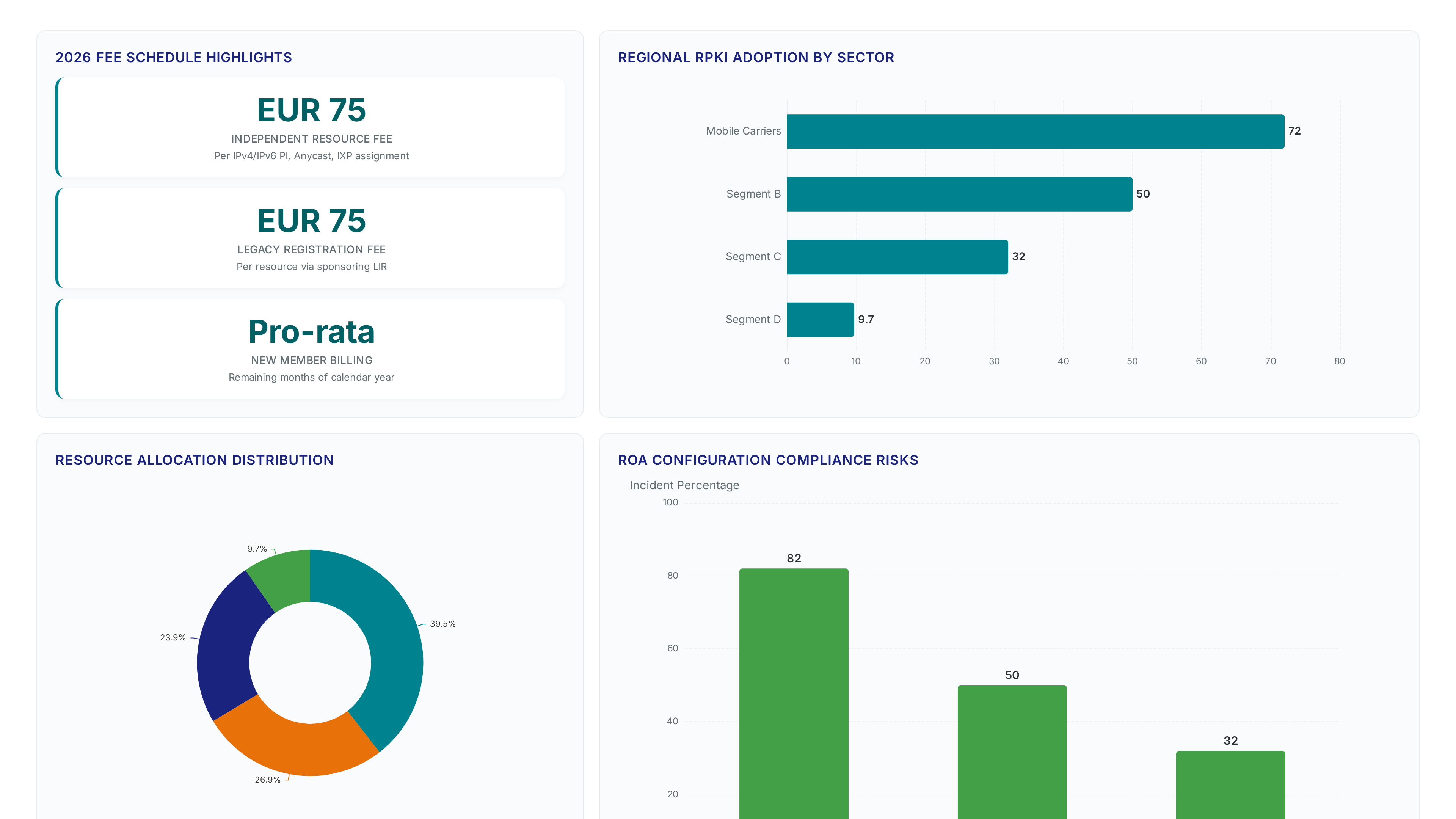
Creating a valid Route Origin Authorization demands precise alignment between an Autonomous System Number, an IP prefix, and a maximum length value. Operators must first verify resource ownership through the LIR Portal before generating any cryptographic attestation. The maximum length field prevents more specific prefix hijacks but introduces complexity if set too broadly during initial deployment. Validation relies on the Resource Public Key Infrastructure framework to sign these origin claims against the global registry. A misconfigured maximum length allows rogue announcements of subnets that should remain unreachable via that origin AS. Most networks fail this step by copying templates without adjusting the length mask to their specific allocation size.
Neglecting the max-length constraint leaves the AS path vulnerable to sub-prefix interception despite having a valid signature. Operators managing the Internet Routing Registry must treat these objects as live safety interlocks, not static documentation entries. Incorrect values trigger rejection policies at upstream peers, causing immediate traffic blackholing for the affected prefixes.
Step-by-Step Submission Process for SEE 14 Presentations
Proposals for SEE 14 should target technical gaps specific to the South East Europe Internet community before the April deadline.
- Define a scope addressing regional routing security or IPv6 deployment challenges rather than generic overviews.
- Draft an abstract that aligns with the bottom-up policy development model emphasized by RIPE NCC governance structures.
- Upload the presentation details through the official portal linked from the RIPE NCC member update.
- Await reviewer feedback, noting that acceptance prioritizes actionable operational data over theoretical frameworks.
Operators recognize that RIPE NCC events serve as venues for resolving local peering disputes through direct consensus. A presentation ignoring the specific topology of the Balkans fails to engage the core audience of local ISPs and regulators. The submission timeline closes weeks before the event to allow schedule finalization for the Belgrade venue. Rejection often stems from a failure to address the unique regulatory environment distinct from other Regional Internet Registries serving different continents. InterLIR advises applicants to validate their topic against recent RIPE Labs analysis. Successful talks frequently dissect failure modes observed in local exchange points rather than reciting global statistics. This focus ensures the content provides immediate utility to attendees managing actual infrastructure constraints.
- Direct relevance to local policy debates
- Higher engagement from regional operators
- Clearer path to implementation
- Stronger consensus building potential
General Meeting Registration and Online Voting Checklist
Register via the LIR Portal before 20 May 2026 to secure credentials for the hybrid General Meeting in Edinburgh. Remote participants must verify identity through two-factor authentication prior to accessing the online voting interface on election day. InterLIR mandates checking resolution texts against the published agenda to prevent accidental approval of unfavorable fee structures.
| Participation Mode | Verification Requirement | Voting Method |
|---|---|---|
| In-Person | Photo ID at Desk | Electronic Ballot |
| Remote | 2FA Token | Web Portal |
| Local Hub | Hub Coordinator Sign-off | Aggregated Proxy |
Execute these steps to guarantee ballot validity:
- Confirm membership status is active in the registry database.
- Generate a time-synced token for the voting session.
- Review the specific text for the three Executive Board seats.
- Submit selections before the poll closes at 17:00.
Operators ignoring the pre-meeting verification window risk losing governance influence despite paying annual fees. The separation of physical attendance from voting rights ensures democratic access but introduces latency risks for remote delegates relying on unstable connections.
- Confirm LIR account status is active
- Validate email address on file
- Test two-factor authentication device
- Review proxy voting rules
- Download agenda PDF locally
- Schedule connection test one hour prior
About
Alexei Krylov serves as the Head of Sales at InterLIR, a Berlin-based marketplace specializing in IPv4 resource redistribution. His unique combination of B2B sales expertise and a legal education background makes him exceptionally qualified to analyze the latest RIPE NCC statistics. As InterLIR enables the transfer and leasing of scarce IPv4 addresses across Europe and Central Asia, Krylov directly navigates the complex regulatory environment governed by the RIPE Network Coordination Center. His daily work involves guiding clients through the intricacies of LIR account management and address transfers, placing him at the forefront of the market shifts highlighted in this update. With global IPv4 exhaustion driving increased demand for leasing, Krylov's frontline experience with RIR policies and network resource availability provides critical, factual context for understanding these evolving industry trends.
Conclusion
IPv4 scarcity creates a fragile economic layer where leasing costs obscure the true operational debt of legacy architectures. As data center spending surges toward $650 billion by 2027, organizations clinging to IPv4 face disproportionate scaling friction that market mechanisms cannot fully absorb. The current asymmetry in route validation leaves critical expansion vectors exposed, specifically as new infrastructure deployments outpace security protocol adoption. Relying on secondary markets for address space is a temporary stopgap, not a sustainable strategy for next-decade growth.
Operators must mandate a complete IPv6 transition plan by Q3 2026, tying capital expenditure approvals to dual-stack readiness rather than lease extensions. This timeline aligns with projected infrastructure booms and prevents locking assets into depreciating IPv4 dependencies. Governance participation remains vital, but technical execution determines survival. Start by auditing your Route Origin Authorization coverage for IPv6 prefixes this week to identify gaps before they compromise incoming traffic flows. Fixing these validation holes now secures the foundation for future capacity without incurring the hidden latency of retroactive security patches.
Frequently Asked Questions
Leasing prices for IPv4 blocks start at $0.38 per address depending on the specific block size. This market-based approach replaces free allocations due to the total exhaustion of the global address pool.
North America currently consumes 39.5% of all global IPv4 allocations, representing the largest regional share. Europe follows with a significantly smaller portion, accounting for only 23.9% of total assignments.
Route Origin Authorization protects 76% of IPv4 space but covers only 43% of IPv6 prefixes. This asymmetry creates significant validation risks for newer deployments that lack cryptographic origin proofs.
Approximately 63% of websites globally do not currently support IPv6, causing many engineers to treat it as secondary. This lag often leads to deprioritized route security for future traffic flows.
The global address space contains only 4.3 billion unique identifiers, which can no longer meet current demand. This finite limit has forced a permanent shift toward market-based transfers and migration.