RIPE registry helps Middle East operators survive war costs
With 88% of industry respondents expecting fiber costs to surge, the RIPE NCC prioritizes payment extensions over infrastructure expansion for conflict-affected members. (RIPE's charging scheme 2026 estimator) The organization's March 2026 stance confirms that financial flexibility, not just technical redundancy, is the critical mechanism for sustaining Internet access during active warfare. While public cloud spending races toward 45% of enterprise budgets by 2027, physical network survival in the Middle East depends entirely on administrative forbearance from regional registries.
Readers will examine how the RIPE Network Coordination Center uses its membership structure to bypass standard billing cycles when violence disrupts cash flow. The analysis details the specific payment extension form available to operators facing invoice deadlines amidst uncertainty and loss. This procedural safeguard acts as a blunt instrument against the total collapse of local routing tables when revenue streams dry.
The discussion further contrasts the near-universal penetration rate in Northern Europe with the fragile majority connectivity estimated for Central Asia, highlighting the disparity in infrastructure durability. RIPE NCC reports that maintaining these divergent regions requires more than solidarity statements; it demands concrete operational adjustments to keep registry services undisrupted. As labor and material costs climb, the ability to delay payments becomes the only viable strategy for preventing permanent network fragmentation in war zones.
The Role of Registry Service Continuity During Regional Conflict
Defining Registry Service Continuity for Middle East Operators
The 5 Mar 2026 statement defines registry service continuity as uninterrupted allocation services paired with financial solidarity for affected members. This scope exceeds standard commercial uptime guarantees by addressing human disruption alongside technical availability. The RIPE NCC operates as a membership body rather than a pure vendor, maintaining a branch in Dubai to support operators across Europe, the Middle East, and parts of Central Asia. Continuity here means keeping the RIPE Database accessible while offering payment extensions to those facing uncertainty or loss. Commercial service level agreements typically ignore member solvency during regional conflict, focusing solely on DNS resolution uptime. The RIPE NCC approach integrates administrative flexibility with technical stability, acknowledging that financial distress causes route de-aggregation quicker than infrastructure failure. Operators in the region face compound risks where fiber deployment costs surge alongside physical danger. Global industry data indicates 88% of respondents expect cost increases driven by labor and materials, complicating recovery for networks serving areas with only partial connectivity. Feature Commercial SLA RIPE NCC documentation highlights this divergence from standard vendor contracts.
Ignored administrative layers create single points of failure when revenue streams halt due to conflict. An ASN remains valid only if the member organization survives the crisis. Members trigger support requests when conflict disrupts invoice settlement or physical access to registry interfaces. The payment extension form activates specifically for operators anticipating missed deadlines due to uncertainty or loss. This mechanism distinguishes the RIPE Network Coordination Center from commercial vendors that prioritize revenue over member solvency during crises. Operators in the Middle East service region face unique infrastructure challenges where fiber deployment costs surge, complicating recovery efforts even when registry data remains accessible. The membership organisation model enables financial flexibility that pure service providers cannot match. Northern Europe maintains high connectivity while other areas within the jurisdiction experience lower penetration rates, creating disparate durability levels. Requesting support requires documenting anticipated payment delays rather than proving total service failure. This threshold allows early intervention before accounts enter default status. Manual processing times during mass-disruption events limit the speed of this approach. Registry continuity depends on operators using these specific administrative channels before financial penalties accrue.
Infrastructure Cost Surges Threatening Regional Continuity
Rising capital expenditure for physical layer repairs creates the primary economic barrier to maintaining registry access during active conflict. The RIPE NCC provides payment extensions, yet solvency does not solve the inability to procure materials for last-mile restoration. This inflation directly undermines continuity efforts where violence has already damaged underground plant. Operators facing uncertainty must absorb these inflated prices while revenue streams fluctuate. Financial strain introduces a specific failure mode distinct from technical outages. Even with uninterrupted database services, members cannot reconnect customers if the cost of labor and materials exceeds available capital reserves. This flexible shifts the risk profile from service availability to economic viability. Payment relief addresses invoice timing but ignores the exponential rise in reconstruction expenses. InterLIR notes that financial flexibility mechanisms often fail to account for these external market forces. Administrative support cannot subsidize the physical reconstruction of infrastructure. Operators in the Middle East face a compound crisis where registry access remains intact, but the economic means to apply that access evaporate. The 1779477277 article ID references specific cost surge data the to this period. Five distinct regions reported similar inflationary pressures on network buildouts during the first quarter of 2026.
Mechanisms for Maintaining Undisrupted Internet Infrastructure Operations
The 2026 RIPE NCC Fee Structure and Payment Extension Mechanisms
The charging scheme imposes a fixed EUR 75 levy per independent Internet number resource alongside standard service fees. This rigid cost structure creates immediate liquidity friction for operators facing revenue disruption during regional conflict. The RIPE NCC payment extension form functions as the primary mechanical override, allowing members to defer settlement without triggering service suspension. Operators unable to absorb fixed membership costs often pivot to short-term market alternatives. Global IPv4 leasing rates currently range from $0.38 to $0.45 per IP monthly, offering a variable-cost substitute for the static EUR 75 obligation. This arbitrage strategy introduces a distinct operational risk: leased blocks lack the long-term stability of direct allocation and carry no voting rights within the membership organisation. Delayed submission reduces the administrative window for approval before automated dunning processes initiate.
Executing Payment Extensions and Resource Leasing During Crisis
Operators facing conflict-induced liquidity gaps must submit the payment extension form before invoice due dates to prevent automatic service suspension.
- Access the membership portal and locate the specific request interface for deferred settlement.
- Document the operational disruption causing the revenue shortfall without revealing sensitive security details.
- Submit the query to receive a temporary hold on EUR 75 per independent resource fees.
This administrative override preserves registry access while physical infrastructure repairs proceed. Regional disparities significantly impact this strategy; the APNIC region commands premiums exceeding $0.60 due to tighter supply constraints. Leasing bypasses long-term commitment but introduces dependency on third-party lessors rather than direct RIPE NCC allocation stability.
| Cost Factor | Direct Membership | Third-Party Leasing |
|---|---|---|
| Upfront Commitment | High (Annual) | Low (Monthly) |
| Price Stability | Fixed | Market Volatile |
| Administrative Overhead | Moderate | Minimal |
| Resource Ownership | Permanent | Temporary |
Leasing solves immediate capacity needs but fails to build long-term asset equity. Reliance on external pools exposes operators to sudden rate hikes or availability shocks absent in direct membership models. The payment extension form addresses solvency, yet it does not mitigate the strategic risk of losing control over critical addressing blocks during prolonged crises.
Validating Governance Participation via the 2026 General Meeting Timeline
Verifying active membership status requires confirming the draft agenda publication date of 22 April 2026 before attempting ballot submission. Operators facing regional disruption often miss this procedural window, inadvertently forfeiting voting rights despite maintained registry access. The timeline dictates that supporting documents must be reviewed prior to the physical gathering at the Edinburgh International Conference Centre. Failure to register by the stipulated deadline excludes the member from the quorum calculation entirely.
| Governance Step | Required Action | Consequence of Miss |
|---|---|---|
| Document Review | Analyze resolutions by 22 April | Informed voting becomes impossible |
| Registration | Complete portal entry before May | Physical access denied at venue |
| Ballot Casting | Submit credentials during session | Vote count excluded from total |
The Executive Board finalized the fiscal framework on 11 December 2025, setting the baseline for all proposed resolutions debated during the session. High engagement remains possible even during crises, evidenced by the 3,049 votes recorded in the May 2026 proceedings. However, payment extensions do not automatically grant voting eligibility if registration deadlines pass unmet. This distinction creates a gap where financially supported members lose governance influence. Solidarity measures preserve connectivity but do not override procedural bylaws regarding voting procedures.
Steps to Request Payment Extensions for Conflict-Affected Members
Scope of the RIPE NCC Payment Extension Form for Conflict Zones
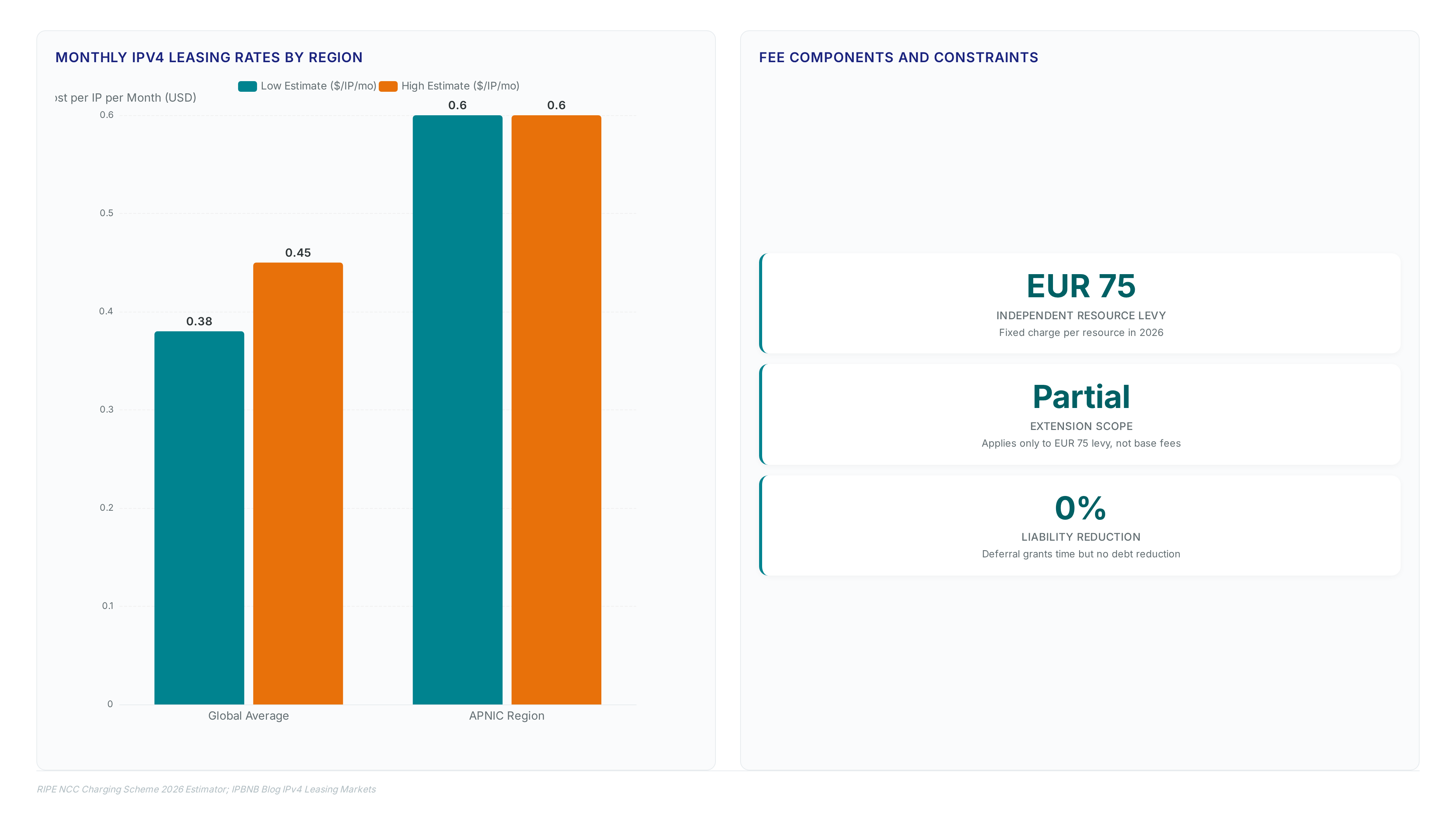
The RIPE NCC payment extension form targets members anticipating deadline failures due to active conflict disruption rather than general insolvency.
- Log into the membership portal and select the specific interface for deferred settlement requests.
- Describe the operational interruption causing revenue loss without exposing sensitive physical security details.
- Submit the query to trigger a temporary hold on the EUR 75 per independent resource levy.com/blog/ region. The extension mechanism specifically addresses liquidity friction caused by violence, distinguishing it from standard financial hardship programs. A critical limitation exists: approval grants time but does not reduce the total charging scheme liability accumulated during the deferral period. Operators must calculate whether deferred payment outweighs the risk of service suspension before the next billing cycle.
Operators must isolate the EUR 75 per-resource levy from base service fees before submitting extension requests.
- Audit the invoice to separate independent resource charges from standard IPv4 and IPv6 allocation costs.
- Submit the payment extension form specifically citing the conflict-induced inability to cover these distinct line items.
- Retain registry access while deferring settlement on the specific EUR 75 increments rather than the entire bill.
This granular approach prevents total service suspension while acknowledging partial liquidity constraints. The fixed nature of the resource charge creates a binary failure mode where non-payment of a single increment risks the entire membership status. Members holding multiple resources face compounding liability that leasing markets cannot fully offset during active conflict. While global rates offer flexibility, the RIPE Database records remain the sole authority for long-term routing stability. Leasing provides immediate capacity but lacks the governance rights attached to direct membership holdings. Operators prioritizing immediate survival may sacrifice long-term policy influence by shifting to leased address space. This trade-off reduces financial pressure but removes the member from the quorum calculation for future General Meetings. Strategic deferral of the specific resource fee maintains both operational continuity and organizational standing.
Pre-Submission Validation for Undisrupted Registry Services
Verify operational status against the Service Registry Architecture definition before filing payment extension claims. Operators must confirm their routing instances remain discoverable despite local infrastructure damage.
- Inspect the service registry entry to ensure flexible binding functions correctly for external clients.
- Validate that the Public Service Registry UI. Page. Cls? KEY=EESB_intro) reflects current reachability states without manual overrides.
- Confirm the EUR 75 resource levy remains the sole outstanding balance preventing full account reconciliation.
| Validation Step | Required State | Failure Consequence |
|---|---|---|
| Registry Lookup | Flexible binding active | Service discovery fails |
| Fee Audit | Only resource levy unpaid | Full suspension triggered |
| API Reachability | REST endpoint responds | Extension request rejected |
Disrupted members often mistake physical link loss for registry invalidity, causing unnecessary self-suspension. The RIPE NCC distinguishes between transport layer failures and application layer registration validity. Maintaining accurate metadata in the underlying database prevents automatic de-provisioning during conflict zones.
Application: Defining Eligibility for RIPE NCC Payment Extensions in Conflict Zones
Eligibility for RIPE NCC payment extensions requires demonstrable conflict-related operational disruption rather than general financial insolvency. Operators must distinguish between market volatility and physical infrastructure failure when submitting claims. The EUR 75 General economic downturns do not qualify under the solidarity framework announced on 5 Mar 2026. This alternative avoids the procedural scrutiny required for conflict waivers while maintaining routing capacity. The payment extension form specifically targets members unable to meet deadlines due to active hostilities in the Middle East service region.
| Criterion | Qualifying Condition | Disqualifying Condition |
|---|---|---|
| Cause | Direct violence disrupting operations | General market recession |
| Impact | Inability to access funds | Voluntary cash flow management |
| Scope | Specific conflict zone affected | Global economic headwinds |
Submitting a request triggers a temporary hold on enforcement actions while the Executive Board reviews the case against the approved Activity Plan and Budget. Failure to properly categorize the disruption type results in immediate rejection. The distinction preserves resources for those facing existential threats rather than temporary balance sheet adjustments.
Applying the EUR 75 Resource Fee Waiver to Independent Internet Number Resources
Operators should apply for a payment extension only when conflict prevents settlement of the specific EUR 75 line item rather than the entire invoice. Isolating this per-resource levy from the base service fee allows members to preserve registry access while deferring payment on independent allocations. The 2026 charging scheme separates these costs, meaning a partial hold targets only the independent Internet number resource charges without triggering full account suspension.
- Audit the invoice to identify the EUR 75 increments associated with each held IPv4 block or ASN.
- Submit the extension form citing the inability to cover these distinct items due to regional disruption. 3.
Submit the payment extension form only after verifying that conflict prevents banking access rather than general liquidity shortfalls. Operators must isolate the EUR 75 per-resource charge from base fees to avoid triggering full account suspension. Review the RIPE Database to confirm which independent Internet number resources remain active despite regional infrastructure damage.
| Validation Step | Required Evidence | Risk of Omission |
|---|---|---|
| Resource Audit | List of held ASNs and IPv4 blocks | Incorrect fee calculation |
| Banking Proof | Statement showing regional transfer blocks | Claim rejection |
| Service Scope | Confirmation of registry access needs | Total service halt |
Members facing pure cash-flow issues might lease capacity at market rates instead of seeking regulatory relief. Small cohorts often manage similar operational overheads between $1,500 and $2,500 monthly without external aid, suggesting extensions suit only those with physical access denial. InterLIR recommends filing only when violence directly severs financial pathways. This distinction preserves the payment extension form for genuine emergencies. Skipping this verification risks diluting support resources for operators who truly cannot act. The checklist ensures solidarity targets those unable to meet deadlines due to force majeure.
About
Vladislava Shadrina serves as a Customer Account Manager at InterLIR, where she specializes in maintaining critical client relations within the global IP resources domain. Her daily work involves direct engagement with network operators who rely on stable IPv4 access to maintain infrastructure, making her uniquely qualified to address the challenges highlighted by the RIPE NCC. As the RIPE NCC expresses solidarity with operators in the Middle East facing disruption, Shadrina's role at InterLIR becomes increasingly vital; she actively enables the redistribution of unused IP resources to ensure network continuity during crises. Based in Tbilisi, she understands the regional complexities of connectivity and infrastructure durability. By bridging the gap between resource availability and urgent operational needs, she embodies the practical support necessary when geopolitical instability threatens internet access. Her expertise ensures that InterLIR remains a reliable partner for operators navigating the uncertainties described in the RIPE NCC's recent statement.
Conclusion
The current leasing model creates a fragile dependency where variable monthly costs eventually outpace the capital efficiency of ownership. As regional supply tightens, operators relying on short-term rentals face compounding operational expenses that erode margins quicker than infrastructure depreciation. This financial bleed becomes critical when market rates spike beyond the $0.60 threshold, transforming a liquidity strategy into a solvency crisis. Networks serving underserved populations cannot sustain indefinite rent payments without a clear path to asset accumulation.
Organizations must transition from leasing to acquisition within the next 18 months if they project sustained growth beyond current capacity. This shift requires treating address space as a balance sheet asset rather than an operating expense. Wait for market corrections, but do not delay the strategic planning required to secure permanent holdings. Relying on emergency extensions or solidarity measures is a stopgap, not a business model, and limits long-term scalability.
Start by auditing your current lease expiration dates against your three-year traffic growth forecast this week. Identify any blocks renewing within six months and calculate the total cost of a five-year lease versus a one-time purchase. Use this data to build a capital request for permanent address space before the next pricing cycle locks in higher rates.
Frequently Asked Questions
RIPE NCC offers a payment extension form for members anticipating deadline challenges. This administrative flexibility supports regions with only 82.0% connectivity where revenue streams often dry up during active warfare.
Global industry data shows 88% of respondents expect fiber costs to surge significantly. These rising material and labor expenses complicate recovery efforts for networks serving areas with fragile infrastructure resilience.
Northern Europe maintains a 97.7% penetration rate while Central Asia faces only 82.0% connectivity. This disparity highlights the urgent need for operational adjustments to prevent permanent network fragmentation in war zones.
Financial flexibility prevents route de-aggregation faster than infrastructure failure can occur. With 88% of respondents expecting cost increases, administrative forbearance becomes the only viable strategy for sustaining Internet access.
RIPE NCC integrates administrative flexibility with technical stability, unlike commercial SLAs ignoring solvency. This membership model supports operators in areas with 82.0% connectivity where standard vendors prioritize revenue over survival.