Route 53 Profiles fix manual DNS logging gaps fast
Sharing DNS configurations across 10,000 accounts is now possible with Route 53 Profiles and AWS RAM.
Manual, per-VPC DNS management is obsolete. A centralized governance model now replaces it, eliminating configuration drift and closing compliance gaps. You can use AWS Resource Access Manager to share these policies securely across organizational boundaries, removing the need for repetitive manual intervention. This approach implements cross-account logging architectures that guarantee consistent audit trails regardless of VPC scale.
Teams historically suffered blind spots because enabling logging demanded individual attention to every single Amazon Virtual Private Cloud. That fragmented approach created massive operational burden, leaving security teams guessing during cross-VPC troubleshooting. Defining logging rules once at the Profile level allows administrators to enforce uniform policies that apply instantly to all associated resources. This simplifies compliance verification and drastically reduces the human error inherent in manual deployment scripts. DNS query management becomes a predictable utility rather than chaotic overhead.
The Role of Route 53 Profiles in Modern DNS Management
Route 53 Profiles and Resolver Query Logging Architecture
Route 53 Profiles act as standardized containers encapsulating private hosted zones, Resolver rules, and DNS Firewall rule groups. These entities aggregate complex settings like DNSSEC validation and Reverse DNS lookup configuration into single manageable objects. Support for Resolver query logging configurations arrived in November 2025, enabling centralized policy enforcement across distributed VPCs. AWS RAM enables this cross-account sharing within a specific region, eliminating manual per-VPC setup tasks.
Local DNS settings override Profile associations during query resolution. Operators must account for this hierarchy when debugging connectivity issues in hybrid environments. Public internet resolution incurs standard pricing of $0.40 per million queries, making efficient rule matching financially critical. Logs capture query names, types, and response codes for traffic originating from EC2 instances or Lambda functions.
| Component | Managed Entity | Scope |
|---|---|---|
| Profile | Private Hosted Zones | Multi-Account |
| Profile | Resolver Rules | Regional |
| Profile | DNS Firewall Groups | Organizational |
Security teams gain visibility into malware communication patterns without configuring individual log destinations. Log destinations must reside in the same region as the query logging configuration. This constraint forces architects to plan data aggregation paths carefully before enabling wide-scale deployment. Resolver Query Logging captures DNS traffic from Amazon EC2 instances and Lambda functions across all resolution paths. The mechanism processes queries for local VPC names, private hosted zones, and those forwarded to on-premises servers via Resolver Endpoints. Each entry records the VPC ID, timestamp, Query Name, and Query Type within a JSON payload.
Centralization simplifies logging but risks suboptimal routing for services like Amazon EFS, where local resolution is required for Availability Zone affinity. Route 53 Profiles resolve this by allowing granular control over which rules apply to specific VPCs without breaking the logging chain.
Manual per-VPC DNS logging configuration creates fragmented visibility that obscures cross-boundary threats. Engineers historically applied Resolver Query Logging settings individually to each Amazon Virtual Private Cloud, a process scaling linearly with infrastructure growth. This approach introduces significant management overhead. Inconsistent implementation frequently leaves specific VPCs unmonitored, generating compliance gaps where malicious domain resolution occurs undetected. Troubleshooting becomes prohibitively complex when security incidents span multiple accounts, forcing analysts to aggregate disparate log streams manually.
Organizations now treat such operational complexity as a direct financial liability. The labor cost of maintaining fragmented policies often exceeds the hourly fees of automated management services. Without centralized enforcement, configuration drift inevitably corrupts the security posture, rendering audit trails incomplete.
Manual Per-VPC DNS Logging Limits and AWS RAM Constraints
Traditional DNS logging hits a hard wall at 100 VPC associations per account within an AWS Region, forcing fragmented architectures.
Operators sharing query logging configurations via AWS RAM face a critical governance gap: only the owning account retains modify or delete permissions. This restriction creates a single point of failure where the owner controls the visibility of all downstream consumers. If the owner removes the share, logging ceases instantly for every associated VPC without warning to the receiving accounts.
| Dimension | Manual Per-VPC Setup | Profile-Centric Approach |
|---|---|---|
| Association Limit | Counts against 100 VPC limit per account | Centralized management bypasses per-account caps |
| Modification Rights | Owner-only; receivers are read-only | Owner updates propagate automatically to all VPCs |
| Operational Risk | High; deletion stops logging globally | Medium; profile removal stops logging globally |
| Scaling Model | Linear effort per new VPC | Constant effort regardless of VPC count |
Strict access control conflicts with operational agility. Centralizing the Resolver Query Logging configuration simplifies deployment but concentrates risk in the owner's lifecycle management. A misstep by the sharing account administrator blindsides every Production VPC and Development (Dev) environment simultaneously. Teams must implement strict change-control policies around the owner account to prevent accidental data loss. Manual association of VPCs to shared logging configurations creates a rigid 100-association ceiling per account that Profiles bypass.
The architectural shift removes the linear operational burden of scaling DNS visibility across hundreds of environments. However, direct sharing exposes a single point of failure where owner deletion silently halts logging for all consumers. Profiles mitigate this risk by treating logging as an immutable property of the network posture rather than a detachable resource link. This structural change ensures that DNS query logging persists even as individual VPC attachments fluctuate during flexible scaling events. Deleting a shared logging configuration instantly halts DNS query logging for all associated VPCs without warning. This catastrophic failure mode stems from the architecture where only the owning account retains permission to modify or delete shared configurations.
Centralization reduces configuration drift but creates a single point of failure for visibility.
Route 53 Profiles as Centralized DNS Logging Controllers
November 2025 updates enable Resolver query logging configurations:
- Enable Route 53 Resolver Query Logging in the Shared Services account targeting a CloudWatch Logs group.
- Create a Route 53 Profile and attach the logging configuration to this central entity.
- Share the Profile with member accounts using AWS Resource Access Manager to bypass individual VPC association limits.
- Associate target VPCs in Production and Dev accounts to the shared Profile for immediate log ingestion.
This architecture collapses the traditional three-step manual workflow into a single attachment action, eliminating the risk of missed VPCs during fleet expansion.
Deleting a shared logging configuration in the owner account immediately halts DNS query logging for all dependent VPCs without warning. Receiving accounts possess zero autonomy to restore visibility if the owner removes access or accidentally deletes the resource. The failure mode creates instant blind spots across the entire Production and Dev footprint, violating compliance mandates that require continuous audit trails. Operators must treat the owner account as a single point of failure for security telemetry.
- Restrict delete permissions on the Route 53 Profile using strict IAM policies to prevent accidental removal.
- Implement automated alerts detecting when a shared resource state changes to `unshared` or `deleted`.
- Maintain a secondary, independent logging path for critical VPCs to survive primary configuration loss.
Executing this command terminates logging for thousands of associated VPCs instantly. The sharing mechanism allows propagation to up to 10,000 accounts, amplifying the blast radius of a single administrative error. Unlike per-VPC configurations where failures remain isolated, centralization couples the fate of all consumers to one master switch. The cost of lost visibility during an incident far exceeds the operational friction of added approval steps.
Operational Risks and Log Format Behaviors in Dual Associations
Dual Association Log Duplication and Format Divergence
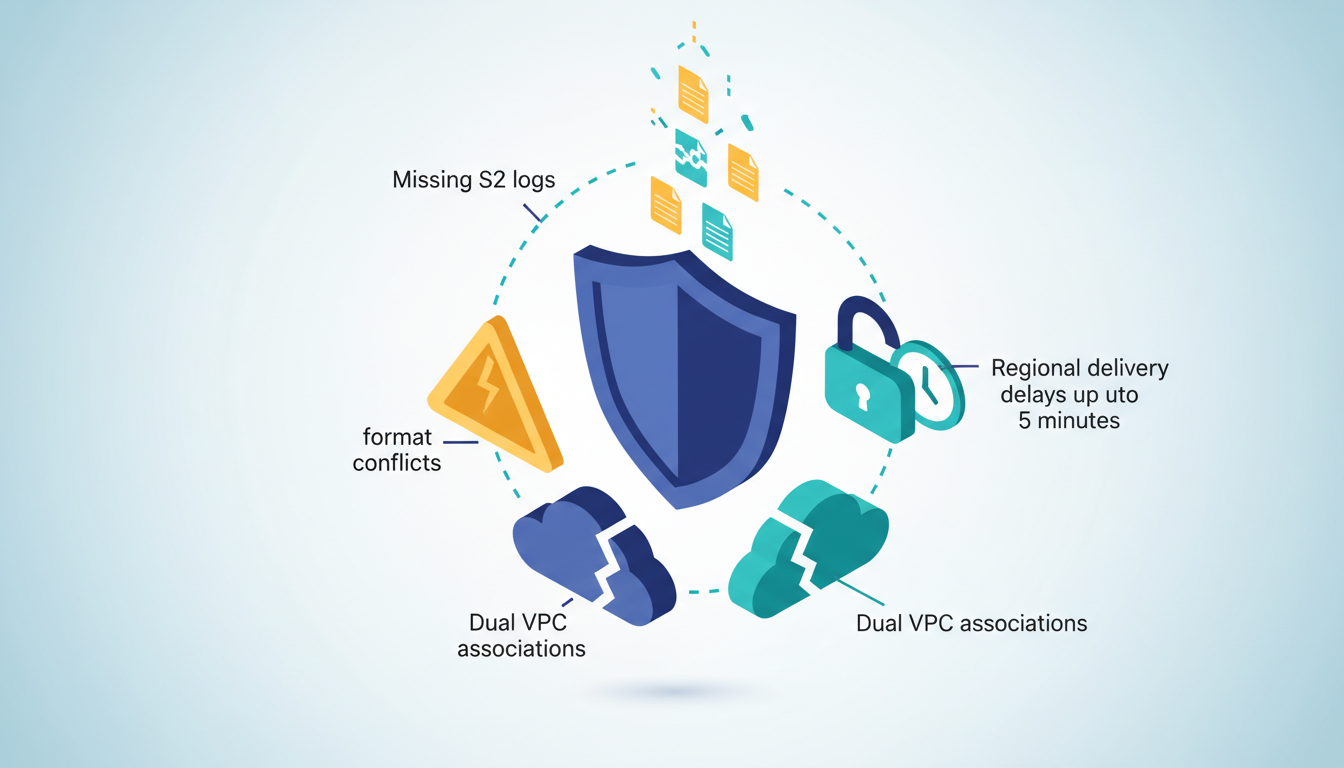
Simultaneous direct and Profile associations create structural divergence in naming conventions, complicating automated parsing pipelines. Direct VPC association logs apply the (vpc-id_instance-id) format, whereas Profile-based association logs prepend the profile identifier as (profile-id_vpc-id_instance-id). Scripts expecting a fixed two-field delimiter fail immediately when encountering the three-field Profile structure, causing silent data loss during aggregation.
| Association Type | Log Name Format | Parsing Risk |
|---|---|---|
| Direct VPC | (vpc-id_instance-id) | Low (static length) |
| Route 53 Profile | (profile-id_vpc-id_instance-id) | High (variable offset) |
Hidden operational costs emerge from maintaining dual ingestion paths:
- Storage bills double for the same query traffic.
- Custom parsers require conditional logic to handle mixed formats.
- Alerting thresholds trigger falsely due to inflated query counts.
- Audit trails become fragmented across disjointed S3 buckets.
The root cause is often a staged migration where legacy configurations remain active post-deployment. Removing the direct association before validating the Profile propagation eliminates the duplication vector. Operators must treat these formats as mutually exclusive states rather than complementary layers. Failure to serialize the transition results in permanent log schema inconsistency.
- Duplicate Storage Costs: Maintaining parallel manual logging in unsupported regions inflates storage bills alongside the primary Route 53 Resolver Query Logging stream.
- Parsing Overhead: Engineering teams must write custom scripts to normalize log formats between manual VPC associations and Profile-driven entries.
- Incident Response Delay: Troubleshooting DNS failures slows significantly when security teams cannot correlate events across fragmented logging destinations.
InterLIR recommends treating the owner account as a critical single point of failure and implementing strict deletion guards via IAM policies. The limitation is absolute: sharing resources with Route 53 Profiles stops at the edge of supported infrastructure, requiring hybrid management models for truly global footprints.
About
Evgeny Sevastyanov serves as the Support Team Leader at InterLIR, a specialized IPv4 marketplace dedicated to optimizing network resource availability. His daily responsibilities involve managing complex DNS configurations, including the creation and maintenance of objects within RIPE and APNIC databases, which directly informs his expertise on Amazon Route 53 Profiles. Having led customer support for IPv4 leasing, Evgeny understands the critical need for consistent DNS query logging across fragmented network environments. His hands-on experience troubleshooting connectivity issues for global clients highlights the operational burdens of manual VPC management. At InterLIR, where security and clean BGP route objects are core values, implementing centralized logging is necessary for maintaining IP reputation and transparency. This article uses Evgeny's practical background in network administration to guide teams toward reducing compliance gaps and achieving thorough visibility into their AWS DNS activities through automated profiles.
Conclusion
Scaling Route 53 Profiles reveals a hidden tax on engineering velocity rather than just infrastructure spend. As query volumes swell, the structural divergence between manual and automated logging prefixes creates a compounding debt in log normalization that standard parsing tools cannot resolve without custom intervention. This fragmentation forces security teams to maintain parallel investigation workflows, directly increasing mean time to detection during DNS-based incidents. The current architecture demands a hybrid operational model where global consistency is sacrificed for regional availability, making a "set and forget" strategy impossible for multi-region enterprises.
Organizations must freeze new Profile deployments for critical workloads until AWS expands regional support or offers native cross-region replication. Until then, treat the owner account as a high-risk single point of failure by enforcing strict SCP guardrails that prevent resource deletion across all member accounts. Do not rely on eventual consistency for audit trails; instead, architect your logging strategy assuming specific regions will remain isolated indefinitely.
Start by auditing your S3 bucket policies this week to identify any logging prefixes created outside the Profile standard, then tag these resources explicitly as "manual-override" to track the true scope of your fragmentation. This inventory provides the baseline data needed to calculate the actual cost of bypassing native limitations before committing to a permanent hybrid architecture.
Frequently Asked Questions
Public internet resolution incurs standard pricing of $0.40 per million queries. Efficient rule matching becomes financially relevant to control these specific query costs effectively.
Structural divergence in naming conventions causes duplicate entries stored in separate S3 prefixes. Architects must plan data aggregation paths carefully before enabling wide-scale deployment.
AWS Resource Access Manager facilitates secure sharing of these configurations across organizational boundaries. This allows complex multi-account architectures to maintain comprehensive DNS visibility without manual setup.
The architecture enforces strict precedence rules where local DNS settings override Profile associations. Operators must account for this hierarchy when debugging connectivity issues in hybrid environments.
The limitation remains that log destinations must reside in the same region as the query logging configuration. This constraint forces architects to plan data aggregation paths carefully.