Route leak lessons from Cloudflare's 25-min outage
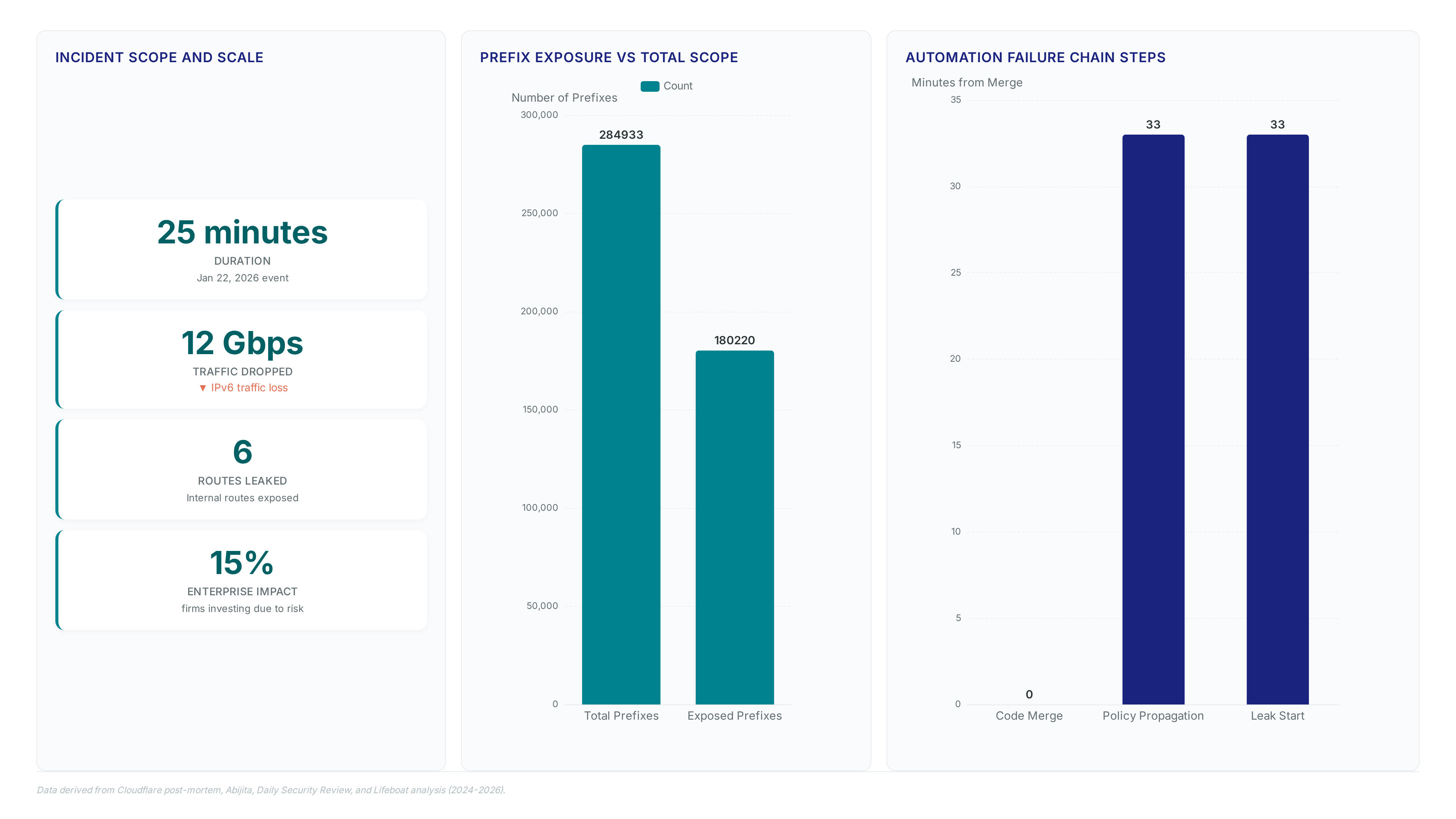
A 25-minute automation error forced 12Gbps of stray IPv6 traffic through Cloudflare's Miami router on January 22, 2026. This incident proves that automated policy platforms now pose a greater stability risk than human error when rigorous testing protocols fail. The industry's rush toward configuration efficiency has created fragile systems where a single code merge triggers cascading routing failures across the global backbone.
We must dissect the mechanics of valley-free routing violations, specifically how Cloudflare inadvertently breached RFC7908 standards by redistributing peer routes to upstream providers. The automation failure chain documented by Bryton Herdes traces the bug from a merged repository change to the discard of non-downstream prefixes by firewall filters. Moving beyond theoretical best practices, we need concrete operational mitigation strategies to prevent similar BGP route leaks in an era of hyper-automated network management. This event highlights a critical shift: the need for "safer configuration changes" that account for the volatility of automated routing policies. As ARIN reports and other bodies track these anomalies, the focus must turn to hardening the automation tools themselves rather than just reacting to the outages they cause.
The Mechanics of BGP Route Leaks and Valley-Free Routing Violations
RFC7908 defines a route leak as an Autonomous System appearing unexpectedly in an AS path to forward traffic it should not handle. This anomaly violates valley-free routing principles when a network propagates peer-learned routes upstream to a provider. Such violations create transient blackholes because intermediate routers lack firewall filters for the misdirected flow volume. The standard describes this specific failure mode where policy boundaries between customer, peer, and provider roles collapse.
Operators relying on public datasets can detect these anomalies using RIPE RIS (RIPE's routing information service ris) ripe.net/presentations/55-bgpstream. Pdf) collectors that monitor global route propagation patterns. These tools reveal how a single misconfigured export policy injects invalid paths into the global table. The January 2026 incident involving AS8048 demonstrated how separate announcements over an hour can compound congestion across multiple transit links. Detection latency remains high because most monitoring systems correlate data slowly compared to the speed of automated policy deployment.
Prevention requires strict adherence to RFC9234 which ties BGP roles to update permissions explicitly. The limitation of this approach is that legacy gear often lacks support for the required only-to-customer attribute signaling. Networks must therefore implement manual prefix filters as a fallback mechanism until hardware refreshes occur. Cloudflare propagated Type 3 and Type 4 route leaks for 25 minutes, discarding 12 Gbps of IPv6 traffic due to permissive export policies.
The incident originated when automation code removed specific prefix filters, causing the Miami router to accept and re-advertise internal routes to external peers and providers. This configuration error violated valley-free routing by pushing peer-learned paths upstream, a behavior explicitly categorized under RFC7908 definitions. External observers tracking the January 22, 2026 anomaly noted that Route Views data captured the sub-30-minute window more effectively than slower full-state snapshots. The AS path manipulation forced distant networks to route traffic toward a node lacking firewall rules for those destinations, resulting in immediate packet drops.
| Leak Type | Direction Violation | Consequence |
|---|---|---|
| Type 3 | Peer to Provider | Upstream congestion |
| Type 4 | Peer to Peer | Lateral traffic loop |
Manual intervention by operators halted the incident after 25 minutes, yet the 12 Gbps loss volume highlights the speed at which automation bugs cascade. Relying solely on post-event analysis leaves networks vulnerable during the detection gap. The cost of rapid reversion is high: pausing automation halts all legitimate policy updates across the infrastructure. Operators must implement local RPKI validation to reject anomalous paths before they consume bandwidth.
Hijacking asserts unauthorized origin ownership, whereas leaks introduce unexpected AS numbers into valid AS path sequences. Mitigation strategies differ: origin validation stops hijacks, while path analysis catches leaks. BGP hijacking involves an AS claiming prefixes it does not hold, breaking the chain of trust at the source. Conversely, a route leak preserves origin authenticity but violates valley-free routing by propagating routes upstream to providers.
| Feature | BGP Hijacking | Route Leak |
|---|---|---|
| Origin Validity | Invalid / Unauthorized | Valid / Authorized |
| Path Anomaly | Shortest path diversion | Unexpected AS appearance |
| Primary Defense | RPKI ROA | ASPA / RFC9234 |
| Intent Signal | Malicious or accidental | Typically accidental |
Automation bugs frequently trigger leaks by stripping export filters, causing peers to re-advertise traffic to providers. Such incidents resemble the AS8048 anomaly observed in Venezuela earlier in 2026, where separate announcements created similar path confusion. Detecting these shifts requires moving from manual logs to frameworks like BGPStream for large-scale pattern recognition. However, implementing RFC9234 roles adds operational overhead that smaller networks often defer. The cost of delayed adoption is measurable: leaked traffic consumes backbone capacity meant for customer flows, forcing manual reversion under load. Operators must distinguish path anomalies quickly to apply the correct filter, as rejecting valid origins during a leak causes unnecessary outages.
Anatomy of the Cloudflare Incident and Automation Failure Chain
Policy Automation Diff Logic and Prefix List Removal
Removing the `6-BOG04-SITE-LOCAL` prefix list from export policies inadvertently created a permissive rule set that accepted all internal routes. The automation platform interpreted this diff as a complete removal of restrictions rather than a targeted update for the Bogotá data center. This logic error transformed a specific filter into a blanket accept statement for any route matching the `route-type internal` criterion.
The mechanism failure stems from how policy generators handle negative diffs in stateful configurations. When the code repository merged the change, the resulting configuration lacked explicit deny statements for non-target prefixes.
- The automation engine calculated the delta between old and new states.
- It deleted the specific Bogota prefix references from multiple peer export terms.
- The remaining policy structure defaulted to accepting all unmatched internal routes.
Operators often assume that removing a specific item narrows scope, yet the policy automation platform expanded the attack surface by eliminating the only restrictive clause. The cost of this assumption is measurable: internal IPv6 routes were advertised to external peers, violating valley-free principles.
| Configuration State | Prefix Filter Status | Route Acceptance Scope |
|---|---|---|
| Pre-Change | `6-BOG04-SITE-LOCAL` active | Restricted to Bogota unicast only |
| Post-Change | Filter removed entirely | Unlimited internal route acceptance |
Network architects must treat diff-based deployments as requiring explicit default-deny safeguards. Relying on implicit restrictions creates fragility when automation modifies BGP announcements Without hard-coded fallbacks, a single line deletion can propagate invalid paths globally.
Meanwhile, the 19:52 UTC code merge initiated a chain reaction that propagated faulty export policies to edge routers by 20:25 UTC. Automation logic removed specific prefix lists intended for the Bogotá data center, inadvertently creating a blanket permit rule for all internal IPv6 routes. This configuration diff transformed a targeted filter into a permissive statement accepting any route matching the `route-type internal` criterion. The router in Miami immediately advertised these internal paths to upstream providers like Cogent and Level3, violating valley-free routing principles.
External traffic flowed toward Miami based on these erroneous announcements, triggering discards on ingress interfaces. Firewall filters designed to protect customer services dropped the misdirected flow because the source prefixes did not match allowed access lists. The volume of discarded packets caused measurable congestion on backbone links within the Florida facility. Operators investigating the incident architecture observed that the leak persisted until a manual revert at 20:50 UTC halted the advertisements.
| Event Time | Action Type | Network State |
|---|---|---|
| 19:52 UTC | Code Merge | Repository updated with bug |
| 20:25 UTC | Automation Run | Invalid routes advertised globally |
| 20:40 UTC | Detection | Team begins traffic analysis |
| 20:50 UTC | Manual Revert | Automation paused; leak stops |
This sequence highlights how automation-induced instability can bypass standard validation checks when diffs alter policy logic rather than static values. The reliance on automated platforms introduces a single point of failure where a minor syntax change cascades into global disruption. Dual-stack environments remain particularly vulnerable to such IPv6 specifics because monitoring tools often prioritize IPv4 visibility. Rapid manual intervention remains the only reliable fallback when automated safeguards fail to catch permissive policy generation.
IPv6 Traffic Congestion and Backbone Infrastructure Impact
IPv6-only exposure during the January 22, 2026 The route leak funneled external traffic through the Miami data center, creating immediate congestion on backbone links that lacked capacity for the unexpected volume. Firewalls discarded non-downstream packets, yet the sheer influx saturated ingress buffers before filtering could occur. This bottleneck forced legitimate traffic into queue overflows, spiking latency for unrelated parties traversing the Miami node.
The automation failure highlights a tension between aggressive prefix optimization and safety margins in export policies. Removing specific lists without verifying default deny behaviors created a permissive hole that accepted all internal routes.
| Traffic Type | Filter State | Result |
|---|---|---|
| IPv4 | Specific prefix lists active | Normal forwarding |
| IPv6 | Prefix lists removed | Global route leak |
Operators must recognize that firewall filters act as a final defense, not a primary control plane safeguard. Once a router advertises a path, upstream peers shift traffic immediately, often overwhelming local discard mechanisms. The cost of this architectural assumption is measurable congestion that persists until manual reversion stops the advertisements.
BGP Community Safeguards and Explicit Reject Policies
Explicit reject policies using BGP communities block provider-learned routes from external exports, enforcing strict valley-free routing boundaries. Operators must tag ingress routes with specific community values that trigger drop actions in egress policy terms, preventing accidental redistribution to upstream transit. This mechanism counters automation errors where removing a prefix list inadvertently creates a blanket permit statement for all internal routes. Cloudflare identified this logic gap as the root cause of their January 2026 incident, where a diff operation erased restrictions on Bogotá prefixes. The safeguard requires embedding reject logic directly into export templates rather than relying solely on positive prefix matches.
Embedding policy validation scripts into CI/CD pipelines catches empty terms before the 20:25 UTC automation window. Operators must configure linters to flag policy statements lacking explicit match conditions, preventing the logic error where removing a prefix list creates a blanket permit. The January 22, 2026 incident proves that stateful diffs can erase restrictions if generators lack negative-diff safeguards. Testing frameworks should reject any configuration where `from` clauses resolve to null sets after variable substitution.
| Validation Stage | Check Type | Failure Mode |
|---|---|---|
| Pre-merge | Syntax lint | Malformed community lists |
| Staging | Logic audit | Empty prefix lists |
| Production | Rollback trigger | High discard rates |
Strict validation increases deployment friction, potentially delaying legitimate updates during outages. Teams face a tension between speed and safety when manual reversion takes longer than automated propagation. Patching the routing policy automation Without these checks, code repositories accept changes that violate valley-free routing principles. The industry shift toward AI-driven network operations demands rigorous testing, yet the projected 1.2 million engineer deficit forces reliance on fragile scripts. This approach shifts failure detection left, stopping leaks before they reach edge routers.
Automated configuration changes lack sufficient validation gates, allowing permissive policy diffs to propagate before detection systems trigger. The Cloudflare January 22, 2026 Route Leak Detection latency increases when relying on standard collector intervals rather than high-frequency feeds capable of catching transient events. Route Views offers higher frequency updates every five minutes, providing a narrower window for identifying anomalies compared to fifteen-minute cycles. This temporal gap allows erroneous advertisements to saturate backbone links before operators observe the shift in traffic patterns.
The root cause lies in automation logic that fails to validate empty match conditions after variable substitution.
| Failure Mode | Trigger Condition | Detection Gap |
|---|---|---|
| Null Prefix List | Variable removal | Policy accepts all internals |
| Silent Merge | CI/CD bypass | No staging audit |
Operators must integrate linters that reject policy statements resolving to null sets during pre-merge checks. Automation-Induced Instability trends indicate that efficient platforms introduce cascading failure risks without rigorous testing frameworks. The cost of rapid deployment is measurable: false permits propagate globally while monitoring tools wait for the next polling cycle.
Defining Reversion Triggers Using Empty Policy Term Detection
Immediate reversion becomes mandatory when automation removes a prefix list, leaving a policy term with no match conditions to accept all internal routes. This specific failure mode transforms a restrictive export filter into a permissive gateway, violating valley-free routing principles within seconds of deployment. The January 2026 incident illustrates how a diff operation targeting Bogotá prefixes inadvertently erased restrictions on the Miami router, creating a blanket permit statement for IPv6 traffic. Operators must embed linters into CI/CD pipelines that specifically flag empty policy terms where `from` clauses resolve to null sets after variable substitution.
Real-World Impact of Discarded Traffic on SLA Credits
Discarding 12Gbps of non-downstream IPv6 traffic triggered immediate financial penalties through SLA credit clauses. Congestion between Miami and Atlanta forced firewall filters to drop legitimate packets intended for external networks. This packet loss represents a direct cost in terms of SLA credits that operators must honor regardless of root cause. Delayed manual reversion extends the window of liability, compounding the reputational damage alongside monetary fines. Network engineering teams face a tension between rapid automation deployment and the fiscal risk of unvalidated policy diffs. The economic impact includes measurable congestion costs that exceed simple bandwidth overage fees.
Dual-Stack Vulnerability Risks in IPv6-Only Incidents
IPv6-specific automation failures bypass standard IPv4 health monitors, creating false confidence during dual-stack outages. The January 2026 event proves that protocol-specific misconfigurations Operators monitoring only aggregate link utilization miss the total loss of IPv6 reachability because IPv4 metrics remain nominal. This asymmetry delays detection until customer complaints overwhelm NOC channels. Automated policy platforms introduce cascading failures when logic errors target unicast prefix lists for one address family exclusively. Firewalls discard non-downstream traffic silently, masking the scale of the leak from internal telemetry. Network teams often lack separate alerting thresholds for BGP announcements per protocol stack. Relying on unified dashboards obscures the precise moment a route leak begins affecting only half the infrastructure. InterLIR recommends deploying independent validation gates for IPv6 policy diffs to prevent silent stack degradation.
About
Georgy Masterov, a Customer Support Specialist at InterLIR and Computational Business Analytics student, offers a unique perspective on the recent BGP route leak incident. His daily work managing IP resource management and ensuring clean BGP records directly connects to the technical complexities of routing policy errors. At InterLIR, a Berlin-based IPv4 address marketplace founded on values of security and transparency, Georgy routinely verifies route objects to prevent exactly these types of network availability issues. This practical experience with IP reputation and infrastructure integrity allows him to analyze how configuration mistakes at substantial providers like Cloudflare ripple through the global internet. By combining his background in finance, IT, and direct customer support, Georgy effectively bridges the gap between high-level network theory and the real-world impact on businesses relying on stable IPv4 resources.
Conclusion
Scale breaks when automation treats dual-stack environments as a single logical entity, allowing IPv6 policy errors to propagate undetected while IPv4 metrics remain stable. The operational cost here is not merely lost traffic but the delayed mean-time-to-detection caused by aggregated dashboards that mask stack-specific failures. As networks grow, assuming uniform health across address families creates a blind spot where BGP announcements can hijack half your infrastructure without triggering standard utilization alarms. You must decouple validation logic for each protocol immediately.
Implement independent IPv6 policy gates within your CI/CD pipeline by next quarter, mandating that any prefix-list modification undergoes stack-specific simulation before deployment. Do not wait for a post-mortem to justify the engineering overhead; the financial exposure from a twenty-five-minute silence on one stack exceeds the investment in segregated testing frameworks. Start by auditing your current alerting rules this week to ensure IPv6 reachability checks exist separately from IPv4 link utilization monitors. If your NOC cannot distinguish a total IPv6 blackout from normal operations using current tools, you are operating on false confidence. Fix the visibility gap before the next automation cycle runs.
Frequently Asked Questions
The automation error caused routers to discard exactly 12 Gb of stray IPv6 traffic. This massive volume overwhelmed firewall filters designed only for specific Cloudflare services, causing immediate packet loss.
The incident involved Type 3 and Type 4 leaks that breached valley-free routing principles. These violations forced 12 Gb of external traffic through a node lacking proper firewall acceptance rules.
Operators manually reverted the bad configuration after twenty-five minutes of unintended route advertisements. During this brief window, the error funneled significant congestion onto backbone infrastructure before being halted.
External traffic was incorrectly funneled through Miami routers that dropped packets via firewall filters. This misdirection created elevated loss and higher latency for any data attempting to traverse the affected links.
A merged repository change removed specific prefix filters, allowing permissive export policies to activate. This single code merge caused the Miami router to accept and re-advertise internal routes to external peers.