RTBH validation needs strict originASonly checks
Validating RTBH routes demands strict originAS-only checks paired with the mandatory BLACKHOLE community. This combination stops hijack abuse cold.
The industry is shifting toward RPKI-dependent RTBH architectures. Operators now couple RTBH services with Route Origin Validation (ROV) specifically to prevent attackers from blackholing legitimate traffic via prefix hijacks. Major exchanges like the London Internet Exchange (LINX) treat this as standard. Any route announcing the BLACKHOLE community must pass origin-AS and prefix-object validation before propagation. Relying on maxLength checks alone leaves dangerous gaps. Widely adopted filtering solutions that ignore strict originAS verification create openings for abuse if the BLACKHOLE community attachment isn't enforced.
We will architect a secure verification pipeline using BMP monitoring sessions isolated for IP transit customers. Only specific /32 and /128 prefixes enter the validation loop. We also address the critical operational risk of misordered import policies. Moving the RPKI check before the RTBH filter in your router configuration is non-negotiable to avoid accepting invalid routes.
The Role of OriginAS-Only Validation in Secure Blackhole Routing
OriginAS-only validation for RTBH routes ignores maxLength constraints. It strictly mandates the BLACKHOLE community attachment. This mechanism prevents attackers from hijacking prefixes to trigger remote blackholes without possessing the legitimate origin key. Validation logic discards any announcement lacking the specific community tag, regardless of origin signature status.
Research presented at PAM 2024 confirms that IXP route servers remain vulnerable to prefix mis-origination attacks unless ROV checks precede propagation. Without this strict ordering, invalid routes bypass filtering layers and consume upstream bandwidth. The BLACKHOLE community standard set in RFC 7999 establishes the baseline requirement for this operational safety.
Architecture of RTR Protocol and BMP Monitoring for Route Verification
RTR Protocol Synchronization and VRP Payload Mechanics
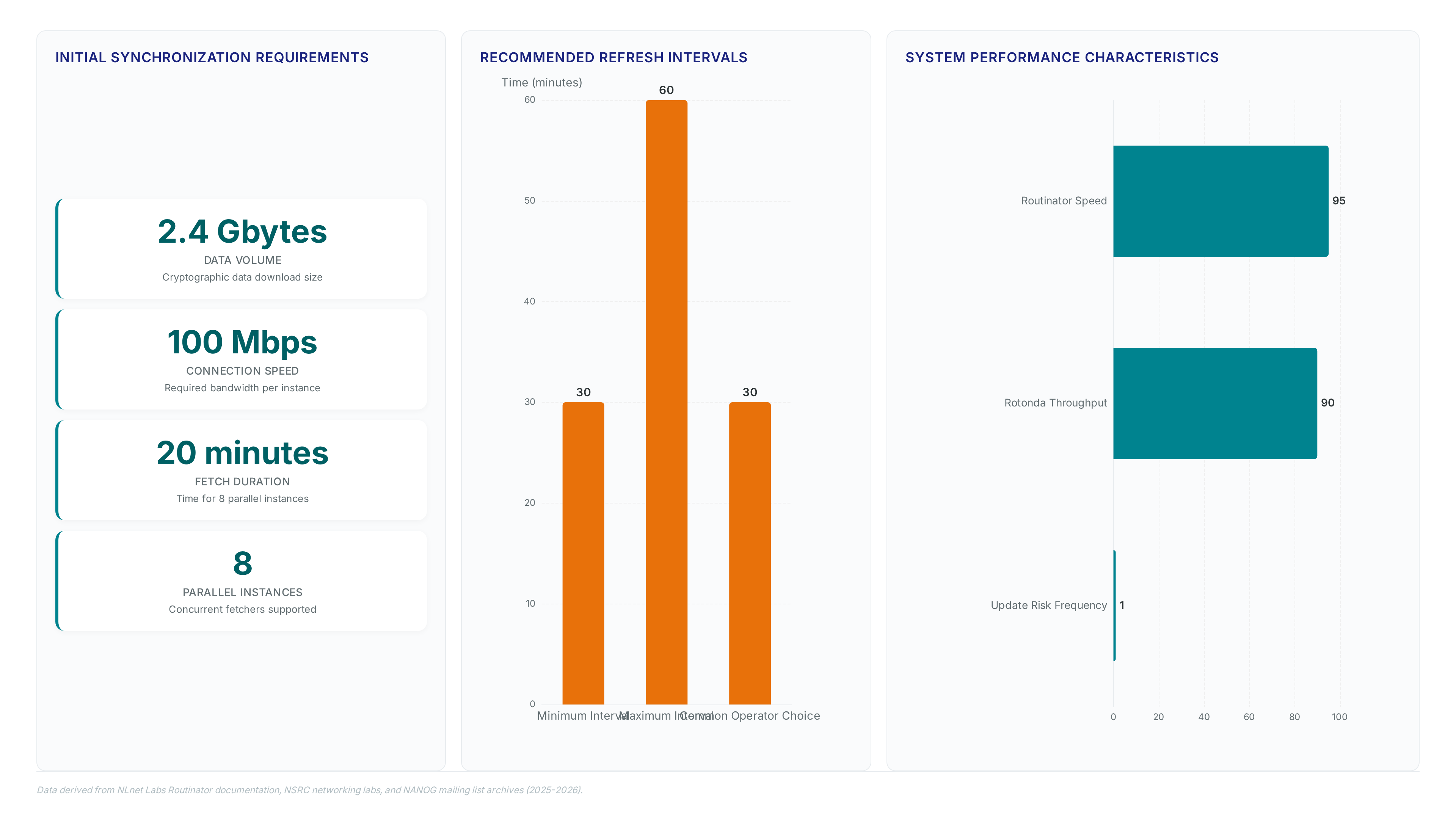
Initial VRP synchronization downloads 2.4 Gbytes of cryptographic data before routers can enforce origin validation. The Routinator software acts as a cache, fetching certificates from Trust Anchors to build a local database of Validated ROA Payloads. Routers connect to this cache over TCP, pulling only the delta changes rather than re-downloading the full dataset every cycle. This separation minimizes cryptographic load on the forwarding plane while maintaining up-to-date validation states.
Synchronization speed depends heavily on available bandwidth and concurrent instance counts. Operational costs include maintaining a 100Mbps connection to ensure eight parallel instances complete their initial fetch within 20 minutes. Standard industry guidance suggests refreshing this data every 30 to 60 minutes to balance freshness against network overhead. Quicker intervals increase CPU utilization on the cache server without significantly improving security posture against slow-moving hijacks.
| Component | Function | Data Source |
|---|---|---|
| Routinator | Fetches ROAs from RIRs | Trust Anchors |
| RTRTR Daemon | Pushes JSON updates | Rotonda RIB |
| Router | Enforces policy | RTR Session |
Update frequency fights stability. Pushing updates every second, as seen in custom daemon implementations, risks flapping routes if the upstream RPKI repository experiences transient inconsistencies. Most operators accept the 30-minute window to avoid unnecessary churn in the global routing table. The drawback is a brief exposure window where newly issued ROAs remain invisible to edge routers, potentially allowing invalid announcements to pass until the next cycle completes.
Configuring Junos BMP Sessions for Transit Customer adj-RIB-in
Junos isolates adj-RIB-in updates for transit customers by binding specific BGP groups to a dedicated BMP session.
This complexity carries operational overhead: maintaining three distinct daemons requires rigorous version control and host hardening. Unlike monolithic validators, this distributed approach allows independent scaling of the filtering plane versus the crypto plane. Failure in the custom daemon halts blackhole propagation entirely, creating a single point of failure absent in standard RTR setups. Network teams must monitor the JSON write latency specifically, as delays here directly extend the window of vulnerability during active attacks.
The Roto filter allowed only /32 v4 and /128 v6 prefixes to prevent the blackholing of large aggregates which could cause widespread collateral damage. Without this strict length gating, a single misconfigured announcement carrying the BLACKHOLE community could sink an entire regional block instead of a specific host. Operators relying on originAS checks alone face exposure if the attacker controls a valid origin for a broader aggregate. The prefix length restrictions enforced by tools like Rotonda act as a mandatory circuit breaker against such cascading failures.
Missing community verification creates a binary failure mode where any route with the tag becomes a discard entry regardless of validity. This flaw allows hostile actors to announce stolen space with the community tag to drop legitimate traffic upstream. The LINX route server policy Ignoring these constraints turns a mitigation tool into a vector for denial-of-service attacks against valid prefix owners.
| Failure Mode | Trigger Condition | Consequence |
|---|---|---|
| Aggregate Blackhole | Missing length filter + present community | Entire /24 or larger block dropped |
| Origin Hijack | Missing ROV check + present community | Traffic redirected to sinkhole |
| Policy Bypass | Incorrect import order | Invalid routes installed in FIB |
In practice, the cost of omitting these checks is measurable in lost reachability for thousands of unrelated customers.
Moving the RTBH check after the RPKI check forces invalid origins to drop before community logic evaluates the route. This reordering modifies the import policies list without altering individual policy definitions, effectively changing the validation flow. Operators asking if they should move the RTBH check after the RPKI check must recognize that sequence dictates survival. A route failing origin validation never reaches the blackhole term, preventing attackers from hijacking prefixes and tagging them for discard. Linx.
However, this dependency creates hidden operational costs when validation states fluctuate during cache syncs.
- Valid routes temporarily marked unknown may bypass blackhole filtering if the policy chain skips strict terms.
- High-throughput environments require blazingly fast validation engines to prevent queue buildup before policy execution.
- Misordered lists allow malicious actors to exploit the gap between community detection and origin verification.
The limitation is clear: Junos processes terms sequentially, so a misplaced reject statement renders subsequent community matches unreachable. Operators must prioritize cryptographic origin proof over tag presence to secure the adj-RIB-in table. The cost of incorrect ordering is total bypass of the safety mechanism, leaving the network exposed to hijacked discards.
Implementing Local-Preference Tags for Valid RTBH Routes
Setting local-preference to 1000 forces routers to select validated blackhole paths over standard transit immediately after RPKI clearance.
Operators apply this high metric only when the route carries the no-export community, preventing accidental leakage to external peers Community Attributes The mechanism relies on strict policy ordering where origin validation occurs before community evaluation. A production deployment described on NANOG utilized a custom daemon to fetch prefixes from a filtered RIB, validate the origin ASN against VRPs, and inject only confirmed routes into the forwarding plane. This setup ensures that invalid origins never trigger the high-preference discard logic.
Skipping mandatory BLACKHOLE community verification allows attackers to inject invalid prefix hijacks that trigger immediate traffic discard. Policy chains evaluating remote-triggered black hole markers before cryptographic origin checks create a fatal logic gap where bad routes win. An adversary announcing a stolen prefix with the discard tag exploits this ordering to sink legitimate traffic before RPKI validation occurs. The cost of non-compliance includes potential traffic hijacking which represents a significant implicit financial loss for ISPs failing to filter correctly.
Hidden operational costs emerge when policy order remains static while threat vectors evolve dynamically across the global routing table.
Rotonda Roto Filter Logic for RTBH Prefix Validation
Rotonda enforces strict /32 IPv4 and /128 IPv6 prefix limits to block aggregate blackholing. The Roto filter accepts routes only if they carry the RTBH community or represent withdrawals. This logic prevents a single misconfigured announcement from sinking entire regional blocks instead of specific hosts. Operators relying solely on originAS checks face exposure if an attacker controls a valid origin for a broader aggregate.org/nanog/2026/Mar/43) act as a mandatory circuit breaker against such cascading failures. Validation requires a specific sequence where cryptographic checks precede community evaluation. A custom daemon fetches prefixes from the Rotonda RIB via API before verifying the origin ASN against VRPs. This validation workflow ensures invalid routes drop before the blackhole term ever processes them. However, this dependency introduces latency if the API polling interval exceeds the convergence window.
Skipping the length gate allows attackers to exploit valid origins for massive traffic diversion. Most deployments fail because they treat community tags as sufficient without verifying prefix specificity. The cost of this omission is measurable in widespread collateral damage during active hijack events.
Configuring Junos Import Policy Order for RPKI and RTBH Checks
Junos import policy lists require reordering so the RPKI check term precedes the RTBH check term to block invalid origins. Operators must modify the sequence in the `import` list rather than rewriting individual policy definitions. This structural change ensures that routes failing origin validation never reach the blackhole evaluation logic. Pdf) confirms that skipping this order leaves blackhole services vulnerable to prefix mis-origination. The implementation uses a dedicated RTR session for real-time updates alongside standard synchronization channels. A custom daemon fetches filtered prefixes from Rotonda and validates the origin ASN against local VRPs. Only confirmed routes enter the JSON file read by the RTRTR daemon every second.
Standard practice enforced by the London Internet Exchange (LINX) mandates that routes carrying the Blackhole community pass origin-AS and RPKI validation if prefix lengths fall between /8 and /24. Operators must tag valid RTBH routes with the no-export community attribute to prevent accidental leakage to external peers Community Attributes. Setting a specific local-preference value of 1000 or 200 ensures the blackhole route overrides standard paths within the local domain. However, relying solely on originAS checks without prefix-length restrictions exposes networks to aggregate hijacks that sink legitimate traffic. InterLIR recommends coupling these community checks with strict prefix filters to mitigate collateral damage from misconfigured announcements.
| Attribute | Required Value | Function |
|---|---|---|
| Community | no-export | Prevents external propagation |
| Local Preference | 1000 or 200 | Overrides standard path selection |
| Prefix Length | /32 (v4) or /128 (v6) | Limits scope to specific hosts |
- Verify the no-export community exists on all incoming blackhole announcements.
- Confirm local-preference settings exceed default values to guarantee preference.
- Apply prefix-length filters to reject aggregates larger than host routes.
Skipping the no-export tag allows malicious actors to propagate discard routes across peering boundaries, causing widespread outages. This configuration gap turns a defensive tool into an offensive weapon when validation logic fails to enforce containment.
About
Evgeny Sevastyanov serves as the Head of Customer Support at InterLIR, a Berlin-based IPv4 marketplace specializing in secure network resource redistribution. His daily responsibility involves managing RIPE and APNIC database objects, giving him direct, practical expertise in BGP routing security and Route Origin Validation (ROV). This hands-on experience with route object creation makes him uniquely qualified to discuss RTBH route validation methodologies. At InterLIR, ensuring clean BGP propagation and preventing prefix hijacks are critical to maintaining the reputation of leased IP blocks. Sevastyanov's work directly aligns with the article's thesis on coupling RTBH services with strict originAS checks. By enforcing policies that require the BLACKHOLE community, he helps safeguard the integrity of the global routing table, ensuring that InterLIR's customers receive reliable, attack-resistant network resources while adhering to industry best practices like those at LINX.
Conclusion
Scaling RTBH infrastructure reveals a critical bottleneck: the substantial cryptographic payload required for index synchronization demands sustained 100Mbps bandwidth just to meet the 20-minute fetch window. As networks couple RTBH with strict Route Origin Validation, this bandwidth tax compounds, creating a single point of failure where stale VRP data allows hijacked prefixes to bypass blackhole filters entirely. The operational cost shifts from simple route injection to maintaining high-throughput, low-latency connectivity for validation daemons, otherwise, the 30-minute refresh cycle creates dangerous exposure windows. Operators must treat validator connectivity as critical infrastructure, not an auxiliary service.
Mandate RPKI-dependent RTBH only after securing redundant, high-capacity links to RPKI repositories by Q3. Do not enable origin-coupled blackholing on links incapable of sustaining parallel fetches without packet loss. Start by auditing your router's fetch completion time against the 20-minute threshold this week; if synchronization exceeds this limit, provision dedicated bandwidth or localize the validator cache immediately. Failure to validate fetch latency renders the entire validation chain unreliable, allowing attackers to exploit the gap between data freshness and policy enforcement.
Frequently Asked Questions
You need a 100Mbps connection to ensure parallel initial fetches complete quickly. This speed supports the 2.4 Gbytes download required before your router can begin secure blackhole routing operations effectively.
Industry guidance suggests refreshing data every 30 to 60 minutes for optimal balance. Most operators accept the 30minute window specifically to avoid unnecessary churn in their routing tables while maintaining security.
The Roto filter allows only /32 IPv4 or /128 IPv6 prefixes carrying the blackhole community. This strict length constraint ensures that only specific host routes enter the validation loop for secure processing.
The software uses the BSD 3-Clause license, making it free for commercial use without fees. However, professional support services under an SLA are available though specific pricing tiers remain unpublished currently.
Enterprises face a talent shortfall of 1.2 million engineers by 2026, making manual auditing impossible. Automated validation becomes essential to prevent configuration errors when staff lack capacity to audit complex policy chains.