SCION network fixes fragile global bank paths
As of early 2026, SCION connects every bank clearing Swiss francs. BGP never guaranteed this for the entire sector. This deployment proves that digital sovereignty demands replacing vulnerable, trust-less routing with architecturally secure alternatives built for critical infrastructure. Bolting security onto the global Internet is obsolete. Financial institutions now require deterministic performance and cryptographic trust baked directly into the network layer.
We examine how the Secure Swiss Finance Network (SSFN) leverages Public Key Infrastructure to eliminate the routing hijacks plaguing traditional systems. We dissect the Colibri framework, enabling entities like the Swiss National Bank to reserve bandwidth via contracts instead of hoping for best-effort delivery during peak congestion. Finally, we analyze the strategic pivot to private infrastructure, where overlay networks deliver the low-latency certainty high-frequency trading demands without relying on the unstable public fabric.
While Border Gateway Protocol scales through opportunistic security patches, SCION enforces equity through a structured hierarchy of certification and price adjustments. Born from ETH Zurich research, this architecture aligns with European interests in network certainty. As Network World predicts a broader industry migration to isolated clouds this year, the SIX Group implementation stands as the definitive blueprint for securing the world's most sensitive data flows against geopolitical and technical fragility.
The Role of SCION in Establishing Digital Sovereignty for Financial Institutions
SCION Architecture and Deterministic Networking Principles
SCION discards best-effort forwarding for path-aware networking where end hosts construct explicit routes. Originating from ETH Zurich research in 2011, the architecture embeds cryptographic proofs directly into packet headers to validate every hop. This mechanism ensures deterministic networking by enforcing strict bandwidth contracts rather than relying on flexible table updates. Trading algorithms fail when latency varies unpredictably during market volatility; financial institutions cannot afford that risk. Adrian Perrig described the protocol as a quantum leap forward for securing global data flows against state-level interference.
Secure Swiss Finance Network Deployment for Digital Sovereignty
As of early 2026, the Secure Swiss Finance Network connects all banks clearing Swiss francs to enforce data sovereignty. This deployment links critical entities like the Swiss National Bank and SIX Group within a single PKI-secured overlay. Traditional BGP fabrics cannot guarantee the deterministic latency required for high-frequency trading algorithms during market volatility. SCION resolves this by allowing end hosts to construct explicit routes with cryptographic proofs embedded in packet headers. Operators gain path awareness that prevents unauthorized intermediaries from injecting delay or inspecting traffic flows. The architecture supports a 25 Gbit/s Testbench Workstation announced on 14 January 2026 for validating these performance bounds.
SCION Path Control Versus Legacy BGP Routing Vulnerabilities
The Internet's routing architecture relies on a 40-year-old foundation where intermediate routers dictate forwarding decisions without source input. SCION replaces this opacity with path-aware networking, allowing end hosts to construct explicit routes carried directly in packet headers. Traditional systems depend on fixed routing tables that offer no defense against hijacking once a packet leaves the local domain. In contrast, SCION enables both source and destination to jointly control route construction while respecting intermediate ISP policies. This shift from best-effort delivery to deterministic networking eliminates the ambiguity that plagues legacy BGP implementations during congestion events.
| Feature | Legacy BGP | SCION Architecture |
|---|---|---|
| Forwarding Logic | Hop-by-hop decisions | End-to-end path selection |
| Security Model | Opportunistic add-ons | Embedded cryptographic proofs |
| Path Visibility | Opaque to source | Fully visible to source |
| Trust Basis | Implicit peer relationships | Explicit PKI certificates |
Simulation studies tested 100 Autonomous Systems across 3 Isolation Domains to validate isolation properties before production rollout. The verification of the no Frankenpaths property was announced on 10 February 2021, proving mathematical guarantees absent in legacy systems. Operators gain superior flexibility because the protocol resolves security issues that incremental BGPsec adoption cannot address alone. The cost is increased complexity in managing control services for each Isolation Domain rather than relying on distributed router logic. Financial institutions accept this overhead because trading algorithms fail when latency varies unpredictably during market volatility.
Inside SCION: How PKI and Colibri Replace Vulnerable BGP Routing Mechanisms
The architecture divides the Internet's Autonomous Domains into a hierarchy of Trust Domains and Isolation Domains to enforce mutual accountability. Each domain agrees on a coherent root of trust, creating distinct security boundaries that legacy systems lack. This structure groups Autonomous Systems that share policy expectations, preventing unauthorized route propagation across organizational lines. Isolation Domains act as the primary containment unit for routing anomalies, ensuring that compromises in one sector do not cascade globally.
| Feature | Trust Domain (TD) | Isolation Domain (ISD) |
|---|---|---|
| Scope | Set of ADs with shared trust | Group of ASes with common root |
| Function | Enforces route computation rules | Maintains security boundaries |
| Failure Mode | Policy disagreement | Root certificate revocation |
Operators must manage certificate lifecycles manually, introducing operational overhead absent in BGP. The cost is measurable: every new peer requires explicit cryptographic validation rather than implicit acceptance. Durability to attacks improves because routing attacks become impossible by design through authenticated information. However, this security model demands strict coordination between entities, limiting spontaneous peering arrangements common in the current fabric. Public Key Infrastructure dependencies mean that losing a root key invalidates the entire domain's reachability until re-issuance completes.
Remote surgery and high-frequency trading demand deterministic latency that standard BGP fabrics cannot guarantee due to inherent congestion variability. The Colibri framework resolves this by enabling hosts to reserve bandwidth across specific paths, creating flyovers that bypass external traffic jams. Unlike BGP, which treats all packets equally during saturation, this mechanism enforces strict contracts between communicating parties using Public Key Infrastructure (PKI) certificates. Robotic surgical instruments require uninterrupted high-bandwidth video streams to prevent fatal control lag, while trading algorithms fail if execution delays fluctuate unpredictably. Operators configure these reservations through a lightweight inter-domain infrastructure that prioritizes protected packets over best-effort traffic.
The cost of this precision is the requirement for explicit coordination; operators must negotiate bandwidth prices and availability before traffic flows. This brokering bandwidth creates friction. Financial institutions accept this trade-off because market volatility renders variable latency unacceptable for arbitrage strategies. The framework integrates directly with SCION to ensure packets remain protected from external congestion throughout the entire process. Deployments relying on physical assets without such reservation capabilities remain vulnerable to the instability of the underlying routing fabric.
PKI Certificate Coordination and Price Adjustment Requirements
SCION coordination mandates Public Key Infrastructure (PKI) certificates and price adjustments to enforce equity among participating ISPs. Unlike Border Gateway Protocol (BGP), which added security opportunistically, this model makes routing attacks impossible by design through authenticated path construction. Operators must navigate a rigid hierarchy where Trust Domains (TDs) and Isolation Domains (ISDs) agree on a coherent root of trust before exchanging traffic. The cost of this security is measurable: deployment requires synchronizing certificate states across 12 referenced ISPs for Colibri integration, creating a coordination bottleneck absent in legacy fabrics. Price adjustments function as a market mechanism to prevent any single participant from monopolizing reserved bandwidth slices.
| Mechanism | BGP Legacy Approach | SCION Coordination Model |
|---|---|---|
| Trust Basis | Opportunistic patches | Built-in PKI certificates |
| Path Control | Hop-by-hop decision | Source-constructed explicit routes |
| Attack Surface | Vulnerable to hijacks | Routing attacks impossible by design |
| Resource Allocation | Best-effort congestion | Contracted bandwidth reservations |
Control plane operations shift from individual routers to dedicated services per ISD, simplifying hardware but centralizing logical complexity. This architecture guarantees communication despite DDoS attempts, yet it demands strict adherence to certification timelines that smaller carriers often miss. Failure to align price signals with certificate validity periods results in immediate path revocation, cutting off critical financial or medical data flows.
Deploying SCION Overlay Infrastructure for Low-Latency Financial Trading Systems
SCION Overlay Deployment Without BGP Forklift Upgrades
SCION deploys as a parallel architecture using simplified border routers that require no internal Autonomous System restructuring. Operators install these edge devices to encapsulate traffic, leaving the existing Border Gateway Protocol (BGP) fabric untouched for legacy reachability. This approach treats the new infrastructure as an independent plane rather than a patch, allowing SCION packets to traverse physical links without altering core forwarding tables.
| Deployment Aspect | Legacy BGP Upgrade | SCION Parallel Deploy |
|---|---|---|
| Internal AS Changes | Required | None |
| Router Hardware | Full replacement | Edge addition only |
| Risk Profile | High disruption | Low impact |
Global universities currently validate this model via SCIONLab, connecting independent Autonomous Systems through Attachment Points over standard Internet links. The separation allows financial firms to test deterministic paths while maintaining incumbent routing for general traffic. However, true independence demands eventual migration to dedicated physical assets to eliminate underlying BGP volatility entirely. Until that shift occurs, the overlay remains vulnerable to the very instabilities it aims to bypass.
Trading firms configure Colibri reservation agents to lock 25 Gb paths across trusted Isolation Domains before market open. Operators generate Public Key Infrastructure (PKI) certificates that bind specific bandwidth quotas to authenticated Trust Domains, preventing unauthorized path stitching. This process forces hosts to reserve bandwidth explicitly. The mechanism bypasses external traffic jams by enforcing strict contracts between communicating parties rather than relying on best-effort delivery. Financial institutions gain deterministic latency, yet the requirement for synchronized certificate states introduces a coordination bottleneck among peers.
Overcoming Carrier Cost Drivers and BGP Incumbency Barriers
Carrier procurement teams reject SCION because legacy Border Gateway Protocol (BGP) decisions prioritize short-term cost avoidance over national durability. The SCION Association highlights potential WAN cost efficiencies compared to traditional architectures, yet incumbents ignore these long-term savings. Eliminating manual tools for traditional protocols reduces operational spend, but carriers lack incentives to abandon established billing models. Deployment costs drop further because control plane operations shift to dedicated services, simplifying router hardware requirements at the edge. Technical superiority loses to entrenched economic inertia. Operators face a binary choice: continue subsidizing insecure best-effort transit or invest in sovereign infrastructure. The barrier is not technical feasibility but the financial refusal to alter existing revenue streams. Only then will Trust Domains displace the incumbent BGP fabric in critical financial sectors.
Strategic Criteria for Adopting SCION in Critical Banking and Healthcare Networks
Defining Digital Sovereignty Through SCION's Trust Domain Hierarchy
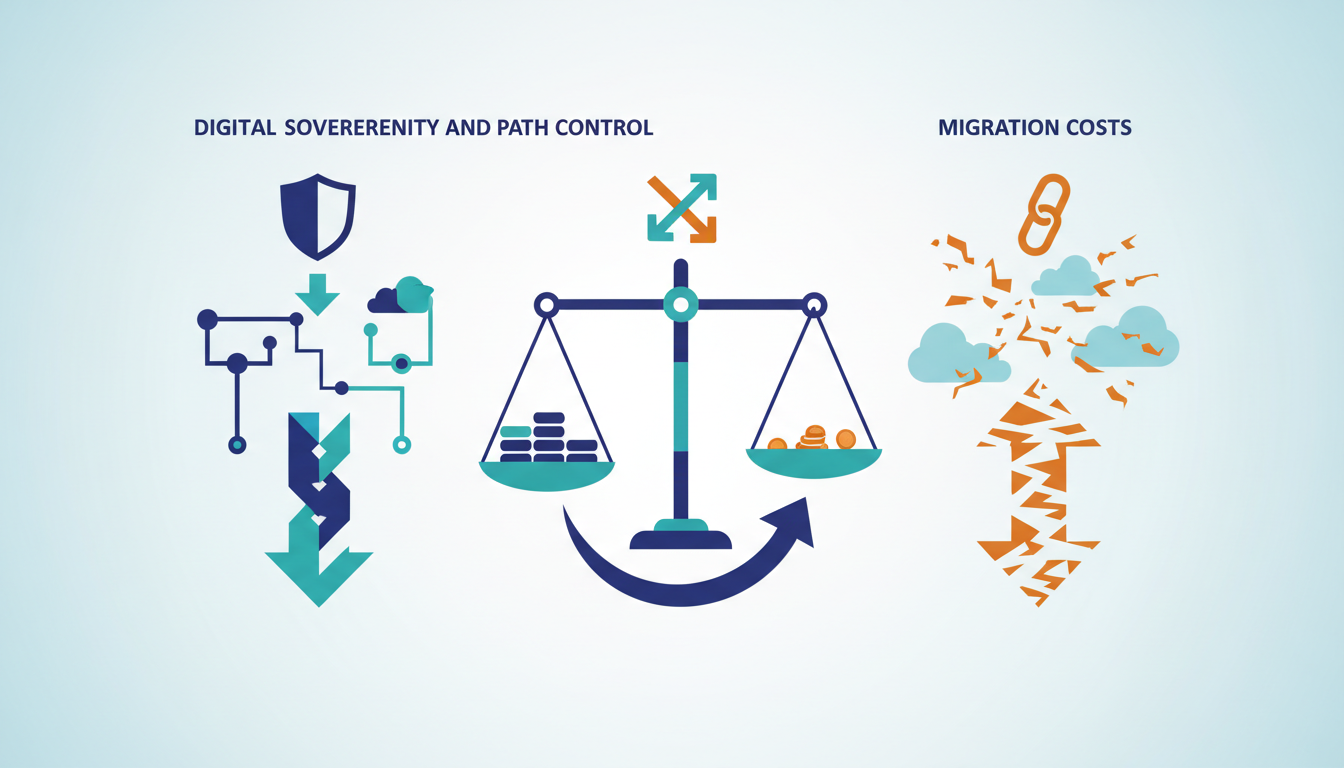
Financial institutions adopt SCION to replace state-anchored BGP roots with autonomous trust boundaries that enforce local policy control. This architecture groups Autonomous Systems into Isolation Domains where every participant agrees on a single, coherent certificate authority, effectively decoupling routing logic from global political interests. European banks use this hierarchy to ensure that path validation never relies on external jurisdictions, creating a sovereign network enclave distinct from the public Internet fabric.
| Trust Attribute | Legacy BGP Model | SCION Trust Domain |
|---|---|---|
| Root Authority | Implicit global consensus | Explicit local certificate |
| Path Validation | Post-hope filtering | Pre-computed cryptographic proof |
| Sovereignty Level | Low ( | High ( |
Operators gain deterministic control over data flows, yet this sovereignty introduces a rigid coordination requirement that slows flexible peering. The shift toward private cloud infrastructure in 2026 validates the need for such isolated networks, though managing multiple distinct roots increases operational complexity compared to a single global table. Banks must weigh the benefit of absolute path certainty against the overhead of maintaining independent PKI hierarchies for each trusted partner. True digital sovereignty demands accepting these administrative burdens to eliminate reliance on foreign routing policies.
Banking planners cut Wide Area Network spend by eliminating manual networking tools that plague legacy BGP operations. Research highlights WAN cost efficiencies. The SCION Association notes that removing manual intervention reduces both infrastructure outlays and operational overhead significantly. Financial firms shifting to private cloud infrastructure in 2026 find this automation aligns with broader moves toward isolated, secure networks. Regulated sectors like finance increasingly adopt these architectures to gain direct control over data traffic.
| Cost Factor | Legacy BGP Operations | SCION Automated Paths |
|---|---|---|
| Tooling Overhead | High manual configuration | Zero-touch provisioning |
| Staff Hours | Significant weekly allocation | Minimal oversight required |
| Error Remediation | Reactive troubleshooting | Preventive path validation |
The trade-off involves upfront integration complexity versus long-term operational savings. Banks must deploy edge devices to encapsulate traffic, leaving existing fabrics untouched for legacy reachability. This parallel deployment avoids full forklift upgrades but demands initial capital for edge encapsulation hardware. Operational teams gain deterministic latency without altering core forwarding tables. The real constraint lies in carrier incentives; providers often prioritize short-term billing models over client-side efficiency gains.
State actors prioritize digital sovereignty over the marginal carrier savings that dictate legacy BGP procurement cycles. National security mandates require routing fabrics immune to foreign jurisdiction, a gap the Secure Swiss Finance Infrastructure fills by linking central banks entirely outside public Internet trust roots. Carrier economics favor incumbent BGP because existing billing models monetize congestion rather than guaranteeing latency.
Financial institutions face a structural tension: national policy demands sovereign control, yet carrier contracts penalize deviation from standard best-effort transport. The 2026 market shift toward private cloud infrastructure validates the need for isolated networks, yet most operators delay migration due to short-term budget constraints. SCION eliminates manual tooling costs eventually, but the initial capital outlay for parallel infrastructure deters procurement teams focused on quarterly earnings. This creates a deployment gap where high-value sectors like healthcare and finance remain exposed to global routing instability despite available sovereign alternatives. InterLIR advises that organizations weighing financial system durability must calculate the total cost of a BGP outage against the premium for deterministic paths. Sovereign nations cannot outsource routing security to cost-driven carriers without accepting systemic risk. The choice remains binary between state-aligned durability and carrier-optimized expense.
About
Nikita Sinitsyn serves as a Customer Service Specialist at InterLIR, bringing eight years of dedicated experience in telecommunications support and IP resource management. His daily work managing RIPE database operations and ensuring clean BGP routing provides a unique, ground-level perspective on the critical need for secure network architectures like SCION. While SCION represents a futuristic overlay for banking stability, Sinitsyn's expertise in maintaining current IP reputation and resolving connectivity issues highlights the practical challenges legacy systems face today. At InterLIR, a Berlin-based marketplace focused on transparent IPv4 redistribution, he directly addresses the network availability problems that SCION aims to solve structurally. This combination of hands-on technical support and deep familiarity with global routing policies qualifies him to analyze how alternative infrastructures can complement existing IP markets to enhance overall network security and reliability for critical sectors.
Conclusion
Scaling SCION reveals that deterministic path selection fractures when reservation agents cannot synchronize across disparate Isolation Domains quicker than traffic bursts occur. The operational burden shifts from managing unpredictable route leaks to maintaining the state consistency required for sub-millisecond failover, a complexity legacy teams often underestimate. While carrier economics currently favor congestion-based billing, the hidden cost of sovereign exposure during global BGP instability will soon outweigh the premium for reserved bandwidth contracts. Organizations must treat routing sovereignty as a capital investment rather than an operational expense to survive the 2026 shift toward private cloud fabrics.
Deploy SCION overlay nodes in non-critical environments by Q4 2027 to validate latency guarantees before mandating them for core financial transactions. Do not wait for carrier incentives to align with national security needs; the market will not subsidize your risk mitigation. Start by auditing current BGP outage costs against the projected capital outlay for parallel SCION infrastructure this week. Quantify the specific financial impact of a single hour of routing instability to build the business case for immediate isolation. This data-driven approach forces procurement to confront the true price of best-effort transport versus the stability of localized trust anchors.
Frequently Asked Questions
The architecture supports a 25 Gb Testbench Workstation for validating performance bounds. This specific capacity allows institutions to verify deterministic latency requirements before full deployment.
SCION replaces the 40yearold foundation where intermediate routers make dynamic decisions with path-aware networking. End hosts now construct explicit routes with cryptographic proofs embedded directly in packet headers.
The Colibri framework allows entities to reserve bandwidth via contracts rather than hoping for best-effort delivery. This ensures deterministic networking essential for trading algorithms during market volatility.
The system maintains interoperability with existing IPv4 and BGP infrastructure, allowing parallel operation during migration. Operators do not need to rip out legacy hardware to start using SCION overlays.
Operators gain path awareness that prevents unauthorized intermediaries from injecting delay or inspecting traffic flows. Cryptographic proofs in packet headers validate every hop against the established route.