Data centre power demand hits a wall
Goldman Sachs forecasts a 165% surge in data center power demand by 2030, driven almost entirely by AI workloads. This isn't just growth; it's a collision. Hyperscale data centres have mutated from back-office technical assets into contentious public infrastructure. They must now prove their national interest while fighting society for electricity, water, and land. The era of unchecked expansion is dead. Governments now demand a strong social licence before flipping the switch.
We need to talk about how AI-driven power demand creates bottlenecks that encourage speculative overbuilding. This gamble risks hoarding critical resources needed elsewhere. Look at the friction between infrastructure scaling and public policy: Google paused a $20 billion hub, yet AWS commits $20 billion to Australia. The market is schizophrenic.
Stop looking at technical specs. Ask whether these digital service hubs serve the public or merely extract value while destabilizing local workforces. As construction costs rise and power grids strain, progress shifts from raw capacity to sustainable integration. Ignore these environmental costs and workforce impacts, and the rush to build creates stranded assets and social backlash. Economic durability requires more than concrete.
The Role of Hyperscale Data Centres in the Global AI Economy
Defining Hyperscale Data Centres Amid 100 GW Global Capacity Surge
Traditional colocation cannot absorb the multi-speed IT market divergence where AI segments outperform legacy infrastructure. A hyperscale data centre solves this by engineering for horizontal scaling to support massive, elastic workloads rather than fixed enterprise loads. Operators define these sites by their ability to deploy thousands of homogeneous racks with unified power and cooling domains. Worldwide spending on Artificial Intelligence (AI) is forecast to total trillions of dollars in 2026, driving the requirement for roughly 100 GW of new capacity between 2026 and 2030.
Capital volume creates a dangerous gap between speculative construction and verified demand. Utilization rates for AI-optimized capacity are projected to peak at near-universal levels in late 2026, up from a high baseline in 2023. This tight margin encourages a "build now" mentality that risks stranding assets if workload growth slows. Layered financing arrangements noted by Paolo Ardoino highlight the financial complexity required to sustain such rapid expansion.
| Feature | Traditional Facility | Hyperscale Facility |
|---|---|---|
| Scaling Model | Vertical expansion | Horizontal pod replication |
| Power Density | 5–10 kW per rack | 40–100 kW per rack |
| Owner Operator | Colocation provider | Cloud hyperscaler |
Continuous power availability is the model's Achilles' heel, frequently clashing with local grid constraints. Construction bottlenecks in electricity supply create a scenario where facilities sit completed but powerless. The multi-speed IT market accelerates this divergence, forcing legacy providers to cede ground to AI-centric software segments that command premium power densities. Facilities exist without available power to energize them. Financial models assuming immediate revenue generation fail when physical commissioning waits on public utility timelines. Empty racks trigger compliance reviews.
Entry points for Australian digital infrastructure represent the last opportunity to price below projected 2030 value due to supply constraints. Failure to align with these metrics results in immediate devaluation. The cost of non-compliance exceeds construction overruns.
Resource Constraints and Environmental Costs of Rapid Infrastructure Scaling
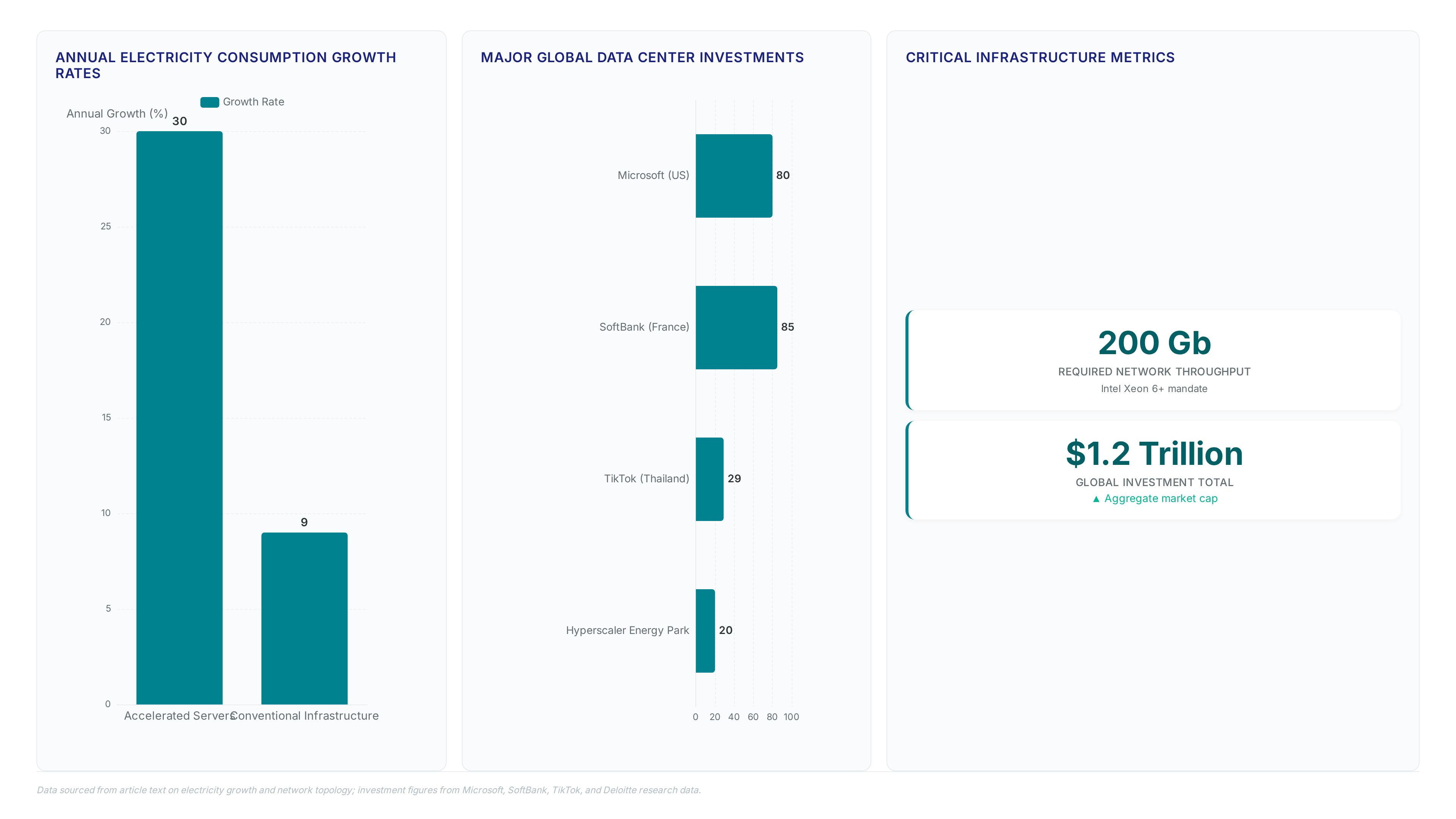
Electricity consumption in accelerated servers grows at 30% annually, vastly outpacing the 9% rate for conventional infrastructure. Grid interconnection queues stall deployment regardless of capital availability. Transmission upgrades require years of permitting, yet AI workload density demands instant power delivery that existing substations cannot supply. Facilities rely on diesel generation or curtail compute during peak demand windows. Projects risk becoming stranded assets if local distribution networks cannot absorb the sudden load spikes characteristic of training clusters.
Transformer availability limits growth just as much as generation capacity. Supply chains for high-voltage equipment remain constrained, delaying energization even where generation exists. Network architects must shift from pure performance optimization to power-aware scheduling. Placing workloads based on real-time grid capacity rather than lowest latency becomes mandatory to prevent circuit breaker trips. Speculative construction ignores the finite nature of electrical infrastructure, leading to overbuilt facilities that sit idle awaiting grid connection.
Intel's May 2026 launch of Xeon 6+ processors mandates a split network topology to sustain 200GbE throughput without packet loss. This architecture isolates standard control traffic on a front-end ethernet segment while dedicating a backend lossless ethernet fabric exclusively for GPU-to-GPU communication. Cisco validates this dual-network approach as necessary for preventing head-of-line blocking during massive parallel training jobs.
| Network Segment | Traffic Type | Reliability Mechanism |
|---|---|---|
| Front-End | Management & Storage | Standard Best-Effort Delivery |
| Back-End | GPU Tensor Exchange | Priority Flow Control (PFC) |
Doubling the physical layer cost is the price of admission. Operators must provision separate cabling and switching stacks for each domain. Speculative overbuilding often ignores this requirement, deploying single-plane fabrics that collapse under AI workload bursts. Sustainable growth requires verifying that power budgets account for two distinct switching layers rather than one converged fabric.
Physical assets are outpacing actual workload requirements, leaving facilities stranded before commissioning completes. Analysts at MIT Sloan Management Review predict a potential deflation of the AI bubble in 2026, which would render these overbuilt sites economically non-viable overnight. Developers secure land and power based on theoretical maximums rather than verified tenant contracts.
| Asset Class | Trigger for Stranding | Consequence |
|---|---|---|
| Shell Structures | Power cap exceeded | Incomplete fit-out |
| Cooling Systems | Load density mismatch | Thermal inefficiency |
| Network Fabric | Tenant churn | Unused port capacity |
Pre-build strategies face a specific trap: digital twin simulations often optimize for peak theoretical load, ignoring the probability of demand contraction. A $6 billion campus announcement in Arkansas illustrates the scale of capital exposed to this volatility, as power targets reach 1 GW without confirmed long-term off-takers. The cost is measurable in stranded real estate value when projected 50% growth fails to materialize due to macroeconomic shifts. Sovereign mandates further complicate the environment by prioritizing national security over commercial viability, forcing private capital into lower-yield configurations.
Defining Social Licence in the Context of AI Workforce Displacement
Social licence for AI infrastructure now hinges on whether capital deployment offsets the net loss of human labor roles. This friction undermines the national interest mandate when facilities replace 1,000 jobs with automated systems operated by a fraction of the original workforce. Operators mistake speed for value. Rapid scaling via modular pods containing 576 GPUs reduces construction labor hours without creating equivalent operational roles. The market signals a closing window where entry pricing remains below projected 2030 valuations due to supply constraints, pressuring builders to prioritize anchor customers over community stability.
| Factor | Capital Goal | Social Requirement |
|---|---|---|
| Labor Input | Minimize headcount | Retain skilled roles |
| Deployment | Fast modular pods | Phased local hiring |
| Validation | Anchor tenant | Public utility proof |
Microsoft's planned $80 billion investment in fiscal 2026 illustrates the scale of capital outlays driving this displacement. Efficiency gains that eliminate more positions than they create erode the consumer base required to sustain the services these data centers provide.
Replacing 1,000 roles with infrastructure managed by 10 operators creates a net deficit in local purchasing power that speculative capital cannot offset. Software developers face layoffs as firms pursue efficiency through AI-based models, reducing the consumer base required to sustain regional economies. A facility constructed by 100 people but operated by a skeletal crew fails the social licence test when unemployment rises substantially across the knowledge sector.
| Phase | Labor Input | Societal Output |
|---|---|---|
| Construction | 100 workers | Temporary income spike |
| Operations | 10 workers | Permanent income collapse |
| Net Effect | A sharp decline in roles | Reduced local demand |
Global investment benchmarks illustrate the scale of this mismatch, such as the $29 billion approved for Thailand's regional hub which prioritizes asset value over workforce retention. High utilization rates do not translate to broad economic stability if the revenue concentrates among equipment vendors rather than residents. Governments requiring projects to serve the national interest must reject builds where the Google Cloud Pause in Australia scenario becomes the norm due to policy friction.
Economies face systemic fragility when infrastructure automation eliminates knowledge sector roles quicker than new positions emerge. This displacement mechanism reduces aggregate demand, creating a feedback loop where fewer consumers purchase the services hosted on newly built facilities. The uncertainty of current AI adoption results means capital deployed today may not generate the projected economic multipliers required to sustain regional markets. These investments assume continuous growth, yet the ability of economies to absorb displaced entrants remains unproven.
Implementation: Defining National Interest Amid Speculative Build Now or Fall Behind Investment
Assessing national interest requires filtering speculative capital from verified public utility through a four-step validation protocol. Operators must distinguish between genuine infrastructure needs and fear-driven deployment that risks creating overbuilt, underused assets.
- Verify tenant contracts against power allocation to prevent resource hoarding based on theoretical maximums.
- Calculate net labor impact, ensuring construction crews do not merely replace a larger permanent workforce with a skeletal automation team.
- Cross-reference local grid capacity with Sovereign AI Growth forecasts to avoid straining national energy reserves for transient workloads.
- Mandate public disclosure of water usage metrics before granting zoning approval for hyperscale campuses.
Private asset creation often mimics public good while consuming constrained electricity and land. Uncertain market conditions encourage a 'build now or fall behind' mentality, yet this speculation increases the probability of stranded infrastructure. Governments must reject projects that fail to demonstrate long-term societal value beyond temporary construction jobs.
Grid capacity acts as the primary filter for approving projects that serve long-term stability rather than short-term tenant fit-out spend. Rising construction costs and constraints in electricity supply create immediate bottlenecks for development, forcing planners to reject speculative proposals lacking verified power access.
- Calculate total load against available substation headroom, noting that accelerated server consumption grows significantly quicker than conventional workloads.
- Require proof of modular designs to manage higher costs and allow aggressive energy optimization instead of monolithic builds.
- Cross-reference demand projections with national grid limits to prevent resource hoarding based on theoretical maximums.
- Validate that proposed facilities align with explicit government requirements for serving the public interest.
| Constraint Type | Verification Method | Rejection Trigger |
|---|---|---|
| Power Availability | Substation headroom audit | Demand exceeds local generation capacity |
| Construction Model | Modular deployment plan | Monolithic design lacks phase-gates |
| Public Utility | National interest alignment | Speculative "build now" without tenants |
Strict power gating may delay sovereign compute expansion even when strategic necessity exists. However, approving facilities without confirmed energy access ties up capital and land that societies badly need elsewhere. InterLIR recommends treating power constraints as a hard stop to avoid overbuilt infrastructure.
Validation Checklist for Preventing Deflation of the AI Bubble in 2026
Planners must verify signed tenant commitments before approving permits to filter speculative builds from viable infrastructure. This step prevents capital lock-up in facilities that lack the revenue streams necessary to survive a market correction predicted by MIT Sloan Management Review analysts. Governments should prioritize public interest by mandating proof of power access alongside labor retention plans.
- Cross-reference proposed load against grid headroom, noting that accelerated server consumption grows significantly quicker than conventional workloads.
- Demand evidence of anchor customers like substantial tech firms to distinguish adaptable infrastructure from standard colocation gambles.
3.
About
Alexei Krylov serves as the Head of Sales at InterLIR, a specialized marketplace dedicated to the redistribution of IPv4 resources. His unique qualification to discuss data centre expansion stems from the direct correlation between new infrastructure projects and the critical demand for IP addresses. As data centres multiply to support AI and cloud services, the scarcity of available IPv4 space becomes a primary bottleneck for operators. Krylov's daily work involves navigating Regional Internet Registries and facilitating secure IP leases, placing him at the forefront of the resource constraints facing the industry. Through InterLIR, he helps organizations secure the necessary network foundations required to build these facilities efficiently. This practical experience allows him to analyze whether current build-outs are sustainable or merely exacerbating resource shortages. His insights bridge the gap between high-level government mandates for national interest and the on-the-ground reality of acquiring clean, routable IP space for modern infrastructure.
Conclusion
When utilization hits that projected near-total ceiling, the real fracture point will not be power availability but thermal density limits within existing racks, forcing a sudden pivot from expansion to expensive retrofits. Operators chasing raw capacity today face a looming operational deficit where cooling costs outpace revenue per watt, rendering high-density zones financially toxic by late 2027. Halt all speculative shell construction immediately. Shift capital exclusively toward liquid-cooling readiness for facilities already under development. Approve no new permits unless the developer demonstrates a signed power purchase agreement covering at least a majority of projected load for three years. This specific threshold filters out vaporware projects while preserving grid stability for genuine demand. Audit your current portfolio's power usage effectiveness (PUE) against liquid-cooling compatibility this week. Identify which rows require immediate electrical re-architecture to handle next-generation silicon. Delaying this technical assessment until 2026 guarantees stranded assets when the market corrects. The window to adapt physical infrastructure before the density wall hits closes within eighteen months. Immediate engineering verification is the only viable path to solvency.
Frequently Asked Questions
Facilities operating below 80% utilization face immediate permit suspension and capital freezes. This strict regulatory trigger ensures that speculative builds without verified public benefit do not consume scarce national resources unnecessarily.
Microsoft plans a massive $20 billion investment to expand its AI-enabled data centre capacity during fiscal 2026. This substantial outlay illustrates the intense competition for power and land among global hyperscale operators.
Utilization for AI-optimized capacity is projected to peak at 95% in late 2026, up significantly from 85% in 2023. This tight margin forces operators into a risky build-now mentality to avoid missing demand.
Worldwide spending on Artificial Intelligence is forecast to total $2.52 trillion in 2026, driving the requirement for roughly 100 GW of new capacity. This financial surge creates severe bottlenecks in electricity supply and land availability.
Goldman Sachs forecasts a 165% surge in data centre power demand by 2030, driven almost entirely by AI workloads. This explosive growth forces facilities to compete directly with society for limited electricity and water.