Agentic AI jobs: Why 50% IPv6 needs shepherds
Global native IPv6 access hit 50.10% on March 28, 2026, yet agentic AI now dictates how we manage the remaining half. The industry must pivot from manual configuration to autonomous operations while securing data sovereignty and preserving routing history against inevitable obsolescence. Readers will examine how agent shepherds and sovereignty architects are replacing entry-level roles as operators delegate firewalling and service configuration to natural language interfaces. We dissect the mechanics of IPv6-mostly architecture, detailing how NAT64 data flow bridges legacy systems without creating fragile translation dependencies. Finally, the text outlines strategies for executing IPv6 pilots that respect regulatory boundaries while actively archiving operational exhaust before it vanishes.
Timothy Hildred's coverage of APRICOT 2026 highlights that while Mukhammad Andri Setiawan demonstrates agents installing themselves on virtual machines, the cost of failure remains high when subscription tokens expire or vendors withdraw support. (APRICOT's google hits 50 ipv6) With Gartner predicting 75% of European enterprises will soon mandate localized solutions, the pressure to balance autonomous agents with data stewardship has never been more critical. The path forward demands rigorous policy assurance rather than blind reliance on black-box automation.
The Role of Agentic AI in Modernizing Network Operations
Agentic AI Agents and Operational Exhaust Set
Agentic AI functions as an autonomous entity executing routine VM tasks like firewalling via natural language commands. Less than 5% of enterprises deployed such agents for infrastructure operations in 2025, yet projections indicate a surge to 70% by 2029. This shift demands operational exhaust preservation to prevent historical data evaporation as systems evolve. Operational exhaust comprises measurements, routing snapshots, DNS histories, logs, and institutional memory required for future forensic analysis. Metadata disappears when servers decommission or staff retire without explicit retention policies. Modernizing legacy IT systems can reduce operational costs by a substantial margin providing financial justification for integrating these autonomous tools. SaaS-delivered monitoring tools may impose data volume constraints compared to on-premise solutions offering greater control. Operators face a tangible cost between the efficiency of autonomous agents and the overhead of maintaining thorough historical records. Failure to archive operational exhaust renders agentic decisions unexplainable during incident post-mortems. The dependency on external vendor tokens introduces continuity risks if subsidies end or regulations shift. Sustainable network evolution requires balancing agent autonomy with rigorous, distributed stewardship of the resulting data legacy.
Deploying Agent Shepherds for Virtual Machine Management
An agent installed on a virtual machine before firewalling tasks defines the initial agent shepherd role. Mukhammad Andri Setiawan installs this software first, delegating routine configuration via natural language rather than manual CLI entry. This workflow shifts engineers from line-by-line scripting to system-level oversight, creating the sovereignty architect archetype. Rapid adoption is evident as infrastructure autonomy moves from niche experiments to mainstream enterprise deployment Safe implementation requires defining strict boundaries where agents operate versus where human approval remains mandatory. Operators must plan for service continuity if an AI dependency fails or vendor subsidies end.
Operational exhaust vanishes when decommissioned servers erase routing snapshots and DNS histories without funded preservation plans. Jim Cowie warned that this record evaporates as projects end and staff retire, leaving future researchers blind to why today's architecture exists. The danger intensifies as enterprises shift toward private AI deployments built atop private clouds, creating isolated data silos that lack external stewardship. Relying solely on vendor-hosted agents creates a single point of failure for historical context. If a subscription lapses or a vendor exits a market, the associated institutional memory disappears instantly. Operators often prioritize immediate cost reduction over long-term data retention. The drawback is clear: SaaS-delivered network monitoring tools reduce overhead but frequently impose data volume constraints that truncate historical logs. On-premise alternatives provide control but demand higher operational effort. Without explicit mandates to host cold replicas, critical evidence of network behavior will vanish before analysts can study failure modes. The industry must treat data preservation as a mandatory line item, not an optional afterthought.
Inside IPv6-Mostly Architecture and NAT64 Data Flow
IPv6-mostly networks route all client traffic over IPv6, invoking NAT64 translators only when destinations lack IPv6 addresses. This architecture replaces dual-stack complexity with on-demand translation, reducing the operational surface area while maintaining compatibility with legacy IPv4 services. Mobile carriers achieved a 72% adoption rate by using this model, whereas enterprise uptake remains lower due to legacy application dependencies. Data flow begins when a DNS64 resolver synthesizes an AAAA record for an IPv4-only destination, embedding the IPv4 address into a specialized IPv6 prefix. The client sends packets to this synthesized address, triggering the NAT64 gateway to map the IPv6 header to an IPv4 header before forwarding.
| Component | Function | Deployment Context |
|---|---|---|
| DNS64 | Synthesizes AAAA records for A-only zones | Resolver infrastructure |
| NAT64 | Translates IPv6 headers to IPv4 headers | Network edge gateway |
| CLAT | Performs local translation on the client device | Mobile endpoints |
Operators often hesitate because designing such transition architectures introduces stateful processing points that require careful monitoring. The IPv6 packet structure minimizes router overhead, yet the header incompatibility mandates these translation layers for universal reachability. Unlike dual-stack, this approach forces visibility into broken IPv6 paths rather than hiding them behind fallback mechanisms. The constraint lies in application logic that hardcodes IPv4 literals, bypassing DNS64 synthesis entirely and causing connection failures. Successful migration requires auditing software for such hardcoded addresses before disabling DHCPv4 on the core network.
Implementing DHCPv4 Signals and CLAT for Smooth Connectivity
Jen Linkova | Google | IPv6 | 2026 data confirms that capable clients now ignore DHCPv4 offers when signaled to prefer IPv6-only operation. This mechanism allows operators to reclaim scarce addresses while maintaining connectivity through CLAT translators on the device itself. The client synthesizes a local IPv4 interface, mapping outgoing traffic to IPv6 before it ever hits the wire. Such architecture eliminates the hidden defects of dual-stack, which increases operational surface without solving address exhaustion. Silent regressions occur when engineers re-enable IPv4 "just to test," masking broken translation paths that would otherwise surface immediately. Happy Eyeballs logic shields users during this transition, yet depends on accurate DNS64 synthesis to function correctly.
| Failure Mode | Trigger Condition | Detection Method |
|---|---|---|
| Silent Drop | CLAT misconfiguration | TCP dumps on pilot SSIDs |
| Timeout | Missing AAAA records | Happy Eyeballs latency logs |
| Loop | Recursive NAT64 | Packet capture analysis |
The limitation remains that legacy applications often bypass system resolvers, breaking the translation chain entirely. Hyperscalers report adoption rates of 82%, proving the model scales under load. Enterprises must pilot these segments where engineers can analyze packets directly, rather than rolling out globally. The cost of designing a dual-stack arrangement often exceeds the one-time engineering effort required for IPv6-mostly migration.
Dual-stack architectures hide defects and increase operational surface without addressing IPv4 scarcity. Maintaining parallel protocol stacks creates a silent regression vector where IPv6 failures go unnoticed because traffic falls back to IPv4 automatically. This fallback mechanism masks broken translation paths, delaying detection until a complete IPv4 exhaustion event occurs. The dual-stack approach allows IPv6 to coexist with production IPv4 networks, yet this coexistence often becomes a permanent state of deferred maintenance rather than a transition phase.
| Architecture | Defect Visibility | Operational Surface |
|---|---|---|
| Dual-Stack | Low (auto-fallback) | High ( |
| IPv6-Mostly | High (forced translation) | Reduced (single core) |
The additional expense of designing and implementing a dual-stack arrangement acts as a recurring cost barrier that prevents enterprises from realizing the efficiency gains of a simplified core. Transition solutions like DS-Lite support IPv6-only cores while maintaining compatibility, offering a clearer path than indefinite coexistence. Operators must disable DHCPv4 on capable clients to stop the network from hiding its own broken state.
Executing IPv6 Pilots and Preserving Routing History in Practice
Defining the IPv6 Pilot Scope Against Enterprise Adoption Gaps
Enterprise pilots must target IPv6-mostly segments because dual-stack implementations incur prohibitive additional expense while masking connectivity defects. A successful pilot definition explicitly excludes parallel protocol stacks, focusing instead on client segments where engineers can capture TCP dumps during translation events. The DREN IPv6 Pilot demonstrated that a three-year scope is necessary to uncover deep application incompatibilities rather than simple reachability issues. Operators should define the boundary by selecting guest SSIDs or public zones where DHCPv4 signaling can disable IPv4 default routes without impacting core revenue services.
| Pilot Constraint | Dual-Stack Risk | IPv6-Mostly Goal |
|---|---|---|
| Scope Duration | Permanent coexistence | Fixed translation validation |
| Fault Visibility | Silent fallback to v4 | Immediate breakage signal |
| Addressing | Continued v4 exhaustion | Reclaimable v4 pool |
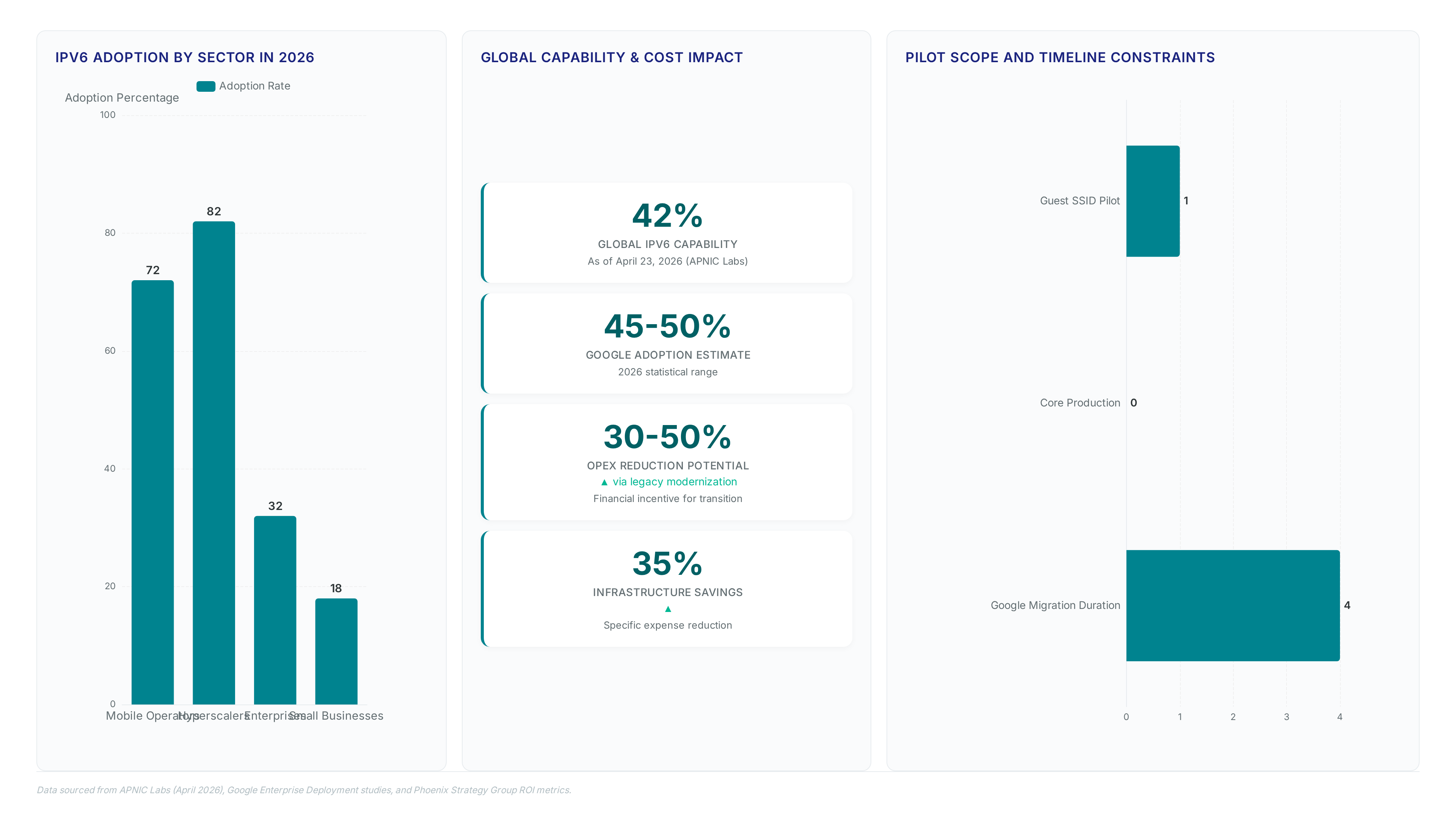
Limiting the scope to non-critical user groups allows teams to validate NAT64 behavior under load before expanding to production VLANs. The analytical tension lies between speed of deployment and depth of validation; rushing to cover all subnets often results in re-enabling IPv4 'just to test,' which hides broken translation paths. This approach forces visibility into latent defects that dual-stack architectures routinely obscure.
Executing IPv6-Mostly Pilots Using NAT64 and DNS64 Translation
Worldwide IPv6 capability reached 42% as of April 23, 2026, yet enterprise pilots must deploy NAT64 gateways to bridge the remaining legacy gap. Operators synthesize AAAA records via DNS64 resolvers, embedding IPv4 addresses into specific IPv6 prefixes to trigger translation at the network edge. This mechanism forces traffic over the modern stack while maintaining reachability to untouched IPv4 resources. The Google Enterprise IPv6 Deployment spanned four years, proving that simultaneous migration of services and platforms requires incremental translation layers rather than immediate cutover. Pilots targeting guest SSIDs allow engineers to capture TCP dumps without risking core production stability. Such segments apply CLAT translators on endpoints to handle local IPv4 synthesis before traffic exits the device. Common transition architectures like 464XLAT support this model by decoupling client signaling from core routing logic. However, relying on translation introduces latency penalties that degrade real-time application performance if gateways lack sufficient throughput capacity.
| Component | Role in Pilot | Risk Factor |
|---|---|---|
| DNS64 | Synthesizes AAAA records | Breaks literal IPv4 dependencies |
| NAT64 | Translates packet headers | Creates single point of failure |
| CLAT | Handles local mapping | Increases endpoint CPU load |
The hidden cost involves debugging failures where Happy Eyeballs algorithms prefer broken IPv6 paths over functional IPv4 fallbacks.
Capture BGP snapshots and DNS histories immediately to prevent the evaporation of institutional memory as servers decommission. Jim Cowie argues that this operational exhaust serves as the primary evidence future researchers require to understand current internet architecture. Without intentional custody, the record vanishes when projects end or staff retire. Operators must establish a distributed stewardship model where multiple entities host cold replicas of legacy datasets.
| Data Type | Retention Risk | Stewardship Action |
|---|---|---|
| Routing Snapshots | High during peering changes | Archive full AS path tables weekly |
| DNS Histories | Critical during zone migration | Store query logs with full metadata |
| System Logs | Lost on hardware refresh | Forward to immutable cold storage |
| Config Diffs | Overwritten by automation | Version control every prefix update |
Selecting the right storage tier balances control against expense. On-premise tools The orchestration of accelerated compute and specialized storage is now mandatory for full operational integration of these archives. Neglecting this step leaves the network blind to its own evolutionary path. Setiawan's scenarios illustrate agents installing themselves on virtual machines to handle firewalling, creating governance dependencies where service continuity relies on external token validity. This architectural change introduces a fragile supply chain; if a vendor subsidizes access at a modest monthly fee but ceases operations, local fallbacks often lack equivalent capability. The cost of private AI deployments on private clouds rises sharply when accounting for hardware power and cooling, deterring immediate migration for resource-constrained operators. A tension exists between operational speed and auditability, as natural language configuration obscures the specific policy changes an agent executes.
| Risk Vector | Traditional Automation | Agentic AI |
|---|---|---|
| Failure Mode | Static syntax error | Drifted intent |
| Recovery | Rollback script | Human intervention |
| Audit Trail | Command log | Opaque reasoning |
Operators must establish approval gates before agents modify production state, because distributed compute infrastructure hosting small language models expands the attack surface beyond the corporate perimeter. The limitation of current tooling is the absence of standardized rollback mechanisms for non-deterministic actions. Without these controls, the agentic shift converts transient glitches into systemic outages that manual teams cannot trace.
Publishing Patterns for Safe Agent Use in Operations
Asia Pacific operators must publish explicit approval gates and rollback procedures because unmanaged agent dependencies cause cascading failures when vendor tokens expire. Setiawan's scenarios promise speed but raise governance needs that require documented boundaries for autonomous actions. Only 18% of networks currently apply advanced automation tools effectively, leaving most deployments vulnerable to untested logic loops. This approach prevents total service blackout during external provider outages. A significant gap exists between tool availability and deployment maturity across the region. Planning for Wi-Fi upgrades in 2026 often ignores the underlying agent orchestration layer required to manage them safely. Operators should mandate audit logs for every natural language command translated into network configuration changes.
| Risk Vector | Mitigation Pattern | Operational Cost |
|---|---|---|
| Token Expiry | Local fallback scripts | High engineering time |
| Logic Drift | Weekly policy diffing | Moderate compute load |
| Vendor Lock-in | Multi-model abstraction | Significant refactoring |
The hidden tension lies between rapid iteration and the necessity of freezing agent behavior during critical maintenance windows. Relying on external subsidies for AI access creates a fragile supply chain that vanishes if local regulation becomes too difficult to comply with. Engineering teams must shift focus from line-by-line configuration to verifying system-level assurance policies. Without these published patterns, the move toward autonomy merely obscures defects rather than resolving them. This divergence stems from methodological differences where active probes measure potential while passive flow data records actual user traffic. Relying on a single metric creates a false sense of completion for enterprise architects planning migration. The cost of ignoring this gap is silent failure during client onboarding when devices lack true stack support. Hpc. Blind trust in high-level aggregates masks defects in the access layer where dual-stack configurations hide translation errors. InterLIR recommends cross-referencing passive flow data with active capability tests before disabling DHCPv4 signals. This dual-validation approach exposes the hidden IPv4 dependency that single-source dashboards frequently miss.
About
Vladislava Shadrina serves as a Customer Account Manager at InterLIR, where she specializes in client relations within the critical domain of IP resources. While her background includes architecture, her daily work managing IPv4 address rentals and leasing directly informs her perspective on the evolving internet infrastructure discussed in this article. As agentic AI begins to automate network operations, the efficient allocation and stewardship of IP addresses become increasingly vital for autonomous systems. At InterLIR, Shadrina enables the transparent redistribution of unused network resources, ensuring organizations have the fundamental connectivity required to support these advanced technologies. Her frontline experience with customers navigating IP scarcity provides practical insights into the operational shifts necessary for IPv6 migration. By connecting current market realities with future technological demands, she highlights how reliable IP management underpins the next-generation of agentic internet services and global data stewardship.
Conclusion
Scaling agentic AI reveals a critical fracture point: the orchestration layer cannot sustain infinite natural language requests without deterministic guardrails. As adoption surges, the operational burden shifts from writing configurations to continuously validating that agent decisions align with static security policies. Teams ignoring this transition will face compounding technical debt as logic drift accumulates quicker than manual review cycles can detect. You must implement a mandatory freeze protocol for agent behaviors during all critical maintenance windows by Q3 2027, ensuring autonomous systems do not introduce volatility when stability is paramount. Relying on subsidized vendor access creates an unsustainable dependency; organizations need to budget for full-cost local inference models within 18 months to avoid sudden service discontinuation. Start this week by auditing your current agent command logs against your existing change management tickets to identify any unrecorded modifications. This immediate reconciliation exposes the gap between perceived automation safety and actual network state. Only by establishing this baseline of verified assurance can engineering teams safely transition from reactive troubleshooting to proactive system governance. The path forward requires treating agent outputs as untrusted inputs until proven otherwise through rigorous, automated diffing.
Frequently Asked Questions
Less than 5% of enterprises deployed agents for infrastructure operations in 2025. Projections indicate this figure will surge to 70% by 2029 as operators shift from manual configuration to autonomous workflows.
Modernizing legacy IT systems can reduce operational costs by 30-50%. This financial incentive supports integrating autonomous tools while ensuring operators preserve operational exhaust like routing snapshots and logs.
Hyperscalers report adoption rates of 82%, proving the model scales under load. However, operators must plan for service continuity if vendor subsidies end or subscription tokens expire unexpectedly.
Worldwide IPv6 capability reached 42% as of April 23, 2026, yet enterprise pilots often lag behind. NAT64 data flow bridges legacy systems by embedding IPv4 addresses into specific IPv6 prefixes.
Gartner predicts 75% of European enterprises will soon mandate localized solutions. This pressure forces a balance between autonomous agents and strict data stewardship to ensure regulatory compliance.