APNIC Strategy: Four Pillars for a Stalled Market
APNIC's 2025 membership growth stalled at just 1.6%. That number screams a hard truth: the era of expansion is over. Survival now demands a pivot from counting members to maximizing resource efficiency and security automation. Gartner predicts an AI-driven infrastructure overhaul by 2026 that will render historical delegation trends useless. IPv4 volumes are dropping. Autonomous agents are demanding verified routing data. The old playbook is dead.
This analysis dissects how APNIC's four strategic pillars are being recalibrated to handle plateauing numbers while maintaining rigorous registry services. We look at the mechanics behind steady yet declining IPv6 delegations and the persistent high volume of IPv4 transfers detailed in the 2025 Annual Report presented by Tony Smith. The focus shifts to RPKI Signed Checklists and new BGP data sources in the Network Health Dashboard-tools operators need to navigate a volatile routing environment.
Compliance is no longer enough. Jakarta's APRICOT 2026 sessions forced the Executive Council to rethink Internet number resource management. Helpdesk response times improved to 7.6 hours, shifting the mandate from basic support to proactive network security outcomes. As the organization prepares for Mumbai, the imperative is clear: adapt governance structures where resource scarcity meets algorithmic complexity.
The Role of APNIC Strategic Pillars in Regional Internet Governance
Defining APNIC's Four Strategic Pillars for 2026
Director General Jia Rong Low restructured APNIC operations around four pillars: Registry, Development, Engagement, and Capability. The Registry function now ties product improvements to outcome-based themes like Internet security, ditching isolated feature updates. Resource allocation links directly to measurable network health metrics, not abstract availability goals.
Development efforts prioritize a train-the-trainer model to scale IPv6 and RPKI knowledge. This approach updates training labs with specific curriculum on routing and security that generic vendor certifications miss. Operators gain immediate policy integration skills, though relying on local partners introduces variability in instruction quality. The Engagement pillar adjusts conference rotations to prevent overlaps with APRICOT while launching sub-regional forums. Participation in the 2026 APNIC Survey during June provides the data required to validate these strategic shifts. Capability investments target leadership development while enforcing strict cost containment to eliminate the forecast deficit. Balancing budget recovery against staff reductions risks degrading the service response times that previously averaged 7.6 business hours.
The train-the-trainer model deploys updated labs at APRICOT 2026 to refresh curricula on routing and security. This application of the Development pillar shifts capacity building from direct instruction to multiplier effects via Network Operator Groups (NOGs). Operators gain specific skills in RPKI validation and IPv6 deployment that generic vendor certifications often miss due to lagging policy integration. The curriculum refresh APNIC Labs records a 42% network capability score, revealing a gap between user-centric metrics and actual infrastructure readiness. Broad adoption claims often mask localized deployment failures in edge networks.
IPv6 delegations held steady yet dipped slightly below 2024 levels while IPv4 assignments continued their long-term decay. Mobile operators running IPv6-only cores now drive regional growth despite insufficient legacy resources. Transfer volumes remained elevated against the decade average, though total moved space in 2025 fell short of the 2023–2024 peak. Scarcity drives transfer activity even as organic delegation slows.
| Resource Type | 2025 Trend | 10-Year Context |
|---|---|---|
| IPv4 Delegations | Gradual Decline | Consistent Drop |
| IPv6 Delegations | Stable / Slight Dip | Rapid Rise |
| Transfer Volume | Lower than Peakers | Historically High |
Enterprises face tangible costs designing dual-stack arrangements to support coexistence between protocols during this transition window. Pure IPv6 deployments avoid the engineering overhead inherent in dual-stack setups. Operators holding blocks up to a /22 pay reduced fees, creating a financial incentive to fragment holdings rather than consolidate. This fee structure subtly discourages the return of unused space to the free pool. This governance shift decouples election cycles from annual budget pressures, allowing longer strategic planning horizons for the Executive Council. Extended terms reduce the frequency of policy discontinuity often seen during annual leadership turnovers.
RPKI Adoption Mechanics Within APNIC's Internet Security Theme
Operators initiate adoption by generating Route Origin Authorizations within the APNIC portal to cryptographically sign prefix origins. This procedural step transforms abstract policy into enforceable route validation rules that upstream peers can verify automatically. Implementation timing aligns strictly with the refreshed training curriculum debuted at recent industry gatherings to ensure staff competency before enforcement. Network engineers should consult the updated training labs. Delaying deployment until after staff certification creates a dangerous gap where signed routes exist but local routers still accept invalid announcements.
A measurable discrepancy exists between user-centric metrics showing over 50% global adoption and network capability measurements indicating lower readiness. Many end-users possess IPv6 stacks while their local ISPs lack the RPKI validation infrastructure to secure traffic. Operators relying solely on user statistics may falsely assume the system is ready for strict reject policies. Premature enforcement without verifying upstream ROA coverage risks dropping legitimate traffic from peers who have not yet signed their prefixes.
APRICOT 2026 debuted refreshed training labs specifically targeting RPKI and routing security to bridge the gap between policy and configuration. Operators initiate deployment by accessing these updated modules, which distinguish APNIC's approach from general vendor certifications that often lag in specific RIR policy integration. The curriculum prioritizes a train-the-trainer model, enabling Network Operator Groups to scale internal upskilling without relying on external consultants for every iteration. Engineers must configure their routers to validate Route Origin Authorizations before enforcing drop policies on invalid paths.
- Register for the refreshed curriculum focusing on network security and IPv6 delegation standards. 2.
Operationalizing Community Engagement and Training Programs
APNIC Labs IPv6 Capability Metrics and Measurement Scope
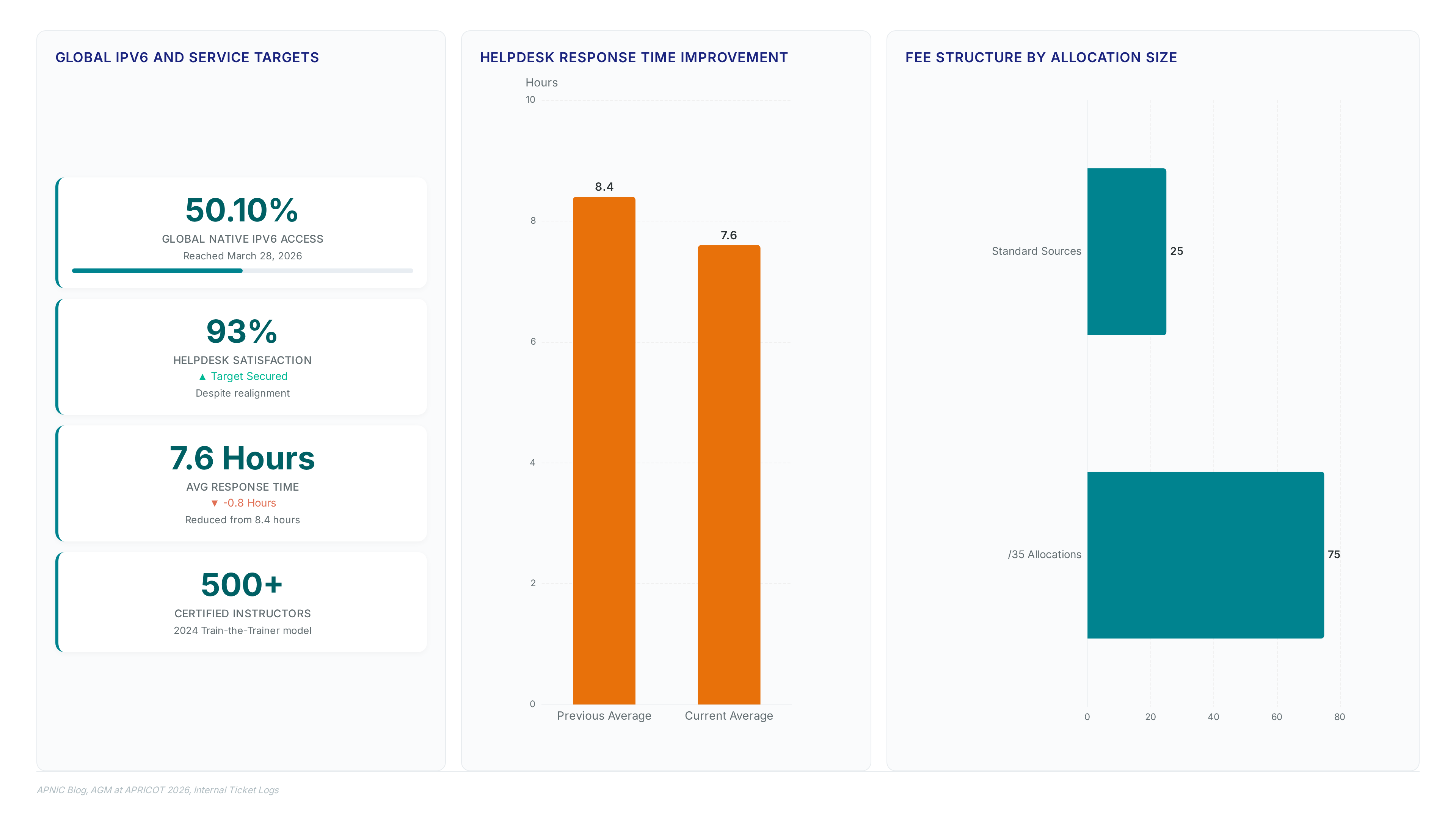
Global native IPv6 access reached 50.10% on March 28, 2026. Do not mistake this user-centric milestone for complete infrastructure readiness. The methodology distinguishes between clients who can reach IPv6 content and networks that can natively route it without translation layers.
| Metric Type | Definition Focus | Operational Implication |
|---|---|---|
| User Access | Client-side connectivity | Validates content delivery success |
| Network Capability | Native routing capacity | Dictates IPv6-only architecture feasibility |
Engineers seeking to participate in APNIC training labs must align with the refreshed curriculum targeting IPv6 and routing security. These updated modules debuted at recent industry events to bridge the gap between theoretical policy and practical training labs. Participation requires registering for sessions that specifically address the transition from dual-stack to native deployment models.
Reducing average helpdesk response times from 8.4 to 7.6 hours secured the 93% satisfaction target despite organizational realignment. Operational teams achieved this efficiency by adopting automated policy translation systems similar to those used by a Fortune 500 Retailer to slash configuration errors. Automation removes manual bottlenecks that typically delay ticket resolution during periods of staff consolidation. The strategy relies on a train-the-trainer model to disseminate troubleshooting skills across Network Operator Groups without external dependency.
Service quality metrics remained strong despite the 2025 realignment, with user ratings holding steady at levels exceeding targets. Operators must verify that helpdesk response times did not degrade during staff reductions by cross-referencing ticket logs against the published 7.6-hour average. The train-the-trainer model allowed Network Operator Groups to absorb frontline support duties, preventing the backlog spikes seen in other regional registries. External market shifts toward FTTH services increased query volume regarding IPv6 delegation, yet resolution rates stayed consistent. Decentralized training effectively offset the loss of centralized engineering headcount without compromising member experience.
| Metric Category | Pre-Realignment Baseline | Post-Realignment Result |
|---|---|---|
| User Satisfaction | Above Average | Excellent |
| Response Time | 8.4 Hours | 7.6 Hours |
| Training Scale | Limited | Expanded via NOGs |
InterLIR recommends auditing internal ticket resolution paths to ensure automated policy translation tools are active before scaling back senior staff. Relying solely on aggregate satisfaction scores masks potential delays in complex routing security cases that require deep protocol knowledge. Foundation/) investment in digital development provided the necessary buffer to maintain these service levels during the fiscal tightening. Operators ignoring this validation step risk discovering latent capability gaps only after a substantial incident overwhelms junior responders. Sustained performance requires continuous verification that knowledge transfer from senior engineers to community trainers remains.
About
Alexei Krylov, Head of Sales at InterLIR, brings critical industry perspective to the analysis of the APNIC Annual General Meeting. With extensive experience managing B2B relationships and navigating Regional Internet Registries (RIRs), Krylov understands how governance decisions directly impact global IP resource availability. His daily work facilitating IPv4 address leasing and ensuring BGP security relies heavily on the regulatory frameworks discussed at APRICOT 2026. As InterLIR specializes in redistributing unused network resources, changes in APNIC by-laws or strategic planning significantly influence the company's ability to provide transparent, efficient solutions to clients. Krylov's unique combination of legal education and practical sales expertise allows him to interpret complex community-driven governance updates for network operators. This insight bridges the gap between high-level policy shifts at APNIC and the operational realities faced by businesses seeking reliable IP addresses in a constrained market.
Conclusion
Manual delegation processes collide with the 25% surcharge structure, creating unpredictable operational expenditure for high-volume assigners. Membership growth stagnation signals that traditional registry value propositions are decoupling from modern cloud-native requirements. AI Agents will soon automate the very policy compliance tasks that currently justify administrative overhead, forcing a fundamental shift in how registries deliver value beyond simple number allocation. Treat IPv4 holdings as depreciating financial liabilities rather than static assets. Adjust internal accounting models immediately to reflect the rising cost of retention versus utility.
Deploy an automated address utilization audit within the next fourteen days. Identify dormant blocks incurring unnecessary quarterly fees before the next billing cycle closes. This specific action isolates waste that aggregate satisfaction metrics completely obscure. Do not wait for annual reviews; the window to optimize cost structures before AI-driven market corrections tighten further is narrowing. Shift focus from maintaining legacy inventory to architecting flexible allocation policies that align with actual traffic engineering needs. The entities that survive this transition will be those that proactively shed inefficient holdings today, not those that hope for regulatory relief tomorrow. Execute the audit now to establish a baseline for the coming fiscal contraction.
Frequently Asked Questions
Temporary assignments incur a charge equal to 25% of the Annual Fee. This specific rate applies for each approved three-month period under the updated fee structure.
Overall membership growth stalled at just 1.6% against a base of 26,000 entities. This stagnation signals a critical shift toward managing finite Internet resources efficiently.
APNIC Labs records a 42% network capability score regarding infrastructure readiness. This figure reveals a significant gap between user-centric metrics and actual deployment status.
Helpdesk improvements secured the 93% satisfaction target by reducing average response times. The team achieved this by lowering wait times from 8.4 to 7.6 hours.
Survey results show that 95% of users rated their service experience as excellent or above average. This performance exceeded the initial target set for the year.