APRICOT 2026: Why 95% of networks lack visibility
95% of organizations lack visibility into critical segments. APRICOT 2026 in Jakarta forces a reckoning. Surviving the next decade means ditching manual patching for agentic automation and rigorous data preservation. This isn't theoretical. Attendees will dissect the strategic necessity of this premier Asia Pacific event, explore advanced routing architectures for deep space and enterprise edges, and master IPv6 migration tactics that actually work.
Gartner predicts that by 2027, 30% of enterprises will automate over half their network activities. In mid-2023, that number sat under 10%. Legacy workflows are dead. The specific operational durability taught across the 56 economies APNIC serves is now mandatory. The conference agenda closes this gap directly: Jen Linkova breaks down IPv6-mostly concepts while Marc Blanchet analyzes IP networking in deep space environments.
Technical sessions here intersect with hard governance realities. Timothy Hildred's coverage coincides with the APNIC member voting period on Executive Council term limits. From Budi Rahardjo's warnings on AI cybersecurity risks to Jim Cowie's argument for operators as digital archivists, the program rejects superficial trends. Engineers leaving Jakarta will possess concrete strategies for DNS resolver optimization and the architectural blueprints needed to secure Internet infrastructure against increasing congestion and latency.
The Strategic Role of APRICOT 2026 in Modern Network Operations
APRICOT 2026 Scope: 56 Economies and AI Cybersecurity Mandates
APRICOT 2026 convenes in Jakarta from 4 to 12 February 2026 to address operational risks across 56 economies. The summit operates under the multi-stakeholder governance of APNIC, a sharp contrast to state-controlled internet models emerging elsewhere. Policy direction here originates from operator consensus, not top-down decrees. Budi Rahardjo, Chairperson of ID-CERT, details how AI cybersecurity threats now outpace manual mitigation capabilities. A significant majority of organizations struggle with AI adoption, creating security gaps in automated environments.
The conference defines IPv6-mostly architecture as a transitional state where IPv6 carries primary traffic while IPv4 remains for legacy compatibility. Jen Linkova presents this model as the only viable path for enterprises facing address exhaustion. A separate session examines Indonesia's multi-IXP system, revealing how fragmented exchange points cause asymmetric routing without unified monitoring. Operators managing peering across multiple facilities face congestion that single-IXP designs avoid. For 95% of networks lacking segment oversight, the tension between rapid automation and security visibility remains unresolved. Failure to adapt to these agentic AI operational shifts invites route leaks that validation protocols cannot filter.
Operationalizing Network Automation: From 10% Baseline to 30% Enterprise Target
Gartner predicts 30% of enterprises will automate over half their network activities by 2026, up from under 10%. This shift demands production-grade automation rather than isolated trials. Telecommunications firms show high engagement at 97% yet only 49% operate in production. Operators must move from proof-of-concept to composable agent lakes to close this deficit.
| Deployment Phase | Automation Scope | Primary Barrier |
|---|---|---|
| Initial Trial | 50% coverage | Ethical governance |
Delayed migration costs money. Persistent congestion and unmanaged latency plague critical segments. IPv6-only transitions succeed only when intelligent automation handles dual-stack complexity without manual intervention. Preserving Internet measurement data becomes impossible without automated archival agents running alongside routing protocols. Attendees should join APRICOT 2026 to master these specific operational patterns before legacy tooling fails completely. Ethical Proof of Concepts often stall due to budget reallocation toward nimble providers. Network teams ignoring this trend face obsolescence as peer networks achieve threefold efficiency gains.
Operators relying on trial deployments face visibility gaps across critical segments that manual auditing cannot close. Agentic operations promise autonomous decision-making, but the delay in moving to production leaves networks vulnerable to automated threats that outpace human response times. Security policies lag behind infrastructure changes because the gap between engagement and active usage is wide.
| Deployment Stage | Risk Profile | Operational Control |
|---|---|---|
| Pilot / Trial | High exposure to zero-day automation attacks | Manual override required |
| Production Agentic | Governed, traceable execution | Policy-enforced autonomy |
| Legacy Manual | Blind to sub-second anomalies | Fully human-dependent |
Organizations lacking insight into network behavior cannot validate AI agent actions, leading to potential configuration drift. Hesitation allows competitors with deployed agents to optimize latency and throughput while others struggle with basic congestion. The cost of delay is measurable in lost service level agreement compliance and increased mean time to resolution. Attendance at APRICOT 2026 provides the necessary framework to transition from experimental scripts to governed autonomous decision-making.
Agentic Operations and the 2026 Automation Surge Mechanics
Script-based automation fails against flexible routing policy complexity. We need a shift to agentic operations. This architectural pivot replaces static playbooks with reasoning loops that evaluate AS path attributes and execute remediation without human intervention. Network automation is forecast to increase threefold by 2027 to manage hybrid infrastructure scale. Manual CDN interconnection strategies crumble under traffic volume variance, whereas intelligent agents negotiate peering sessions based on real-time latency metrics.
| Feature | Script-Based Automation | Agentic AI Operations |
|---|---|---|
| Decision Logic | Pre-set conditional statements | Probabilistic reasoning models |
| Error Handling | Halt and alert operator | Self-heal and re-route traffic |
| Policy Scope | Static per-device configuration | Flexible cross-domain enforcement |
| Adaptation | Requires manual code updates | Learns from network telemetry |
- Ingest real-time telemetry from BGP speakers and flow sensors.
- Reason against local preference goals and congestion thresholds.
- Execute configuration changes via secure API channels.
- Audit actions against compliance policies in continuous loops.
This transition involves significant governance overhead to prevent rogue agent behavior. Operators must define strict guardrails or risk autonomous systems propagating invalid routes quicker than humans can intervene.
Marc Blanchet presents IP networking in deep space to demonstrate delay-tolerant principles stabilizing path selection where manual policies fail. Asymmetric flows in multi-IXP setups often stem from inconsistent local preference values across peering points, causing return traffic to traverse suboptimal links. Applying deep space buffering concepts allows routers to hold packets until a symmetric return path confirms availability, effectively decoupling forward and reverse path decisions. This mechanism contrasts sharply with standard BGP behavior, which assumes immediate bidirectional reachability.
Operational data from Indonesian operators highlights congestion and asymmetric routing as primary failures in the absence of unified monitoring systems. The multi-IXP ecosystem suffers when manual configuration cannot match the velocity of traffic shifts during peak hours. Deep space protocols introduce a store-and-forward layer that absorbs transient path asymmetry without dropping packets.
| Standard BGP | Delay-Tolerant Approach |
|---|---|
| Immediate next-hop rejection | Buffered packet retention |
| Symmetric path assumption | Asymmetric path tolerance |
| Manual policy tuning | Autonomous path reconciliation |
Implementing these buffers increases memory requirements on edge routers. Few ISPs accept this trade-off without guaranteed latency SLAs. Additional RAM usage scales linearly with buffer duration settings. Recursive resolver optimizations further stabilize this architecture by caching DNS responses longer during path instability events. Geoff Huston details how DNS resolvers select authoritative servers, a process parallel to routing path selection under stress.
Recursive resolvers face validation failures during the May 2026 KSK roll if they lack the updated KSK-2024 trust anchor. The mechanism replaces the private key value without altering the algorithm, forcing a strict chain-of-trust update for successful resolution. Operators relying on static configurations risk complete lookup timeouts for signed zones. Geoff Huston uses the APNIC distributed ad system to measure server selection latency shifts across global vantage points during this transition.
| Resolver State | Validation Result | Traffic Impact |
|---|---|---|
| Trusts KSK-2024 | Success | Normal flow |
| Trusts KSK-2017 Only | Failure | Silent drop |
| No Rollover Logic | Timeout | High latency |
Deploying flexible trust updates introduces a measurable risk of accepting forged keys if the distribution channel lacks integrity checks. Potential exposure to man-in-the-middle attacks exists during the propagation window. This trade-off demands rigorous monitoring of DNSSEC validation states rather than blind automation. Blindly enabling aggressive caching to improve speed exacerbates the outage duration when keys mismatch.
Implementing Unified Routing Policies and IPv6 Migration Strategies
Unified Routing Policies and the Agentic Operations Shift
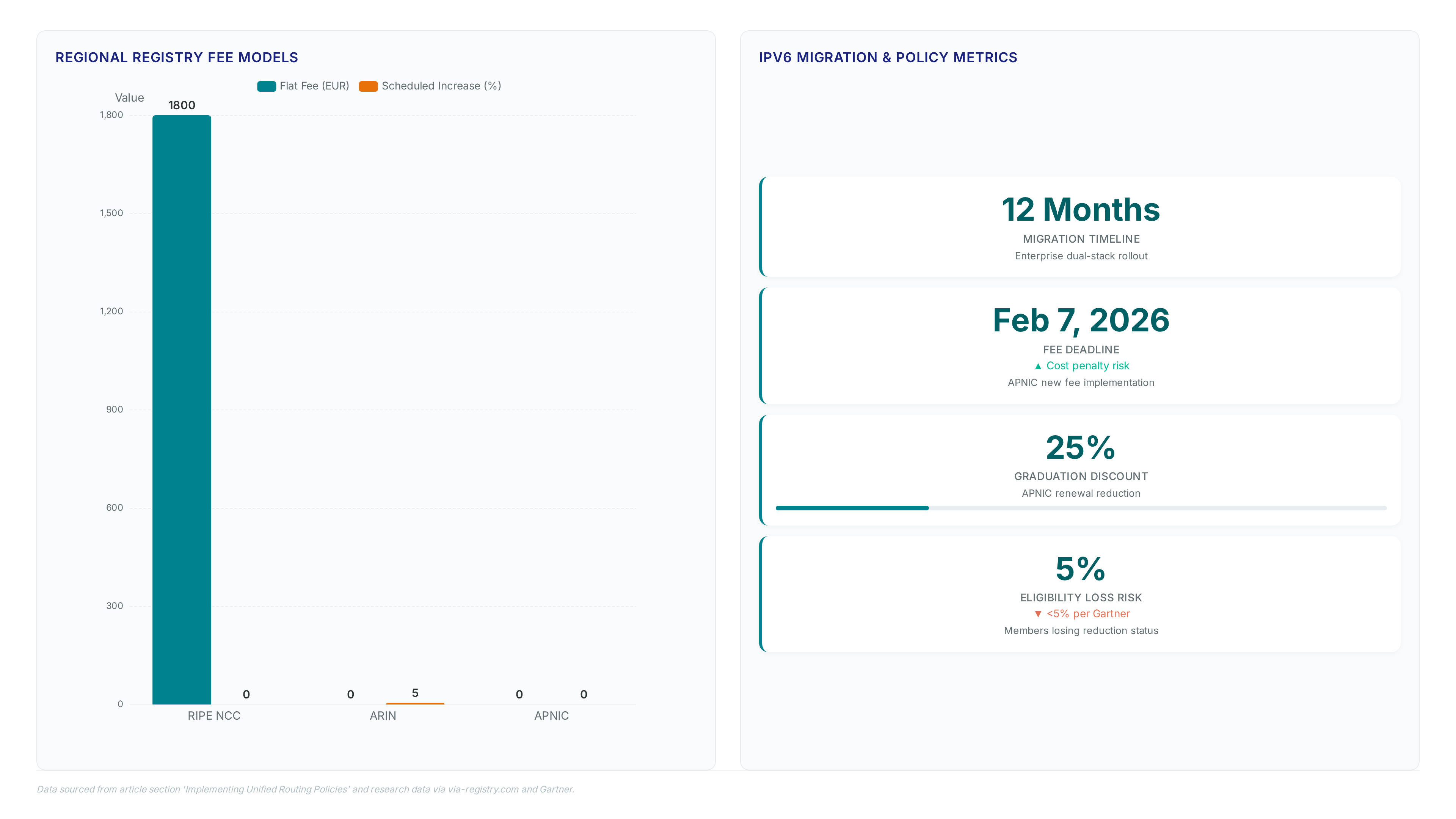
Unified routing policies replace manual BGP filters with agentic operations that autonomously validate AS path attributes against global constraints.
- Map physical diversity requirements to logical policies, acknowledging that geopolitical instability now forces route selection based on jurisdictional risk rather than latency alone.
- Deploy agents to ingest telemetry, closing the visibility gaps where static monitors fail to detect asymmetric flows in multi-IXP ecosystems.
- Enforce IPv6 migration rules by having agents negotiate dual-stack peering sessions only when origin validation signals confirm prefix legitimacy.
The cost of this shift involves diverging registry economics. ARIN fee increases contrast with APNIC adjustments, altering the budget for autonomous resource management. Agents must optimize prefix holding costs while maintaining redundant paths. Aggressive path diversity conflicts with rising operational expenditures for IP resources. Agents cannot resolve policy conflicts arising from contradictory organizational mandates without human arbitration.
Executing IPv6 Migration Steps Before the 7 February 2026 Fee Deadline
Enterprises must finalize temporary IP address assignments before APNIC implements fees on 7 February 2026 to avoid immediate cost penalties. 1.2. Configure dual-stack border routers to prefer IPv6 next hops while maintaining IPv4 fallback for legacy applications during the transition window. 3. Submit registration paperwork verifying member status to lock in pricing tiers before the billing cycle reset occurs next month.
Operators delaying this process face compounding expenses. Very Small tier members lose eligibility for the 25% renewal reduction if graduation status changes mid-year. The Xiong'an New Area delegation demonstrated large-scale deployment viability by presenting an IPv6 City Plaque to illustrate centralized coordination benefits. Measurement data preservation requires enabling flow exporters on all dual-stack interfaces prior to address plan changes. Failure to document pre-migration baselines renders post-deployment troubleshooting impossible when asymmetric routing emerges. The cost of delay exceeds administrative overhead, creating permanent budget inefficiencies for networks that miss the waiver window.
Operators must update trust anchors to KSK-2024 before the May 2026 root zone key change to prevent validation failures.
- Verify recursive resolver software supports the new private key value without algorithm modification.
- Enable logging for validation failures to detect outdated trust chains during the transition window.
- Query test domains using the APNIC distributed ad system to confirm global reachability from edge locations.
- Establish peering sessions with substantial CDNs to reduce latency for signed zone queries.
Preserving network measurement data requires correlating resolver logs with RIPE Atlas probe results to identify regional outage patterns.
| Configuration State | Validation Outcome | Operational Risk |
|---|---|---|
| Static Trust Anchor | Failure on Roll Date | Total Resolution Loss |
| Auto-Update Enabled | Successful Handover | Minimal Latency Spike |
| Manual Key Injection | Conditional Success | High Administrative Overhead |
Delayed updates carry a measurable cost: resolvers rejecting KSK-2024 return SERVFAIL responses to all signed queries. This failure mode disrupts service for clients relying on strict security policies rather than falling back to insecure resolution.
Defining Agentic AI Agents for IT Infrastructure Operations
Agentic AI replaces static scripts with autonomous systems capable of independent decision-making on network infrastructure. Traditional automation executes predefined playbooks, whereas agentic operations reason through novel failure modes without human intervention. Gartner data indicates less than 5% of enterprises deployed such agents in 2025, marking the early stage of this technical shift. The distinction lies in the agent's ability to select tools and validate outcomes against security policies dynamically. Budi Rahardjo highlights specific cybersecurity risks inherent in this gap.
A significant gap exists between organizational engagement and production readiness. While nearly all telecommunications firms explore these technologies, roughly half remain stuck in trial phases rather than live deployment. This hesitation stems from the complexity of governing autonomous actions within strict compliance frameworks. Operators must define clear boundaries for agent authority to prevent unintended configuration changes.
| Capability | Static Automation | Agentic AI |
|---|---|---|
| Decision Logic | Pre-scripted | Flexible Reasoning |
| Error Handling | Halt and Alert | Self-Correction |
| Scope | Single Task | Multi-Step Workflow |
The projection suggests 70% adoption soon. This rapid scaling demands immediate investment in governance models that track agent decisions. The cost of delay is measurable in increased exposure to threats that outpace human reaction speeds.
Quantifying TCO Reductions with Alkira NaaS Platforms
Retailer Michaels transformed its nationwide network in three weeks using the Alkira platform, bypassing standard hardware procurement delays. This deployment model contrasts sharply with traditional data center refresh cycles that typically consume 18-24 months for similar scope. Operators shifting to this architecture realize a potential 40% TCO reduction by eliminating capital expenditure on proprietary appliances. The financial baseline for maintaining legacy infrastructure remains high, with fixed overhead for a core Network-as-a-Service platform in 2026 budgeted at a substantial sum to support a team of five full-time employees.
| Metric | Traditional Refresh | NaaS Deployment |
|---|---|---|
| Timeline | 18-24 months | Weeks |
| Cost Model | High CapEx | OpEx only |
| Scalability | Manual hardware add | API-driven |
This approach involves rigid dependency on the provider's API stability for network automation. A failure in the controller plane can stall provisioning across all connected sites simultaneously, creating a single point of logical failure. The strategic implication forces a choice between hardware ownership control and operational velocity. Organizations accepting this trade-off gain the ability to scale bandwidth on demand without physical site visits. This flexibility proves necessary when agentic operations require flexible topology changes that manual processes cannot support. Budi Rahardjo identifies this opacity as the primary driver for cybersecurity failures, where automated systems inadvertently propagate errors across unmonitored paths.
| Risk Factor | Impact Scope | Mitigation Strategy |
|---|---|---|
| Blind Automation | High | Deploy observability agents |
| Policy Drift | Medium | Enforce strict guardrails |
| Data Poisoning | Critical | Isolate training sets |
Operators must treat visibility as the core currency before scaling autonomous actions, otherwise agents optimize for local metrics while degrading global stability. The cost of skipping this step manifests as increased mean-time-to-resolution during incidents involving agentic decision loops. InterLIR recommends auditing all network segments for telemetry coverage prior to enabling write-access for AI controllers. Without this baseline, the shift toward agentic operations fails. Most failures stem not from algorithmic flaws but from incomplete topological maps fed into the decision engine.
About
Georgy Masterov, a Customer Support Specialist at InterLIR and Computational Business Analytics student, offers a unique perspective on the evolving environment of network operations. His daily work managing IP resource allocation and ensuring clean BGP routing directly aligns with the critical infrastructure challenges discussed at APRICOT 2026. As the industry pivots toward automation to handle scarce IPv4 addresses, Georgy's frontline experience in resolving network availability issues provides practical insights into real-world operational bottlenecks. At InterLIR, a Berlin-based marketplace dedicated to transparent IPv4 redistribution, he witnesses how efficient resource management underpins stable internet governance across the Asia Pacific and beyond. This article bridges his technical background in IT and finance with the strategic goals of global network summits, illustrating how optimized address markets support the broader system of internet stability and growth.
Conclusion
Scaling agentic network operations fractures when telemetry gaps exceed a significant share of the total topology. Autonomous agents optimize local latency while silently destabilizing global routing tables. The hidden operational tax here is not software licensing, but the relentless manual intervention required to untangle logic loops created by blind automation. Organizations rushing to deploy write-access AI controllers before establishing full-segment visibility will face compounding incident resolution times that erase any initial efficiency gains. This timeline aligns with the maturation of stable controller APIs while preventing premature exposure to cascading logical failures. Do not gamble on algorithmic self-correction when the underlying map is incomplete. Start by running a read-only telemetry audit on your guest and IoT VLANs this week to identify specific segments missing flow export capabilities. Fix these data voids immediately before granting any system the authority to alter configuration states. Real autonomy demands perfect sight; anything less is just quicker chaos.
Frequently Asked Questions
Seventy-nine percent of organizations struggle with AI adoption, creating critical security gaps. This lack of integration leaves ninety-five percent of networks without necessary visibility into their most important operational segments.
Telecommunications firms show high engagement at ninety-seven percent, yet only forty-nine percent deploy AI in live operations. This significant maturity gap prevents operators from fully closing deficits in composable agent lakes.
Gartner predicts thirty percent of enterprises will automate over half their network activities by 2026. This represents a massive leap from under ten percent adoption rates recorded in mid-2023.
Ethical governance remains the primary barrier preventing initial trials from achieving fifty percent coverage. Without addressing these concerns, teams face obsolescence as peer networks accelerate their own automation strategies.
Security visibility remains unresolved for ninety-five percent of networks lacking segment oversight. This critical blind spot invites route leaks that standard validation protocols cannot effectively filter or mitigate.