ARIN 57 Strategy: Securing IPv4 in a Scarce Market
North America holds 39.5% of global IPv4 allocations. That scarcity makes ARIN 57 a strategic necessity, not a optional trade show. As the industry faces a reality where IPv4 and IPv6 will coexist through 2040, presence at this gathering determines who shapes the rules of engagement.
We dissect the mechanics of community-driven Internet policy, analyzing how ARIN 57 serves as the primary venue for negotiating resource distribution amidst stagnating IPv4 pools. We provide a comparative breakdown of sponsorship tiers and benefits, moving beyond generic marketing fluff to identify which packages offer genuine access to the engineers and policymakers controlling the region's 39.5% IPv4 share. The analysis reveals where your capital actually buys influence versus simple logo placement.
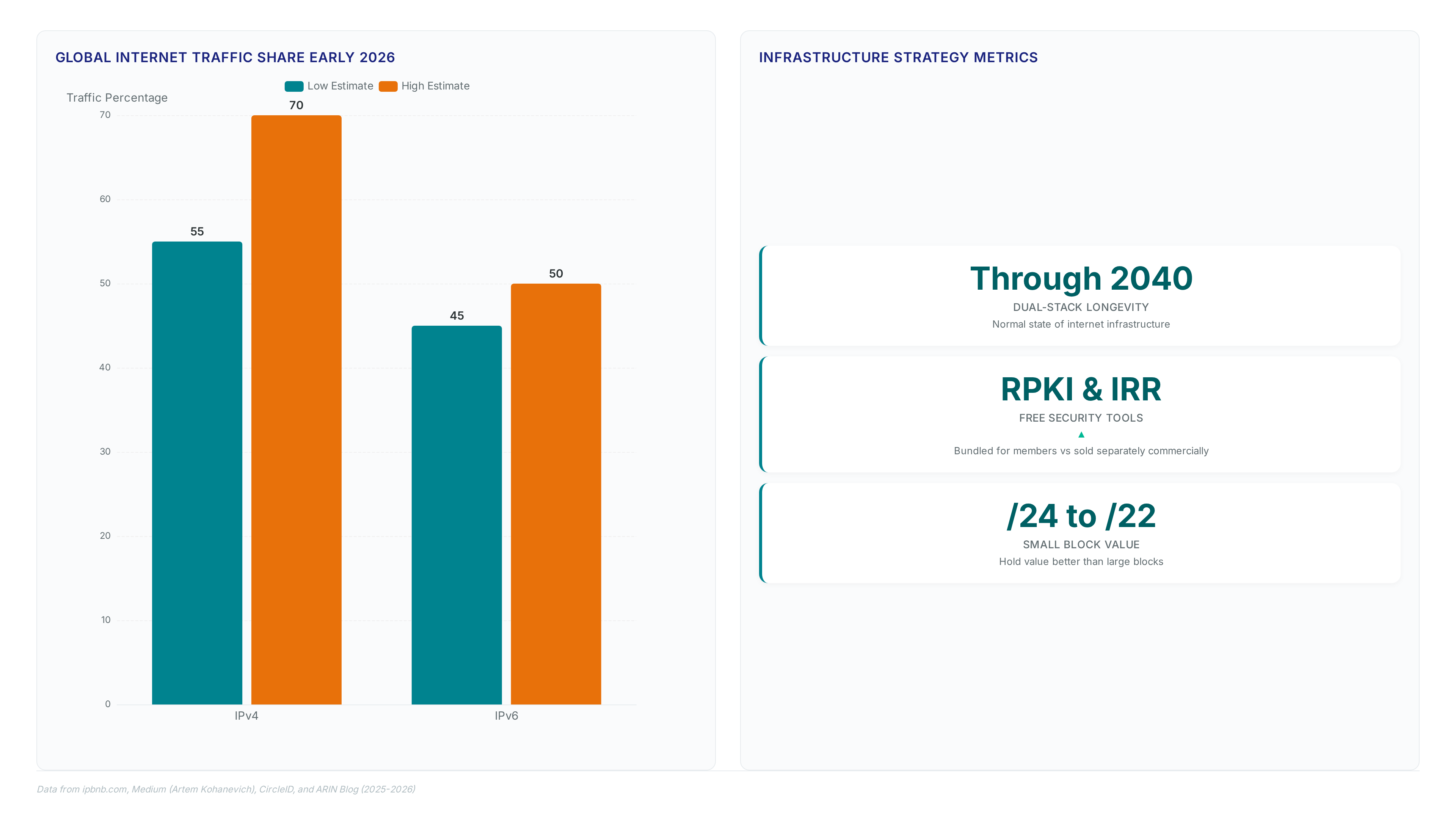
Finally, we deliver a tactical step-by-step guide for securing an exhibitor sponsorship, using ARIN's February 2026 announcement to navigate the application process before slots vanish. With global IPv6 adoption hovering near 50% yet IPv4 still carrying the majority of traffic in key regions, the window to assert dominance in this hybrid environment is narrowing. Ignoring this event means ceding ground to competitors who understand that the Internet system is still built on the scarcity of legacy resources.
The Role of ARIN 57 in Community-Driven Internet Policy
ARIN 57 as the Public Policy and Members Meeting Venue
ARIN 57 marks the 57th iteration of the Public Policy and Members Meeting, set for 19-22 April in Louisville, Kentucky. Network operators gather here to shape transparent policy development through a bottom-up governance model instead of accepting top-down commercial mandates. Delegates debate resource allocation rules that directly impact the 39.5% of global IPv4 holdings managed within the North American region. Access to free routing security tools like Resource Public Key Infrastructure (RPKI) remains available, though hijack risks rise while adoption lags. Enterprise networks stuck at 32% IPv6 adoption face distinct pressure during these sessions to align with majority mobile carrier standards.
Funding consensus building differs sharply from purchasing booth space at standard trade shows. Organizations gain visibility among the specific engineers who configure border routers and manage number resources daily. Timing creates a hard constraint since attendance requires travel during a quarter when many firms freeze discretionary spending before fiscal year-end reviews. Missing this cycle delays feedback loops on draft policies by six months until the next convening. Strategic participation allows stakeholder voices to shape rules governing future address space availability.
ARIN 57 convenes network engineers to address the disconnect between 72% mobile carrier readiness and stagnant enterprise deployment. Attendees including ISP technical staff and grant recipients gather in Louisville to transform policy proposals into operational fixes for this bifurcated infrastructure. The bottom-up governance model empowers participants to draft rules influencing how organizations allocate scarce resources during the transition.
Fortune 500 entities maintain a dominant reliance on legacy addressing for public services, creating a security perimeter that mobile users increasingly bypass. This disparity forces operators to maintain complex translation layers rather than pursuing native connectivity. ARIN mitigates this through community grants funding testbeds like Internet2, enabling vendors to validate IPv6-only capabilities before production rollout. Inaction carries a high cost as AI workloads drive renewed demand for small IPv4 blocks, yet the long-term strategy requires abandoning translation mechanisms entirely.
Sponsors gain visibility while funding Advisory Council operations that keep the policy process functional. Without direct financial support from the private sector, the volunteer-driven mechanism risks slowing down updates needed for global routing stability. Tension between immediate leasing needs and long-term protocol adoption defines the current strategic position for North American network planners.
Dual-stack operation remains the standard infrastructure state through at least 2040, delaying a full IPv4 sunset. Dual-stack longevity creates a stable baseline where running IPv4 and IPv6 simultaneously persists as the norm. Industry analysis confirms this infrastructure state will not yield to IPv6-only architectures soon. Conversely, the rise of AI workloads generates renewed demand for routable IPv4 addresses. This pressure targets small blocks used for geotargeting and efficient network scaling. Operators must balance long-term transition goals against immediate capacity needs.
Transparent policy development requires addressing these conflicting forces within the community forum. Participants must define rules accommodating both enduring dual-stack requirements and surging AI consumption. The bottom-up model allows engineers to propose solutions for market supply constraints rather than accepting top-down commercial mandates. Failure to participate leaves network architecture decisions to external market pressures alone.
Comparative Analysis of ARIN 57 Sponsorship Tiers and Benefits
Defining ARIN 57 Sponsorship Tiers and Fellowship Program Access
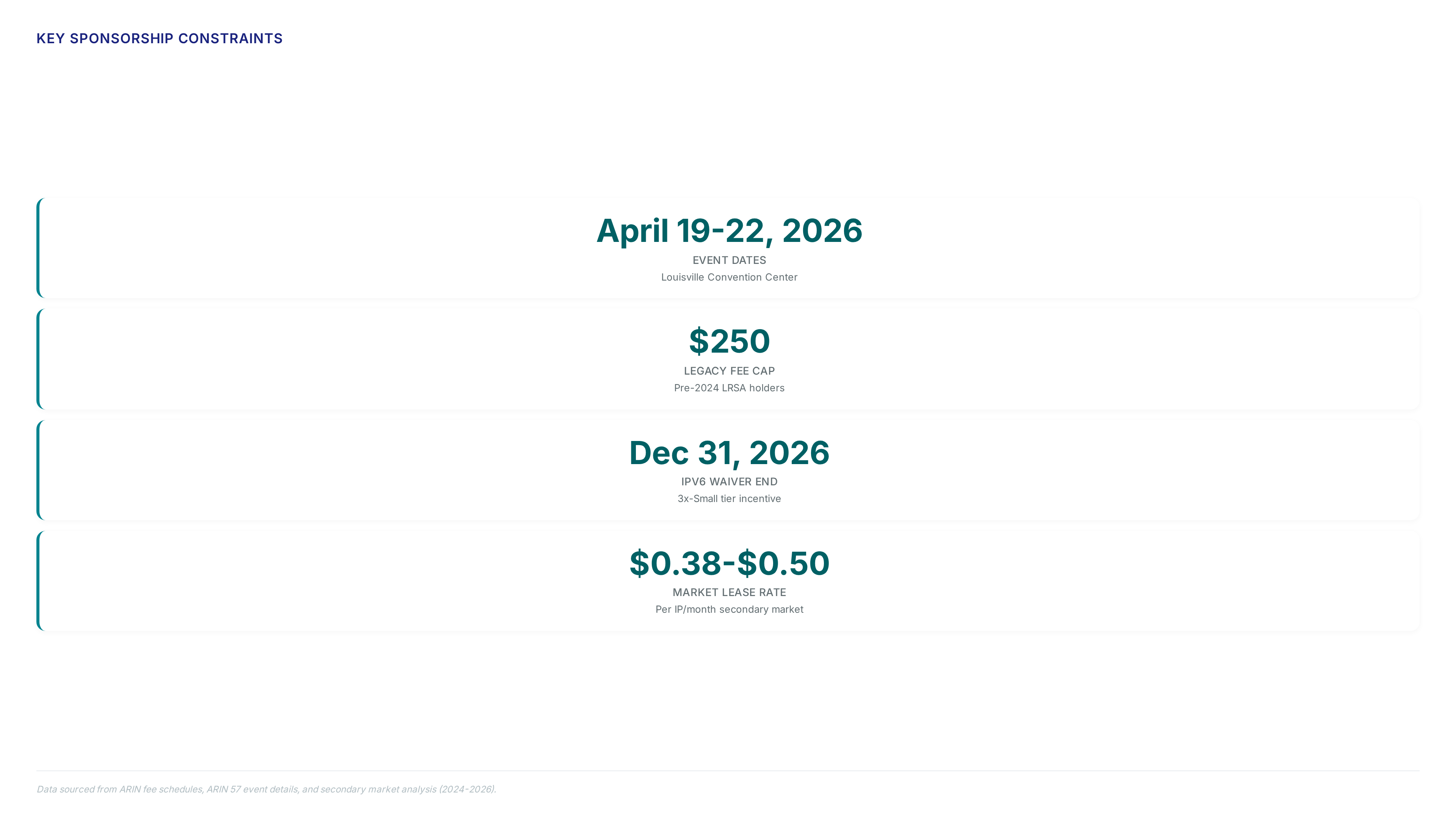
Seven distinct sponsorship packages for ARIN 57 range from Bronze entry levels to exclusive Social Event and Webcast slots. Organizations seeking precise cost structures must consult the official sponsorship portal rather than relying on generalized estimates. The tiered structure balances high-value brand exposure against direct community engagement, with Fellowship Program sponsors specifically targeting educational outreach rather than commercial lead generation. Unlike commercial vendors who monetize scarcity through leases costing $0.38 to $0.50 per IP address monthly, these packages fund a non-profit steward managing resources across the United States, Canada, and parts of the Caribbean region.
| Tier Focus | Primary Benefit | Strategic Limitation |
|---|---|---|
| Gold Sponsor | Maximum logo visibility | Highest capital requirement |
| Fellowship | Direct student interaction | No exhibition floor access |
| Exhibitor | Booth space allocation | Limited speaking opportunities |
Selecting a tier requires aligning budget constraints with specific policy influence goals. A tension exists between purchasing broad recognition and funding the Community Grant Program which supports technical IPv6 projects through June 14, 2026. Operators prioritizing long-term routing security often favor Fellowship sponsorship to cultivate future talent pools over immediate sales metrics. This approach supports the bottom-up governance model while avoiding the perception of purely transactional involvement.
Meanwhile, selecting a Social Event Sponsorship directly funds community networking while bypassing the high costs of commercial IP leasing models. Organizations targeting brand visibility among network architects should prioritize this tier over standard booth placements to maximize engagement during informal policy discussions. A Fellowship Program Sponsor aligns capital with educational grants that enable entities like Internet2 to test IPv6-only capabilities, demonstrating tangible commitment to protocol evolution rather than mere logo placement.
| Sponsorship Focus | Primary Outcome | Budget Efficiency |
|---|---|---|
| Fellowship Program | Supports grant recipients testing new stacks | High social impact |
| Social Event | Enables direct peer-to-peer dialogue | Moderate cost per lead |
| Webcast | Extends reach to remote global participants | Low physical overhead |
Webcast options provide an alternative for groups unable to travel to Louisville, extending reach to remote participants who monitor RPKI adoption metrics globally. The limitation of lower-tier packages remains the lack of exclusive branding rights during key policy voting sessions. Operators must weigh immediate lead generation against long-term reputation building within the governance system. Timing matters significantly, as fee waivers for specific IPv6 tiers expire on December 31, 2026, creating urgency for sponsors advocating rapid transition. Contact [[email protected]](mailto:[email protected]) to negotiate custom packages that align with specific technical advocacy goals.
Bronze, Silver, and Gold tiers differ primarily in booth placement priority and logo sizing on event materials. Organizations must weigh static brand exposure against active engagement opportunities when selecting a package. Bronze sponsors receive standard listing placement, whereas Gold partners secure premium positioning near registration desks to maximize foot traffic. The cost differential often mirrors the value of direct access to policy makers during peak hours.
| Tier | Visibility Scope | Engagement Level |
|---|---|---|
| Bronze | Digital roster only | Passive |
| Silver | Breakout session signage | Moderate |
| Gold | Main hall keynote banner | High |
Silver sponsorship offers a balanced approach for firms seeking moderate visibility without the expense of exclusive event rights. Gold status commands the highest investment but delivers dominant presence throughout the four-day agenda. Operators should note that fee structures for resource holdings vary significantly based on legacy status. Entities holding resources under agreements signed before 2024 benefit from a flat rate cap that preserves capital for marketing activities like sponsorship. This financial efficiency allows smaller networks to compete for attention alongside larger corporations.
Conversely, newer allocations face variable costs that might constrain discretionary spending budgets. The strategic choice depends on whether the goal is broad awareness or targeted relationship building with engineers. A mismatch between budget and objectives yields poor returns regardless of the selected level.
Step-by-Step Guide to Securing ARIN 57 Exhibitor Sponsorship
Exhibitor Sponsorship Definition Within ARIN 57 Package Tiers
The Exhibitor Sponsor tier mandates a physical booth presence at the Louisville convention center, distinguishing it from passive Bronze or Silver branding slots. Applicants must submit the request via [email protected] to secure floor space before the general sponsorship pool closes. This specific package targets organizations requiring direct technical dialogue rather than simple logo placement on digital rosters. While other tiers fund general operations, exhibitors gain exclusive access to policy makers during scheduled breaks. The strategic value lies in converting abstract support into tangible vendor conversations.
Securing this role requires navigating distinct geographic resource mandates.
Initiate the Exhibitor Sponsor application by emailing [email protected] with "ARIN 57 Louisville" in the subject line to bypass generic intake queues.
- Draft a message specifying the desired tier and explicitly mentioning the April 19-22 dates to trigger immediate routing to the events team.
- Reference the temporary IPv6 fee waiver expiration on December 31, 2026, to demonstrate technical alignment with current community incentives.
- Include your organization's autonomous system number so staff can verify resource holdings against the flat rate cap of $250 for eligible legacy holders.
- Await a response within 48 hours; failure to receive confirmation indicates the inquiry landed in a spam filter requiring a follow-up call.
Operators often overlook that early contact secures booth placement near policy drafting rooms, whereas late applicants face peripheral locations with reduced foot traffic. This workflow transforms a simple inquiry into a strategic positioning maneuver within the limited convention center layout.
Pre-Submission Validation Checklist for ARIN 57 Sponsorship Inquiries
Verify the Louisville event runs 19-22 April 2026 before drafting any inquiry to avoid scheduling conflicts.
- Confirm the target Exhibitor Sponsor tier aligns with goals for direct technical dialogue rather than passive logo placement.
- Review the fee schedule to determine if legacy resource caps apply to your organization's current billing status.
- Check the IPv6 fee waiver expiration date to time financial commitments before costs normalize later in the year.
- Prepare an email to [email protected] that explicitly references the April dates and desired package level.
Organizations often overlook how fee structures impact total sponsorship cost when budgeting for multi-year engagements.
| Validation Step | Required Artifact | Risk if Skipped |
|---|---|---|
| Date Confirmation | Calendar invite | Missed submission deadlines |
| Fee Analysis | Billing statement | Budget overruns |
| Protocol Alignment | IPv6 deployment plan | Lost incentive eligibility |
| Contact Draft | Email template | Routing to generic queue |
The policy development cycle drives attendee engagement more than vendor exhibitions alone. Skipping the fee analysis step risks allocating funds inefficiently when flat-rate caps could reduce overhead.
Strategic Value of Sponsoring Internet Infrastructure Policy Events
Calculating return on investment for ARIN 57 sponsorship demands a focus on the bottom-up, community-driven policy development process instead of simple lead counts. Commercial trade shows operate differently because this specific gathering shapes the Internet governance model through direct contact with an elected Advisory Council. Sponsors earn visibility among stakeholders debating Resource Public Key Infrastructure (RPKI) adoption while backing the core infrastructure of the global network. The primary value lies in accessing decision-makers during critical policy discussions that set future routing security.
ROI here appears as long-term alignment with transparent processes rather than immediate sales conversions. Supporting these meetings increases brand presence within a niche audience controlling a vast number of actively maintained websites. This engagement validates an operator's commitment to system stability in a way standard marketing cannot. The community-driven nature of ARIN ensures that sponsor contributions directly enable the technical dialogues necessary for internet growth.
Top-down commercial policies face restrictions here since influence flows through consensus, making presence at these specific gatherings necessary for strategic positioning. This divergence creates a specific market opportunity for vendors offering transition tooling rather than generic connectivity. Sponsors gain direct access to network architects debating Dual-Stack Longevity through at least 2040, a timeline that dictates capital expenditure cycles for Fortune 500 companies. The mechanism involves aligning brand messaging with the technical realities of AI-Driven Demand, where renewed need for routable IPv4 addresses complicates pure IPv6 migration strategies. Exhibitors can demonstrate solutions that manage this hybrid state without forcing premature infrastructure rip-and-replace.
A limitation exists in the audience scope because policy forums attract governance stakeholders rather than immediate procurement decision-makers for enterprise hardware. The cost of misaligned messaging remains high since technical audiences reject marketing fluff in favor of concrete interoperability data. Recent grant applications (arin.net/blog/2026/05/04/grant-applications-open/) validated IPv6-only environments for 30 participants. This proof point shifts the conversation from theoretical capability to deployed reality. Operators attending ARIN 57 seek vendors who understand the nuance of running parallel stacks while preparing for an eventual IPv4 sunset. Brand visibility here signals commitment to the transparent processes that underpin global routing stability.
Navigating Dual-Stack Longevity Risks Through ARIN 57 Engagement
Ignoring the projected Dual-Stack Longevity timeline extending to 2040 leaves enterprise brands unprepared for persistent IPv4 dependency. Absence from ARIN 57 policy discussions risks misalignment with the transparent processes governing future number resource allocation. Organizations skipping this engagement miss critical signals regarding RPKI adoption curves that prevent route hijacking in mixed-protocol environments. Vendors lose direct access to architects defining standards for the next fifteen years when they do not participate.
InterLIR advises immediate sponsorship enrollment to secure visibility among decision-makers shaping these technical mandates.
- Direct engagement with the Internet governance model during active policy formulation.
- Access to technical teams managing the transition for IRR data maintenance.
- Influence over AI-Driven Demand protocols before they become entrenched industry defaults.
- Opportunity to showcase interoperability data to a skeptical technical audience.
- Early insights into capital expenditure cycles affecting Fortune 500 planning.
Failure to sponsor results in reactive adaptation rather than proactive strategy definition. Brands absent from Louisville will face market conditions dictated by competitors who shaped the rules. Securing an Exhibitor Sponsor tier ensures presence during debates that determine capital expenditure cycles through 2040.
About
Alexander Timokhin, CEO of InterLIR, brings necessary industry perspective to the discussion of ARIN 57 sponsorship opportunities. As the leader of a specialized IPv4 address marketplace, Timokhin manages daily operations centered on the redistribution of critical internet number resources. This direct involvement in the IP addressing system makes him uniquely qualified to analyze the value of engaging with ARIN's policy forums. His work at InterLIR, founded in Berlin to solve network availability challenges, relies heavily on the transparency and governance standards that ARIN promotes. By connecting his experience in IT infrastructure and international business relations to the upcoming meeting in Louisville, Timokhin highlights how sponsorship allows organizations to influence the very policies shaping global resource allocation. His insights bridge the gap between commercial IP market dynamics and the public policy discussions that define the future of internet numbering.
Conclusion
Scaling parallel protocol stacks inevitably fractures operational efficiency when legacy addressing dependencies collide with modern traffic loads. The hidden tax of maintaining dual-stack environments extends far beyond simple lease fees; it introduces complex routing instability that grows exponentially as mobile carrier readiness outpaces enterprise implementation. Organizations clinging to static IPv4 allocations without a set sunset path will face escalating operational friction that erodes margin stability by 2030. You must treat current address holdings as depreciating assets rather than permanent infrastructure.
Commit to a strict 18-month migration window for all public-facing services, conditioning any further IPv4 acquisition on proven IPv6 traffic thresholds exceeding 60%. Do not wait for regulatory mandates to force this shift; the market penalty for lagging adoption will arrive well before policy deadlines. Immediate financial modeling should assume IPv4 lease costs will double within three years, making long-term reliance fiscally unsustainable.
Start by auditing your current BGP announcements this week to identify any non-essential IPv4 prefixes that can be deprecated immediately. Remove these redundant blocks from your active routing table to reduce attack surface and establish a baseline for your transition metric. This tangible reduction in legacy exposure provides the necessary data to justify budget reallocation toward native IPv6 engineering resources next quarter.
Frequently Asked Questions
Enterprises lagging at 32% IPv6 adoption face distinct pressure to align with mobile standards. This disconnect forces operators to maintain complex translation layers instead of pursuing native connectivity for their networks.
The event convenes engineers to address the disconnect between 72% mobile carrier readiness and stagnant enterprise deployment. Attendees transform policy proposals into operational fixes for this bifurcated infrastructure landscape.
Fortune 500 entities maintain a 76% reliance on legacy addressing for public services today. This creates a security perimeter that mobile users increasingly bypass, forcing complex network maintenance strategies.
Delegates debate resource allocation rules impacting the 39.5% of global IPv4 holdings managed within North America. These decisions directly shape how organizations allocate scarce resources during the current transition.
Global IPv6 adoption hovers near 50% yet IPv4 still carries the majority of traffic in key regions. This hybrid environment narrows the window for organizations to assert dominance effectively.