ARIN Committee Picks: 5 Fellows for Policy Roles
Five specific individuals, including two former Fellows, comprise the ARIN 57 Fellowship Selection Committee announced on 7 Jan 2026. (ARIN's fee schedule) This roster functions as the gatekeeper for regional internet governance, heavily weighting institutional memory over fresh external perspectives. Who sits on this panel dictates which applicants successfully navigate the increasingly complex policy environment.
Applicants must recognize that committee composition drives the assessment workflow, blending ARIN staff oversight with volunteer judgment from General Member organizations. As the industry pivots toward on-device AI decision-making for network management in 2026, the criteria for selecting fellows who grasp these technical nuances become critical. RCR Wireless predicts this technological shift will dominate the year, yet the selection process remains rooted in traditional policy evaluation methods managed by leaders like John Curran.
We need to dissect the specific roles of members like Stephen Middleton and Caleb Ogundele within the broader governance structure. The guide details the application assessment workflow, revealing how past fellows influence current selections. Finally, a step-by-step breakdown clarifies the submission process for the ARIN 57 cycle, ensuring candidates align their proposals with the committee's established preferences before the 8 January opening.
The Role of the Fellowship Selection Committee in Internet Governance
ARIN Fellowship Selection Committee Mandate and Structure
Internet number resource governance flows through a community-driven, bottom-up policy process managed by volunteers, not corporate executives. The ARIN Fellowship Program relies on a specific committee to evaluate applicants and select participants for upcoming policy meetings. This body operates under the direction of the Office of the Chief Experience Officer while drawing membership from diverse stakeholder groups. General Member organizations, the Board of Trustees, internal staff, and previous Fellows all contribute voting representatives to the panel. A former Fellow sits within this group to provide continuity grounded in direct program experience instead of abstract administrative oversight.
Committee composition merges institutional memory with fresh perspectives through set slots:
- One lead from the Office of the Chief Experience Officer
- Volunteers from ARIN General Member organizations
- Representatives from the ARIN Board of Trustees
- ARIN staff members
- Two previous Fellows
- Additional ad-hoc advisors as needed
Assessing applications and choosing Fellows for ARIN Public Policy and Members Meetings forms the core duty of this group. Regional stability hinges on these choices because approximately a majority of enterprises transitioning to multi-cloud environments must align with registry decisions. Inclusion of a Board of Trustees representative keeps selections aligned with broad governance goals without surrendering operational control to executive mandates. Volunteer availability creates scheduling friction that paid commercial staffing models typically avoid.
Access to policy forums where IPv6 adoption strategies become formalized depends entirely on this governance body. Selection outcomes influence how enterprises navigate the doubled cost of links and ports in AI connectivity architectures. Organizations face inflated infrastructure expenses driven by suboptimal resource allocation when fellows fail to advocate for efficient addressing. Candidates who understand that regional registry decisions directly impact cloud interconnection economics receive priority during review.
Measurable protocol shifts follow successful fellows much like the trajectory observed at TELUS Communications. That operator reached 45% IPv6 traffic after transitioning voice over LTE to IPv6-only configurations. Current selections must replicate such technical rigor while managing the complexity of community-driven policy development. Fellowship terms often end before long-term migration projects reach maturity. Non-technical stakeholders sometimes dominate discussions and slow consensus on urgent routing security updates. Applications close before the March 3, 2026 effective date of NRPM version 2026.1, establishing a hard regulatory boundary for eligibility. The announcement timeline for ARIN 57 began January 7, 2026, which aligns committee formation with the new policy cycle. Selected Fellows operate under the updated governance framework rather than legacy rules due to this synchronization. The Board of Trustees adopted these changes on December 15, 2025, mandating immediate compliance for all resource requests.
Operators submitting fellowship applications after the window closes face disqualification regardless of technical merit. The selection process acts as a gatekeeper for access to the community-driven, bottom-up policy process set in the manual. Missing this cycle delays participation by six months until the next meeting series. Total exclusion from the upcoming policy forum remains the cost of non-compliance.
Committee Composition and the Application Assessment Workflow
ARIN General Member Status and Committee Eligibility
Stephen Middleton qualifies for the committee through verified ARIN General Member organizational status, a prerequisite distinct from individual membership. This classification grants entities the right to vote in the 2026 ARIN Elections and nominate representatives for governance roles. The Advisory Council comprises exactly 15 elected members who guide the Policy Development Process alongside these General Member delegates. Eligibility relies on holding resource allocations rather than paying sponsorship fees found on the ARIN sponsorship page.
| Role Type | Selection Method | Primary Function |
|---|---|---|
| General Member | Organizational Registration | Vote on Board and Council |
| Former Fellow | Committee Appointment | Evaluate new applicants |
| ARIN Staff | Internal Assignment | Provide administrative support |
Organizations must maintain active registrations to sustain this voting privilege within the regional internet registry framework. The structure prevents commercial vendors from dominating policy discussions without holding actual number resources. General Member status creates a firewall between resource holders and service providers seeking market influence. This distinction ensures that committee members like Middleton represent operational network needs rather than sales objectives. The governance model separates resource management from the corporate leadership structures driving AI connectivity strategies at equipment vendors. InterLIR observes that this separation remains vital for maintaining neutral policy development outcomes.
Operational Workflow for Assessing Fellowship Applications
Applications enter a structured review where Caleb Ogundele and Atefeh Mohseni evaluate candidate technical readiness against prior program outcomes. Former Fellows provide necessary context that staff members Joe Westover and Hollis Kara cannot replicate through administrative metrics alone. This dual-layer assessment prevents the selection of candidates who lack the specific operational background required for proven policy engagement. The workflow proceeds through four distinct stages to ensure rigorous vetting:
- Staff verifies organizational eligibility and resource holding status.
- Former Fellows score technical essays based on real-world deployment scenarios.
- The full committee debates scores to balance geographic and sector diversity.
- Final selections align with the broader goal of supporting community projects like those funding IPv6-only networks.
Volunteers contribute by joining this evaluation chain, directly influencing who gains access to community-benefiting projects. The manual nature of this process contrasts sharply with automated systems that achieve 75% reduction in assessment time elsewhere. ARIN retains human judgment to capture detailed technical competence that algorithms miss.
| Evaluation Phase | Primary Reviewer | Key Constraint |
|---|---|---|
| Eligibility Check | ARIN Staff | Resource ownership proof |
| Technical Scoring | Former Fellows | Direct experience relevance |
| Diversity Balance | Full Committee | Regional representation limits |
| Final Selection | Committee Chair | Program capacity caps |
Stephen Middleton brings General Member perspective to finalize the roster, ensuring organizational interests remain represented. The reliance on volunteer time creates a bottleneck that limits the total number of Fellows selected per cycle.
Validating the committee mix requires exactly one General Member, two former Fellows, and two staff representatives to prevent governance bias. Stephen Middleton satisfies the ARIN General Member quota, granting the body authority derived from entities eligible for the 2026 ARIN Elections. Caleb Ogundele and Atefeh Mohseni provide historical context that pure administrators lack, while Joe Westover and Hollis Kara enforce procedural compliance. This specific distribution balances operational memory with current policy mandates found in the Policy Development Process.
| Role Category | Required Count | Function |
|---|---|---|
| General Member | 1 | Validates organizational standing |
| Former Fellow | 2 | Scores technical readiness |
| ARIN Staff | 2 | Verifies resource eligibility |
| Board Trustee | 1 | Oversees fiduciary alignment |
Operators contributing as volunteers must navigate tensions between advocacy and assessment duties. Selection limits access for those seeking only networking opportunities without policy engagement intent. The structure excludes individuals lacking verified resource holdings or prior program completion. Missing any single category invalidates the committee's quorum for final selection votes.
Step-by-Step Guide to Submitting the ARIN 57 Fellowship Application
ARIN 57 Fellowship Application Window and Key 2026 Dates
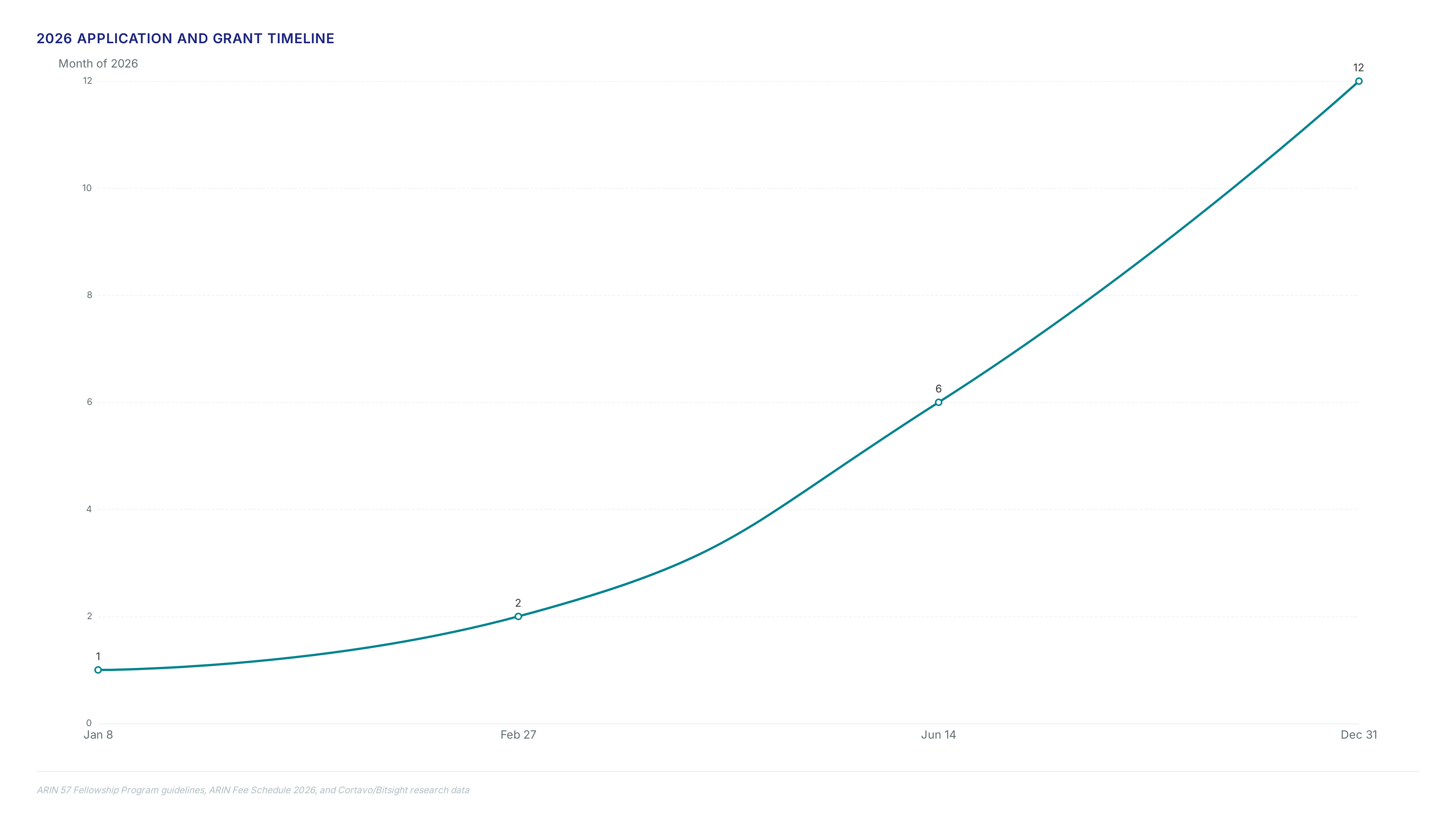
Applications for the ARIN 57 Fellowship Program open 8 January 2026, establishing a fixed submission window for policy engagement. Operators must align internal review cycles with this date to ensure candidate readiness before the Policy Engagement Survey closes on February 27, 2026. Missing this survey deadline eliminates a primary data source for fellowship essays, reducing application competitiveness. The broader 2026 calendar offers layered participation opportunities beyond the fellowship track. Financial support remains available through the 2026 ARIN Community Grant Program until June 14, 2026, allowing rejected fellows to pivot toward project funding. Past recipients like James Harr from Internet2 used such grants to enable 30 participants to test software on IPv6-only networks, demonstrating an alternative path for technical community contribution. Submission requires strict adherence to the following procedural steps:
- Verify organizational status against General Member requirements prior to drafting.
- Complete the online form available at the fellowship portal immediately upon opening.
- Cross-reference essay topics with active working group charts from the Advisory Council.
- Submit final documents before the system timestamp reaches the closing minute.
Delaying preparation until the window opens risks missing the compressed timeline for survey data integration. The cost of late submission is total disqualification, as no extensions exist for this governance gateway.
Executing the Submission via ARIN Online and Fellowship Portal
Access recovery tickets via Ask ARIN now resolve Point of Contact locks that previously blocked ARIN Online submissions. Operators must secure account integrity before the 8 January 2026 window opens to avoid disqualification.
- Validate Point of Contact status using the updated recovery tools.
- Draft technical essays referencing IPv6-only testing methodologies.
- Upload documentation to the fellowship portal before the deadline.
Linking fellowship applications to broader grant initiatives strengthens candidate profiles significantly. Projects mirroring the Internet2 model, where 30 participants validated software on restricted networks, demonstrate the practical rigor selection committees prioritize. This approach aligns individual learning with tangible community outcomes rather than abstract policy interest. The 2026 ARIN Community Grant Program remains open until June 14, 2026, offering a parallel path for funding related research. Applicants ignoring this cooperation miss a chance to showcase funded execution capability alongside theoretical knowledge. Failure to integrate these distinct but complementary programs results in fragmented applications that lack demonstrated project momentum.
Pre-Submission Validation Against 2026 Grant and Election Deadlines
Applicants must cross-reference the ARIN 57 Fellowship Program start date with the Policy Engagement Survey closing on February 27, 2026, to secure the data for technical essays. Submitting after this survey deadline removes a primary evidence source, weakening the application's operational grounding. Operators should also evaluate parallel funding windows, as the 2026 ARIN Community Grant Program remains open through June 14, 2026, offering financial support for related infrastructure projects. James Harr from Internet2 previously used such grants to enable 30 participants to test software on IPv6-only networks, demonstrating a viable path for fellowship candidates seeking project backing. Aligning these timelines prevents resource fragmentation and maximizes community impact.
| Milestone | Deadline | Strategic Value |
|---|---|---|
| Fellowship Application | Opens 8 January 2026 | Mandatory entry point |
| Policy Survey | 27 February 2026 | Necessary data source |
| Community Grants | 14 June 2026 | Project funding option |
| General Elections | 22–30 October 2026 | Leadership selection |
Execute the following validation sequence before finalizing submission materials:
- Confirm Point of Contact access recovery via Ask ARIN tickets to prevent portal lockouts.
- Extract survey responses prior to the February cutoff for essay integration.
- Draft grant proposals concurrently if infrastructure testing aligns with fellowship goals.
Missing the survey window creates an unrecoverable gap in policy context that no amount of technical expertise can fill later.
Strategic Value of Fellowship Participation for Network Professionals
Defining the ARIN Fellowship Value Proposition for IP Professionals
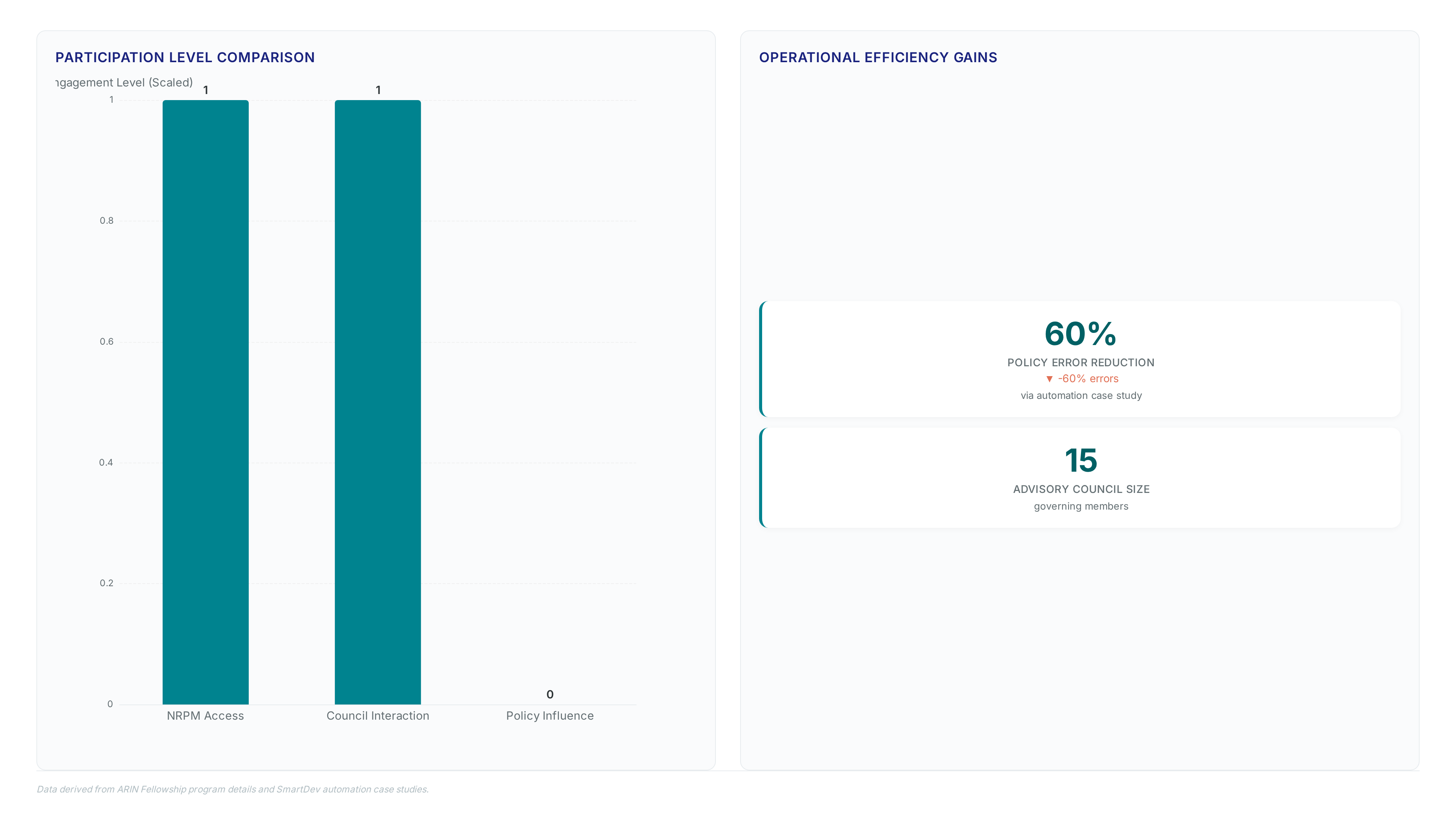
The ARIN Fellowship transforms individual operators into direct contributors to the Number Resource Policy Manual rather than serving as a simple travel subsidy. This mechanism bridges the gap between technical implementation and the 15-member Advisory Council that governs allocation rules. Participants gain access to the Policy Development Process, where a Recommended Draft Policy must satisfy three stewardship principles before adoption. Ignoring this pathway leaves network architects reacting to rules they had no hand in shaping.
| Feature | Standard Attendance | Fellowship Participation |
|---|---|---|
| NRPM Access | Passive observation | Direct drafting input |
| Advisory Council Interaction | Limited Q&A | Structured mentorship |
| Draft Policy Influence | None | Vote eligibility |
Operators often mistake policy work for abstract bureaucracy, yet the stages of policy development dictate real-world routing constraints. A failure to engage means accepting IPv6 assignment limitations set by others. The cost of non-participation is measurable in reduced flexibility during multi-cloud transitions. The limitation remains that selection favors those with existing policy literacy, creating an entry barrier for pure technical staff. Applicants must demonstrate understanding of how AS path validation intersects with registry rules to succeed. Without this specific technical grounding, essays lack the necessary operational weight. The program demands more than general interest; it requires proof of direct impact potential on resource stewardship.
However, accessing this fluency requires navigating a competitive selection process managed by the Fellowship Selection Committee. Applicants should evaluate career benefits against the time investment required for policy meeting attendance. Ignoring this gateway leaves network architects reacting to rules they had no hand in shaping, resulting in preventable outages. The limitation remains that only selected fellows receive direct mentorship, forcing others to rely on delayed public minutes.
Pre-Application Checklist: Aligning Goals with 2026 Grant and Election Cycles
Applications submitted before the February 27, 2026 Policy Engagement Survey closure gain access to live community sentiment data for technical essays. Candidates missing this window lose the ability to cite current operational friction points in their proposals. Operators must treat the fellowship not as an isolated event but as a component of a broader annual engagement strategy. The 2026 ARIN Ecosystem Grant Program remains active through June 14, 2026, offering a parallel funding track for infrastructure projects that complement policy study. Ignoring this overlap forfeits potential financial support for lab environments needed to test proposed policy changes.
| Timing Factor | Fellowship Window | Grant/Election Window |
|---|---|---|
| Data Source | Survey closes late February | Grants open through mid-June |
| Strategic Goal | Essay evidence gathering | Project funding or voting rights |
| Outcome | Selection for ARIN 57 | Financial support or Board influence |
Late applicants face a disjointed experience where policy education occurs without the context of ongoing grant-funded trials. InterLIR recommends synchronizing application drafts with the 2026 ARIN Elections schedule to maximize long-term governance impact. This alignment ensures fellows transition directly from observation to active voting participation within the same fiscal year.
About
Alexei Krylov serves as the Head of Sales at InterLIR, a specialized marketplace dedicated to the redistribution of IPv4 resources. His extensive background in B2B sales and direct experience working with Regional Internet Registries (RIRs) uniquely qualifies him to analyze the composition of the ARIN Fellowship Selection Committee. As ARIN implements its updated Number Resource Policy Manual, understanding how leadership is selected becomes critical for organizations navigating IP resource availability. Krylov's daily work involves guiding clients through complex RIR policies and ensuring secure, compliant access to network addresses. This practical expertise allows him to contextualize how committee decisions at ARIN directly impact the broader IP market and resource distribution strategies. By connecting these governance changes to real-world operational challenges, he provides valuable insight into how such selections influence the future of internet infrastructure and resource management for providers like InterLIR.
Conclusion
Scaling policy engagement beyond a single fellowship reveals a critical bottleneck: mentorship scarcity creates a knowledge gap where the majority of architects operate on outdated precedents. As AI shifts network management to on-device decision-making by 2027, reliance on delayed public minutes becomes a tangible operational risk rather than a mere inconvenience. Organizations that fail to integrate policy literacy with real-time infrastructure trials will face compliance drift when automated systems enforce rules their teams do not understand. The window for synchronizing educational goals with funding cycles is narrow; waiting until the June grant deadline decouples technical validation from governance influence.
Committees must mandate that candidates submit policy drafts alongside infrastructure grant proposals by late February 2026. This specific timing ensures that technical essays use live survey data while securing budget for the lab environments necessary to test those policies. Do not treat these tracks as separate administrative hurdles. Start by auditing your current RIR engagement calendar this week to identify the exact overlap between the Directive Engagement Survey closure and your Q2 infrastructure budget planning. Aligning these dates now prevents the fragmentation of technical and political capital later in the fiscal year.
Frequently Asked Questions
Two former Fellows provide continuity that shapes current selection outcomes significantly. Their presence ensures approximately 53% of enterprises transitioning to multicloud environments align with registry decisions effectively.
Selected fellows often replicate technical rigor seen in major operator transitions like TELUS Communications. That specific operator reached 45% IPv6 traffic after transitioning voice over LTE configurations successfully.
Five individuals including Stephen Middleton and two former Fellows comprise the official selection committee announced recently. They assess applications to ensure regional stability for approximately 53% of transitioning enterprises.
The group blends volunteer judgment with staff oversight to evaluate grasp of on-device AI decision-making nuances. This balance helps operators reach targets like the 45% IPv6 traffic milestone achieved by TELUS.
Applicants must submit before the March 3, 2026 effective date to operate under updated governance rules. Missing this window excludes candidates from influencing the 45% IPv6 traffic transitions observed in the sector.