ARIN Committee Roles: Secure Your Seat by May
ARIN extends its application deadline to 1 May for two General Member seats on the 2026 Grant Selection Committee. (ARIN's program)
Stop treating Internet number resource governance as a spectator sport. Passive observation gets you nothing. The Board of Trustees cannot allocate funds for critical Internet education and infrastructure projects without community-driven validation. This isn't administrative paperwork; it is strategic influence. If you aren't auditing project viability before July reviews begin, you are letting others decide the technical future of your region.
Here is how the machine actually works. Fifteen elected Advisory Council members translate committee recommendations into binding policy advice. We skip the superficial checks and dive straight into the online portal review process, where research proposals get torn apart to ensure regional network stability. You need a tactical roadmap to execute your application before the 1 May deadline, or you will miss the chance to address the operational needs ARIN leadership faces right now.
John Curran and the founding team built this nonprofit corporation in December 1997 on one premise: members must accept the burden of scrutiny. Today, the intersection of Artificial Intelligence and network management requires evaluators who understand that current grant decisions shape tomorrow's on-device decision-making capabilities.
The Strategic Role of General Members in ARIN Governance and Grant Allocation
The Grant Selection Committee is the engine room. It evaluates project applications for financial support ranging from $1,000 to a substantial amount. ARIN cannot sustain organizational governance without General Members stepping up for elections and distinct program committees. This structure exists for one reason: to ensure the ARIN Community Grant Program selects initiatives that provide maximum benefit to the regional Internet community. Since December 1997, this organization has operated as one of five Regional Internet Registries (RIRs) managing number resources globally.
General Members carry a dual mandate. You vote in scheduled elections, and you staff committees that review funding requests. The 2026 program maintains a total budget cap of a substantial sum, demanding rigorous assessment of every submission against technical merit. Committee members access an online portal to analyze proposals before convening for a single consensus call. This workflow directly dictates which infrastructure or research projects receive capital within the fixed annual allocation.
| Governance Component | Primary Function | Member Requirement |
|---|---|---|
| General Assembly | Elects leadership | All General Members |
| Grant Selection Committee | Evaluates funding apps | Two elected reps |
| Advisory Council | Advises Board of Trustees | 15 elected members |
Time is the currency here. Participation demands document review during the July evaluation window. Without sufficient volunteer engagement from the General Membership, the committee cannot form a quorum. Low civic participation creates a single point of failure that stalls the entire funding cycle. The organization published an announcement extending the application deadline specifically to secure necessary representation for the upcoming term.
General Members assess project applications targeting Internet education, infrastructure, or research against strict benefit criteria for the regional community. The committee reviews submissions via an online portal before convening a single group call to finalize recommendations for the Board of Trustees. Funded initiatives must deliver tangible value, not theoretical improvements.
Evaluation prioritizes proposals demonstrating measurable protocol adoption or security hardening within the ARIN region. Past success includes enabling 30 participants to test software on IPv6-only networks through Internet2 funding in 2023. Another grantee developed open-source hardware security modules, directly contributing to broader security infrastructure. These outcomes validate the preference for deployable tools over abstract studies.
Critics argue the selection process forces a choice between funding many small experiments versus fewer large-scale deployments. Limited total resources force the committee to reject viable projects that lack immediate community impact. Applicants must articulate clear deliverables within the established financial caps to survive initial screening.
Network operators need to hear this: successful proposals link technical execution to direct community utility. General Members serving on the committee wield significant influence over which technical directions receive financial support.
The extended application deadline of 1 May targets two General Member representatives for immediate committee integration. Operators must submit credentials before this date to join the team evaluating proposals for the 2026 ARIN Community Grant Program. Selection prioritizes members capable of reviewing technical merit across infrastructure and education sectors during the July assessment window. Failure to secure these seats leaves the evaluation process dependent on remaining incumbents, potentially slowing consensus on funding allocations. Prospective applicants should note that while committee service concludes with recommendations, the broader grant applications remain open until mid-June for submitters. This separation ensures reviewers are appointed before the influx of project proposals requires scoring. General Members influence the distribution of the annual budget through this single annual appointment cycle. Missing the May cutoff defers governance participation until the next elections scheduled for late October. Delays in committee formation create a bottleneck where worthy projects await scoring rather than receiving timely capital deployment. Active participation remains the only mechanism for direct oversight of community-funded technical initiatives within the region.
Inside the Grant Evaluation Workflow from Online Portal Review to Final Recommendations
Online Portal Review Mechanics for Grant Applications
Committee members access the online portal in July to score submissions. Total effort scales directly with application volume. This asynchronous workflow separates individual technical assessment from the single synchronous call required to finalize Board recommendations. Reviewers evaluate proposals against strict benefit criteria, examining past successes like the IPv6-only networks testing enabled by Internet2. Another validated outcome includes the RPKI coverage reporting tool deployed by the DNS Research Federation using prior funding. The process demands rigorous scrutiny of technical merit before any consensus forms regarding resource allocation.
High application counts create a bottleneck. Reviewer fatigue degrades the granularity of feedback provided to applicants. Operators must balance thorough due diligence against the fixed July window to prevent delayed funding decisions. The dependency on volunteer capacity means that a surge in submissions could compromise the depth of security vetting. Fatigue sets in quickly when volumes spike.
Executing the Mandatory Group Call for Board Recommendations
One scheduled group call finalizes consensus recommendations for submission to the Board of Trustees. This single synchronous session converts individual portal scores into a unified funding strategy. Committee members debate technical merit during July reviews before locking their positions. The process dictates that only the collective group decides grant recipients, not individual reviewers.
| Pre-Call | Score via online portal | Individual ranking |
|---|---|---|
| Live Call | Debate conflicting scores | Consensus list |
| Post-Call | Submit to Board | Final recommendation |
Absent members cannot vote, forcing reliance on remaining quorum. Funding supports initiatives like IPv6-only networks testing to drive protocol adoption. Another validated focus area includes tools measuring RPKI coverage across the region. These projects align with the goal to benefit the Internet community in the ARIN region. Operators must recognize that the Board retains final approval authority over committee suggestions. Rejection occurs if proposals fail to meet strict benefit criteria for the regional system. The tight timeline between July reviews and the final submission creates pressure for rapid agreement. Delays in reaching consensus risk pushing recommendations past the optimal funding window. Successful execution requires all participants to prepare detailed notes before the scheduled connection. This preparation ensures the single call suffices for finalizing all project evaluations.
Evaluators must verify that proposals advance IPv6 adoption following the 2015 declaration of IPv4 exhaustion. Applications seeking funds for general IT spending fail the strategic alignment test immediately. Valid projects demonstrate measurable community benefit within the ARIN region rather than isolated commercial gain. Reviewers distinguish infrastructure upgrades from routine maintenance by checking for protocol novelty.
The committee prioritizes initiatives using existing assets like Resource Public Key Infrastructure (RPKI) for security visibility. Proposals must show how outcomes extend beyond the applicant organization to the broader system. Statistical analysis of address acquisition helps estimate adoption timelines and barriers effectively. This strict filtering prevents the dilution of limited resources across non-necessary activities. Deadlines loom large.
Executing Your Application for the 2026 Committee Before the May 1 Deadline
Defining the 2026 Grant Selection Committee Application Window
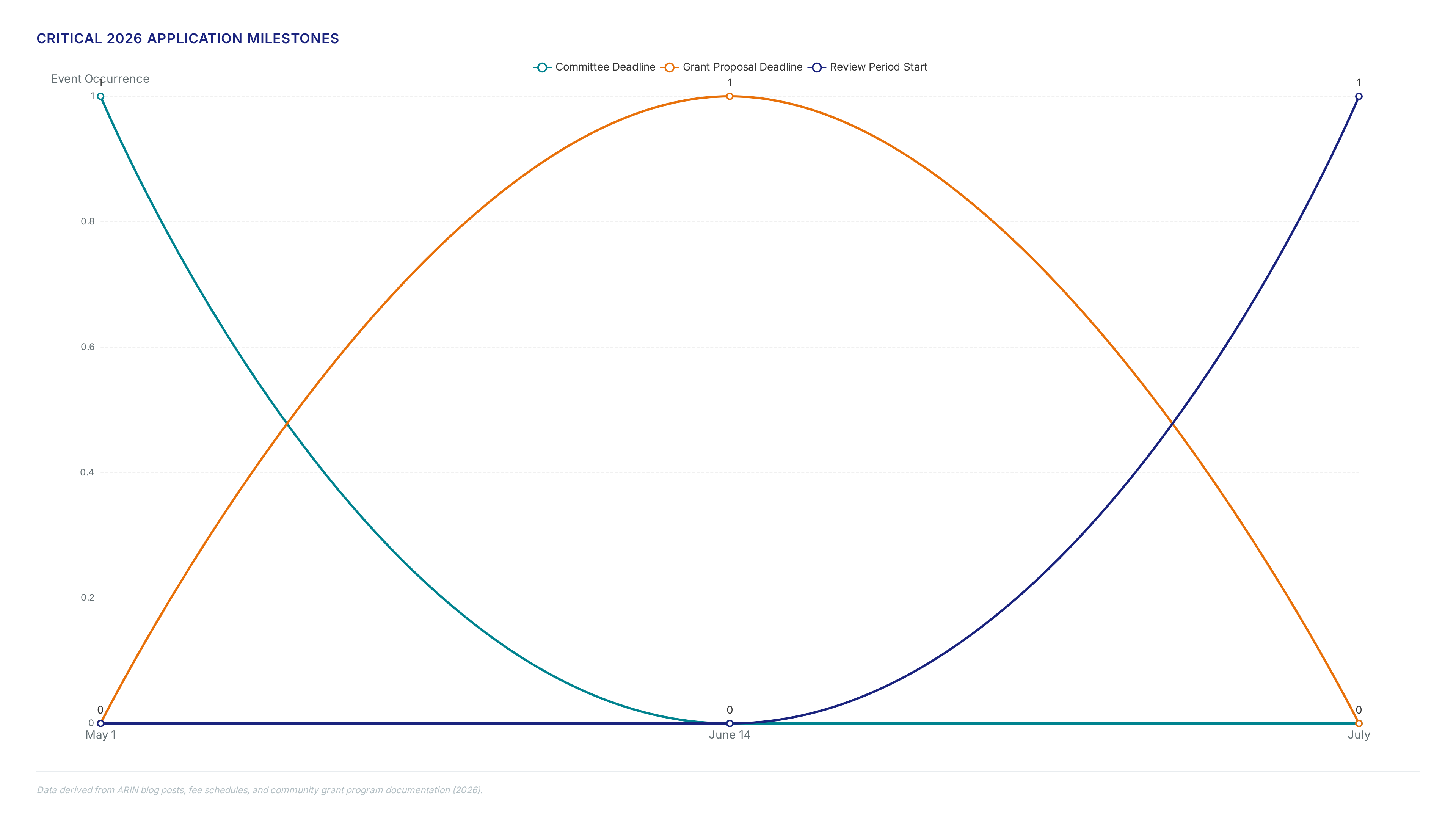
The application window for General Members closes strictly on 1 May to secure two committee seats. Arin. Arin. This staggered timeline ensures evaluators are in place before the final influx of project requests arrives. 1. Verify General Member status in the ARIN online registry. 2. Complete the survey form linked in the official extension notice. 3. Prepare for asynchronous reviews starting in July.
The tension between early committee formation and late grant submissions creates a bottleneck if recruitment lags. Delays in filling these roles force remaining members to process higher volumes without additional time allocation. Secure your position using the official application link to avoid disqualification.
Navigating the Online Portal for Committee Member Submission
Access the dedicated SurveyMonkey form to register as a General Member before the 1 May deadline expires. Operators must navigate this external portal rather than the standard ARIN Online interface to submit committee credentials. The submission workflow demands specific attention to the mandatory group call commitment listed in the role description. Reviewers will assess applications based on the ability to evaluate technical proposals during the July review window. Successful candidates join a process that ultimately directs funding toward projects like the IPv6-only network tests performed by Internet2. Applicants should note that while committee selection closes soon, the broader grant cycle accepts proposals until the June 14, 2026 date.
The rigid 1 May cutoff prevents late General Member entries regardless of SurveyMonkey platform glitches. InterLIR mandates immediate browser validation because external portal failures do not justify missing the strict window for the 2026 Grant Selection Committee Operators facing submission errors must capture screenshot evidence before the deadline expires, as ARIN grants no technical extensions for third-party interface faults. Missing this date shifts the entire evaluation burden to remaining incumbents, potentially delaying the July review cycle. Applicants should verify connectivity against the distinct timeline for the broader grant applications which remains open until mid-June. The separation between committee recruitment and project submission creates a single point of failure for governance participation.
- Clear browser cache and disable ad-blockers before accessing the survey link.
- Submit the form at least 24 hours prior to the 1 May expiration.
- Email ARIN support immediately if the portal returns a timeout error.
Failure to secure a seat removes operator influence from the funding consensus process entirely. This exclusion leaves critical infrastructure decisions to a smaller pool of reviewers without diverse technical input.
Assessing the Value of Committee Participation for Community Impact and Professional Growth
Defining the General Member Role in ARIN Governance and Elections
General Members execute governance duties distinct from commercial vendors by managing the Advisory Council election cycle rather than selling connectivity. Evaluation of technical merit for community grants replaces the pursuit of profit margins typical of firms like Bitsight. Operators serving on committees review applications via an online portal to fund projects such as open-source hardware security modules. Workload varies notably based on application volume. Flexible scheduling becomes necessary during the July review period. Participants must attend a single group call to finalize recommendations for the Board of Trustees before voting concludes. These members uphold a nonprofit corporation model that prioritizes bottom-up policy development over top-down strategy.
Risks of Variable Time Commitments During the July Review Period
July review hours scale linearly with submission volume. Unpredictable conflicts emerge for professionals managing peak summer traffic. The time commitment remains undefined because ARIN ties workload directly to the total count of received proposals rather than a fixed schedule. Operators balancing this duty against commercial obligations face risks similar to BARBRI, which encountered severe monitoring gaps during time-compressed demand after migrating to Azure. A sudden surge in applications could force reviewers to sacrifice depth for speed. Detailed technical merits in complex infrastructure proposals might get overlooked. InterLIR warns that without buffer capacity in professional calendars, the single mandatory group call may become a logistical bottleneck instead of a consensus builder. Enterprise adoption studies show that statistical analysis of address acquisition requires careful attention to detail that rushed reviews cannot support. The Asia-Pacific region emerges as the fastest-expanding area for internet services throughout the forecast period. Global grant interest may spike unexpectedly. Applicants must assume the worst-case scenario for time allocation before accepting the role. InterLIR advises securing explicit employer approval for flexible hours during July to mitigate these variable demands.
About
Alexei Krylov serves as the Head of Sales at InterLIR, a specialized IPv4 marketplace dedicated to optimizing global network resource distribution. His extensive background in B2B sales and direct engagement with Regional Internet Registries (RIRs) makes him uniquely qualified to discuss the Grant Selection Committee. In his daily role, Krylov navigates complex governance frameworks to ensure clients secure critical IP assets, giving him practical insight into how community grants impact network infrastructure development. As ARIN seeks members to evaluate applications for maximum community benefit, Krylov's experience in assessing resource viability aligns perfectly with the committee's mission. Through InterLIR, he champions transparency and efficiency in IP management, values necessary for selecting grants that truly advance the technical system. His perspective bridges the gap between commercial IP operations and the non-profit governance required to sustain a healthy, evolving internet environment for all stakeholders.
Conclusion
Scaling this review process without set operational boundaries creates a critical failure point where technical rigor collapses into administrative box-checking. As global IT expenditure swells, the hidden cost of variable volunteer time becomes unsustainable, forcing a shift from deep protocol analysis to superficial compliance checks. The intersection of AI and network management predicted for 2026 demands that governance bodies evolve beyond manual, linear review models that cannot handle sudden surges in application volume. Relying on undefined summer availability invites the same monitoring gaps that plague rushed cloud migrations, jeopardizing the integrity of address space allocation.
Organizations must mandate a fixed capacity model for reviewer bandwidth by Q3 2026, replacing open-ended volunteer commitments with scheduled, compensated audit windows. This transition ensures that complex infrastructure proposals receive the necessary scrutiny regardless of seasonal traffic spikes. Do not wait for the next July bottleneck to expose these structural weaknesses; the current ad-hoc approach cannot support a market expanding at a solid pace annually. Start by auditing your team's available review hours against last year's submission peak before the end of this week to quantify your specific exposure to logistical failure.
Frequently Asked Questions
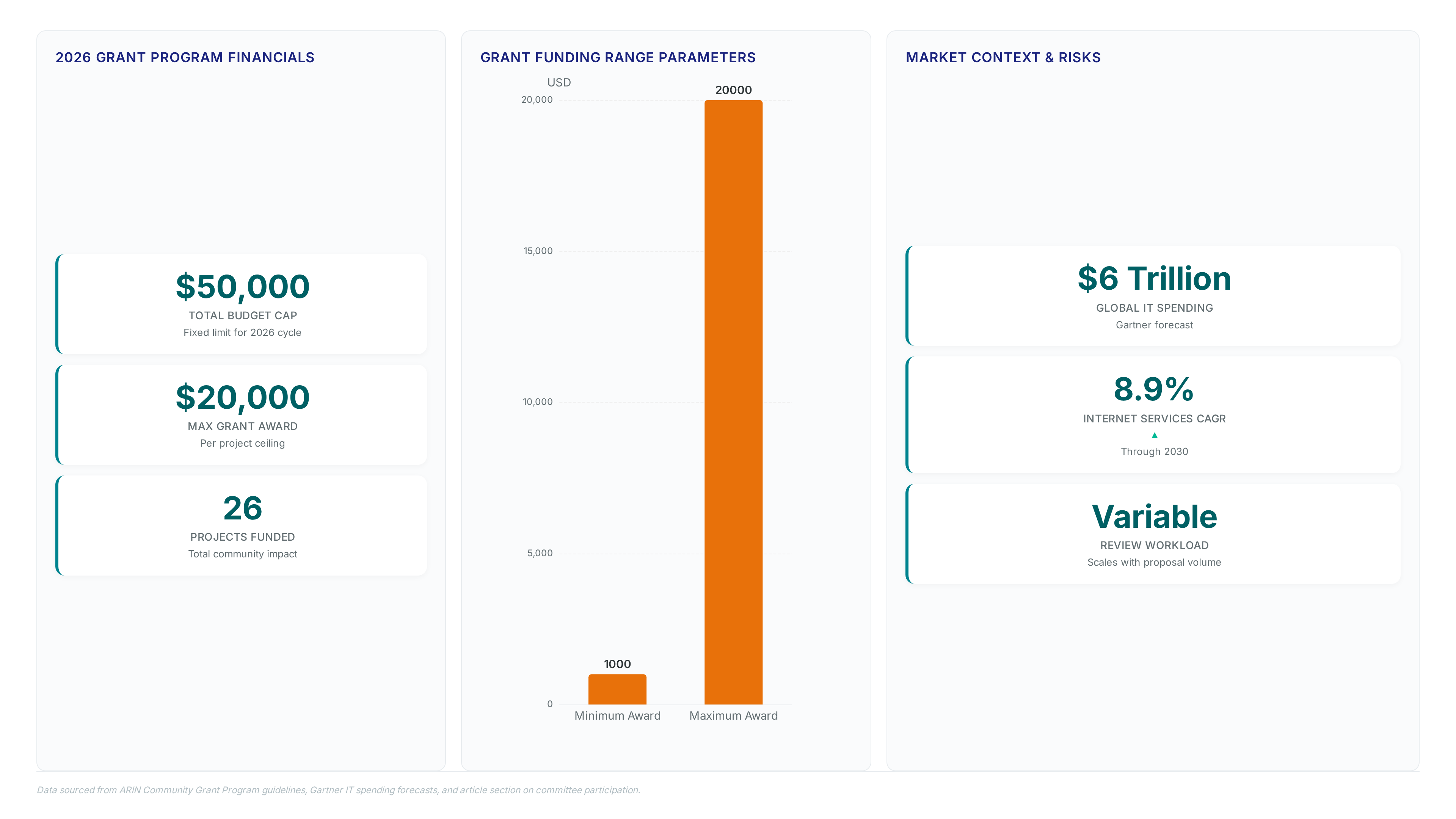
A single project can receive up to $20,000 in financial support from the program. The total budget for all grants combined in 2026 is capped at $50,000 for the entire cycle.
The total program cap for all grants awarded in 2026 is strictly limited to $50,000. Individual requests within this pool range from $1,000 to $20,000 depending on project scope.
The minimum financial award size for any approved project is set at $1,000 per application. This ensures smaller initiatives can still access funding within the total $50,000 annual program limit.
Committee members must conduct all their application reviews via the online portal during the month of July. This precedes the single group call used to finalize recommendations for the Board.
General Members must submit their application forms by the extended deadline of 1 May. Late submissions after this date will not be considered for the two available seats on the committee.