ARIN Governance in Louisville: What Operators See
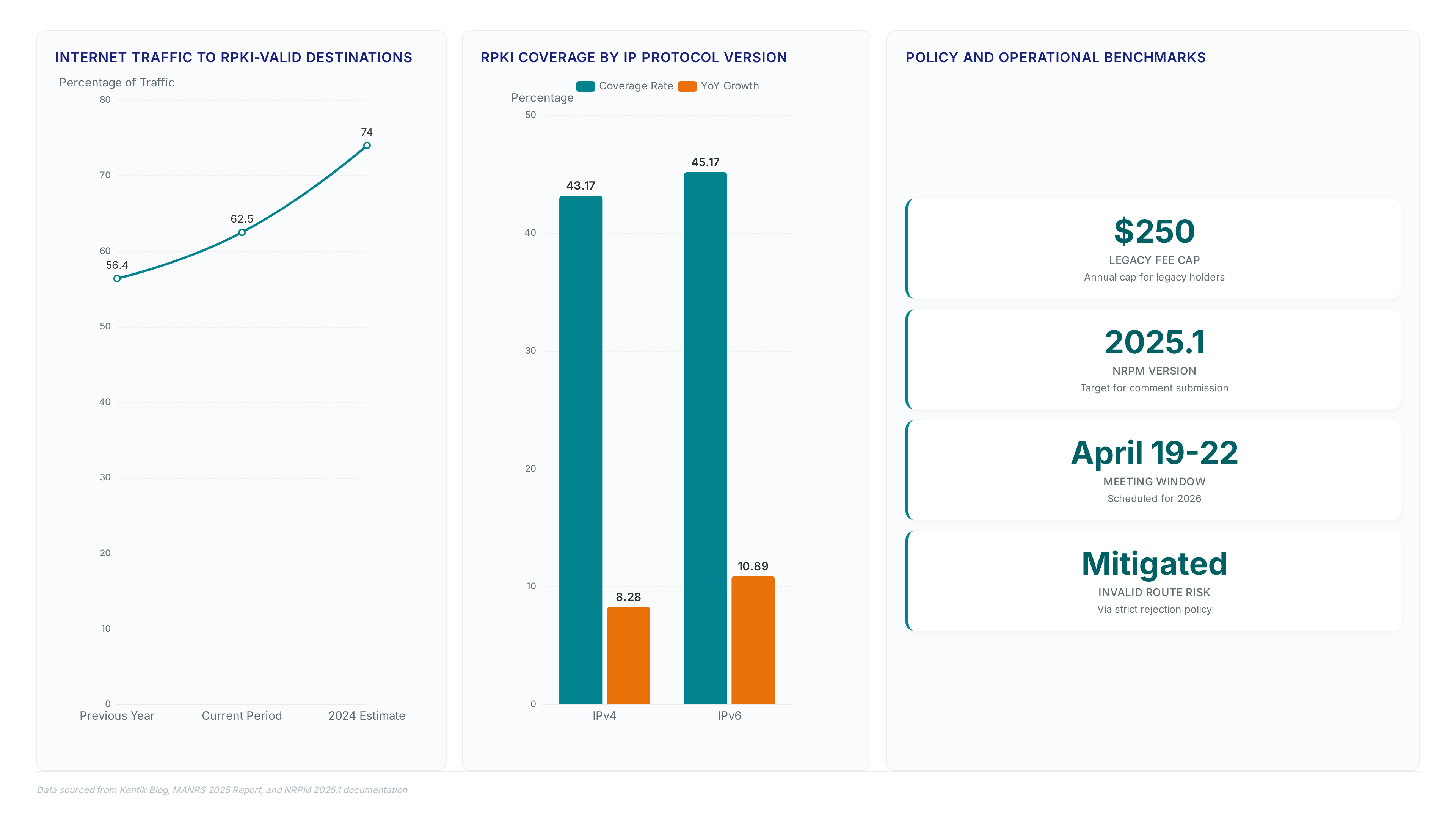
With 62. (ARIN's fee schedule) A small share of internet traffic now routed to RPKI-valid BGP routes per Kentik data, ARIN 57 serves as the critical enforcement mechanism for global routing security. This gathering transforms abstract policy debates into tangible infrastructure hardening, proving that resource governance now demands active cryptographic validation rather than passive trust.
Attendees will dissect the hybrid meeting mechanics enabling simultaneous physical and virtual policy formulation, a necessity as the community bridges the gap between local advocacy and global implementation. The agenda moves beyond standard administrative reports to execute direct policy influence through technical workshops, specifically targeting the remaining unsecured address space before AI-driven network management becomes the 2026.
The Strategic Role of ARIN 57 in Internet Resource Governance
ARIN 57 Governance Structure and Board of Trustees Role
ARIN 57 defines the 57th Public Policy and Members Meeting scheduled for 19-22 April 2026 in Louisville, Kentucky. This gathering functions as the operational nexus where the Board of Trustees reports on fiscal stability while the Advisory Council presents draft policies for community review. The structure relies on a bottom-up model where elected members shape resource allocation rules rather than internal product managers dictating terms. Such community-driven governance contrasts sharply with proprietary vendor roadmaps that lack transparent stakeholder input. John Curran leads the organization as President and CEO, having served as a founding member since ARIN became the first RIR to operate in December 1997.
ARIN 57 policy sessions review route origin validation progress while 74% of global IP traffic now reaches RPKI-secured destinations. Discussions focus on the gap between route coverage and actual traffic protection. Commercial entities like IPinfo. Io enrich flow data with validation status to expose operational risks that raw route counts hide. traffic coverage significantly outpaces the percentage of signed routes, revealing that substantial networks prioritize securing high-volume paths first. Operators attending the Louisville event must recognize that signing low-volume prefixes yields diminishing immediate security returns compared to protecting core transit links. Cloudflare set an early precedent by announcing full support for validation in 2018, yet legacy software remains a persistent barrier for smaller ISPs. The cost of upgrading relying party systems often delays deployment despite available native support from vendors like Cisco and Juniper. This creates a fragmented security posture where edge networks remain vulnerable even as Tier-1 providers enforce strict reject policies.
| Deployment Stage | Primary Constraint | Operational Impact |
|---|---|---|
| Initial Rollout | Legacy RP software | Inability to fetch fresh ROA sets |
| Policy Enforcement | Fear of false positives | Retention of default-accept rules |
| Full Maturity | Upstream coordination | Complete path validation coverage |
Without local validation infrastructure, global adoption statistics offer no protection against local route leaks.
AI Talent Gaps Threatening 2026 Network Infrastructure Operations
Job postings for emerging AI roles surged dramatically between 2023 and 2024, creating an immediate staffing deficit for network teams. This velocity outpaces training pipelines, leaving operators unable to staff the agent-driven automation frameworks predicted by Gartner analysts gartner.com/en/newsroom/press-releases/2025-12-11-gartner-identifies-the-top-trends-impacting-infrastructure-and-operations-for-2026). Without skilled personnel, planned infrastructure transformations stall before deployment begins. The mechanism of failure involves complex policy logic that autonomous agents require but current staff cannot configure or audit.
| Risk Factor | Impact Level | Mitigation Path |
|---|---|---|
| Skill Shortage | Critical | Partner training |
| Tool Complexity | High | Vendor support |
| Policy Drift | Medium | Manual review |
However, a significant share of tech leaders cited skill gaps as a substantial obstacle in 2025, confirming the bottleneck is human capital rather than software maturity. This statistic highlights a divergence where tool capability exceeds operator capacity to manage it safely. Unlike previous technology shifts, this gap prevents basic operational hygiene alongside advanced automation. The implication for ARIN 57 attendees involves prioritizing education over mere policy debate. Community grants previously helped 30 participants test software on IPv6-only networks, proving targeted funding bridges technical divides. Failure to address this deficit risks misconfigured BGP policies that automated systems propagate at scale.
Hybrid Meeting Mechanics for In-Person and Virtual Participation
Galt House Venue Logistics and Hotel Discount Deadlines
The Galt House in Louisville, Kentucky hosts the in-person segment, requiring room bookings before 17 March to secure discounted rates. Missing this deadline forces attendees into standard pricing, increasing operational costs for teams already managing tight infrastructure budgets. Distinct from general registration, the RPKI Deep Dive on Sunday, 19 April demands separate intent to execute first-time Route Origin Authorization configurations under expert guidance. This session addresses a critical gap, as only a tiny fraction of global ASes currently publish ASPA records. Operators relying on leased prefixes face unique pressure, the that such assets secured via RPKI grew from 29.9% to 71.0% between 2021 and 2024. Unlike commercial monitoring vendors, ARIN functions as the nonprofit authority ensuring global uniqueness of the addresses discussed in these sessions.
| Requirement | General Attendee | Deep Dive Participant |
|---|---|---|
| Registration Type | Standard Meeting | Specific Workshop Add-on |
| Primary Goal | Policy Voting | Technical Configuration |
| Timing Constraint | 17 March (Hotel) | Sunday, 19 April (Session) |
| Output Artifact | Meeting Minutes | Signed ROA or ASPA |
Virtual participants access streams via email links but cannot physically perform the hands-on key generation required during the deep dive. The logistical separation creates a bifurcated experience where remote observers analyze policy while on-site engineers implement cryptography.
Daily email delivery provides the virtual access link, yet registration remains the mandatory gate for interactive policy engagement. Operators must complete sign-up to enable comment submission, poll participation, and chat visibility within the session interface. This distinction separates passive observers from active contributors in the governance process. The system enforces behavioral monitoring on all text channels to maintain compliance with expected standards. Failure to register beforehand results in read-only access, effectively silencing remote voices during critical debates.
| Access Level | Registration Required | Capabilities |
|---|---|---|
| Viewer | No | Stream video only |
| Participant | Yes | Polls, chat, questions |
| Moderator | Yes | Full control, enforcement |
Unlike commercial vendors focused on software monitoring, ARIN operates as a nonprofit corporation managing actual resource allocation. This structural difference dictates that tool access serves policy development rather than product sales. The platform supports hybrid mechanics where virtual inputs carry equal weight to floor statements. However, the requirement for pre-registration creates a friction point that can delay real-time reaction to emerging draft proposals. Operators should note that legacy resource holder status does not automatically grant webinar privileges; separate event registration is strictly enforced. The architectural choice prioritizes orderly discourse over open anonymity, ensuring that every submitted comment traces back to a verified entity.
Virtual Meeting Orientation and NRPM Version 2025.1 Review
Tuesday, 14 April hosts the virtual Meeting Orientation, requiring operators to reserve a spot during the ARIN 57 registration process to secure interactive access. This session arrives immediately following the March 3 release of Version 2025.1 of the Number Resource Policy Manual, which mandates WHOIS registration for static IPv6 reassignments containing a /47 or larger block. Missing this policy update risks non-compliance when submitting policy proposals during the live debate windows. The orientation clarifies how these new rules intersect with existing RPKI validation workflows, yet a significant tension remains between policy intent and operational reality. While the manual enforces stricter IPv6 reassignment tracking, global ASPA record publication lags far behind ROA adoption rates. Operators face a dilemma: comply with immediate WHOIS requirements while lacking the upstream data necessary for full path validation. Follow this checklist to maximize the virtual experience:
- Select the Meeting Orientation option when completing your initial registration form.
- Review the specific SWIP requirements for IPv6 blocks before the Tuesday session begins.
- Verify email delivery of daily access links to avoid last-minute connection failures.
- Prepare questions regarding the gap between manual mandates and current routing security metrics.
Executing Policy Influence Through RPKI Deep Dives and Sponsorship
Route Origin Authorization Mechanics in RPKI Deep Dive Sessions
A Route Origin Authorization binds an IP prefix to a specific ASN using a cryptographic signature to prevent origin spoofing. The RPKI to Router Protocol delivers this validated data directly to border routers for real-time BGP decision making. Operators configure their equipment to reject announcements where the AS path origin fails this cryptographic check. This mechanism stops accidental leaks by enforcing a strict allow-list at the network edge. However, barriers such as outdated Relying Party software persist across many production environments. Legacy systems often lack the capacity to parse updated validation payloads, creating security gaps despite correct policy intent. The trade-off is operational complexity versus immediate threat mitigation.
| Validation State | Router Action | Risk Profile |
|---|---|---|
| Valid | Accept | Low |
| Invalid | Reject | Mitigated |
| NotFound | Accept | High |
Cloudflare announced full support for RPKI validation Yet many peers still operate in a trust-but-verify mode rather than strict rejection. The cost of enabling hard fails includes potential traffic loss during misconfiguration events. This cautious approach balances security gains against stability risks during the transition phase.
Executing Policy Influence via NRPM 2025.1 Comment Submission
Submitting comments on Version 2025.1 of the Number Resource Policy Manual requires active registration before the 19-22 April 2026 meeting dates. Operators must complete sign-up to enable the capability to submit text or participate in live polls within the Zoom interface. This gatekeeping mechanism ensures that only verified community members shape the community-driven bottom-up policy process. Passive viewing remains open to all, yet influence demands authenticated identity. The distinction separates observers from actual governors of Internet resources.
| Action | Requirement | Outcome |
|---|---|---|
| View Stream | None | Read-only access |
| Submit Comment | Registration | Voice in debate |
| Vote in Poll | Registration | Direct metric input |
| Access Chat | Registration | Real-time dialogue |
Joining the RPKI Deep Dive on Sunday, 19 April provides the technical grounding necessary to critique proposals affecting cryptographic validation. Attendees gain direct experience creating a Route Origin Authorization under expert supervision. This hands-on exposure reveals how RPKI constraints interact with proposed policy changes. Without this context, submitted comments often miss operational feasibility. New mandates often outpace the deployment cycle of router firmware. Operators risk voting for rules their current infrastructure cannot enforce.
Organizations select sponsorship tiers by matching visibility goals against the specific $250 annual fee cap for legacy holders. Legacy resource managers with active agreements predating January 1, 2024, operate under a fixed financial ceiling regardless of IPv4 volume held. This fee structure distinctively separates nonprofit registry costs from commercial IP leasing models that scale linearly with inventory. Budget planners must account for this static liability before allocating surplus funds to network sponsorship visibility. Operators using this waiver provision free up capital specifically for high-visibility sponsorship slots at the Galt House event. Charter currently holds the premier network sponsor position, setting a high bar for brand placement. Smaller entities should target lower-tier packages to avoid overspending on redundant exposure. Renewal date to prevent cash flow conflicts between mandatory fees and voluntary sponsorship commitments. Failure to align these cycles risks budget shortfalls during critical policy windows.
Registration Protocols and Attendance Decision Frameworks
ARIN 57 Registration Workflow and Virtual Access Requirements
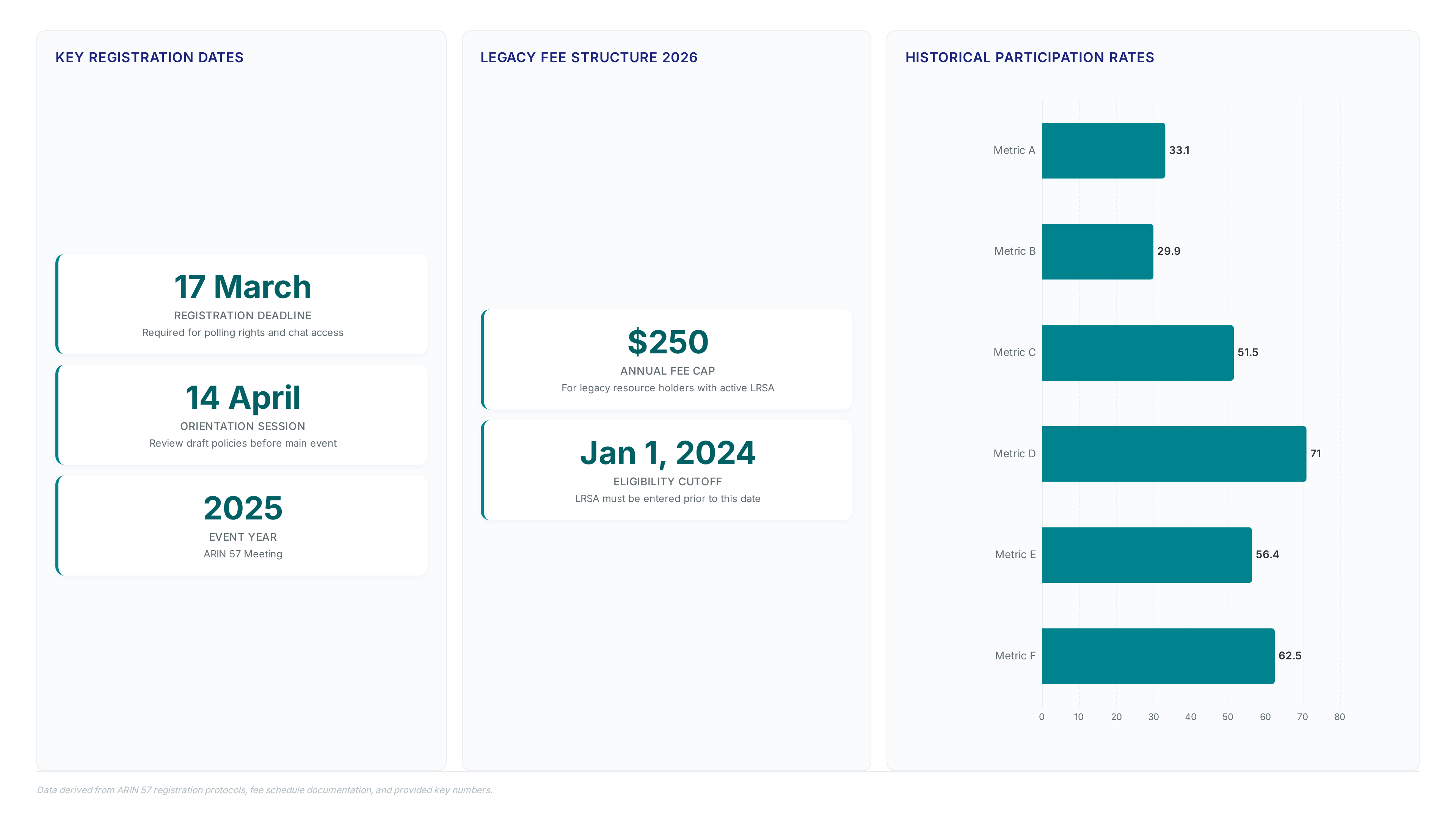
Complete the online form by 17 March to enable polling rights and chat access within the Zoom webinar interface.
- Submit personal details on the registration portal to generate a unique attendee profile.
- Select the Meeting Orientation option scheduled for 14 April to review draft policies before the main event.
- Verify email delivery daily for the rotating virtual access link required to join the session.
Registration acts as the cryptographic key for active governance, separating passive observers from participants who shape policy proposals. Without this authenticated identity, operators cannot submit comments or vote during live debates, effectively silencing their technical input. The distinction creates a hard boundary between viewing the stream and influencing the Number Resource Policy Manual evolution. A critical tension exists between open accessibility and the need for verified accountability in resource management. While the event remains free, the gatekeeping mechanism ensures that only identified entities alter the global routing environment. Organizations managing legacy assets should note that fee structures differ significantly from standard commercial models, as detailed in the fee schedule documentation. Missing the orientation risks misunderstanding the new IPv6 reassignment rules mandated for blocks larger than a /47.
Executing In-Person Attendance with RPKI Deep Dive Session Planning
Secure the Galt House room rate by booking before 17 March to enable Sunday attendance for the RPKI Deep Dive session.
- Complete registration immediately to reserve lodging at the discounted tier before the deadline expires.
- Arrive in Louisville, Kentucky, on 19 April specifically for the hands-on Route Origin Authorization workshop.
- Execute configuration changes using guidance from ARIN experts regarding Delegated publication models.
This session addresses the scarcity of Autonomous System Provider Authorization records, a gap where current adoption remains negligible across the global routing system. Operators gain direct experience creating ROA payloads that map prefixes to authorized origin ASes, moving beyond theoretical validation. The practical value lies in understanding how leased markets secure routes quicker than the general internet, reducing hijack risks for specific assets. Participants configure their local caches to fetch data from trust anchors, enabling routers to enforce real-time BGP decision making based on cryptographic validity.
| Step | Action | Technical Outcome |
|---|---|---|
| 1 | Book hotel by 17 March | Guarantees Sunday access |
| 2 | Attend 19 April workshop | Creates first ROA/ASPA |
| 3 | Update router config | Enables origin validation |
Skipping this physical session leaves operators reliant on vendor documentation that often lags behind Repository Publication Service updates. ### Pre-Meeting Validation Checklist for NRPM 2025.
The 14 April orientation requires prior registration to resolve Zoom access issues before policy debates begin.
- Select the Meeting Orientation option during sign-up to secure a virtual seat for the preliminary session.
- Review the NRPM Version 2025.1 text released on March 3 to understand new SWIP mandates for IPv6 reassignments.
- Acknowledge that chat monitoring enforces behavior standards, filtering unauthenticated comments from the public view.
| Step | Action | Constraint |
|---|---|---|
| 1 | Reserve Orientation Spot | Requires active registration |
| 2 | Read Policy Manual | Covers /47 static blocks |
| 3 | Verify Conduct Rules | Applies to all virtual users |
Operators skipping the manual review face immediate disorientation when discussing certificate synchronization mechanics during live polls. The NOT FOUND status often triggers local policy disputes that unprepared attendees cannot adjudicate effectively. InterLIR advises treating the orientation as a technical prerequisite rather than a casual webinar. Failure to validate WHOIS directory requirements beforehand renders an operator unable to contribute meaningfully to reassignment policy modifications.
About
Nikita Sinitsyn serves as a Customer Service Specialist at InterLIR, where he manages critical RIPE and ARIN database operations daily. With eight years of experience in the telecommunications sector, Nikita is uniquely qualified to analyze the upcoming ARIN 57 meeting, as his work directly involves navigating the regulatory frameworks discussed at such events. His expertise in KYC procedures and IP resource management provides him with practical insights into how policy changes impact address redistribution. At InterLIR, a Berlin-based marketplace specializing in IPv4 address leasing, Nikita ensures clients maintain compliant and secure network resources. This hands-on involvement with internet number resources allows him to contextualize the meeting's focus on RPKI adoption and draft policies for industry professionals. By bridging daily operational challenges with high-level governance discussions, Nikita offers a grounded perspective on how ARIN's decisions will shape the future of global internet infrastructure availability.
Conclusion
Current validation metrics mask a critical fragility: as AI-driven traffic spikes reshape routing tables, static RPKI configurations will fail to adapt to flexible prefix announcements without automated orchestration. The surge in AI infrastructure demand means manual ROA creation cannot sustain the velocity required for secure global connectivity. Operators relying on quarterly manual reviews will soon face unacceptable exposure windows where valid traffic gets dropped due to stale cryptographic data. You must transition from periodic compliance checks to continuous, API-driven validation pipelines immediately.
Commit to integrating real-time RPKI fetching into your CI/CD network workflows by Q3 2026, specifically targeting the intersection of on-device AI decision-making and border router security. Waiting for vendor updates to handle this latency introduces unnecessary risk as autonomous network agents begin making sub-second routing choices. Do not treat the upcoming ARIN session as merely educational; view it as the baseline for a mandatory architectural shift toward self-healing route origins.
Start by auditing your current router firmware's support for asynchronous RPKI-to-Router (RTR) protocol updates this week, and document any gaps preventing sub-minute synchronization before the next policy cycle begins.
Frequently Asked Questions
Attendees must book rooms before 17 March to receive discounted rates. This timing ensures access to the Galt House while 62.5% of traffic reaches validated routes.
Remote attendees gain equal voting rights on policy proposals compared to physical participants. This parity supports governance as 54% of global prefixes now utilize route coverage.
The technical deep dive occurs on Sunday, 19 April, guiding first-time authorizations. This session addresses security gaps before 74% of IP traffic reaches secured destinations.
The schedule includes a Welcome Reception Sunday evening and a social at the Louisville Slugger Museum Monday night. These gatherings foster community alongside rising AI role demands.
Registration for this public policy and members meeting is completely free for all participants. This open access facilitates discussion while job postings for AI roles surged recently.