ARIN Grant 2026: How Six Volunteers Review 8M Records
Eight million registration records hang in the balance. ARIN needs six volunteers to decide where its 2026 funding goes. The Grant Selection Committee acts as the gatekeeper, filtering raw innovation before it reaches the Board. This body ensures resources fund technical merit, not political favors.
These six evaluators scrutinize applications against rigid criteria before passing winners to the ARIN Board of Trustees. Gartner predicts dedicated AI governance headcount becomes standard by 2027, making human-led oversight in resource distribution critical. The committee's makeup-split evenly between ARIN staff, elected body volunteers, and General Members-forces friction. That friction stops groupthink when evaluating complex technical proposals.
We break down how this six-person panel works, from the questionnaire deadline on 24 April to the final Zoom call no later than 12 August. Past wins, like the 2023 Internet2 IPv6 testing initiative, set the precedent for this year's high-stakes calls.
The Role of the ARIN Grant Selection Committee in Internet Governance
The 2026 ARIN Grant Selection Committee is a six-member machine built to evaluate funding requests for the ARIN Community Grant Program. Two staff members, two volunteers from elected bodies, and two General Member representatives review applications against strict technical criteria. Their findings go straight to the ARIN Board of Trustees. This layer separates operational assessment from final fiscal approval.
Reviews happen in a fixed window. Individuals assess proposals before the group meets to finalize recommendations. The application period stays open through 14 June 2026, defining the intake timeline.
Funding novel protocol tests often clashes with supporting immediate connectivity builds. Software validation must precede hardware rollout, which delays tangible user benefits. The ARIN Community Grant Program acts as a risk-mitigation engine. By funding Internet2 to resolve software compatibility early, the committee prevents costly failures during mass deployment. This shifts failure modes from production outages to controlled laboratory errors. Treat these grants as pre-deployment insurance policies that validate stack readiness before you spend capital on physical plant.
2026 Volunteer Application Timeline and Review Process Deadlines
Recruitment for the 2026 ARIN Grant Selection Committee opens 30 Mar 2026. It closes strictly on 24 April 2026. Miss this application deadline, and you are out. No late submissions enter the pool. Individual assessments run from early July to early August. Volunteers audit technical proposals asynchronously via an online platform. The process ends with a mandatory Zoom meeting by 12 August where the six-member body finalizes recommendations for the Board. This rigid schedule keeps funding decisions aligned with the fiscal year and prevents scope creep. Operators must balance these administrative windows against their own network upgrade cycles.
| Phase | Start Date | End Date |
|---|---|---|
| Volunteer Recruitment | 30 Mar 2026 | 24 April 2026 |
| Individual Review | 6 July 2026 | 7 August 2026 |
| Final Deliberation | N/A | 12 August 2026 |
The online platform handles initial questionnaire intake. Final consensus requires synchronous discussion. Delays in the Zoom meeting stage push back grant disbursement dates for recipients.
Committee Composition and the Project Evaluation Workflow
Committee Composition Ratios and Governance Representation
The 2026 ARIN Grant Selection Committee enforces a strict 2-2-2 split between staff, elected volunteers, and General Members. This prevents unilateral funding decisions. Two representatives come from the ARIN Advisory Council, a body of 15 elected officials advising the Board of Trustees. This structure enforces a community-driven policy development model, distinct from top-down corporate governance. Staff members report to President John Curran, ensuring operational continuity without dominating the vote. General Member representatives bring commercial operator perspectives often missing in purely technical reviews.
| Role Type | Count | Selection Source |
|---|---|---|
| ARIN Staff | 2 | Internal Appointment |
| Elected Volunteers | 2 | Advisory Council Pool |
| General Members | 2 | Membership Election |
Balancing these three factions creates friction when applying grant selection criteria. Staff prioritize feasibility; volunteers favor innovation. Consensus requires agreement across divergent operational mandates, potentially slowing approval for borderline projects. Operators gain assurance that funded initiatives survive scrutiny from both administrative and field perspectives. This tripartite governance stops any single interest group from directing the Number Resource Organization budget toward niche agendas.
Individual assessments begin 6 July on an online platform and conclude 7 August before synchronous debate.
- Volunteers access the portal to audit technical merit against strict feasibility metrics.
- Reviewers score proposals asynchronously, eliminating bias from real-time group dynamics.
- The six-member body convenes via Zoom by 12 August to reconcile divergent scores.
- Final recommendations transmit directly to the Board of Trustees for fiscal approval.
This phased approach separates objective analysis from consensus building. Using a video conferencing tool adopted by 70% of Fortune 100 firms ensures high-fidelity communication during final deliberations. The platform supports over 300 million daily participants, providing the stability required for binding governance decisions. Hybrid models drive this adoption, increasing the need for strong resource management workflows. Key stakeholders note that successful governance relies on process transformation rather than mere tool deployment.
| Phase | Mode | Duration |
|---|---|---|
| Intake | Asynchronous | 33 days |
| Scoring | Individual | 4 weeks |
| Deliberation | Synchronous | 1 day |
Separating async review from sync debate prevents dominant personalities from skewing early scoring. Relying on digital tools introduces a dependency on uninterrupted connectivity during the final vote. Operators must verify bandwidth availability before the August deadline to avoid procedural delays. Submitting the volunteer application by 24 April remains the only entry point for participation in this cycle.
Applications must align with strict technical merit metrics before the 14 June 2026 submission window closes. Reviewers audit proposals against feasibility standards to ensure funds support viable infrastructure rather than theoretical concepts. The committee formulates recommendations for the Board of Trustees based on this rigorous assessment. A specific policy shift impacts eligibility, as the NRPM 2026.1 policy version now governs resource rules for grant recipients. Operators must verify compliance with these updated manuals before filing.
| Phase | Action Item | Constraint |
|---|---|---|
| Submission | File project proposal | Deadline 14 June 2026 |
| Review | Score technical viability | Async via online portal |
| Deliberation | Finalize Board advice | Meeting by 12 August |
Individual reviews occur asynchronously from 6 July through 7 August to eliminate group bias. The body then convenes via Zoom to reconcile scores and draft final advice. This synchronous step ensures consensus before the hard deadline. Missing this cutoff delays fiscal approval for an entire cycle. Thorough technical auditing clashes with rigid calendar constraints, forcing reviewers to prioritize depth early in the process. Late submissions receive no consideration regardless of project quality.
Executing the Volunteer Application and Questionnaire Process
SurveyMonkey Questionnaire Scope and NRPM 2026.1 Policy Context
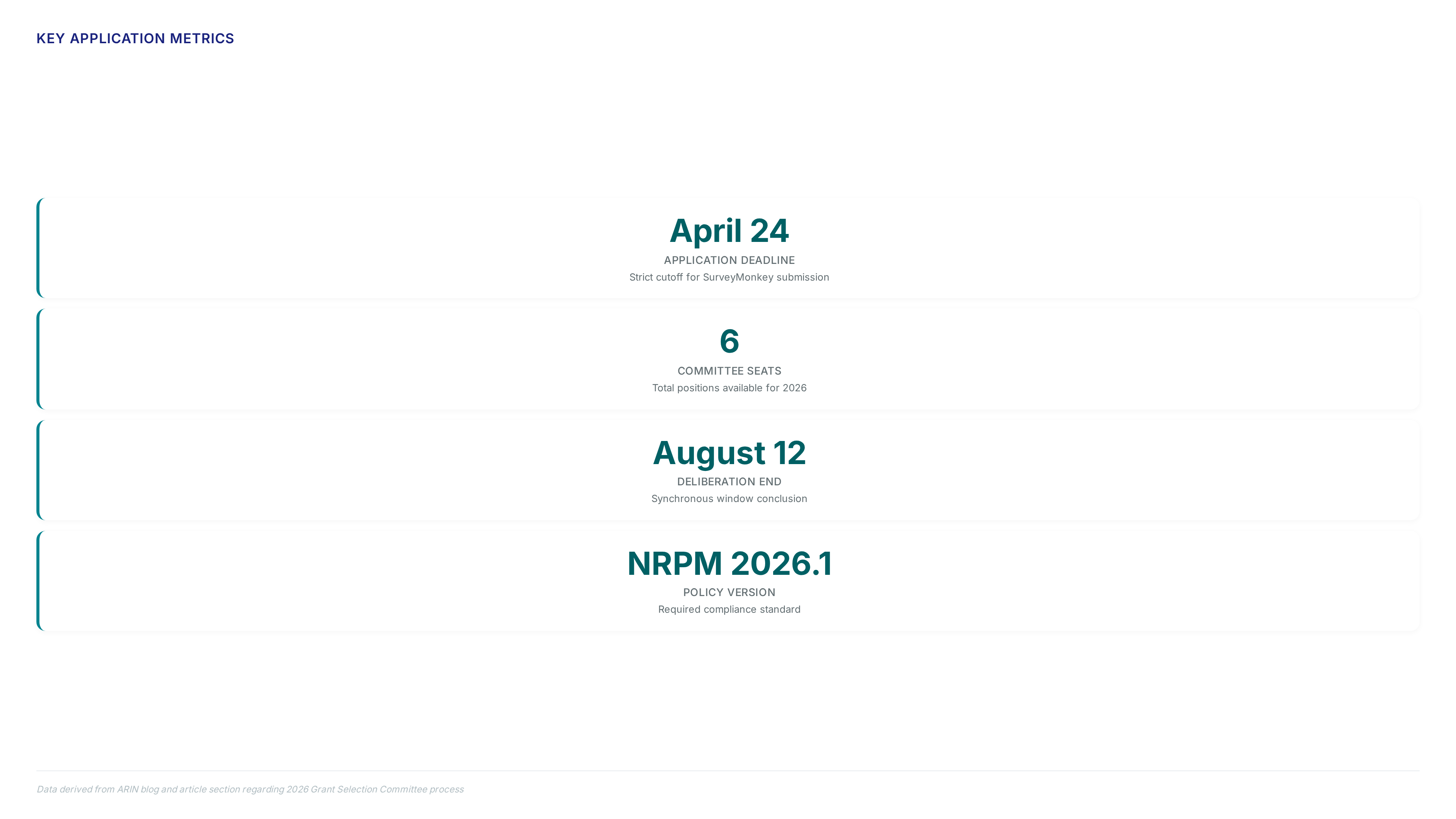
The SurveyMonkey questionnaire serves as the sole intake mechanism for 2026 Grant Selection Committee candidates before the 24 April deadline. Prospective volunteers must navigate this digital form to declare eligibility under the updated NRPM 2026. This regulatory shift modifies the Registration Services Agreement. Operators ignoring these textual updates risk submitting incompatible project scopes during the June application window.
- Access the portal using valid ARIN Online credentials to initiate the vetting process.
- Confirm alignment with the new policy manual regarding resource stewardship obligations.
- Submit responses before the cutoff to enter the asynchronous review pool.
Strict adherence to the March update filters out legacy project templates that lack modern compliance clauses.
Accessing the SurveyMonkey portal before Friday, 24 April initiates the vetting process for the 2026 Grant Selection Committee.
- Navigate to the dedicated questionnaire link to declare candidacy status.
- Confirm availability for the synchronous deliberation window ending 12 August.
- Verify understanding of the updated NRPM 2026.1 policy constraints.
- Submit responses to lock in eligibility for the six-seat body.
Missing this Friday cutoff excludes candidates from the entire cycle. Late entries trigger automatic disqualification without appeal. The reliance on Zoom for final consensus demands high-fidelity connectivity during the August convening. This architecture separates video processing from stream routing to maintain stability under load. Prospective volunteers should recognize that proven governance mirrors business process transformation rather than simple tool adoption. Success requires integrating review workflows into existing operational schedules instead of treating them as isolated tasks. Failure to secure a seat now defers influence until the 2026 ARIN Elections later in the year.
Post-Submission Verification and 2026 Election Cycle Alignment
Confirming receipt of the SurveyMonkey questionnaire before Friday, 24 April prevents silent disqualification from the six-seat body.
- Audit email inboxes for an automated confirmation token immediately after form submission.
- Cross-reference personal availability against the October election window spanning 22–30 October 2026.
- Validate that declared conflict-of-interest statuses align with current governance consultation reports published earlier this year.
- Archive a local copy of the submitted responses for future reference during individual reviews.
Volunteers must recognize that service terms extend beyond the August recommendation deadline into the broader internet governance environment. The selection process operates independently of the grant application window closing 14 June 2026, creating a staggered timeline that demands sustained attention. Failure to align personal schedules with the late-year election cycle risks vacating a seat during critical board ratification phases.
Committee recommendations directly bind the ARIN Board of Trustees to specific funding allocations based on technical merit. Six evaluators assess applications against strict criteria, transforming individual reviews into collective infrastructure policy. This process determines which projects receive capital, effectively shaping the physical topology of the North American internet. Past awards demonstrate tangible impact, such as funding Internet2 to enable IPv6-only testing for multiple network operators. Such precedents prove that committee choices drive protocol adoption rather than merely distributing funds.
However, the binding nature of these recommendations creates a single point of failure if evaluators lack diverse operational backgrounds. A homogenous panel might overlook edge cases critical to rural deployment or specialized peering arrangements. The Grant Selection Committee must therefore balance internal consensus with external technical reality to avoid funding theoretical solutions over practical fixes. Operators watching this cycle should note that John Curran leads the organization receiving these binding directives, linking technical assessment directly to executive execution.
Aligning Volunteer Goals with 2026 AI Governance and Digital Divide Trends
Volunteering for the committee directly addresses the normalization of AI governance programs predicted by Gartner for 2026. Evaluators apply structured risk management to grant proposals, mirroring doctrinal shifts where cybercrime law consolidates with security doctrine as dominant vectors. This alignment ensures funding targets projects that withstand evolving regulatory pressures rather than transient technical fixes.
The persistent gap between urban and rural access demands specific intervention strategies. With billions of global users representing a substantial majority penetration, the remaining unconnected populations face systemic barriers. National governments increasingly pressure IP allocation mechanisms, challenging the multi-stakeholder model through which ARIN operates. Volunteers must weigh applications that bridge this divide against those reinforcing existing infrastructure concentrations.
| Focus Area | Volunteer Action | Strategic Outcome |
|---|---|---|
| AI Risk | Enforce governance criteria | Sustainable project lifecycles |
| Rural Access | Prioritize deployment equity | Reduced connectivity disparity |
| Policy Pressure | Validate multi-stakeholder compliance | Resilient number resource management |
Ignoring these trends carries a cost: projects lacking governance frameworks face higher rejection rates as board oversight tightens. Operators gain influence over how BEAD funding dynamics interact with IPv4 market prices by shaping selection criteria now. Failure to align volunteer goals with these macro-trends renders the evaluation process reactive rather than directive.
Operational Risks of IPv4 Market Volatility and BEAD Funding Impacts
Volunteers must assess grant viability against BEAD funding predictions that drive IPv4 price increases through heightened infrastructure demand. This economic pressure complicates the Grant Selection Committee evaluation of projects requiring address space acquisition in 2026. A proposal appearing feasible today may fail financially tomorrow as broadband deployment accelerates market costs. The ARIN Board of Trustees relies on accurate risk modeling to prevent funding stranded assets.
| Risk Factor | Impact on Grants | Mitigation Strategy |
|---|---|---|
| Price Volatility | Budget overruns | Phased address acquisition |
| Supply Scarcity | Project delays | Early IPv6 migration |
| Policy Shifts | Eligibility changes | Flexible scope definition |
The telecom numbering environment shifts under Internet Protocol Enabled Services (IPES) pressures, altering traditional valuation models. Evaluators face a tension between supporting immediate rural connectivity and ensuring long-term fiscal sustainability for recipients. Ignoring these market dynamics risks awarding grants that cannot execute due to sudden cost spikes. InterLIR recommends integrating real-time market analysis into the individual review phase starting 6 July. This analytical rigor protects the 2026 ARIN Community Grant Program from funding obsolete or unaffordable network designs.
About
Alexei Krylov, Head of Sales at InterLIR, brings necessary industry perspective to the discussion on the ARIN Grant Selection Committee. As a specialist managing B2B transactions for IPv4 and IPv6 resources, Krylov possesses deep operational knowledge of Regional Internet Registries (RIRs) and the critical scarcity of network addresses. His daily work involves navigating complex IP allocation landscapes, making him uniquely qualified to evaluate grant proposals that address global Internet infrastructure challenges. At InterLIR, a Berlin-based marketplace dedicated to redistributing unused IP resources, Krylov ensures clients secure clean, reliable network assets. This direct experience with IP resource management aligns perfectly with the ARIN Ecosystem Grant Program's mission to fund projects enhancing Internet stability. His background in legal frameworks and cybersecurity further enables him to assess the viability and compliance of potential grant recipients, ensuring funds support initiatives that genuinely advance the technical community.
Conclusion
The current thirty-three-day asynchronous intake creates a dangerous latency gap. Market conditions shift before the one-day synchronous deliberation occurs. By the time volunteers finalize scores, IPv4 acquisition costs may have invalidated the project's financial baseline, turning approved grants into stranded assets. This rigid separation between review phases prevents real-time adjustment to BEAD funding fluctuations, forcing the committee to approve budgets based on obsolete data. Relying on static scoring models in a volatile address market guarantees operational friction and reduces the actual deployment success rate for funded initiatives.
Committees must integrate flexible pricing checks directly into the individual four-week scoring window by Q4 2027. Do not wait for the final deliberation day to validate fiscal feasibility; embed market volatility triggers into the initial rubric immediately. This shift transforms the process from a passive approval mechanism into an active risk management tool that protects both the organization and the recipients. Start by auditing the current scoring rubric against last month's IPv4 price index before next Friday's intake cycle begins. Identify exactly where static budget assumptions fail to account for weekly market swings and insert a mandatory verification step for any request exceeding standard acquisition thresholds.
Frequently Asked Questions
The committee targets regions where rural internet usage lags significantly behind urban centers. Data shows urban use stands at 85% compared to only 58% in rural areas, guiding their impact measurements.
The committee operates with the weight of millions of existing records influencing their decisions. They specifically safeguard the integrity of the 8 million registration records currently held within the ARIN database.
A previous grant successfully enabled a large group of users to test software on new networks. Specifically, 30 participants validated IPv6-only connectivity through the Internet2 initiative funded by this process.
The panel balances institutional memory with fresh community perspectives through its specific staffing structure. It includes two staff members, two elected volunteers, and two General Member representatives to ensure diverse viewpoints.
After weeks of individual asynchronous reviews, the group meets virtually to finalize their decisions. This synchronous deliberation occurs via Zoom no later than 12 August to close the cycle.