ARIN IPv4 Blocks: April's 67 New Allocations
ARIN fulfilled 67 waiting list requests on April 2, 2026, proving IPv4 scarcity management remains a critical operational reality. (ARIN's fee schedule) The IPv4 Waiting List functions not as a temporary stopgap but as the primary mechanism for sustaining legacy infrastructure amidst permanent pool exhaustion. While the industry chases theoretical transitions, North American operators rely on these reclaimed blocks to maintain connectivity for the majority of current traffic.
Readers will examine how ARIN distribution mechanics convert returned space into immediate assets, specifically analyzing the April event where 40 cleared blocks satisfied dozens of pending applications. Finally, the discussion covers strategic request timing for network operators aiming to secure resources before the next scheduled distribution late in the second quarter of 2026.
The Role of the IPv4 Waiting List in Modern Resource Management
ARIN operates the IPv4 Waiting List as the exclusive path for distributing reclaimed space after the 2015 free pool ran dry. This queue handles organizational demands in strict order using blocks returned by subscribers or seized for non-compliance. On Thursday, 2 April 2026, ARIN fulfilled 67 requests from the IPv4 Waiting List. These allocations utilized 40 specific blocks previously cleared for redistribution. North America holds 39.5% of global allocations yet faces inventory depletion since 2015. Regions like those under APNIC (APNIC's history of the internet) potaroo.net/) exhausted reserves sooner, so ARIN keeps this return loop active to support limited growth.
Fixing reputation risks tied to recycled space determines success. Blocks frequently carry legacy blocklist entries from past misuse, causing instant connectivity failures for unsuspecting recipients. ARIN states that prior inferences about these address blocks are likely invalid after reclamation. Operators must verify clean status before deployment to prevent service degradation. This mechanical constraint adds a hidden validation tax for all waiting list participants. Ignoring this step makes the acquired resource useless despite the assignment. The mechanism solves quantity scarcity while introducing quality uncertainty needing active management.
Reputation Reset for Cleared IPv4 Blocks in Enterprise Networks
Cleared IPv4 blocks are reclaimed address spaces where prior blocklist inferences get explicitly invalidated by ARIN policy. Operators treating these allocations as tainted miss immediate deployment windows. The announcement confirms historical reputation data causing previous listings is most likely no longer valid. This reset allows enterprises to integrate addresses without inheriting legacy spam scores. Support remains split globally, with a majority of sites lacking IPv6 capability as of 2026. Adoption lags notably at roughly 32%, forcing continued reliance on dual-stack architectures for critical services.
Operational risk moves from reputation inheritance to configuration hygiene. AI workloads and IoT deployments drive sustained demand for routable space despite protocol transitions. Organizations ignoring this reset face unnecessary procurement costs in the secondary market. Integration strategies used by providers like Swisscom show how automated systems lower management costs during such transitions. Failure to apply cleared inventory creates artificial scarcity within the organization. Network teams must update filtering policies to accept these ranges immediately. IPv4 Waiting List allocations risk rapid obsolescence as infrastructure shifts toward dual-stack dominance.
Operators acquiring legacy blocks today face a narrowing window where IPv4 dependency becomes a liability rather than an asset. Global adoption rates now sit between a significant share and 50%, yet sector disparity creates a fragmented connectivity environment. Hyperscalers have reached an 82% adoption rate, leaving pure IPv4 services increasingly isolated from core cloud ecosystems. This gap forces new deployments to maintain costly translation layers despite the regional variance in rollout speed. Strategic cost involves interoperability friction as IPv6-only peers become standard. Traffic patterns show that between a majority and 70% of total flow still relies on the older protocol, yet the growth trajectory Investing in Waiting List resources without a clear sunset plan locks capital into depreciating infrastructure. Acquiring addresses now merely delays inevitable transition costs while adding reputation monitoring overhead.
Inside ARIN's IPv4 Distribution and Fulfillment Mechanics
ARIN IPv4 Waiting List Distribution Schedule and Block Sizing
The next distribution of IPv4 blocks from the Waiting List is scheduled to occur late in the second quarter of 2026. Operators targeting this window must prioritize applications for small IPv4 blocks ranging from /24 to /22, as demand for these specific prefixes remains steady due to their utility in geotargeting. Market data indicates that smaller allocations have retained value improved than bulk inventory, driven by enterprise preferences for flexibility over sheer volume. This sizing strategy contrasts with historical bulk acquisitions, reflecting a shift toward efficient network scaling rather than hoarding.
| Block Size | Primary Use Case | Market Trend |
|---|---|---|
| /24 | Edge segmentation | High stability |
| /23 | Regional expansion | Moderate demand |
| /22 | Data center pods | Steady growth |
Meanwhile, the mechanical constraint lies in the sequential fulfillment process, where queue position dictates access to these scarce resources. Organizations entering the queue now face a timeline extending past mid-year, requiring immediate budget alignment for annual fees capped at $250 for legacy holders. The tension between immediate operational needs and the fixed distribution calendar creates a bottleneck where timing outweighs technical eligibility. Missing the late Q2 window defers acquisition until inventory replenishment occurs, potentially stalling expansion projects dependent on fresh address space. ### Executing IPv4 Fulfillment Using Cleared Address Blocks
ARIN converted 40 cleared blocks into 67 fulfilled requests on 2 April 2026, proving inventory moves quicker than manual reputation audits. Operators must trigger allocation immediately upon block appearance rather than waiting for external blacklist databases to sync. The Waiting List mechanism Historical spam scores attached to these prefixes are explicitly invalidated, yet automated filters often lag behind policy updates. This delay creates a brief window where legitimate traffic faces unwarranted drops despite the official reset. Leasing alternatives remain costly, with rates holding steady near $0.50 per IP monthly through 2024.
| Action | Timing Constraint | Risk Factor |
|---|---|---|
| Monitor Cleared Page | Daily | Missed allocation window |
| Update Firewalls | Immediate | False positive blocking |
| Submit RIR Request | Within 24 hours | Queue position loss |
The cost of hesitation involves losing the specific block size needed for efficient scaling. Small prefixes like /24s vanish first due to high utility in geotargeting scenarios. Failure to align internal allow-lists with ARIN's announcement timeline results in self-inflicted outages for new services. The tension between cautious reputation vetting and immediate availability favors speed in this specific context.
Verification Steps for IPv4 Block Reputation and Release
ARIN clears 40 specific blocks from the Waiting List mechanism Operators must execute four validation steps before integrating these reclaimed prefixes:
- Confirm the block appears on the official 'Cleared for Waiting List' page.
- Verify the release date aligns with the blocklist reset announcement.
- Audit internal firewalls for cached reputation data older than 48 hours.
- Test outbound SMTP connectivity to substantial providers immediately upon assignment.
Unlike RIPE NCC, which began allocating from its final /8 inventory in 2012, ARIN manages scarcity through this structured queue rather than open market sales. This distinction creates a unique operational tension: speed of acquisition versus the latency of external reputation database updates.
| Validation Target | ARIN Process | External Reality |
|---|---|---|
| Reputation Status | Explicitly invalidated | Propagates slowly |
| Availability Source | Centralized queue | Decentralized brokers |
| Update Frequency | Quarterly cycles | Real-time feeds |
The cost of delay involves missed deployment windows while competitors secure address space. Historical spam tags persist in private feeds long after the registry declares them void. This range stabilizes budget forecasting for operators avoiding capital expenditure on depreciating assets. Market analysis shows leasing stability persists despite sharp corrections in bulk purchase prices for large blocks. This fee cap creates a significant cost disparity between legacy retention and new market acquisitions. Operators must distinguish between monthly variable costs and fixed annual regulatory fees. Leasing transfers reputation risk to the provider while ownership demands active remediation. Small blocks retain value improved than large allocations due to enterprise flexibility requirements. A waiting list request remains viable only if the operator accepts the latency of fulfillment versus immediate market rates. Budget models ignoring this price floor will underestimate the cost of hybrid IPv4 strategies.
Applying Small Block Flexibility Strategies to Avoid Depreciation Risk
Tactical acquisition of /24 to /22 blocks mitigates asset devaluation where bulk /16 purchases face sharp market corrections. Enterprises increasingly choose to lease IPv4 addresses tactically rather than committing capital to depreciating inventory. Smaller allocations have held their value improved than large blocks because operators prioritize flexibility over bulk ownership for geotargeting needs. This approach contrasts with direct allocation strategies that lock funds into assets losing utility as network architectures shift.
| Strategy | Asset Class | Risk Profile |
|---|---|---|
| Tactical Leasing | /24–/22 | Low depreciation exposure |
| Direct Ownership | /16+ | High correction vulnerability |
| Hybrid Model | Mixed | Balanced scalability |
Buying large blocks offers permanent control but exposes the organization to rapid value loss if demand shifts toward smaller, modular prefixes. Conversely, leasing preserves liquidity but forfeits equity buildup in the address space itself. Operators must verify cleared inventory status before deployment to ensure no residual reputation issues affect traffic delivery. Waiting list requests satisfy immediate needs without the premium pricing of the open market. Depreciation risk remains the primary driver for this strategic pivot toward smaller, more agile network scaling units.
Pre-Request Validation Checklist Using NRPM Version 2025.1 Criteria
Operators must align justification with NRPM Version 2025.1 criteria released March 3, 2026, before submitting waiting list applications. Validation requires four specific administrative and technical checks to prevent immediate rejection:
- Verify organizational status against the January 1, 2024 LRSA cutoff date for fee benefits.
- Confirm requested block size matches steady demand patterns for geotargeting efficiency.
- Audit internal systems for cached reputation data older than 48 hours regarding cleared prefixes.
- Ensure technical contact records match current ARIN Online database entries exactly. Operators ignoring this date face unexpected cost increases while competitors maintain fixed overhead. Demand for small blocks remains high due to scaling flexibility, yet applicants frequently miss the narrow window between policy release and distribution cycles. The Waiting List mechanism
Executing an IPv4 Request and Mitigating Blocklist Risks
ARIN Online Submission Workflow for IPv4 Waiting List Requests
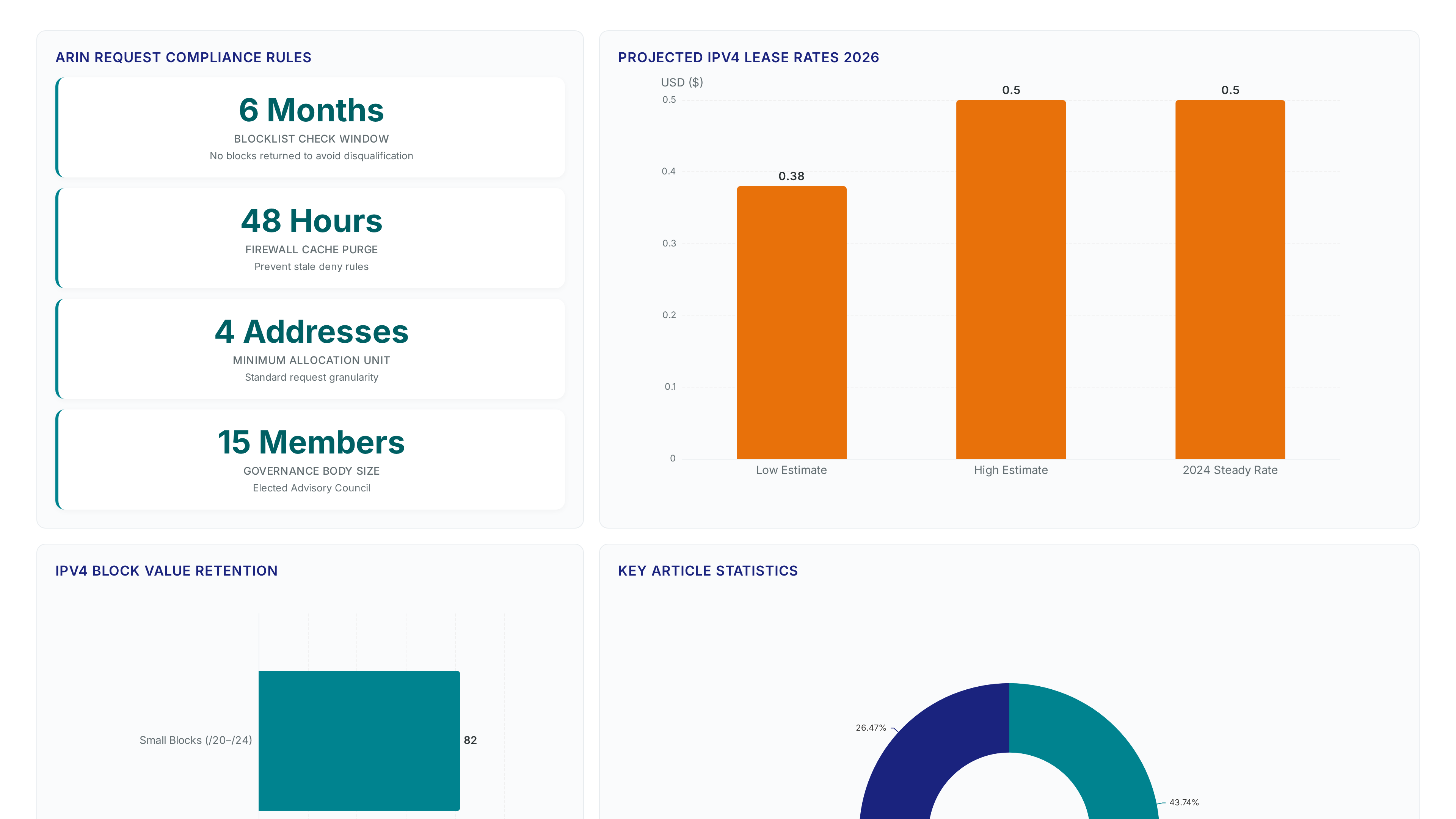
Operators initiate requests by logging into ARIN Online The submission interface enforces strict adherence to the Number Resource Policy Manual version released March 3, 2026. Governance oversight comes from the Advisory Council, comprising 15 elected members who shape these distribution rules.
- Navigate to the resource request dashboard and select the IPv4 waiting list option.
- Input the required block size, noting that small allocations retain value improved than bulk purchases.
- Attach technical justification documents proving immediate deployment necessity within your network.
- Submit the form and monitor the ticket queue for staff validation updates.
Policy development moves slowly while operational demand spikes abruptly. Administrative overhead burdens teams without dedicated staff. Treat the submission as the audit. Simple form filling invites rejection.
Using RPKI and IRR Tools to Validate Recycled IPv4 Block Reputation
Network engineers must query RPKI and IRR databases immediately upon receiving ARIN Waiting List notifications to verify path authorization before announcement. ARIN declared its free pool exhausted in 2015, forcing reliance on recycled inventory that often carries stale reputation signals from previous holders. Operators cannot assume prior blocklist inferences are invalid without independent verification against authoritative routing data. The technical mechanism requires validating that the new AS path matches published Route Origin Authorizations, preventing accidental hijacks of legacy space.
- Retrieve the specific prefix list from the ARIN cleared blocks page.
- Query the IRR database for existing route objects matching the new allocation.
- Verify ROA coverage exists for the assigning AS number in the RPKI repository.
- Submit delisting requests to substantial vendors if historical data conflicts with current ownership.
Propagation delays create a narrow window of vulnerability. RPKI caches retain invalid states for hours after reassignment. Strict peers reject traffic during this interim period. ARIN provides cryptographic trust foundations absent in commercial leasing markets. Operators bear the burden of active monitoring. Failure to update IRR records results in filtered traffic regardless of legitimate ownership. This silent failure mode differs from standard connectivity loss.
Post-Distribution Verification Checklist Following the April 2, 2026 Fulfillment Event
Operators receiving addresses from the April 2, 2026 event must execute immediate reputation validation before announcing prefixes to peers.
- Query global blocklist feeds to confirm the April 3 ARIN announcement regarding cleared reputation signals holds true for specific IPs.
- Purge local firewall caches older than 48 hours to prevent stale deny rules from blocking legitimate traffic on newly assigned space.
- Publish RPKI Route Origin Authorizations immediately, as hyperscalers reaching high adoption rates often reject unsigned paths by default.
- Monitor IRR objects for conflicting route claims that could trigger filtering by upstream providers relying on legacy database entries.
| Validation Step | Tool Source | Failure Symptom |
|---|---|---|
| Reputation Scan | External Feeds | Silent packet drop |
| Cache Flush | Local Firewall | Intermittent connectivity |
| ROA Signing | RPKI Portal | Path rejection |
| IRR Audit | Registry DB | Route leak alerts |
Announcing unsigned paths risks immediate filtering by peers enforcing strict RPKI policies. Enterprises lagging in IPv6 integration face higher scrutiny when reusing IPv4 space. This verification step remains non-negotiable for service continuity. InterLIR advises automating these checks to align with the expected late second-quarter 2026 distribution cycle. Operators ignoring this workflow risk reintroducing blocklist status despite ARIN's clearance notice. Rapid deployment conflicts with security requirements.
About
Alexander Timokhin, CEO of InterLIR, brings critical expertise to the discussion surrounding the recent ARIN IPv4 Waiting List distribution. As the leader of a specialized IPv4 address marketplace founded in Berlin, Timokhin manages the daily complexities of IP resource redistribution and reputation management. His direct experience navigating global supply constraints makes him uniquely qualified to analyze how cleared blocks impact market availability. At InterLIR, his team prioritizes security and clean IP reputation, directly aligning with ARIN's notice that prior blocklist inferences may no longer be valid. Timokhin's work involves verifying address history and ensuring safe transfers, providing a practical lens through which to view these regulatory updates. By connecting high-level policy changes to real-world infrastructure needs, he illustrates how efficient resource allocation supports the broader IT sector. This insight bridges the gap between registry announcements and the operational realities faced by networks seeking connectivity.
Conclusion
Scaling dual-stack architectures without addressing the underlying reputation debt of reclaimed IPv4 space creates a fragile operational baseline. As AI-driven network management becomes dominant by 2027, automated systems will aggressively filter unsigned or historically tainted routes, rendering manual remediation too slow for modern traffic velocities. The cost of maintaining legacy IPv4 dependency shifts from simple leasing fees to complex, continuous security auditing that erodes margin efficiency. Organizations must treat IPv4 not as a permanent asset but as a transitional liability requiring strict sunset planning.
Commit to a hard deadline of Q4 2027 to reduce IPv4-only traffic flows below a small fraction of your total network volume. Any project launching after January 2026 must default to IPv6-native design, using IPv4 strictly through translation layers rather than dual-stack expansion. This timeline aligns with the anticipated maturity of AI-optimized Wi-Fi environments that demand smooth, protocol-agnostic connectivity. Delaying this transition forces your team into a reactive posture where security incidents dictate your roadmap instead of strategic growth.
Start by auditing your current RPKI coverage and IRR record accuracy against the specific blocks you intend to use from the April 2026 distribution before Friday. Identify any missing Route Origin Authorizations and submit corrections immediately to prevent silent filtering once these addresses enter global routing tables.
Frequently Asked Questions
Legacy blocklist entries often cause instant failures despite ARIN invalidating prior inferences. Approximately 63% of sites lack IPv6 capability, forcing reliance on these potentially tainted IPv4 ranges for critical dual-stack service continuity today.
Hyperscalers reaching an 82% adoption rate leave pure IPv4 services increasingly isolated from core cloud ecosystems. This gap forces new deployments to maintain costly translation layers despite significant regional variance in rollout speed globally.
Traffic patterns show that between 55% and 70% of total flow still relies on the older protocol. However, the growth trajectory favors native v6 transport, making IPv4 dependency a potential liability without a clear sunset plan.
Ignoring cleared inventory creates artificial scarcity within the organization while global adoption rates sit between 45% and 50%. Operators treating these allocations as tainted miss immediate deployment windows needed to sustain legacy infrastructure efficiently.
Adoption lags significantly at roughly 32%, forcing continued reliance on dual-stack architectures for critical services. Organizations ignoring this reset face unnecessary procurement costs in the secondary market instead of utilizing available reclaimed address spaces.