
ARIN IPv4 Waiting List: The 2026 Reality Check
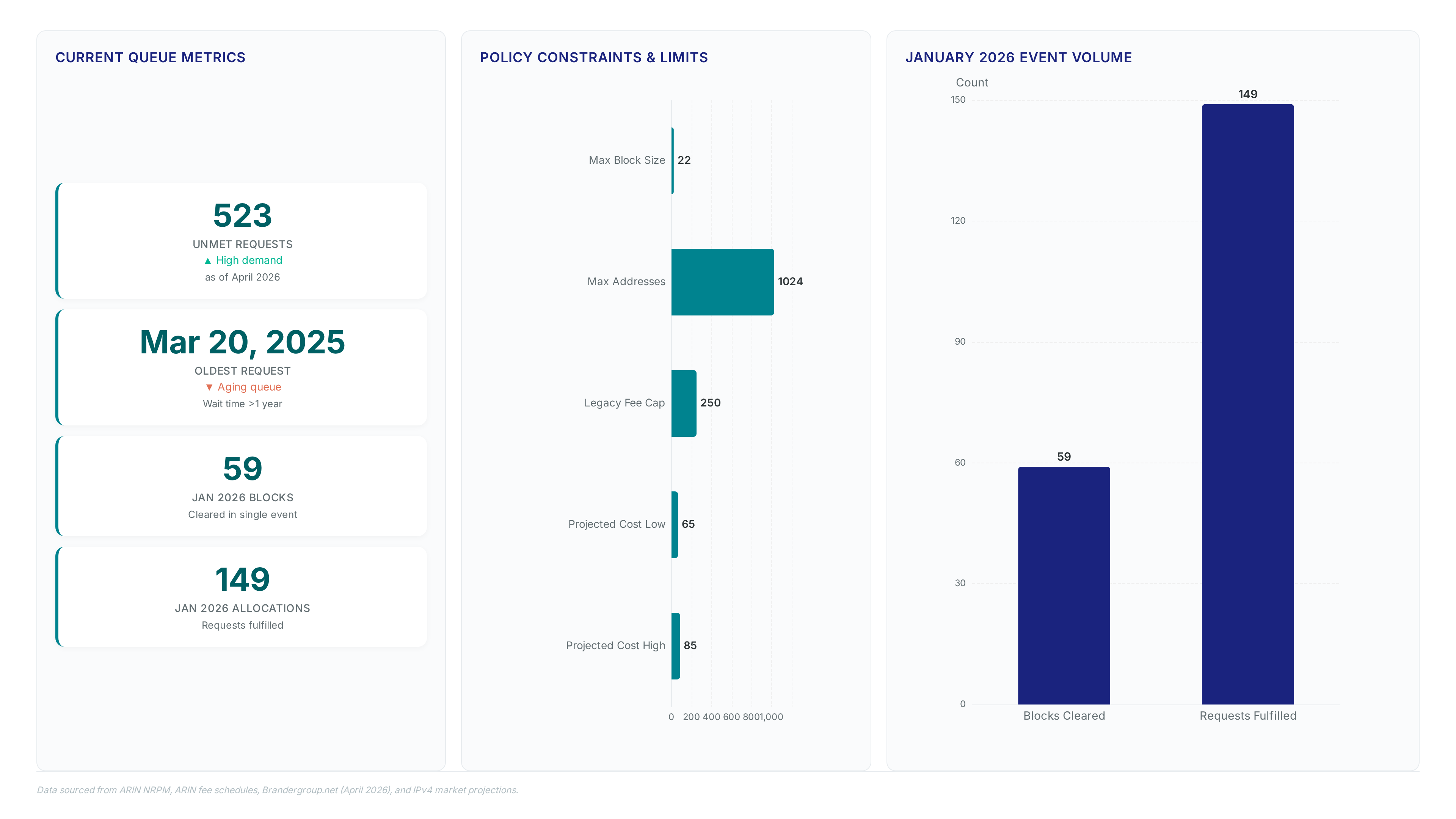
ARIN satisfied 149 pending requests on January 13, 2026, by releasing 59 recovered IPv4 blocks back into circulation. The regional registry's waiting list remains the only viable mechanism for acquiring legitimate address space without paying inflated market rates projected to hit $85 per IP by 2030. Readers will examine how recovered address blocks undergo mandatory quarantine to ensure routing stability before re-entry, effectively resetting their reputation history despite previous blocklist inferences. Finally, the analysis contrasts these administrative hurdles against the volatile economics of private transfers, where AI workloads and IoT deployments drive steady price appreciation regardless of supply fluctuations. Organizations clinging to the hope of immediate large-scale acquisitions ignore the mathematical certainty of the current backlog, where the oldest active request dates back to March 20, 2025. Understanding these distribution mechanics is critical for network architects who must balance immediate operational needs against long-term fiscal responsibility in an exhausted IPv4 environment.
The Role of ARIN's Waiting List in Modern IP Resource Management
ARIN IPv4 Waiting List Mechanics and Cleared Block Definitions
Think of the IPv4 Waiting List as a rigid, first-come, first-served queue for recovered address space distributed by ARIN. Recovered blocks do not jump straight to you; they enter a mandatory quarantine phase to verify routing stability before becoming cleared blocks eligible for assignment. This isolation period mitigates the risk of propagating stale routing information or inherited reputation issues from previous holders. On 14 January 2026, distribution efforts satisfied 149 distinct requests using 59 specific IPv4 blocks that had completed this validation cycle. The batch nature of these releases creates a discontinuous supply curve rather than a steady stream of available resources.
Blind spots plague operators who rely solely on request counts. The waiting list status page updates only after quarantined space clears validation, masking the fragmentation affecting fulfillment rates between recovery events. Successful applicants must align internal provisioning windows with the projected date of the next distribution window. Ignoring the age of the oldest entry leads to unrealistic expectations regarding address allocation speed. ARIN queue depth exceeds 388 days while RIPE NCC wait times reduced to 449 days in early 2026. The IPv4 waiting list operates under distinct regional pressures that dictate acquisition strategy. ARIN manages resources for North America with a backlog creating a wait exceeding one year, whereas the RIPE region recently saw wait times decrease significantly. Queue volatility in Europe shows periodic reductions, such as the drop from 954 to 742 Local Internet Registries in January 2026, yet global demand keeps most lines expanding.
| Region | Queue Trend | Max Allocation |
|---|---|---|
| ARIN | Expanding | /22 block |
| RIPE NCC | Reducing | /24 proposed |
| LACNIC | Expanding | /22 block |
Policy divergence drives these metrics. ARIN maintains a fixed maximum aggregate size of a /22 block, while RIPE analysis suggests changing allocation sizes to /24 to prevent unmanageable growth. North American operators face static supply constraints against flexible European adjustments. Queue reductions in one region do not accelerate distribution in another.
Quarantine Protocols for Recovered IPv4 Space
Recovered address blocks from closed entities enter mandatory isolation to prevent immediate re-hijacking and ensure routing stability. This quarantine phase validates that stale BGP announcements have ceased before space joins the available pool. Operators must treat these returned ranges as potentially tainted until ARIN confirms the cleanup. The process involves verifying that previous holders have ceased operations and that no active routes remain in the global table. Ipv4. Global/blog/what-is-arin/) for residual reputation issues before deployment.
- ARIN identifies space from defunct organizations or voluntary returns.
- Technical staff verify withdrawal of all associated route objects.
- Blocks enter a holding period to monitor for stray traffic.
- Cleared status grants eligibility for the waiting list distribution queue.
Time is the bottleneck. Stability checks delay availability despite high demand. A block might sit idle for weeks while operators confirm the absence of legacy traffic. Supply cannot match the velocity of requests during this pause.
| Phase | Duration | Risk Mitigated |
|---|---|---|
| Identification | Variable | None |
| Verification | Days | Route leaks |
| Quarantine | Weeks | Re-hijacking |
| Clearance | Immediate | None |
Prior inferences about blocklist placement often persist even after cleaning. The January 2026 distribution proved that 59 blocks could satisfy 149 requests only after passing these checks. Operators ignoring this history face filtering by upstream providers who distrust recently recovered space.
Queue position locks to the qualified request submission date, creating a rigid, non-transferable sequence for distribution. This first-come, first-served mechanism means the oldest active entry from March 20, 2025, dictates the starting point for every subsequent fulfillment cycle. Operators cannot purchase priority or swap places; the date of the qualified request serves as the sole sorting key. Consequently, new applicants face a static barrier where time, not capital, determines access.
The batch processing model complicates this linear logic. During the January event, the system satisfied 149 distinct orders from a limited pool of 59 cleared blocks. This disparity forces a partial fulfillment strategy where the queue advances only as far as available inventory permits.
| Factor | Impact on Queue |
|---|---|
| Submission Date | Defines absolute rank |
| Block Availability | Limits forward movement |
| Request Size | Caps individual allocation |
InterLIR notes that queue depth volatility creates uncertainty for project planning. A large distribution might clear hundreds of entries, while a sparse one leaves the head of the line unchanged for months. The rigid ordering prevents operators from bypassing the wait through market mechanisms within the waiting list itself. This structure ensures fairness but introduces significant latency for critical infrastructure deployments requiring immediate addressing.
Blocklist Reputation Risks in Cleared Address Blocks
Cleared blocks often retain negative reputation signals from prior abuse despite ARIN's official stance that such inferences are likely invalid. A blog post published on 12 April 2022 specifically addressed these lingering blocklist concerns regarding distributed resources, yet spam filters frequently ignore registry status updates. The technical mechanism involves external reputation databases caching historical abuse data independently of RIR allocation records. Operators receiving space from the January event, which utilized 59 specific IPv4 blocks for distribution, must verify deliverability before production.
Clearance does not trigger automatic delisting across commercial threat intelligence feeds. Email gateways frequently reject traffic from these ranges based on stale heuristics rather than current ownership. You face a direct conflict between immediate address availability and the operational cost of reputation rehabilitation.
| Risk Factor | Cause | Mitigation |
|---|---|---|
| Stale Blacklists | Cached historical abuse data | Submit delisting requests |
| Spam Traps | Previous holder activity | Warm-up new IPs slowly |
| TLS Errors | Expired certificates on reverse DNS | Update PTR records immediately |
The quarantine phase ensures routing stability but does not sanitize external reputation scores. Network engineers must budget time for warm-up procedures rather than assuming instant usability. Failure to manage this transition results in lost revenue from undelivered transactional emails.
Strategic Application of Waiting List Resources Versus Market Alternatives
Defining the Economic Threshold for Waiting List Eligibility
Financial baselines for eligibility hinge on comparing free allocations against steady secondary market leasing rates of $0.40 per IP. Operators requesting space must weigh the zero-dollar cost of the waiting list against the immediate availability offered by commercial entities like IPXO. This cost disparity defines the threshold where patience becomes more expensive than capital expenditure. Purchase prices for large blocks dropped below $20 per IP in mid2025, yet small block seekers face a different calculation involving opportunity cost. The secondary market provides instant deployment, whereas the regulatory queue imposes indefinite delays that stall revenue-generating projects. Operational risk of waiting exceeds the nominal lease fee for time-sensitive applications. Forecasts suggest prices could appreciate to between $65 and $85 per IP by 2030, making current leasing rates a strategic hedge. Non-transferable positions on the waiting list prevent monetizing any accrued seniority. Decisions rest on whether an organization values liquidity or speed more highly in its current growth phase. Operators must calculate whether indefinite queue positioning outweighs the certainty of current secondary market pricing. Immediate acquisition via platforms like IPXO secures address space now, avoiding the operational drag of delayed projects.
North America controls a significant share of global allocations, creating a dense but exhausted local supply chain. Lost revenue from delayed service launches often exceeds the price difference between today's market rates and future forecasts. Relying on the queue assumes price stability that market data contradicts the the fixed supply dynamics. Operators holding legacy resources should factor in the upcoming fee increases scheduled for 2027 when modeling total ownership costs. Financial thresholds shift when project delays cost more than the premium for immediate address availability.
Legacy Fee Caps and IPv6 Waiver Expiration Risks
Holding strategies face immediate financial exposure when the temporary IPv6 fee waiver expires on December 31, 2026. Organizations currently using this relief for /36 allocations will transition to standard billing structures, eliminating the zero-cost advantage previously enjoyed by small networks. This shift coincides with an approved ARIN Fee Increase scheduled for 2027, compounding operational expenses for entities relying on long-term queue positions. Legacy resource holders operate under a different constraint set by their agreement date. Those with a Legacy Registration Services Agreement established prior to January 1, 2024, retain a strict $250 annually fee cap throughout 2026. This protection creates a divergent cost trajectory where newer applicants face rising liabilities while legacy partners maintain fixed overhead. Tension between free allocation access and escalating maintenance fees forces a reevaluation of holding periods. Networks must now calculate whether indefinite waiting justifies the impending loss of fee exemptions.
Executing a Request for IPv4 Addresses Through ARIN Online
ARIN Online Workflow for Cleared IPv4 Block Fulfillment
Operators convert queue positions into active allocations by accessing the IPv4 Addresses Cleared for Waiting List page within the ARIN Online portal. The interface restricts selection to available cleared blocks from the January event, preventing manual entry of unapproved ranges. Requestors must navigate the fulfillment wizard to claim a specific /22 block before the system auto-assigns the next eligible entity. This automated logic enforces the Number Resource Policy Manual maximum aggregate size limits without human intervention.
- Log into ARIN Online and select the pending waiting list ticket.
- Review the distribution event inventory to identify unclaimed space.
- Submit the allocation request form to trigger immediate resource assignment.
- Update internal routing policies to accept the new prefix advertisements.
Reputation validation remains a manual step external to the portal workflow. External blocklists often retain historical abuse data despite registry clearance, requiring operators to petition third-party vendors for delisting. The queue operates on strict first-come logic, meaning delayed portal interaction results in lost priority against the oldest active request Successful fulfillment demands rapid portal engagement once cleared space appears.
Executing NRPM /22 Aggregate Limits in ARIN Online Requests
ARIN Online enforces the Number Resource Policy Manual /22 block ceiling by rejecting any request exceeding 1,024 addresses during the submission workflow. Operators must submit a single qualified ticket rather than fragmenting needs, as the system aggregates all active holdings against this statutory limit before approval. Attempting to bypass this constraint through multiple organizational entities triggers manual review and potential disqualification from the queue.
- Navigate to the waiting list module and verify the pending request date matches the first-come, first-served priority chain.
- Select an available range from the IPv4 Addresses Cleared for Waiting List page to initiate the claim process.
- Confirm the total allocation size does not surpass the maximum aggregate threshold set in current policy.
Reputation risks linger despite quarantine protocols, requiring operators to validate blocklist status prior to production deployment. While the January 1, 2024 event cleared a significant share of the pool, supply volatility means immediate availability is never guaranteed for late-queue entrants.
Applicants must verify routing stability by examining the specific history of recovered blocks before finalizing submissions. Recovered space enters the pool through a strict quarantine period designed to flush stale routes from global tables. This mechanism prevents immediate propagation of invalid paths but does not automatically clear external reputation filters. Operators should consult the blocklist guidance to distinguish between routing hygiene and sender reputation issues. A manual check against substantial spam databases remains necessary even after ARIN clears the range for distribution.
| Validation Step | Tool Source | Outcome Target |
|---|---|---|
| Route Origin Check | Global BGP Looking Glasses | No active advertisements |
| Reputation Scan | Third-party Blocklists | Clean sender status |
| Policy Review | NRPM Guidelines | Eligibility confirmation |
- Query global looking glasses for any active advertisements of the target prefix.
- Cross-reference the block against known spam lists using external tools.
- Confirm the /22 block size aligns with current operational needs.
- Document findings to accelerate potential dispute resolution post-allocation.
Neglecting this step risks inheriting a tainted AS path history that delays mail server deployment. The quarantine process fixes routing, not trust. InterLIR advises treating every cleared block as potentially compromised until proven otherwise.
About
Vladislava Shadrina serves as a Customer Account Manager at InterLIR, where she specializes in managing client relations within the complex domain of IP resources. Her daily work involves guiding organizations through the challenges of IPv4 scarcity, making her uniquely qualified to explain the nuances of the ARIN IPv4 waiting list. By directly assisting clients who are navigating strict allocation policies and seeking critical network infrastructure, Shadrina gains firsthand insight into the urgent demand for recovered address blocks. At InterLIR, a Berlin-based marketplace dedicated to redistributing unused IPv4 resources, she witnesses how policy shifts and distribution events impact real-world business operations. This article connects her frontline experience with the recent ARIN distribution event, offering a practical perspective on how recovered addresses are utilized to solve connectivity issues. Her role ensures that theoretical policy updates are translated into actionable strategies for businesses striving to maintain routing stability and growth in a constrained market.
Conclusion
Scaling network infrastructure on recovered space introduces hidden operational friction that policy timelines often obscure. While the queue moves, the 388-day delay forces organizations to choose between stalled expansion or expensive interim leasing at $0.40 per IP. Relying solely on registry clearance creates a false sense of security; routing hygiene does not equate to sender reputation. A block can be technically clean yet functionally useless for email services if previous owners abused the range. This disconnect between technical availability and practical utility represents the true bottleneck for late-queue entrants.
Organizations expecting allocation in early 2026 must immediately decouple their network expansion plans from the assumption of instant usability. Treat every incoming /22 block as a brownfield site requiring remediation before production traffic flows. Do not wait for the official handover to begin your due diligence. Start by auditing the specific 59 blocks currently in the recovery cycle against third-party spam databases this week. Identify which ranges carry lingering trust deficits so you can prioritize clean assets or budget for reputation warming campaigns before your turn arrives. This proactive verification prevents the scenario where you receive space but cannot use it for critical services.
Frequently Asked Questions
You may qualify for a maximum aggregate size of a /22 block at any single time. This strict cap prevents large entities from monopolizing scarce recovered supply while smaller networks wait for their turn.
The current queue depth exceeds one year, with the oldest active request dating back to March 20, 2025. This significant delay forces operators to model acquisition timelines against project milestones carefully.
Blocks enter a mandatory quarantine phase to verify routing stability and mitigate risks of propagating stale information. This isolation ensures prior blocklist inferences become invalid before addresses re-enter active circulation.
ARIN fulfilled 149 distinct requests using 59 specific IPv4 blocks that had completed the validation cycle. This batch release demonstrates how recovered space moves from closure to active assignment.
Operators must weigh long delays against projected market rates that could appreciate to $85 per IP by 2030. Relying on distribution events avoids paying these inflated costs for deprecated assets.