ARIN Maintenance Reality: 12 Hours of Silent Drops
ARIN will disable ARIN Online accounts for 12 hours on 28 March, blocking all transaction submissions.
Centralized IP address management shows its cracks when critical RESTful Provisioning and RPKI Up/Down services flatly reject data instead of queuing it. ARIN holds 45% of the global IPv4 pool, yet their maintenance protocol demands absolute timing precision because lost API calls require manual resubmission. A lean workforce of roughly 115 employees manages these 1.66 billion addresses, but the system offers zero redundancy for write operations during scheduled windows.
We need to look past the generic outage notice. The real issue lies in the specific service disruptions targeting ARIN Online and automated provisioning pipelines, while readonly services stay up. The mechanics of this data flow interruption mean RPKI Repository updates cease publication even though the underlying infrastructure stays online. Operators must adopt strategic timing protocols to ensure resource requests avoid the 7:00 AM to 7:00 PM ET blackout. In an IPv4 market where supply consistency drives valuation, costly delays are unacceptable.
The Scope of ARIN System Maintenance and Service Disruptions
Defining the 28 March ARIN Maintenance Window and Scope
Mark your calendars: 28 March. From 7:00 AM ET until 7:00 PM ET, ARIN Online and RPKI transactions go dark for twelve hours. This scheduled outage suspends the RESTful Provisioning service, forcing operators to delay any IRR object modifications. Read-only services like Whois remain functional, yet write capabilities for route and route6 records cease completely.
The timing creates operational friction. ARIN currently manages 45% of the global allocated IPv4 pool, totaling roughly 1.66 billion addresses. Deferring updates carries specific risks for networks relying on immediate cryptographic validation. You cannot simply "wait it out" if your security posture depends on real-time ROA updates.
Mechanics of RPKI Repository Publication Service Rejection
Here is the hard truth: the RPKI Repository Publication Service actively discards transactions during the 12-hour window. It does not buffer them. This hard-failure mechanism forces cryptographic key updates into an immediate rejection state, leaving route origin authorizations unprotected until operators manually resubmit requests after 7:00 PM ET.
Unlike standard HTTP queuing behaviors, the system provides no notification that the server discarded the packet. Silent gaps appear in your routing security posture. Operators managing legacy assets face compounded risks when update cycles collide with this outage. Financial constraints limit some networks to static configurations, exacerbating exposure to hijacks while the repository remains read-only. Automated scripts using Reg-RWS keys continue attempting connections that vanish into the void, requiring manual intervention to restore synchronization.
| ARIN Online | Inaccessible | Wait for restoration |
|---|---|---|
| RPKI Up/Down | Rejected | Resubmit manually |
| Whois/RDAP | Read-Only | None |
The 5 percent increase to Registration Services Plan fees approved for 2026 raises the cost of retry labor for teams managing large portfolios. Silence from the server mimics success in many monitoring dashboards-a dangerous false positive that delays incident response. Treat the maintenance window as a total freeze on trust anchor modifications.
Troubleshooting Failed RESTful Provisioning Calls Without Queuing
RESTful calls sent between 7:00 AM and 7:00 PM ET on 28 March return immediate HTTP errors. The server discards packets; it does not buffer them. Automated scripts attempting Reg-RWS transactions during this window face silent data loss since no queue exists to hold pending requests. Inspect application logs for connection refusals. Do not wait for success callbacks that will never arrive.
The absence of a retry buffer means any RPKI Up/Down submission vanishes instantly upon receipt.
- Halt all automated provisioning jobs immediately upon detecting connection timeouts.
- Verify API Key Management status to ensure credentials remain active despite the outage.
- Manually re-execute failed RESTful Provisioning commands only after 7:00 PM ET.
- Cross-reference the ARIN Online Portal to confirm successful record updates.
| Failure Mode | System Behavior | Operator Action |
|---|---|---|
| HTTP 503 Error | Request rejected instantly | Log error code and stop retry loop |
| Silent Drop | No response received | Check time against maintenance window |
| Queue Overflow | Does not exist | Prepare manual resubmission batch |
Scripts designed for high-availability will fail catastrophically if they assume standard HTTP queuing behavior. This proactive check avoids the operational debt of debugging missing route or route6 objects post-outage. Reliance on non-expiring API keys allows immediate retry without credential regeneration, yet the window for correction remains strictly bounded by human intervention speeds.
Validation Steps for Operational Whois-RWS and RDAP During Downtime
Distinguish between the inaccessible ARIN Online portal and functional read-only APIs. Verification begins by confirming that Whois-RWS and RDAP endpoints return data while rejecting all write attempts. The RPKI repository remains queryable for existing route origin authorizations, though no new cryptographic updates publish until service restoration.
| ARIN Online | Offline | None |
|---|---|---|
| RESTful Provisioning | Offline | Rejected |
| Whois-RWS | Online | Read-Only |
| RDAP | Online | Read-Only |
Engineers should execute these validation steps to confirm operational boundaries:
- Query a known IP block via RDAP to verify read access persists without authentication errors.
- Attempt a dummy RESTful write to confirm the server returns an immediate rejection rather than queuing the request.
- Inspect local monitoring logs for silent failures where automated scripts expect success callbacks that never arrive.
Transitioning to the modern RDAP API ensures more secure search activities during partial outages. Approximately 53% of enterprises now operate multi-cloud environments requiring constant directory access. Relying solely on the web portal creates a single point of failure for resource management. The IRR system continues serving route objects, allowing path validation to proceed despite the provisioning freeze.
Defining the Strategic Window for RPKI Update Delays
The 12-hour outage from 7:00 AM to 7:00 PM ET on 28 March forces a hard stop on all RPKI Up/Down and Repository Publication transactions. Operators must delay updates because the system rejects packets instantly rather than queuing them for later processing. Read-only access persists for Whois-RWS and RDAP, yet no new cryptographic signatures publish until the window closes.
This binary failure mode creates a specific risk for enterprises transitioning to multi-cloud environments. The cost of missed updates extends beyond temporary visibility loss; expired authorizations during this gap can trigger widespread route filtering by downstream peers enforcing strict validation policies. Financial planning complicates this timing decision, as the recent 5 percent fee increase raises the stakes for any transaction errors requiring costly re-submission. Small tier holders facing $2,205 annual bills cannot afford silent failures that delay resource activation.
Scheduling ARIN Transactions Around the 7:00 AM to 7:00 PM ET Outage
Submit all RESTful Provisioning requests before 7:00 AM ET on 28 March. The system discards packets sent during the outage. Automated scripts relying on Reg-RWS keys face immediate data loss since no server-side queue exists to buffer these transactions. Treat the 12-hour gap as a hard failure mode, not a temporary latency spike.
Read-only services like RDAP remain functional, yet any attempt to modify RPKI records returns an error without notification. Teams managing tight inventory should note that the oldest active request on the ARIN IPv4 waiting list already faces a 388-day delay, making lost submission slots costly. Leasing assets offers an alternative, though current IPv4 lease prices in the region range from $0.30 to negligible amounts.
Financial Risks of Delayed Updates Amid 2026 Fee Increases
Deferring RPKI updates past the maintenance window risks missing the fiscal cutoff for lower annual fee tiers before budget cycles lock. Analysts forecast that once BEAD funding distribution begins, injecting approximately $20 billion into broadband expansion, IPv4 prices could increase by 10% to 20% due to intensified demand.
The limitation is stark: any Reg-RWS call sent during the blackout vanishes instantly. This forces a manual re-filing that may miss the accounting period.
Post-Maintenance Procedures for Restoring IP Resource Management Workflows
Defining Post-Maintenance Transaction Resubmission Protocols
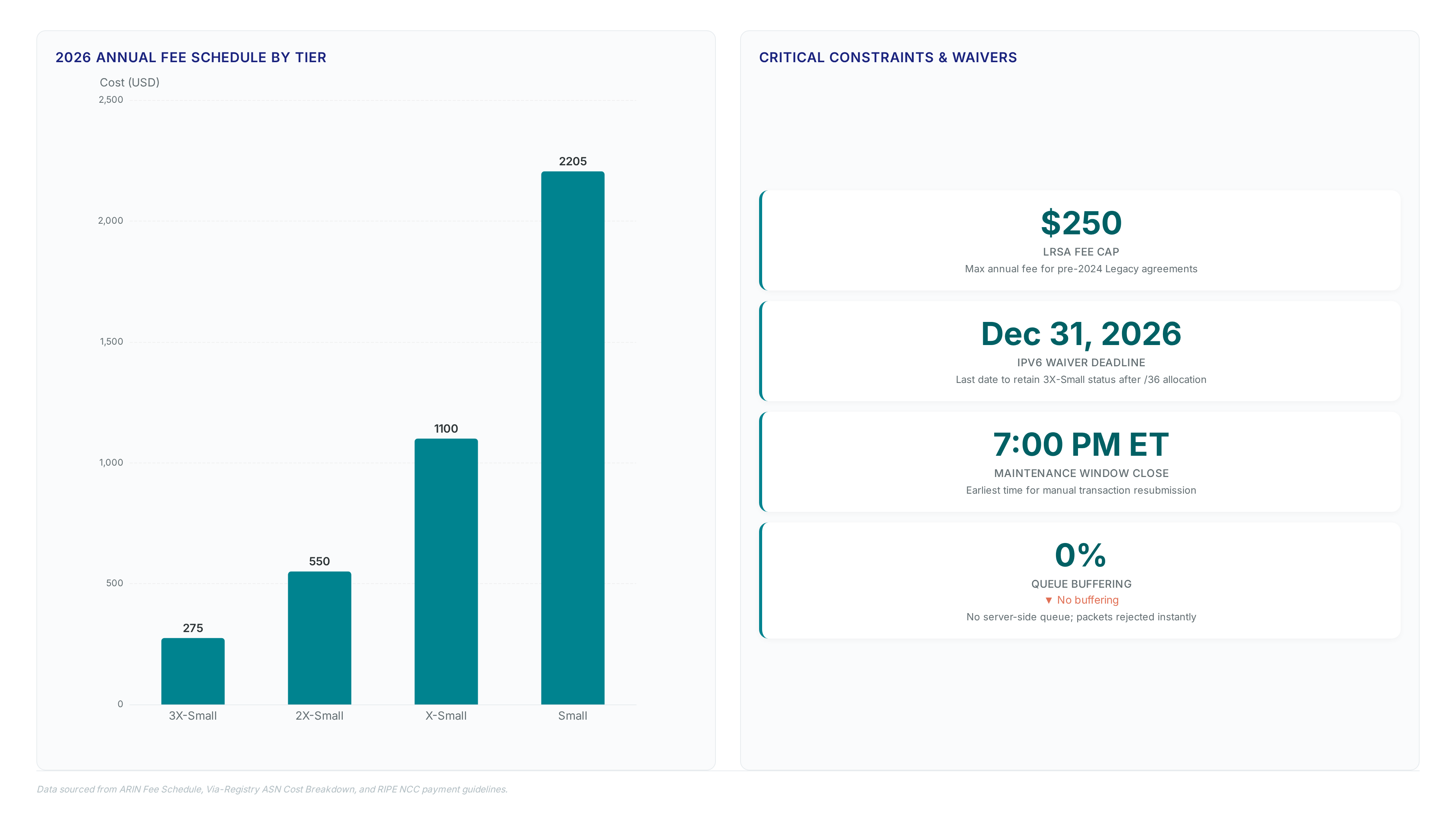
RESTful calls sent during the outage require manual resubmission after 7:00 PM ET. No server-side queue buffers rejected packets. Operators must script retry logic that verifies ARIN Online accessibility before attempting write operations to avoid cascading failures. The system discards RPKI Up/Down transactions instantly, forcing engineers to regenerate cryptographic signatures rather than replay old requests.
- Poll RDAP endpoints to confirm write capability returns before submitting new provisioning data.
- Regenerate Reg-RWS tokens if the initial authentication handshake fails post-maintenance.
- Resubmit RPKI Repository Publication objects manually since automatic retries do not exist in the current architecture.
- Validate that IRR route objects reflect the latest state before announcing prefixes to peers.
Direct interaction with the registry remains mandatory because ARIN lacks the sponsoring LIR program to buffer requests on behalf of members. This architectural constraint places the entire burden of state reconciliation on the network operator rather than a delegated entity. Teams managing complex routing policies should consult the IRR migration strategy to ensure legacy email-based records do not conflict with new web-based submissions.
Regain ARIN Online access immediately after 7:00 PM ET by validating credentials against the restored secure web-based portal before attempting record mutations. Operators must verify that historical data remains intact for compliance audits using the WhoWas service, which discloses past responsibility upon written request. New features added to ARIN Online may alter default permission sets, requiring manual review of user roles before resuming production changes.
- Confirm RDAP write capability returns successful status codes for your specific ASN block.
- Reset Reg-RWS API keys if authentication handshakes fail due to session invalidation.
- Manually resubmit rejected RPKI objects since the system discarded earlier packets without queuing.
- Audit incoming assignment controls to ensure protection against bad actors remains active post-update.
Rapid restoration often conflicts with data integrity. Prioritize critical routing security over administrative convenience. Skipping the credential validation step risks locking accounts due to repeated failed login attempts against freshly restarted services. This delay creates a temporary blind spot for legal teams verifying past IP ownership during dispute resolution.
Validation Checklist for RDAP API and IRR Object Integrity
Operators must verify route and route6 object integrity immediately after the 7:00 PM ET service restoration to prevent routing leaks.
- Query the RDAP API endpoint to confirm the transition from legacy Whois-RWS is active for secure searches.
- Inspect IPv4 route objects and IPv6 route6 objects within the IRR system to ensure edit permissions match original creation methods.
- Resubmit any RESTful provisioning calls rejected during the outage, as the database discards unqueued transactions.
- Validate that no stale RPKI signatures persist by cross-referencing published states against local configuration files.
| Object Type | Protocol | Validation Action |
|---|---|---|
| IPv4 Route | RPSL | Verify origin AS matches ROA |
| IPv6 Route | RPSL | Confirm route6 syntax validity |
| API Token | HTTPS | Test secure web-based portal access |
Automated scripts often assume state continuity, yet the maintenance window creates a hard discontinuity in object versioning. A failed validation here leaves the AS path vulnerable to hijacks that RPKI alone cannot filter. InterLIR recommends manual verification of the first ten prefixes before enabling automated updates.
About
Alexander Timokhin, CEO of InterLIR, possesses the strategic expertise necessary to analyze critical updates regarding ARIN Online accounts. As the leader of a specialized IPv4 address marketplace, Timokhin manages daily operations involving complex interactions with regional internet registries. His direct experience navigating ARIN systems for resource transfers and account management provides unique insight into how scheduled database maintenance impacts global network operators. With InterLIR focused on the efficient redistribution of unused IPv4 resources, Timokhin understands that system availability is vital for maintaining BGP stability and transaction security. His background in IT infrastructure and international policy allows him to contextualize ARIN's operational announcements within the broader environment of internet governance.
When a 12-hour outage occurs, the system's refusal to buffer RESTful calls forces an immediate data consistency gap that automated scripts cannot resolve post-restoration. This architectural rigidity means that relying solely on RPKI signatures leaves organizations exposed to route hijacks during the synchronization lag. The friction between interoperability mandates and legacy fee structures will only intensify as address scarcity drives up the cost of manual remediation.
Organizations holding direct allocations must migrate to redundant validation workflows within the next six months, specifically decoupling critical routing updates from single-points-of-failure portals. Do not wait for the next scheduled maintenance window to test your disaster recovery procedures. Start by auditing your last three months of RPKI signature logs against actual BGP announcements this week to identify any stale authorizations that survived the recent transition. This manual cross-reference reveals whether your current automation assumes state continuity where none exists. Prioritizing this verification now prevents the compounding errors that occur when unqueued transactions are silently discarded during future service interruptions.
Frequently Asked Questions
The system immediately discards unqueued RESTful calls rather than buffering them for later processing. This rejection creates data consistency gaps while ARIN manages 45% of the global allocated IPv4 pool.
Entities capped at $250 annually cannot update cryptographic protections during this specific maintenance blackout. Such stagnation leaves route origin authorizations stale while 85% of allocated addresses remain actively advertised.
Delaying updates leaves authorizations stale while 85% of allocated addresses remain actively advertised in the global routing table. This exposure occurs because ARIN currently manages 45% of the global allocated IPv4 pool.
No, the system flatly rejects data rather than queuing it for subsequent processing after service restoration. This behavior impacts operations managing 1.66 billion addresses under ARIN's current centralized IP address management.
Read-only services like Whois and RDAP continue functioning even when write capabilities cease completely during the update. However, no updates publish while ARIN manages 45% of the global allocated IPv4 pool.