ARIN Online update: Why 32% of IPv4 sits idle
ARIN's March 28, 2026 update introduces a 365-day ROA Change Log to secure routing integrity. (ARIN's ip addresses through 2025) This release marks a critical evolution where ARIN Online shifts from basic allocation to aggressive security enforcement and reputation management. Since the IPv4 exhaustion event of 2015, the registry has pivoted toward thorough oversight, a strategy now codified in this latest architecture.
The platform now empowers administrators to block incoming reassignments from bad actors, directly mitigating reputational risk. We are witnessing a mandatory migration from legacy Whois-RWS interfaces to the Registration Data Access Protocol for enhanced data security.
Administrators must execute complex registration services tasks through the updated portal while leveraging the Reg-RWS API for automation. This is structural hardening, not a cosmetic refresh. Passive record-keeping is dead. The new stance proactively targets routing hijacks and fraudulent transfers.
The Role of ARIN Online in Modern IP Resource Management
ARIN Online as the Secure Portal for US and Caribbean IP Resources
ARIN Online serves as the exclusive web interface for managing internet number resources across the United States, Canada, and parts of the Caribbean since the organization's official establishment in December 1997. This secure web-based portal replaces legacy email systems, centralizing control over resource requests, transfers, and reassignments into a single authenticated dashboard. The platform enables a critical shift from manual command-line interactions to self-service workflows, typically reducing processing times to two business days for standard modifications. Unlike RIPE NCC or APNIC portals, this system enforces region-specific policy constraints while holding 45% of global allocated IPv4 addresses.
Security operations centers must integrate these tools immediately. Enable the incoming reassignments block for all holders of large IPv4 blocks. These controls shift management from reactive cleanup to proactive posture enforcement.
ARIN Size-Based Fees Versus RIPE NCC Flat Contribution Models
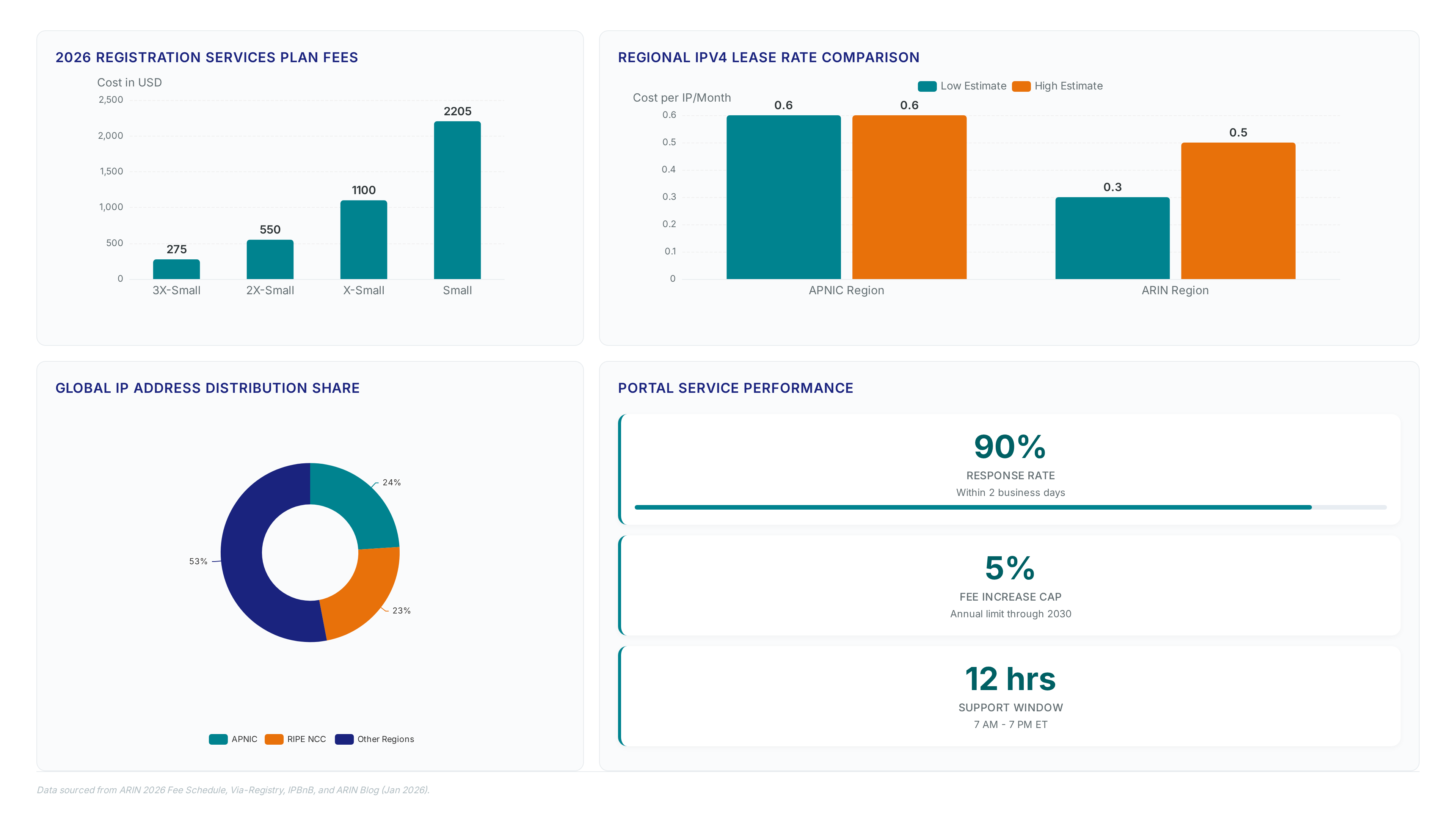
ARIN applies a tiered fee model ranging from $275 to $2,205 annually based on held resource volume. This mechanism ties operational costs directly to inventory size, contrasting sharply with the flat annual contribution of approximately €1,800 charged by RIPE NCC regardless of address count. Small organizations holding minimal IPv4 blocks benefit from ARIN's lower entry threshold, while large holders face escalating expenses that flat-fee competitors avoid. Growth in one registry region triggers fee jumps absent in another.
Secondary market dynamics complicate total cost of ownership calculations. Leasing rates in the ARIN region average between $0.30 and $0.50 per IP monthly, significantly below the premiums observed in Asia-Pacific markets. This pricing structure makes primary registration fees competitive against the high expense of IPv4 leasing elsewhere, even when annual dues rise. Operators must weigh predictable flat costs against variable scaling fees when selecting a home for new deployments. A sudden acquisition of address space can push an organization into a higher fee tier unexpectedly, disrupting annual financial planning.
The 2026 Backend Architecture and Logo Refresh Context
The March 28, 2026 service release couples a visual identity shift with backend stability fixes rather than introducing new protocol validation logic. This update marks the first logo update in 24 years, signaling a maturity phase for the registry following the massive backend systems deployment on March 2, 2019. That earlier project consumed over half the staff's focus to migrate from email-based interactions to current self-service portals. The current release addresses specific system access friction points through minor bug patches instead of architectural overhauls.
| Component | 2019 State | 2026 State |
|---|---|---|
| Interface | New website launch | Visual refresh only |
| Backend | Complete replacement | Stability patches |
| Access Model | Email-to-web migration | Optimized web workflows |
Operators experiencing login failures or timeout errors during this window face issues rooted in session handling rather than data model changes. Deep structural debts in the Reg-RWS API remain unaddressed while surface-level aesthetics receive priority. The branding change offers no functional impact on RDAP query performance or ROA generation speeds. Treat this as a routine stability release where the primary value lies in continued uptime rather than feature expansion.
Applying Reassignment Blocks and Fee Caps to Legacy Agreements
The January 2026 update introduces a specific toggle to explicitly block incoming reassignments from external entities, preventing unauthorized resource association. Operators access this control within the ARIN Online portal to mitigate reputational risk from bad actors attempting to reallocate space into their inventory. This mechanism functions as a hard deny at the registry API layer, stopping the transaction before it reaches the WHOIS database. However, enabling this block requires manual intervention; the system does not default to rejection, leaving unprotected accounts vulnerable to unsolicited transfers. Network teams must audit their assignment policies quarterly to ensure the setting remains active against evolving threat vectors.
Legacy resource holders with agreements signed prior to January 1, 2024, qualify for a fee cap limiting total annual charges to $250. Verification occurs automatically when the billing engine cross-references the LRSA signature date against the current fee schedule. Organizations falling under this threshold pay significantly less than the standard tier pricing for equivalent resource volumes. New agreements or modifications executed after the cutoff date immediately disqualify the holder from this protected rate. Users encountering errors should clear local data or contact the Help Desk via an Ask ARIN ticket.
Validation Steps for the 5 Percent Fee Increase and Board Approval
Administrators must verify the January 1, 2026 effective date on Registration Services Plan invoices to confirm the approved surcharge.
- Confirm the 5 percent adjustment aligns with the April 27, 2025 Board of Trustees resolution rather than a clerical error.
- Check for the IPv6 Fee Waiver status, which expires December 31, 2026.
The system does not automatically apply waivers for organizations holding minimal IPv6 space; manual validation prevents overbilling. Failure to identify misapplied tiers results in irreversible overpayments, as refunds require complex dispute tickets.
Executing Registration Services Tasks Through the Updated Portal
ARIN Online Portal Capabilities for Ticket Submission
The March 2026 update mandates that resource requests flow through the Ask ARIN ticket system rather than legacy email chains. Operators submit technical queries via the secure web-based portal, which replaced manual command-line interactions to reduce processing latency. This interface distinguishes between general informational questions and binding registration actions requiring audit trails. General inquiries receive immediate routing to support staff, whereas tickets trigger validation workflows against existing inventory records.
| Workflow Type | Entry Point | Validation Requirement |
|---|---|---|
| General Inquiry | Help Desk Phone | None |
| The Ticket | ARIN Online Account | API Record Check |
| Legacy Request | Email (Deprecated) | Manual Review |
Self-service creates a dependency on accurate user permissions; misconfigured account roles block ticket submission entirely. The organization confirmed that work on this release has been completed and all systems are operating normally, yet operators must still navigate the transition from email-based interactions to digital forms. Failure to use the assigned portal results in delayed responses, as phone support prioritizes outage mitigation over administrative changes. The Help Desk remains available for escalation, but primary intake now relies on the digital interface.
Step-by-Step Guide to Submitting an Ask ARIN Ticket
Navigate to the Registration Services Help Desk within ARIN Online to initiate the support request.
- Log in and select the ticket category matching the resource action.
- Describe the technical issue with specific AS numbers or IP blocks.
- Submit the form only during the Monday through Friday business window.
The system queues entries received between 7:00 AM to 7:00 PM ET for immediate staff review. Requests arriving outside these hours or on weekends face automatic deferral until the next operational cycle. This temporal constraint creates a hard dependency for operators managing time-sensitive routing incidents during off-hours. Teams must align escalations with Eastern Time business cycles to avoid multi-day delays. The interface enforces strict categorization to route queries correctly, preventing misdirected technical discussions.
| Submission Window | Processing Status | Risk Factor |
|---|---|---|
| Weekday Business Hours | Immediate Queue | Low |
| Weekend / Holiday | Deferred | High |
| Off-Hours Weekday | Deferred | Medium |
Operators ignoring the support schedule risk extended outage durations when manual intervention is required. The Ask ARIN workflow remains the sole authorized channel for complex registration disputes.
Submit the Ask ARIN ticket only after confirming reassignment controls block unauthorized incoming transfers. Operators must audit their inventory before initiating a Registration Services Plan update to prevent invoice mismatches. The 2X-Small tier now costs $550, while the X-Small level sits at $1,100 under the current schedule. Verifying these figures against internal accounting systems avoids automatic rejection by the billing gateway.
| Validation Item | Required State | Failure Consequence |
|---|---|---|
| Incoming Reassignments | Explicitly Blocked | Unauthorized resource association |
| Fee Tier Alignment | Matches Inventory | Invoice processing delay |
| API Access Method | RDAP Preferred | Legacy Whois-RWS deprecation risk |
The Board of Trustees approved the underlying rate structure that dictates these specific cost buckets. Skipping this verification step forces the help desk to manually intervene, extending resolution time beyond standard business hours. This size-based fee model contrasts sharply with the flat annual contribution charged by RIPE NCC, creating distinct financial outcomes for small versus large holders. Smaller entities often pay less under ARIN, while massive catalogs incur higher cumulative costs compared to European peers.
| Dimension | ARIN Approach | RIPE NCC Approach | LACNIC Approach |
|---|---|---|---|
| Pricing Logic | Scales with resource count | Fixed per LIR | Hybrid tiers |
| Small Org Cost | Lower entry point | Higher fixed baseline | Variable |
| Large Org Cost | Expensive at scale | Predictable cap | Moderate |
The geographic service scope remains strictly limited to the United States, Canada, and parts of the Caribbean, excluding global operators with mixed footprint assets. This regional exclusivity forces multinational corporations to maintain separate financial relationships with multiple registries instead of consolidating billing. No amount of protocol optimization can merge these distinct billing domains into a single invoice.
Financial models for 2027 must incorporate the Board-approved 5 percent trajectory to avoid underfunding the Registration Services Plan. This capped increase provides predictability, yet the impending expiration of the IPv6 fee waiver on December 31, 2026, introduces a variable cost spike for specific tiers. Operators holding significant IPv6 inventory face a dual pressure: the standard annual uplift and the removal of temporary subsidies. Failure to model this expiration results in unexpected Q1 2027 cash flow deficits. The fee increase trajectory remains stable, but the loss of the waiver disrupts total cost of ownership calculations for growth-stage networks. Accurate forecasting requires separating the baseline percentage hike from the one-time subsidy removal. This pricing band reflects a mature market where supply constraints drive value without reaching the extremes seen elsewhere. Operators in the Asia-Pacific face steeper hurdles, with leasing rates in the APNIC region frequently exceeding $0.60 per IP due to severe scarcity. North American operators benefit from a relatively accessible transfer mechanism that keeps yields moderate compared to acquisition costs. High demand sustains the premium, limiting arbitrage opportunities available in less liquid markets. Long-term holders must weigh the stability of current lease income against the risk of policy-driven devaluation.
About
Nikita Sinitsyn serves as a Customer Service Specialist at InterLIR, where he manages critical client account operations and database interactions daily. With eight years of experience in the telecommunications sector, Nikita possesses deep practical expertise in navigating ARIN and RIPE registry systems, making him uniquely qualified to analyze updates to ARIN Online. His routine work involves executing KYC procedures, managing spam control, and configuring Route Objects, which directly aligns with the new Route Origin Authorization (ROA) Change Log features discussed in this article. At InterLIR, a Berlin-based IPv4 marketplace dedicated to secure and transparent IP resource redistribution, Nikita ensures clients maintain clean BGP reputations and compliant database records. This hands-on involvement with registry mechanics allows him to clearly explain how these technical enhancements improve efficiency for organizations managing their internet number resources. His insights bridge the gap between complex registry updates and real-world operational needs for network operators.
Conclusion
Scaling IPv4 portfolios within ARIN Online exposes a critical friction point: manual authorization workflows cannot sustain the velocity required for modern flexible leasing. As block sizes grow, the operational drag of individual transaction approvals creates a bottleneck that erodes the margin benefits of the current $0.30 to $0.50 market rate. The real cost is not the annual fee tier, but the latency in resource deployment when automation gaps force engineering teams to wait on administrative gates. Organizations must decouple their internal IPAM logic from reactive registry management before the 2027 fiscal cycle begins.
Adopt a strict mandate to integrate RESTful API hooks for all blocks exceeding /16 equivalence by Q3 2026. This timeline aligns with the post-waiver environment, ensuring your infrastructure handles volume without proportional headcount increases. Do not wait for the next policy review to address these architectural debts; the window to optimize before the subsidy cliff closes is narrow.
Start this week by auditing your current API token permissions against your largest three holdings to identify specific authorization gaps. Verify which modification endpoints require manual intervention and map those to your existing ticketing system. This immediate inventory reveals exactly where your operational scale breaks, allowing you to prioritize automation scripts that eliminate human latency before the next billing cycle locks in higher baseline costs.
Frequently Asked Questions
Small organizations pay specific tiered fees based on their held resource volume annually. The 2026 fee model ranges from a minimum of $275 up to a maximum of $2,205 depending on size.
ARIN manages a massive portion of the worldwide internet number resources through its secure portal. The organization currently holds 45% of all global allocated IPv4 addresses while enforcing region-specific policy constraints.
Legacy holders often pay significantly less than the standard tiered fee model applied to modern allocations. While standard fees reach $2,205, legacy agreements signed before 2024 cap annual costs at just $250.
The new ROA Change Log allows operators to track routing authorization modifications over a specific period. Users can export CSV data covering all changes made within the past 365 days for auditing.
Yes, the architecture supports RESTful registration actions through the Reg-RWS API for automated compliance checks. This enables direct access to native security tools without requiring any third-party intermediaries for operations.