ASPA path security fixes BGP transit gaps fast
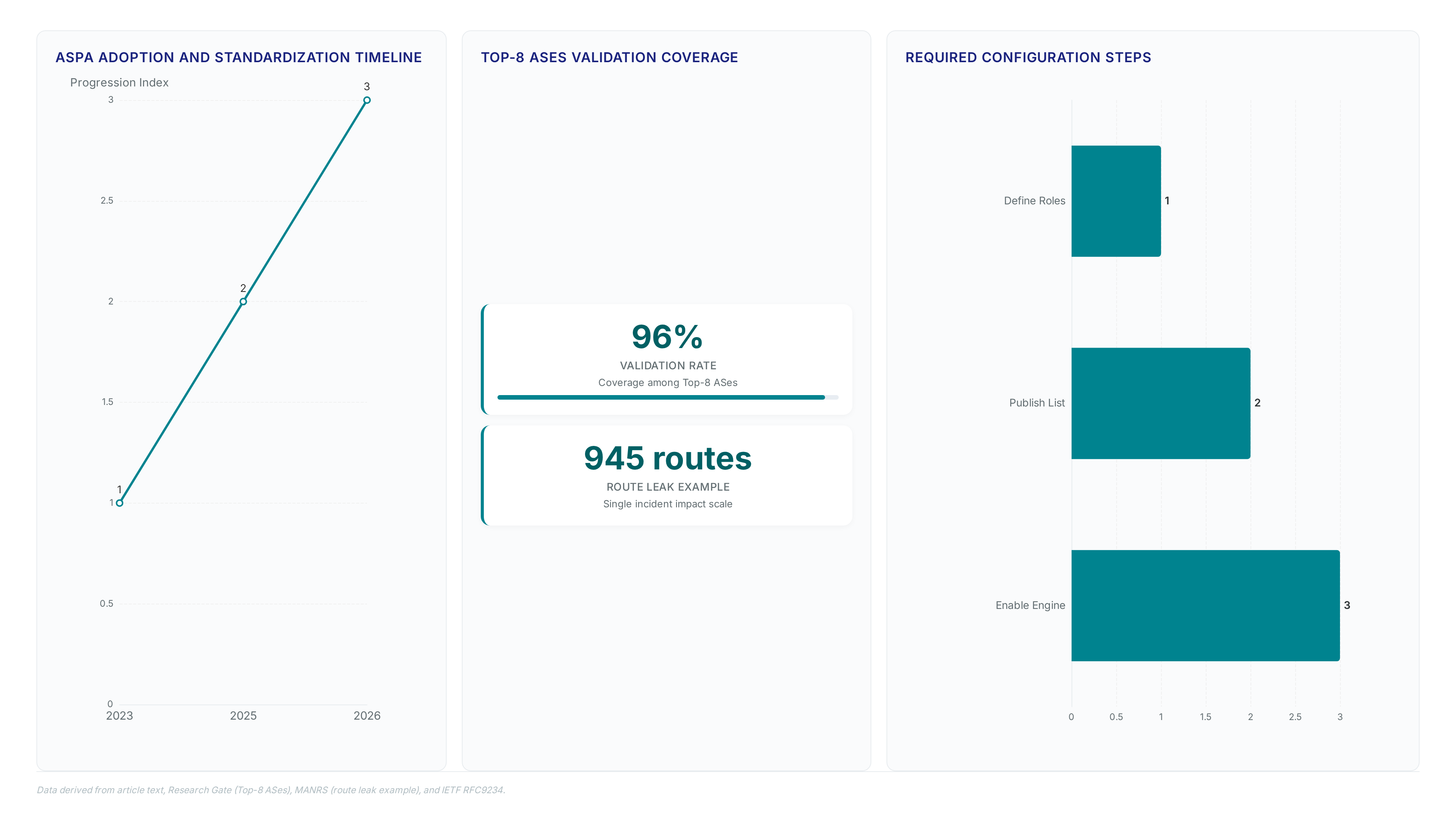
Deploying ASPA records in just the top-eight ASes mitigates 96% of route leak victims, proving immediate value despite low global adoption. ASPA validation transforms BGP security from theoretical promise into operational reality by cryptographically verifying the entire transit path rather than merely confirming the final destination. While ROA records successfully curb origin hijacks, they leave the intermediate path vulnerable to misdirection until this new standard enforces strict provider authorization.
Current RPKI deployment data from Cloudflare Radar indicates that as of February 2026, fewer than one percent of the global ASN space has published ASPA records, marking the technology's early operational phase. (Cloudflare's aspa secure internet The industry is finally addressing the critical gap where traffic passes through unauthorized networks, a flaw that has long plagued the Border Gateway Protocol.
This analysis dissects the role of ASPA architecture in modernizing internet routing security and details the specific mechanics behind its cryptographic path verification. Readers will learn how to configure path validation rules to detect valley-free violations and understand the practical steps for deploying these records within existing RPKI frameworks. By shifting focus from origin authentication to path integrity, network operators can secure the actual flow of data against both configuration errors and malicious interception.
The Role of ASPA in Modern BGP Security Architecture
ASPA vs ROA: Verifying the Process Beyond Origin
ASPA validates the full transit chain while ROAs confirm only the origin AS identity. A ROA acts as a verifiable digital ID card, confirming that an Autonomous System is officially authorized to announce specific IP addresses. This mechanism stops origin hijacks but leaves the path between source and destination unverified. In contrast, an ASPA record verifies the process by declaring authorized upstream providers for every hop in the AS path. Unlike ROA validation which checks only the destination, ASPA specifically targets AS path manipulations and route leaks by verifying the legitimacy of the transit chain. A route can have a valid origin yet traverse an unauthorized provider, creating a leak that RPKI alone cannot detect.
Global ASN space shows less than one percent of published ASPA records as of February 2026, leaving the AS path largely unverified. This cryptographic gap exposes the majority of transit exchanges to valley-free violations despite available mitigation tools. The mechanism relies on signed provider lists to reject unauthorized upstream announcements, yet most operators defer RIR publication. Research indicates that securing just the top-eight ASes could eliminate nearly all route leak victims, creating a strategic deployment target. However, waiting for universal coverage delays protection for smaller networks dependent on these substantial transit hubs. The limitation is clear: partial deployment protects the core but leaves edge peers vulnerable to localized hijacks until broader adoption occurs. Network architects must prioritize peering with ASPA-enabled providers now rather than waiting for global saturation.
The Up-Ramp and Down-Ramp Verification Logic
ASPA validates AS paths by checking the chain of relationships from both ends of the route propagation. The mechanism splits verification into two distinct directional checks that must converge to confirm legitimacy. First, the Up-Ramp logic starts at the origin AS and moves forward through the path. At every hop, the router asks if the current network authorized the next network as a provider. This forward traversal continues until the chain stops ascending. Second, the Down-Ramp check initiates from the destination of the BGP update and moves backward toward the source. Routers performing this verification compare each hop against the `providerASSET` of the downstream.
| Direction | Start Point | Movement | Validation Question |
|---|---|---|---|
| Up-Ramp | Origin AS | Forward | Did this AS authorize the next as Provider? |
| Down-Ramp | Destination | Backward | Is this AS listed in the downstream provider set? |
If the Up path and Down path overlap or meet at the top, the route status becomes Valid. However, a gap between these two ramps indicates a missing authorization link, flagging the route as Invalid. This specific granularity allows detection of leaks even when the origin itself holds a valid ROA. The limitation lies in the requirement for universal record publication; without signed objects, paths default to Unknown status to prevent connectivity loss. Operators must publish accurate provider lists to close the validation gap, otherwise the system cannot distinguish between a legitimate peer and a leaking customer.
AS65539 flags an ASPA Invalid status when AS65538 attempts to bridge traffic between AS65537 and itself. The validation engine executes two discrete checks against the announced AS path. First, the Up-Ramp traversal begins at the origin AS65536 and verifies that each subsequent hop authorized the next as a provider. Second, the Down-Ramp logic initiates from the receiving edge and moves backward through the chain. A route achieves Valid status only if these two directional checks overlap or meet at a common apex. In this specific failure mode, the Up-Ramp terminates at AS65537 while the Down-Ramp halts at AS65538. The lack of connectivity between these endpoints creates a cryptographic gap that defines the leak. Routers identify this anomaly by comparing every hop against the downstream providerASSET. If an AS appears in the path but lacks authorization in the providerASSET of the neighbor, the system rejects the update. This granular verification allows operators to fix route leak incidents automatically rather than relying on manual churn analysis. The economic justification for this complexity stems from the high.
| Check Direction | Start Point | Termination Condition |
|---|---|---|
| Up-Ramp | Origin AS | Chain stops ascending |
| Down-Ramp | Destination AS | Chain stops descending |
The operational limitation remains the dependency on universal record publication. Without signed objects in the registry, the AS path remains unverifiable regardless of router capability.
ASPA fails to block forged-origin hijacks when the malicious provider itself holds valid authorization to transit the victim's prefix. The mechanism exposes deception by allowing a victim network to cryptographically declare its actual authorized providers, yet this defense collapses if the attacker occupies a legitimate spot in the supply chain. A forged-origin hijack occurs when an adversary advertises a correct origin AS but fabricates the intermediate path to bypass standard filters. ASPA validates the entire AS path by declaring authorized upstream transit providers, specifically targeting these manipulated routes. However, if the hijacking entity is an authorized provider for the origin, the cryptographic signature remains intact despite the malicious intent. The validation granularity of the protocol flags routes as Invalid only when the path deviates from declared relationships, not when an authorized actor behaves badly.
| Attack Vector | ROA Status | ASPA Status | Outcome |
|---|---|---|---|
| Unauthorized Origin | Invalid | N/A | Blocked |
| Path Manipulation | Valid | Invalid | Blocked |
| Authorized Provider Hijack | Valid | Valid | Accepted |
This limitation means a rogue transit provider can still redirect traffic while maintaining a Valid status. Operators must recognize that path authorization does not equate to behavioral integrity. Total immunity remains impossible without verifying the intent behind every AS path segment.
Deploying ASPA Records and Configuring Path Validation
ASPA Object Components: AS Numbers and Provider Lists
Constructing a valid record demands the customer ASN and a specific set of authorized upstream provider ASNs. The object structure defines two mandatory fields: `customerASID` identifies the network purchasing transit, while `providerASSET` lists the AS numbers permitted to propagate its routes. Operators must generate separate objects for each address family, as IPv4 and IPv6 authorizations do not merge automatically. This separation introduces operational overhead but prevents cross-protocol validation errors during path verification. Deployment follows a strict sequence to encode the trust relationship correctly:
- Log into the RIR dashboard (RIPE or ARIN) and navigate to the RPKI management section.
- Input the customer AS number as the primary identifier for the attestation.
- Populate the provider list with every upstream ASN purchased for Internet transit.
- Sign the object using the holder's private key to establish non-repudiation.
- Submit the record to the repository for global distribution to validating routers.
Creating these entries implies no additional financial cost beyond standard resource management fees, removing budget barriers for adoption. However, the requirement for address-family specificity forces operators to maintain dual records, doubling the manual entry workload for dual-stack networks.
RFC9234 mandates explicit BGP role assignment on every session to trigger the correct validation algorithm (RFC's draft ietf sidrops aspa profile 06) ripe.net/manage-ips-and-asns/resource-management/rpki/aspa/). Operators must execute these steps to enable path verification:
- Define the neighbor relationship as `provider`, `customer`, `peer`, or `rs-client` in the router configuration.
- Publish the authorized upstream list via the RIR dashboard, a process carrying no additional financial cost beyond standard fees.
- Enable the validation engine to cross-reference the received AS path against published records.
Missing role tags force the router into an Unknown state, effectively bypassing security checks for that link. This configuration gap allows leaked routes to propagate even when ASPA records exist globally. The January 2023 Route Leak Unlike BGPsec, ASPA avoids heavy public-key operations at every hop, reducing CPU load during convergence. However, the reliance on manual role configuration introduces human error risks that automated scripts must mitigate.
Upgrading the RPKI Relaying Party stack forms the mandatory first step before any path validation logic can execute. Operators must sequence four distinct updates to achieve functional deployment:
- Patch the validator to parse new ASPA object types.
- Configure the router to consume RTR protocol extensions.
- Publish provider lists via the registry interface.
- Enable local policy enforcement on edge sessions.
| Component | Update Requirement | Operational Impact |
|---|---|---|
| RP Software | Parse ASPA profiles | Enables object retrieval |
| Signer | Generate customer records | Creates trust anchors |
| RTR Server | Distribute validated data | Feeds router tables |
| BGP Daemon | Enforce valley-free rules | Blocks invalid paths |
Implementation expenses stem largely from the complicated long supply chain of training staff rather than direct licensing fees. Open-source suites like OpenBGPD now include native validation, removing proprietary hardware barriers for smaller networks. Engineers can verify configurations using zero-cost datasets provided by federal testing initiatives. Neglecting the signer update renders the entire chain useless, as routers cannot validate paths without published objects.
Cloudflare Radar ASPA Monitoring and Validation Outcomes
Cloudflare Radar updated in February 2026 to provide ASPA deployment insights at daily granularity across five RIRs. The platform visualizes three distinct validation outcomes for BGP paths: Valid, Invalid, or Unknown. Operators examining these dashboards observe how integration with observability shifts routing security from reactive post-mortems to real-time cryptographic verification. A route marked Invalid indicates the AS path contradicts published provider authorizations, signaling an active leak or hijack attempt. Conversely, an Unknown status implies no ASPA record exists for the customer AS, a state currently dominant the low global adoption.
| Outcome | Definition | Operator Action |
|---|---|---|
| Valid | Path matches ASPA records | Accept update |
| Invalid | Path contradicts ASPA records | Reject update |
| Unknown | No ASPA record exists | Accept update |
This tri-state model prevents outages during partial rollout by defaulting to acceptance when data is missing. However, reliance on Unknown acceptance leaves networks vulnerable until critical mass is reached. Routing software such as OpenBGPD includes native validation capabilities, yet operators must still configure local policies to enforce rejection of Invalid paths. Without explicit reject policies, the monitoring data remains purely informational rather than protective. The true value lies not in viewing the charts, but in automating the response to Invalid signals before traffic traverses unauthorized valleys.
Analyzing AS203898 Provider Authorization and Upstream Status
Zooming into AS203898 reveals whether observed BGP upstream providers match the cryptographically signed list in its ASPA object. Operators inspecting this specific autonomous system can verify if traffic traverses only authorized links, transforming abstract policy into tangible path validation. The monitoring interface displays the full roster of declared providers, allowing immediate detection of unauthorized transits that violate valley-free routing principles. This granular visibility shifts security from reactive post-mortems to proactive cryptographic enforcement of inter-domain relationships. Deployment requires updating the entire software supply chain, starting with RPKI Relaying Party packages to parse new object types. Without these upgrades, routers cannot retrieve or interpret the provider lists necessary for path verification. The process demands coordinated changes across signer implementations and RTR software before any BGP daemon can enforce policies based on ASPA records.
| Validation State | Meaning for AS203898 | Operator Action |
|---|---|---|
| Valid | Path matches declared providers | No intervention needed |
| Invalid | Leak detected via unauthorized hop | Trigger reject policy |
| Unknown | No ASPA record published | Monitor for future signs |
Strategic implementation yields disproportionate safety gains even without universal uptake. However, a gap remains where ephemeral leaks bypass detection if the leaking AS lacks a published record entirely. Operators must therefore combine ASPA checks with traditional anomaly detection to cover these blind spots until adoption matures.
Pre-Deployment Checklist for RPKI RP, Signer, and RTR Updates
Functional ASPA validation fails immediately if the RPKI Relaying Party software cannot parse the new object profile set in draft-ietf-sidrops-aspa-profile-26. Operators must first patch their validator instances to recognize these records before any path analysis occurs. The primary barrier involves the complicated long supply chain Ignoring this sequence leaves the network blind to valley-free violations despite having correct BGP role configurations.
| Component | Required Action | Failure Mode |
|---|---|---|
| RP Software | Parse ASPA profiles | Object rejection |
| Signer | Generate customer records | Missing trust anchor |
| RTR Server | Distribute validated data | Stale router tables |
| BGP Daemon | Enforce role policies | Invalid path acceptance |
NIST provides open-source test tools (Nist releases test tools accelerate adoption emerging rou...) nist.gov/news-events/news/2025/08/nist-releases-test- allowing engineers to verify their stack against zero-cost datasets before production rollout. Skipping this verification phase risks propagating false negatives during the initial deployment window. InterLIR recommends sequencing these updates to align with the October 2026 draft expiration timeline. The cost of delayed adoption is measurable: networks without updated RTR software cannot distinguish between a legitimate path and a leaked route. This gap forces operators to rely on manual filtering long after cryptographic proofs exist.
About
Vladislava Shadrina serves as a Customer Account Manager at InterLIR, where she specializes in client relations within the IP resources domain. While her background includes architecture, her daily work at InterLIR focuses heavily on networking and ensuring the security of digital assets for clients. This role directly qualifies her to discuss ASPA records, as InterLIR prioritizes clean BGP and verified route objects to maintain high IP reputation. In her capacity managing accounts, Shadrina navigates the complexities of internet routing to prevent route leaks that could compromise customer infrastructure. Her practical experience with IPv4 address transactions requires a deep understanding of how traffic paths are secured against misdirection. By connecting her frontline support role with InterLIR's mission of transparency and efficiency, she provides a grounded perspective on why adopting cryptographic standards like ASPA is necessary for the future of reliable internet connectivity.
Conclusion
Scaling ASPA validation reveals a critical friction point: operational latency in the supply chain often outpaces the cryptographic readiness of the network edge. Even with high mitigation potential, the window between software patching and actual policy enforcement creates a temporary blind spot where transient leaks thrive. The real cost is not financial but temporal; every month of delay in updating RPKI Relaying Parties extends the period where routers accept invalid paths as legitimate. Relying solely on static lists is insufficient because the threat environment shifts quicker than manual registries can update. Networks must treat ASPA adoption as a continuous integration pipeline rather than a one-time configuration change to maintain proven defense.
Organizations should mandate a full-stack audit of their RTR servers and BGP daemons by Q2 2026, ensuring all components parse the latest object profiles before the draft expiration. This timeline provides a necessary buffer to resolve dependency conflicts without rushing production changes. Do not wait for universal upstream adoption to begin; partial deployment still yields significant security gains against common misconfigurations. Start this week by running the NIST open-source test tools against your current staging environment to identify specific parsing failures in your validator instances. This immediate verification isolates compatibility issues before they impact live traffic, transforming abstract compliance requirements into concrete, actionable engineering tasks.
Frequently Asked Questions
Securing just the top-eight autonomous systems reduces victim impact by approximately 96%. This strategic partial implementation drastically cuts the attack surface without requiring universal participation from every network operator globally.
Upgrading to secure routing does not necessarily require purchasing new proprietary software licenses. Open-source tools like OpenBGPD and BIRD include native ASPA validation capabilities for immediate deployment.
Creating an ASPA object implies no additional financial cost beyond standard resource management fees. Operators only need to list their AS number and authorized provider AS numbers in the registry.
NIST provides zero-cost datasets and software for researchers to test ASPA implementations. The open-source NIST BGP RPKI IO tool accelerates adoption by allowing risk-free validation of emerging route leak mitigation.
ROA records confirm only the origin AS identity while leaving the intermediate journey vulnerable to misdirection. ASPA fills this gap by cryptographically verifying the entire transit path rather than merely the destination.