Autonomous System Numbers: Why 65,536 Wasn't Enough
The math was always going to fail. The original 2-byte Autonomous System Number format offered exactly 65,536 unique identifiers, capping the total at 65,535 usable values. That ceiling hit hard. To keep the internet running, the industry shifted to 4-byte expansion. Within that cramped legacy range, Afrinic data confirms the Internet Assigned Numbers Authority reserved exactly 1,023 blocks for private use, specifically spanning 64,512 to 65,534. These distinctions aren't just academic; they dictate how ISPs move data and enforce routing policies right now.
This guide cuts through the noise on legacy versus modern ASN formats. We'll cover the specific policy shifts enacted in 2016 that removed contract barriers and walk through the simplified steps for requesting identifiers through your local registry. InterLIR solutions enable compliant navigation of these RIR procedures without the historical overhead of usage invoices. If your entity needs a public ASN to interconnect with multiple networks on the global internet, understanding these mechanics is non-negotiable.
The Role of Autonomous System Numbers in Global Internet Routing
Autonomous System Numbers as Unique Routing Identifiers
Think of an Autonomous System Number as a unique numerical fingerprint. It defines routing rules distinct from network peers. This globally available number enables an autonomous system to exchange exterior routing information efficiently with other networks. The Autonomous System itself represents a group of networks managed under a single administrative entity with its own routing policies. ISPs rely on these identifiers to control data flow and maintain the structural integrity of the internet.
The original 2-byte standard provides exactly 65,536 unique identifiers, covering the range from 0 to 65,535. That sounded like a lot until it wasn't. To address the limitations of this finite capacity, the industry introduced 4-byte formats and reserved specific ranges for private use. Organizations obtain these critical resources through a Regional Internet Registry such as RIPE NCC, AFRINIC, APNIC, LACNIC, or ARIN. The allocation process follows specific regional policies designed to manage resource distribution effectively. Network operators must ensure their deployment plans align with stated projections to maintain registry trust. InterLIR assists organizations in optimizing their existing IPv4 resources while navigating these ASN acquisition protocols. Secure your routing identity today by contacting InterLIR for strategic IP asset management.
IANA and Five RIRs in Global ASN Allocation
Hierarchy keeps the internet from collapsing into chaos. IANA allocates AS Numbers to Regional Internet Registries as the singular global root authority for distribution. This strict hierarchical model ensures that the finite pool of unique identifiers remains organized and conflict-free across the entire internet infrastructure. Rather than interacting directly with the global authority, network operators obtain resources through one of exactly five Regional Internet Registry entities responsible for specific geographic zones. These five distributors include AFRINIC, ARIN, APNIC, LACNIC, and RIPE NCC, each managing allocation policies tailored to their each regions. The technical distribution flow mandates that IANA distributes blocks to these RIRs, which then assign numbers to network operators in accordance with regional policies.
Public Separate System Numbers enable global routing visibility, whereas private identifiers remain strictly confined to internal network boundaries. Within the 16-bit ASN range, the Internet Assigned Numbers Authority (IANA) has specifically reserved 1,023 numbers for private use, occupying the range from 64,512 to 65,534. Network architects apply this reserved block to design internal routing infrastructures that must not conflict with global public routing tables. The industry manages inherent scarcity by distinguishing between these public and private needs, driving broader adoption of 32-bit ASNs for public expansion.
| Feature | Public ASN | Private ASN |
|---|---|---|
| Visibility | Global Internet | Internal Only |
| Range Scope | 0 to 64,511 | 64,512 to 65,534 |
| Routing Policy | Advertised Globally | Stripped at Edge |
| Use Case | Multi-homing ISPs | Lab or Single-Upstream |
The technical distinction in availability influences an organization's choice based on specific public versus private requirements. InterLIR enables access to these necessary public identifiers, ensuring your network maintains proper global reachability without administrative friction. We provide the expertise needed to navigate RIR policies and secure the correct numbering resources for your infrastructure. Contact InterLIR today to optimize your routing architecture and secure your position in the global internet system.
Technical Distinctions Between 2-Byte and 4-Byte ASN Formats
2-Byte and 4-Byte ASN Bitwise Capacity Limits
Exhaustion hit the original 16-bit standard hard. It capped the global pool at exactly 65,536 unique identifiers ranging from 0 to 65,535. This finite structure mirrors the scarcity dynamics of IPv4, necessitating the expanded 4-byte format to accommodate expanding internet demands. Legacy architecture relied on this 16-bit limit until depletion forced a transition similar to the shift toward IPv6 addressing. IANA reserved the range from 64,512 to 65,535 specifically for private use, preventing conflicts within global routing tables.
Policy updates during 2016 RIR Public Policy Meetings reflected the exhaustion of the global 2-byte ASN pool. These changes introduced a global 4-byte ASN pool while eliminating differentiation between the two types. The limitation remains clear: the original standard offers finite address space, driving broader adoption of 32-bit ASNs for public expansion.
Scenarios Requiring 4-Byte ASN Adoption
Total capacity for a 2-byte ASN stays strictly limited to 65,536 unique identifiers, covering the range from 0 to 65,535 structure. Within this constrained space, the Internet Assigned Numbers Authority reserved 1,023 numbers specifically for private use to prevent conflict with global routing tables private use. Such reservation creates a hard ceiling for public assignments, directing new entrants into the expanded 32-bit address space. Industry practice distinguishes between public connectivity needs and internal routing requirements to manage this scarcity effectively. Network architects designing infrastructure must apply the reserved range of 64,512 to 65,534 for private implementations, ensuring internal ASNs do not leak into the global internet.
Qualification for an ASN requires specifying names and ASNs of two upstream ISPs intended for multi-homing or describing a unique routing policy. InterLIR enables acquisition of these necessary identifiers to maintain uninterrupted global reachability. Organizations should verify projected usage dates before applying to simplify the allocation process. Introduction of 32-bit identifiers accommodated expanding demands of the expanding Internet. Secure your Separate System Number through InterLIR to ensure immediate compliance with modern routing.
Legacy 2-Byte Versus Modern 4-Byte ASN Formats
Original 16-bit standards offered a finite address space of 0 to 65,535, creating an immediate ceiling for global routing expansion. This constraint forces network architects to evaluate capacity limits against the reality of a expanding internet where unique identifiers are rapidly consumed. Total capacity of a 2-byte ASN is strictly 65,536 unique identifiers, a figure that proved insufficient as the internet scaled beyond early academic and military origins. Industry introduction of the 32-bit format accommodated expanding demands, mirroring the transition from IPv4 to IPv6 addressing schemes. A specific limitation exists within the legacy range: the Internet Assigned Numbers Authority reserved 1,023 numbers for private use, further shrinking the available public pool. This reservation prevents conflict with global routing tables and supports the necessity for migration.
Applicants no longer need to provide copies of contracts or invoices, though a projected date of usage is still required. Sticking to 2-byte formats faces constraints from the depleted global pool, whereas 4-byte allocation remains available through Regional Internet Registries. InterLIR enables access to these necessary routing resources, helping infrastructure avoid the pitfalls of address exhaustion. Secure your Sovereign System Number today to maintain uninterrupted connectivity and optimal path selection.
Step-by-Step Process for Requesting an ASN from a Regional Registry
Modern ASN Qualification Criteria and Projected Usage Policies
Obtaining a public Self-governing System Number now hinges on declaring multi-homing intent rather than submitting legacy contracts. Organizations qualify by either specifying the names and ASNs of two upstream ISPs they intend to use for multi-homing or by describing a unique routing policy. This shift eliminates the administrative burden of providing copies of contracts or invoices, accelerating access for legitimate network operators.
Applicants must still submit a projected date of usage to validate future deployment plans. The industry has moved away from rigid usage verification toward this intent-based model, ensuring resources are allocated to active projects without unnecessary friction.
- Identify your two primary upstream providers and their corresponding Sovereign System Numbers.
- Define your specific routing policy if multi-homing is not the primary driver.
- Submit your intended activation timeline to satisfy the projected usage requirement.
The removal of invoice requirements speeds allocation, while the mandatory projection date helps ensure resources are directed toward intended use. This balance allows organizations to optimize their existing IPv4 addressing strategies while they secure the necessary routing identifiers for global reachability.
Executing the RIR Portal Request and Agreement Workflow
Submit your the application directly through your assigned Area-based Internet Registry's online portal to initiate the allocation sequence. This self-service entry point serves as the single source of truth for your organizational data and technical justification.
- Navigate to your specific RIR's dedicated request interface and complete the digital form with accurate upstream ASN details.
- Await the review from a Registration Services officer who may request clarifications regarding your projected network topology.
- If your request is approved, you will receive an invoice and a Registration Services Agreement (RSA), if applicable.
- Execute the RSA and settle the associated fees to finalize the assignment of your unique identifier.
The operational process requires the timely execution of the legal RSA framework. While the technical bar for entry has lowered, the administrative requirement for a signed agreement remains a necessary step for global routing visibility. Completion of the RSA and payment are required before the ASN assignment is completed.
Historical Verification Requirements Versus Simplified 2016 Policies
In 2016, following discussions at RIR Public Policy Meetings, verification requirements such as contracts and usage policies were relaxed to simplify the process. Legacy procedures demanded physical copies of transit agreements and strict usage proofs that delayed network deployment for weeks. The exhaustion of the global 2-byte ASN pool necessitated this administrative overhaul alongside the introduction of the 4-byte ASN space. Modern applicants benefit from removed barriers where they no longer need to provide copies of commercial invoices or binding service contracts. This transition reflects a strategic pivot where IPv4 scarcity drove efficiency across all numbering resources.
| Feature | Pre-2016 Verification | Post-2016 Policy |
|---|---|---|
| Documentation | Mandatory Contracts | Intent Declaration |
| Proof Type | Physical Invoices | Projected Usage Date |
| ASN Type | 2-byte Focused | Global 4-byte Pool |
| Timeline | Extended Review | Accelerated Allocation |
Operators must recognize that eliminating document submission does not remove the need for technical justification via upstream ISP identification. The process balances administrative speed with the necessity of proving multi-homing capability or unique routing policies.
- Identify two upstream providers to satisfy the multi-homing requirement without gathering physical contracts.
- Submit a projected usage date to demonstrate immediate operational need rather than speculative accumulation.
- Complete the Registration Services Agreement digitally to finalize the assignment process efficiently.
Regulatory bodies apply simplified processes to enable legitimate network growth while maintaining resource integrity.
Strategic Criteria for Determining Public ASN Necessity
Defining Public ASN Necessity Through Multi-Homing and Unique Routing Policies
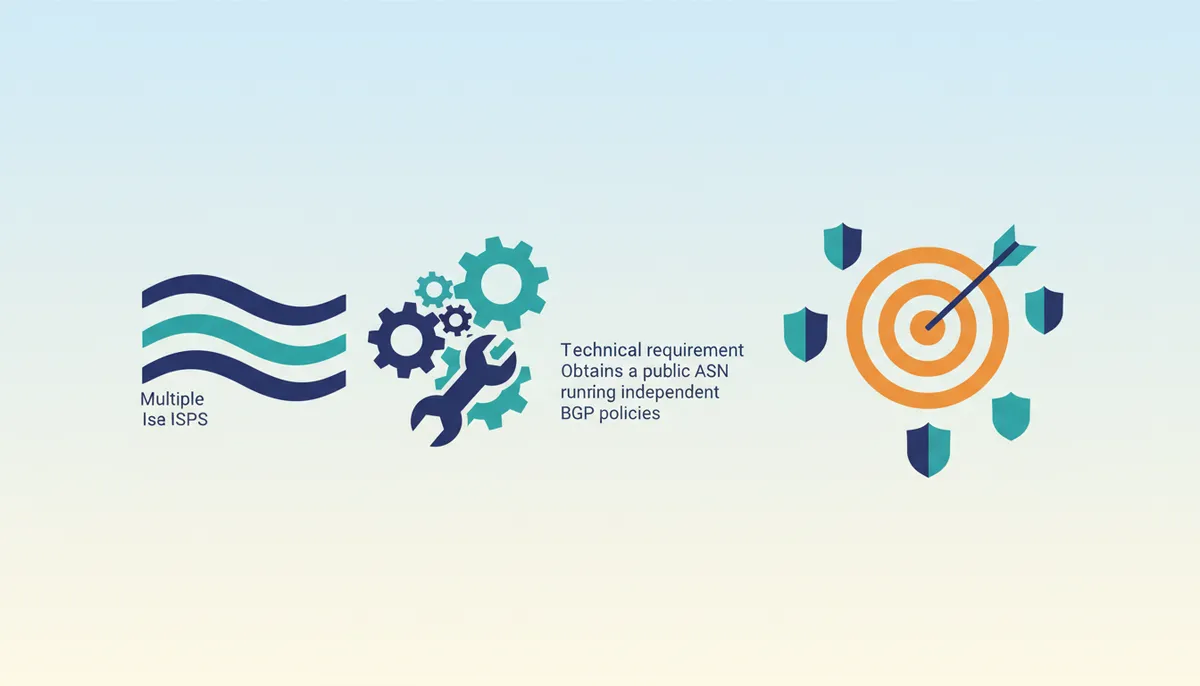
A public Independent System Number becomes mandatory when an organization implements multi-homing or enforces a routing policy distinct from its upstream providers. Without this unique identifier, networks cannot exchange exterior routing information with multiple peers on the global internet. The core technical constraint dictates that every autonomous system requires a unique identifier to prevent routing conflicts and ensure stable data transmission. Organizations qualify for allocation by specifying the names and ASNs of two upstream ISPs intended for multi-homing or by documenting a unique routing strategy. This shift eliminates legacy barriers, as applicants no longer submit copies of contracts or invoices to prove necessity. While previous usage verification requirements have been removed, registrants must still provide a projected date of usage to validate immediate need.
The distinction between simple connectivity and independent routing defines the boundary for public resource allocation. Private ranges exist for internal segmentation, yet connecting to the global grid demands a globally coordinated number.
| Requirement Type | Legacy Process | Current Standard |
|---|---|---|
| Verification | Contract copies required | Projected usage date |
| Timeline | Proof of usage needed | Immediate allocation |
| Criteria | Strict invoice matching | Multi-homing intent |
InterLIR enables this transition by guiding enterprises through the simplified qualification process to secure necessary numbering resources. Securing the identifier before the architecture demands it prevents procurement delays during critical expansion phases.
Applying Simplified Qualification Criteria Without Contract Documentation
Organizations now secure public Self-governing System Numbers by submitting projected usage dates rather than legacy contract copies. This administrative shift removes the burden of providing invoices while maintaining rigorous validation of technical necessity. Applicants demonstrate eligibility by identifying two upstream ISPs for multi-homing or defining a unique routing policy distinct from provider defaults. The removal of previous usage mandates accelerates deployment timelines for networks requiring immediate exterior gateway protocol configuration. However, the requirement to specify a projected date of usage remains a critical control mechanism against speculative hoarding of finite identifier resources.
Network architects apply these reserved ranges to ensure internal routing segments do not conflict with public internet paths. These identifiers are intended for internal segmentation, whereas connecting to the global grid demands a globally coordinated number to exchange exterior routing information with other networks. The distinction between private and public identifiers dictates architectural viability for any organization seeking redundancy.
Operators often mistake internal connectivity for global readiness, a miscalculation that halts traffic flow instantly. You cannot bypass the requirement for a unique public identifier when exchanging routes with multiple autonomous systems. InterLIR enables the acquisition of legitimate public ASNs to guarantee your routing policies propagate correctly across the internet backbone. Secure your public identifier today to avoid catastrophic routing failures.
About
Alexander Timokhin, CEO of InterLIR, brings deep expertise to the complex environment of Independent System Numbers (ASNs). With a background spanning IT infrastructure management and RIPE Database administration, he understands the critical interplay between routing identifiers and IP resource allocation. His daily work at InterLIR, a specialized IPv4 marketplace founded in Berlin, involves navigating the precise regulatory frameworks of Territorial Internet Registries (RIRs) to ensure clean, efficient network operations for global clients. This hands-on experience with BGP routing protocols and IP reputation verification directly informs his perspective on why proper ASN acquisition is vital for organizations managing their own internet routing policies. At InterLIR, the team focuses on transparency and security, helping businesses secure the necessary network resources they need to function smoothly within the global internet architecture without unnecessary intermediaries.
Conclusion
Scaling network infrastructure exposes the fragility of relying on private identifiers for public ambitions. While private ranges suffice for internal labs, attempting to multi-home production traffic with these values causes immediate BSession failures because upstream providers strip non-unique paths. The operational cost here is not merely technical debt but total isolation from redundant internet paths. As administrative processes evolve to remove document burdens like contract copies, the bottleneck shifts from bureaucracy to the precision of your technical justification. Organizations must recognize that simplified allocation demands higher accuracy in defining routing policies before submission.
Deployments targeting global redundancy must secure a public 32-bit identifier immediately if they anticipate exceeding single-homed architectures. Do not wait for a crisis to validate your interconnection strategy. The window to use simplified application workflows favors those with pre-validated network maps. Start by auditing your current BGP configurations this week to ensure no private range leaks into your edge router proposals before contacting external partners.
InterLIR provides the specialized guidance needed to navigate these qualification criteria efficiently, ensuring your application meets strict policy standards without delay. Secure your network's future connectivity by validating your multi-homing strategy today with InterLIR to begin your efficient ASN acquisition process.
Frequently Asked Questions
The original 16-bit format supports only 65,536 unique identifiers, causing inevitable exhaustion for global growth.
IANA reserved exactly 1,023 numbers specifically for private use within the legacy range. These identifiers occupy the range from 64,512 to 65,534, allowing internal network design without conflicting with global public routing tables.
Policy shifts in 2016 eliminated the need for usage invoices and contract copies during application. Applicants now only need to provide a projected date of usage, streamlining the process for organizations needing immediate network connectivity.
You qualify by specifying two upstream ISPs for multi-homing or describing a unique routing policy. This replaces older verification rules, allowing entities to manage internet routing effectively without submitting historical proof of network activity.
References