Bangladesh RPKI: Why 75% Penetration Demands Action
Bangladesh's internet penetration surged from 0.1% to over 75% in two decades. That growth forced a hard pivot at bdNOG 20: theoretical compliance is dead; hands-on technical deployment is the only metric that matters. While Gartner surveys indicate 54% of infrastructure leaders adopt AI merely to cut costs, the Sylhet conference proved genuine security demands human expertise in RPKI validation and DNSSEC implementation.
Attendees skipped generic policy debates to execute dual-stack migration strategies built to survive real-world DDoS mitigation scenarios. We are patching Border Gateway Protocol failures through specific ROA creation labs, not vague mandates. Local engineers have already resolved MikroTik configuration bottlenecks and integrated RADIUS bandwidth management into live ISP environments without service interruption.
The thesis is simple: Bangladesh's upcoming LDC graduation hinges on operators mastering Route Origin Validation before malicious actors exploit the expanding attack surface. We examine the architecture behind these security standards and the practical steps taken during Train-the-Trainer workshops to scale knowledge across banks, universities, and transit providers. This isn't future planning. It is the production deployment securing the country's digital highways right now.
The Role of bdNOG in Advancing National Network Security Standards
bdNOG's Evolution from 0.1% to 75% Internet Penetration
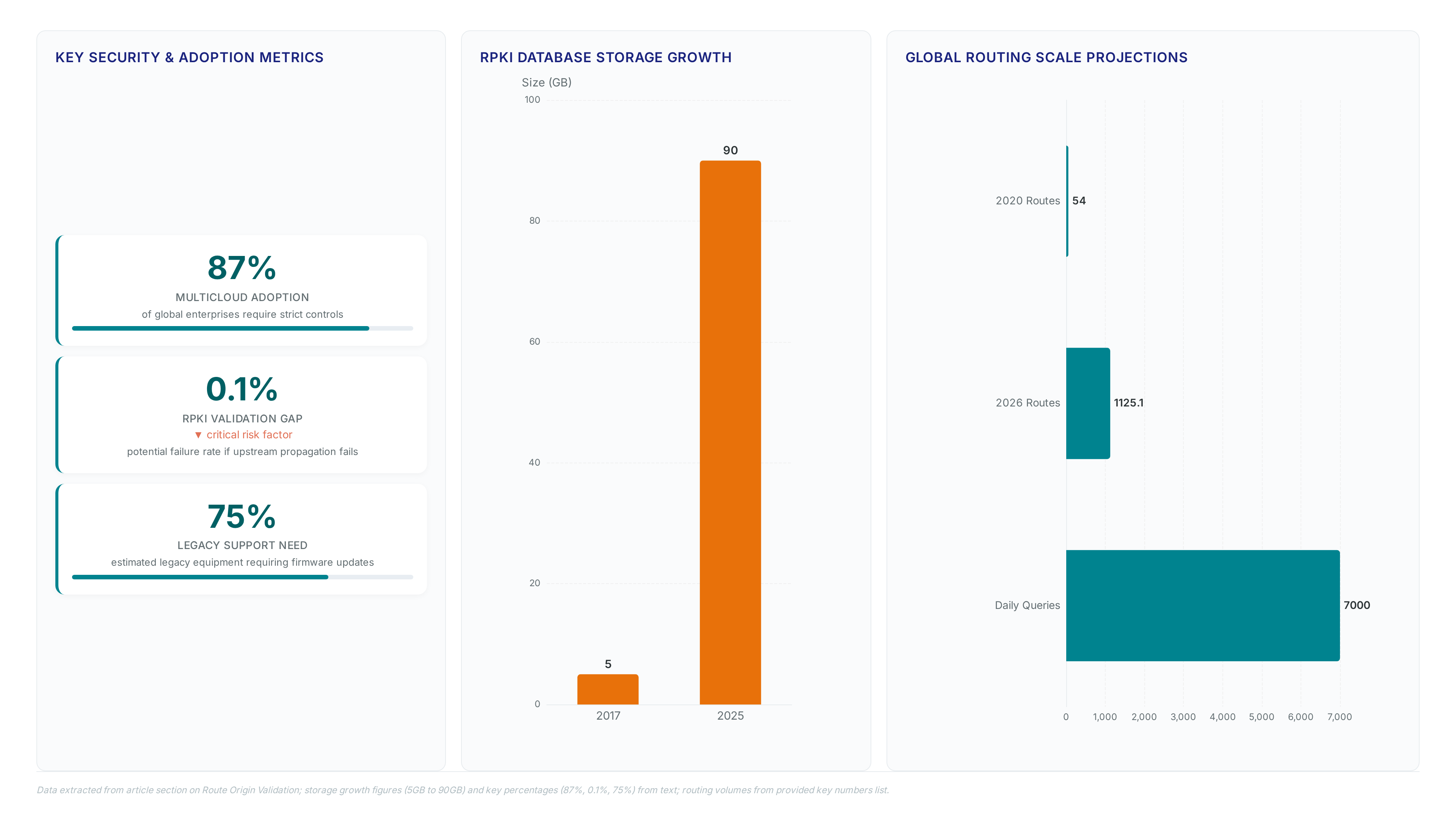
Connectivity in Bangladesh jumped from 0.1% in 2005 to exceeding 75%. The Bangladesh Network Operators Group coordinated this explosion while defining RPKI as the cryptographic framework binding IP address blocks to specific Autonomous Systems. Operators generate a Route Origin Authorization (ROA) to sign these bindings, allowing routers to reject unauthorized announcements. Without this signature, the AS path remains vulnerable to hijacks diverting traffic through unauthorized networks. Rapid deployment means many legacy configurations lack validation logic, exposing the expanding user base to interception risks. Implementing ROV requires updating filter policies on edge routers, a task complicated by heterogeneous hardware fleets across the country.
Global vendor consolidation among Cisco HPE, and Broadcom drives AI-focused features that often ignore legacy dual-stack nuances. Local engineers must script custom workarounds rather than rely on default firmware behaviors.
IPv4 allocation fees rise automatically upon LDC graduation in late 2026, forcing operators to absorb higher APNIC costs without warning. (APNIC's bangladeshs internet transformation from satellit...) Discussions at the Member Gathering highlighted specific anxieties regarding allocation sizes and the financial impact of losing least-developed-country status. Operators risk budget overruns if they fail to model these fee changes before the economic transition completes next year. Virtual training modules cannot replicate the urgency of face-to-face policy debates where network architects negotiate fee structures directly with resource managers. The cost is measurable: losing preferential rates increases operational expenditure for small ISPs disproportionately compared to large transit providers. In-person workshops allow stakeholders like the CTO of Link3 Technology to clarify exactly how new tiers affect national routing tables. Remote sessions often omit the detailed accounting details required for account operations during such regulatory shifts. Failure to attend physical gatherings leaves engineering teams unaware of impending fee changes until invoices arrive. Proactive engagement prevents surprise liquidity crunches when resource management policies tighten post-graduation.
Inside the Architecture of Route Origin Validation and DNS Security
RPKI and ROA Mechanics in BGP Security
Route Origin Validation stops hijacks by using cryptographic signatures to bind IP prefixes to specific AS numbers. BGP lacks native authentication, creating vulnerabilities that RPKI fixes by validating routing announcements before acceptance. Operators create a Route Origin Authorization by signing prefix-to-AS mappings in the RPKI database. Routers then check incoming updates against these signed records during the path selection process. The mechanism rejects any announcement where the origin AS does not match the signed ROA data.
| Feature | Traditional Filtering | RPKI Validation |
|---|---|---|
| Basis | Manual prefix lists | Cryptographic signatures |
| Maintenance | High human effort | Automated via RIR |
| Scope | Static entries | Flexible global state |
| Error Risk | High (typo prone) | Low (math verified) |
Creating valid records requires precise configuration of the AS path attributes in the local policy. The process involves generating keys, publishing objects, and enabling validation on edge routers. BGP-4 was introduced in 1994 to solve scaling issues but originally ignored security entirely. This historical gap means legacy equipment often needs firmware updates to support modern validation checks. The cost is measurable: operators must manage dual systems during the transition period. Global enterprises now operate in complex environments where 87% use multi-cloud setups requiring strict controls. However, validation fails if the upstream provider does not propagate RPKI data correctly. This dependency creates a single point of failure outside the local network boundary. Operators must verify that their transit partners support Route Selection Attributes like local preference alongside origin checks. Without this coordination, valid routes may get dropped due to misconfigured peer policies.
Deploying DNSSEC Signing in Bangladeshi Institutions
DNSSEC implementation at bdNOG 20 moved beyond theory into specific signing key rotations for local banks and ISPs. Operators generate a Zone Signing Key and a Key Signing Key to create a chain of trust extending from the root zone. The process requires publishing DS records in the parent zone to validate the cryptographic signatures attached to DNS responses. Without this step, resolvers cannot distinguish between legitimate data and spoofed answers injected during transit.
- Generate cryptographic keys using the `dnssec-keygen` utility with RSASHA256 algorithms.
- Sign the zone file to produce `. Signed` output containing RRSIG records.
- Publish the DS record hash to the domain registrar for inclusion in the parent zone.
4.
The Network and DNS Security workshop highlighted how trainers now disseminate these specific configurations to regional peers. Adoption remains partial because the cost of managing cryptographic lifecycles outweighs perceived threats for some administrators. Yet the trajectory points toward mandatory validation as global traffic volumes continue their steep upward climb.
Operational Checklist for Resolving BGP Routing Leaks
Immediate rejection of invalid AS paths stops revenue loss during primary circuit failures. Operators must first verify that BGP architecture distinguishes exterior gateway protocols from interior peers to prevent accidental redistribution. Manual prefix lists often fail against flexible leaks, whereas RPKI validates the origin cryptographically before acceptance. The cost is configuration complexity, as routers discard valid paths if local policy overrides cryptographic signals.
- Audit existing filters against known good prefixes to establish a baseline.
- Enable strict mode on edge routers to drop updates lacking valid signatures.
- Cross-reference AS path segments with upstream provider authorization lists.
- Monitor for sudden spikes in withdrawn routes indicating active remediation.
| Validation Method | False Positive Risk | Deployment Speed |
|---|---|---|
| Manual Prefix Lists | High | Fast |
| RPKI ROV | Low | Medium |
| Full BGPsec | None | Slow |
A systematic investigation by a retail platform proved that unresolved leaks cause outages during failover events. Ignoring these checks leaves networks exposed to hijacks that native protocol design cannot stop.
Defining RPKI Route Origin Confirmation and Dual-Stack Mechanics
Route Origin Authentication stops hijacks by matching announced prefixes to cryptographic signatures in the RPKI database. BGP lacks native authentication, leaving networks vulnerable until operators enable RPKI to validate routing announcements before acceptance. Dual-stack operation runs IPv4 and IPv6 simultaneously, requiring distinct address families within the same BGP architecture Engineers must configure routers to process both protocols without letting one dominate the path selection attributes. The limitation is that validation rejects valid paths if local policy overrides cryptographic signals during convergence.
- Create a Route Origin Authorization binding the prefix to the specific origin AS number.
- Configure the router to fetch validation data from trusted RPKI cache servers.
- Apply import policies that assign lower local preference to invalid routes.
- Monitor rejection logs to tune filters before enforcing hard drops on traffic.
Operators ignoring this step risk accepting fraudulent updates that bypass manual prefix lists. Global spending on data center infrastructure is projected to surpass hundreds of billions of dollars by 2032, making such security gaps financially unsustainable.
Resolving MikroTik Dual-Stack and RADIUS IPv6 Accounting Issues
Correcting MikroTik dual-stack faults requires enabling `ipv6 traffic-flow` before RADIUS can ingest byte counters. Operators frequently observe zero-byte reports because the router defaults to IPv4-only accounting streams during mixed-protocol sessions. The fix involves binding the RADIUS client to both address families explicitly within the `/radius` configuration menu. Without this binding, BGP architecture extensions for multiprotocol support fail to trigger accurate billing events on the ISP core. A secondary failure mode appears when bandwidth limits apply only to the IPv4 stack, leaving IPv6 tunnels unshaped. Engineers must define separate simple queues for each protocol version to prevent one stack from consuming the entire pipe. This split approach mirrors findings in a large enterprise case study where port conflicts arose from unmanaged protocol precedence.
- Enable `use-radius-ipv6=yes` in the PPP profile settings to force dual-stack accounting.
- Create distinct queue trees for IPv4 and IPv6 to manage throughput independently.
- Verify RADIUS packet reception using `/tool radius monitor` to confirm attribute arrival.
The limitation is that legacy RADIUS servers often reject IPv6 framed-IP attributes without schema updates. Neglecting this server-side adjustment causes session drops even when the router configuration appears syntactically correct.
Implementation: Validation Checklist for DNSSEC Deployment in Bangladeshi Institutions
Correct DNSSEC deployment starts with generating distinct Zone Signing Keys and Key Signing Keys using RSASHA256 algorithms. Operators must sign zone files to produce RRSIG records before publishing DS records to the parent registry for chain-of-trust validation. Skipping this step leaves resolvers unable to distinguish legitimate data from spoofed answers injected during transit. The limitation is that key rollovers often fail when automated scripts lack explicit timing buffers for signature expiration. Global infrastructure projects demonstrate that complex backends deploy quicker when teams prioritize standardized validation workflows over custom fixes. Teams achieving 80% faster deployment typically enforce strict pre-commit checks on cryptographic material. Bangladeshi institutions face similar pressure as broadband costs shift, with fixed wireless prices dropping by 50% while fiber expenses rise. This economic tension forces operators to balance security overhead against shrinking margins for manual intervention.
| Step | Action | Critical Field |
|---|---|---|
| 1 | Generate keys | `dnssec-keygen` |
| 2 | Sign zone | RRSIG records |
| 3 | Publish hash | DS record |
| 4 | Verify chain | Trust anchor |
Failure to align time sources renders even perfect cryptographic chains useless during resolver verification. Operators define value through community maturity rather than simple savings because progress is driven by people - engineers, operators, trainers, and community leaders - working together. The mechanism shifts focus from capital expenditure to preventing route hijacks that threaten national stability during LDC graduation. Evidence suggests 54% of Infrastructure leaders adopt new technologies specifically to cut costs, yet security adoption here targets long-term durability instead of short-term efficiency gains . The limitation is that measuring prevented incidents yields no direct revenue, making executive buy-in difficult without clear risk metrics.
Applying Vendor Environment Shifts to IPv6 Infrastructure Investment Decisions
Wi-Fi 7 shipments projected to reach tens of millions in 2025 create a narrow window for aligning IPv6 upgrades with hardware refresh cycles. The networking vendor environment evolves into a three-horse race among Cisco, HPE, and Broadcom driven by AI demands, forcing operators to choose vendors supporting dual-stack natively. Purchasing legacy gear now risks stranded assets as AI workloads require the throughput only modern silicon provides.
| Decision Factor | Legacy Hardware | Wi-Fi 7 / AI-Ready |
|---|---|---|
| IPv6 Path Selection | Software-dependent | Hardware-offloaded |
| RPKI Validation | CPU-intensive | Dedicated ASIC |
| Management Overhead | High (dual config) | Unified policy |
Operators asking whether to adopt RPKI now face a binary choice tied to this hardware shift. Newer platforms embed Route Origin Verification directly into the forwarding plane, whereas older boxes rely on control-plane processing that degrades performance under load. Delaying security implementation until after a refresh doubles labor costs because engineers must revisit configurations twice. The cost is measurable: teams skipping synchronized upgrades spend significantly more time troubleshooting inconsistent policy enforcement across mixed generations. Stranded inventory becomes the primary financial risk if IPv6 readiness lags behind wireless capacity expansions. This approach prevents the common failure mode where high-speed Wi-Fi 6E or 7 access points outpace the core router's ability to validate routes securely.
Comparing Immediate Security Training Costs Against Post-LDC Graduation Operational Risks
BdNOG 20 established that RPKI adoption now prevents route hijacks before LDC graduation removes regulatory shields. Operators face a choice between funding Train-the-Trainer pathways immediately or absorbing unplanned downtime costs later. Several fellows expressed interest in continuing their involvement, including potential participation in APNIC Train-the-Trainer pathways, which lowers the barrier for internal skill transfer. The mechanism relies on validating AS path attributes to reject unauthorized announcements before they propagate across peering sessions. Starlink's official licensing in the country in April 2025 under a 10-year term introduces new competitive pressure that demands higher network reliability standards. The limitation is that community-led agendas require sustained volunteer hours, which strains small ISP engineering teams already managing dual-stack migrations. InterLIR recommends timing these investments before late 2026 to avoid compliance gaps during the economic transition.
| Cost Factor | Immediate Training Investment | Post-Graduation Risk Exposure |
|---|---|---|
| Primary Expense | Fellowship stipends and travel | Emergency incident response teams |
| Operational Impact | Scheduled maintenance windows | Unplanned service outages |
| Skill Retention | High via peer-to-peer labs | Low due to staff turnover |
| Regulatory Alignment | Proactive compliance | Reactive penalty avoidance |
The trade-off involves diverting capital from hardware upgrades to human capital development during a tight fiscal year. Networks skipping this phase risk losing route origin integrity when global peers enforce stricter filtering policies.
About
Alexander Timokhin, CEO of InterLIR, brings necessary expertise to the discussion surrounding bdNOG 20 and Bangladesh's rapid digital expansion. As the leader of a specialized IPv4 address marketplace founded in Berlin, Timokhin understands the critical infrastructure challenges facing emerging internet economies. His daily work involves redistributing unused IPv4 resources to ensure network availability, a direct parallel to Bangladesh's transition from satellite reliance to reliable digital highways. Timokhin's background in IT infrastructure and international relations positions him to analyze how communities like bdNOG enable the technical cooperation necessary for such growth. Through InterLIR, he supports global IT development by providing the fundamental network resources that allow active communities in the Asia Pacific region to scale efficiently and securely as they approach substantial economic milestones.
Conclusion
Scaling community-driven security initiatives reveals a critical breaking point: volunteer bandwidth cannot sustain the rigorous validation cycles required by an 87% multi-cloud system once regulatory buffers vanish. The operational cost of delaying human capital investment now manifests as expensive, reactive incident response later, specifically when global peers begin dropping unverified prefixes without warning. Proactive skill transfer is the only viable buffer against this fragmentation, yet it demands a shift from ad-hoc workshops to structured, internal mentorship programs that survive staff turnover.
Organizations must commit to formalizing their Train-the-Trainer pipelines before the end of 2026 to align with the post-LDC graduation timeline. Waiting for hardware refreshes to solve routing integrity issues is a strategic error; the bottleneck is strictly human expertise, not throughput capacity. Start by auditing your current engineering team's RPKI competency levels against the APNIC framework this week, identifying exactly two senior engineers to enroll in the next certification cohort. This specific, low-overhead step creates the necessary internal redundancy before Starlink's market entry intensifies reliability expectations. Delaying this audit until the next fiscal planning cycle leaves your network exposed to preventable origin validation failures during the transition.
Frequently Asked Questions
MikroTik routers failed when RADIUS attributes clashed with IPv6 delegation. Resolving this required separating pools, a fix validated by the 90 workshop attendees who tested the solution.
The event certified 27 participants to replicate fixes across local ISP networks. These trainers now teach others to implement RPKI validation without needing external vendor escalation support.
Strict policies risk dropping legitimate traffic if upstream providers lack valid ROAs. This tension between security and availability delays adoption until peer networks synchronize their signing practices effectively.
Operators use a split border-core architecture where border routers handle validation. This segmentation maintains throughput under load despite core devices lacking full cryptographic validation at line rate.
Connectivity surged from 0.1% to over 75%, creating pressure for routing security. This rapid expansion exposed legacy configurations to hijacks, demanding immediate cryptographic binding of IP blocks.