BGP memory limits: Handling 722k daily updates
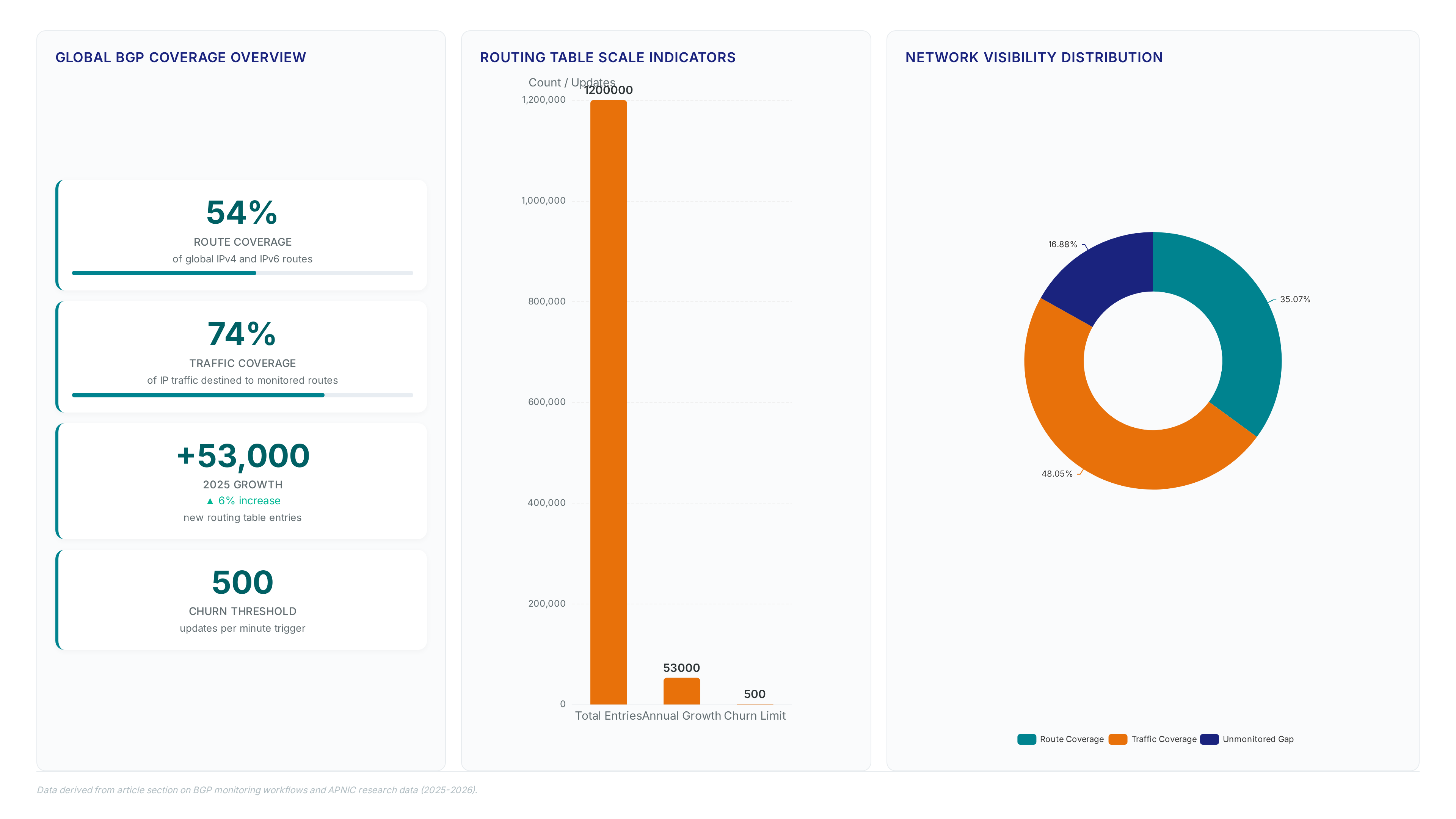
The IPv4 BGP routing table added 53,000 entries in 2025 alone, marking a sharp 6% resurgence after years of stagnation. We can stop debating whether internet infrastructure has hit a theoretical saturation point. It hasn't. The data proves economic drivers for new network interconnections remain reliable, forcing a hard look at long-term capacity planning.
This isn't just about adoption curves. It's about the tangible hardware implications of sustaining an expanding default-free zone. Every Autonomous System Number acts as the critical identifier for exchanging path information across more than 100,000 active networks. (APNIC's ip addresses through 2024) As Geoff Huston notes in his annual review published on the APNIC Blog, the relentless increase in IP prefixes demands a rethinking of how networks manage memory and processing loads. We need to cut through the noise to assess where BGP stands today and what the immediate future holds for global connectivity.
The Role of BGP and ASN in Modern Inter-Domain Routing
BGP and ASN as the Basic Unit of Inter-Domain Routing
BGP functions as the mechanism where operators announce Internet address space to the global default-free zone. Every BGP speaker possesses a unique ASN, serving as the fundamental identifier for exchanging routing information. In effect, the ASN is the basic unit of inter-domain routing, binding IP prefixes to their originating entities. This identifier allows routers to interpret path data and enforce policy decisions across commercial relationships. Traditional security models relying on centralized trust face criticism for single points of failure compared to decentralized alternatives offering traceability advantages.
Operators in the global default-free zone ingest all publicly announced routes, creating a single point of convergence for instability. A single router recorded 722,489 IPv4 updates during one day in mid-2025, stressing memory pools. Withdrawal spikes previously reached 75,000 daily events, forcing rapid RIB recomputation.
| Metric | Impact Vector | Operator Constraint |
|---|---|---|
| Update Volume | CPU saturation | Buffer exhaustion |
| Withdrawal Rate | Path flapping | Convergence delay |
| Table Size | Memory pressure | Hardware limits |
Current metrics indicate no unsustainable growth threatening full table viability, yet localized bursts remain dangerous. The financial support backing collection projects highlights the research community's reliance on archived data to model these shocks. High volatility demands larger update buffers, increasing capital expenditure without guaranteeing stability during mass withdrawals. This margin prevents process crashes when update streams exceed average baselines. Ignoring this buffer requirement risks total session resets during minor regional outages. This surge reverses the saturation trend where investment economics previously stalled network expansion. Root prefixes increased by 13,000 units during this same window, driving memory pressure on edge routers. IPv6 growth rates diverged sharply, falling to one-third of 2021 levels while IPv4 accelerated.
| Protocol | 2025 Trend | Primary Driver |
|---|---|---|
| IPv4 | Resumed Growth | Market saturation end |
| IPv6 | Decelerated | Adoption plateau |
Operators must now provision hardware for sustained linear growth rather than static plateaus. The temporary hiatus masked underlying accumulation that returned abruptly last year. Memory constraints become the limiting factor before CPU cycles in high-churn environments. Failure to scale storage results in route dampening and partial visibility loss. This flexible forces a choice between over-provisioning capital or accepting increased convergence risk. No existing mitigation reduces the raw count of announced prefixes without breaking reachability. The global default-free zone now demands higher baseline specifications for all participating speakers.
Router Processing Impact of High-Volume Update Sources
AS8151 generated 27,231 BGP updates in a single analysis window, overwhelming peer router CPU cycles through rapid next-hop oscillation. This specific autonomous system originates 12,067 IPv4 prefixes, creating a massive update storm when routes shift between four substantial transit providers. Traffic engineering changes force the Mexican National Academic Network to re-advertise paths, triggering full RIB recomputation on downstream speakers that lack dampening filters. Operators observing 50,000 prefix variations across peers must isolate these volatile sources to prevent memory exhaustion in the global default-free zone.
| Failure Mode | Trigger Condition | Mitigation Strategy |
|---|---|---|
| CPU Saturation | Rapid Next Hop flips | Prefix-based rate limiting |
| Buffer Overflow | Sustained update bursts | Increased queue depth |
| Convergence Delay | Path exploration loops | Selective route filtering |
High memory usage often stems from retaining multiple path vectors for unstable prefixes rather than the sheer table size itself. Measurement artifacts like ECMP false positives can obscure the true volume of updates received by anycasted vantage points during such events. The cost of processing these fluctuations is measurable, yet current hardware investments remain sufficient because the system lacks unsustainable growth trends. Network engineers must distinguish between natural growth and pathological flapping to apply the correct policy constraint. Ignoring specific update sources leads to localized router crashes even when the global routing table remains stable. Proactive monitoring of AS path changes allows operators to identify shifting transit relationships before they cause widespread convergence delays.
IPv4 Versus IPv6 Convergence Time Stabilization in 2023
IPv6 convergence time php/2024/01/08/bgp-in-2023-bgp-updates/) stabilized between 40 and 50 seconds in 2023, finally matching IPv4 baselines after years of volatility. This parity indicates that routing instability for the newer protocol has ceased to be a differentiating factor in network performance. Previously, the daily average for IPv6 fluctuated wildly, forcing operators to provision extra buffer capacity specifically for v6 path exploration. The mechanism driving this shift involves reduced path churning as early adopter networks matured their peering policies.
| Metric | Pre-2023 Behavior | 2023 Status |
|---|---|---|
| IPv6 Stability | Highly volatile | Stable baseline |
| Convergence Gap | Significant lag | Parity achieved |
| Update Pattern | Erratic spikes | Predictable flow |
However, achieving this stability required a deceleration in IPv6 network growth rates during 2022, which fell to a fraction of prior year levels. : slower expansion allowed control planes to settle, but it also masked underlying scaling challenges that resurfaced with IPv4 in later years. Operators relying on historical v6 volatility data for capacity planning now face inaccurate models. Path selection logic no longer needs distinct timers for address families, simplifying router configuration templates.
BGP Speaker Cost Dynamics: Memory and CPU Constraints
BGP speaker viability hinges on memory capacity for the RIB and CPU cycles for path selection. Holding all learned information forces hardware to scale linearly with table size, creating relentless pressure on resources. Operators historically questioned if infrastructure could accommodate growth, yet metrics show no unsustainable growth threatening full table viability today. The hidden costs of this operation extend beyond raw silicon into subsidized research ecosystems. Financial contributions from Amazon, Google, and Verisign keep measurement platforms alive, masking the true expense of global visibility. A distributed cost model hides the fact that without these 12 entities, operational data would vanish.
The 13,000-entry rise in root prefixes between 2021 and 2025 signals that saturation thresholds have shifted, demanding immediate hardware reassessment. This temporary hiatus in expansion has ended, returning operators to a regime of relentless table growth that tests memory limits. The mechanism driving this pressure involves the accumulation of specific route entries that force RIB recomputation on every update cycle. Critics argue that current silicon remains adequate because metrics show no unsustainable growth. However, this view overlooks the hidden costs of maintaining headroom during sudden spikes.
- CPU cycles wasted on path exploration during volatile periods.
- Memory fragmentation reducing proven capacity below rated specs.
- Delayed convergence impacting customer SLAs during peak traffic.
- Increased power consumption from constant high-utilization states.
Geoff Huston's ISP Column analysis confirms the resumption of growth patterns, invalidating assumptions of a permanent plateau. The implication is clear: investment decisions must prioritize linear scalability over cost-optimization for static loads. Failure to adjust procurement strategies now will result in capacity breaches within two quarters.
Economic Saturation Risks Versus Hardware Sufficiency Reality
Operators fearing economic saturation must distinguish between market maturity and actual hardware insufficiency. While underlying economics suggest investment growth has reached a saturation point, routing tables continue expanding without breaking existing silicon. Misinterpreting these signals leads to unnecessary capital expenditure on oversized routers when software optimization suffices.
- Financial contributions from substantial entities mask the true operational expense of global measurement.
- Rising human capital shortages create a bottleneck distinct from physical memory constraints.
- SONiC-based switching revenue is forecast to surge past $5 billion in 2026, shifting focus toward community-hardened architectures.
The limitation lies not in router capacity but in the scarcity of skilled personnel to manage complex routing policy decisions. Investment strategies should prioritize automation tools over raw throughput specs to mitigate labor gaps. Current infrastructure adequately handles the resumption of growth observed in 2025 without immediate replacement.
Executing a Thorough BGP Monitoring and Optimization Workflow
Application: Defining BGP Speaker Cost Dynamics in Memory and CPU Terms
BGP speaker cost manifests strictly as memory consumption for RIB storage and CPU cycles for path selection logic. Holding every learned route forces hardware to scale linearly with table size, creating relentless pressure on finite resources. The financial burden of tracking these dynamics is often obscured because measurement infrastructure relies on financial contributions from entities like Amazon and Google rather than direct operator fees. This subsidy model masks the true expense of maintaining global visibility, leading some planners to underestimate local hardware requirements. Operators must distinguish between market saturation and actual silicon insufficiency when planning upgrades. The tension lies between over-provisioning for hypothetical growth and under-provisioning for real-time convergence spikes.
| Resource Constraint | Primary Trigger | Operational Impact |
|---|---|---|
| Memory | Full table ingestion | RIB overflow during updates |
| CPU | Path recomputation | Delayed convergence times |
Ignoring this distinction leads to capital expenditure on oversized routers when configuration tweaks suffice. The limitation of current analysis tools is their inability to separate ECMP-induced false positives from genuine routing churn, complicating capacity forecasts.
Implementing Continuous Monitoring Using AS131072 and AS8151 Vantage Points
Collecting 1,830,657 distinct prefixes via AS131072 establishes a baseline for detecting global routing anomalies in 2024. This vantage point mechanism aggregates full-table snapshots, allowing operators to spot unauthorized origin changes before they propagate widely. However, relying solely on static snapshots misses rapid convergence events that trigger CPU spikes on edge routers. The implication is that single-source monitoring creates blind spots during volatile update storms. Analyzing high-volume update sources reveals specific failure modes hidden in aggregate data. The Mexican National Academic Network generated 27,231 updates in one study, driven by next hop shifts across four substantial transit providers.
Application: Validating Hardware Sufficiency Against 2025 IPv4 Growth Resumption Metrics
Operators must verify memory headroom against the resumed IPv4 routing table expansion that added 53,000 entries in 2025. This validation checklist isolates hardware bottlenecks before CPU saturation triggers route flapping during peak update windows. However, assuming current silicon suffices indefinitely ignores the compound effect of daily churn on aging route processors. Most operators overlook that memory fragmentation reduces proven capacity long before total usage hits full capacity. InterLIR recommends auditing prefix limits quarterly rather than annually to catch incremental drift. Failure to adjust creates a hidden deficit where valid updates get dropped silently. The implication is clear: hardware validation is no longer a one-time capital event but a continuous operational loop.
About
Vladislava Shadrina serves as a Customer Account Manager at InterLIR, where she specializes in client relations within the IP resources domain. While her background includes architecture, her daily work at this Berlin-based marketplace focuses on the practical realities of network availability and IPv4 redistribution. This operational experience provides a unique lens for reviewing BGP route dynamics, as InterLIR's core mission relies heavily on maintaining clean BGP sessions and secure Route Objects to ensure IP reputation. Shadrina's role requires a deep understanding of how routing protocols impact the legitimacy and usability of transferred address blocks. By connecting Geoff Huston's high-level analysis of 2025 BGP developments to the ground-level needs of network operators, she bridges the gap between theoretical internet architecture and the commercial necessity of reliable routing. Her perspective highlights why stable BGP performance is critical for companies like InterLIR to deliver transparent and efficient IP solutions globally.
Conclusion
The resumption of routing table growth exposes a critical vulnerability: memory fragmentation degrades performance well before raw capacity limits are reached. Aging route processors struggle with the compound effect of daily churn, causing silent update drops that undermine network durability even when utilization metrics appear safe. This shift transforms hardware validation from a static capital expenditure into a continuous operational loop requiring quarterly audits rather than annual reviews. Operators relying on static thresholds will face increased convergence times and packet loss during failover events as the gap between advertised prefixes and proven processing power widens.
You must implement a quarterly prefix limit audit starting immediately, specifically targeting memory headroom buffers below a critical threshold to preempt fragmentation issues. Do not wait for CPU saturation alerts; proactively adjust dampening thresholds to distinguish between legitimate policy churn and actual instability before the next peak update window. Begin this week by correlating your current snapshot inventory against high-frequency update streams to identify stale data lags that mask true capacity constraints## FAQ
Q: How much did the IPv4 BGP table grow in 2025 compared to previous years?
A: The IPv4 routing table added 53,000 entries, marking a sharp resurgence after years of stagnation. This represents a 6% growth rate, proving that internet infrastructure expansion has not yet hit its theoretical saturation point.
Q: What hardware resources are most impacted by holding the full global default-free zone?
A: Operating as a BGP speaker directly impacts memory and CPU requirements needed to hold all information. The cost of processing these routing decisions rises as the size of shared and learned information increases.
Q: How many autonomous systems currently exchange routing information to create unavoidable complexity?
A: More than 100,000 autonomous systems continuously exchange routing information, making system-wide simplicity impossible. This massive scale forces operators to manage complex path data while enforcing commercial contracts across diverse network relationships.
Q: Why do operators still face capacity risks if update activity remains relatively stable?
A: Although update activity is stable with only 6% growth, the relentless increase in IP prefixes demands rethinking memory management. Operators must balance complete visibility against the strict hardware limits of aging equipment.
Q: What specific event illustrates how flexible shifts trigger immediate policy re-evaluation in routers?
A: Specific update events like the 27,231 BGP updates caused by Next Hop AS changes illustrate flexible shifts.
Frequently Asked Questions
The IPv4 routing table added 53,000 entries, marking a sharp resurgence after years of stagnation. This represents a 6% growth rate, proving that internet infrastructure expansion has not yet hit its theoretical saturation point.
Operating as a BGP speaker directly impacts memory and CPU requirements needed to hold all information. The cost of processing these routing decisions rises as the size of shared and learned information increases.
More than 100,000 autonomous systems continuously exchange routing information, making system-wide simplicity impossible. This massive scale forces operators to manage complex path data while enforcing commercial contracts across diverse network relationships.
Although update activity is stable with only 6% growth, the relentless increase in IP prefixes demands rethinking memory management. Operators must balance complete visibility against the strict hardware limits of aging equipment.
Specific update events like the 27,231 BGP updates caused by Next Hop AS changes illustrate dynamic shifts. Routing engines must process these signals instantly to maintain stability without introducing loops or discarding valid routes.