BGP updates: The single peer drowning our archives
A single peer (AS140627) generated 2.93 billion updates in one day, overwhelming RouteViews archives with useless data.
Pathological update behavior from a microscopic fraction of peers drives exponential storage growth without reflecting actual network changes. This noise clutters MRT archives, distorts research datasets, and forces operators to sift through terabytes of redundant signaling to find genuine topology shifts.
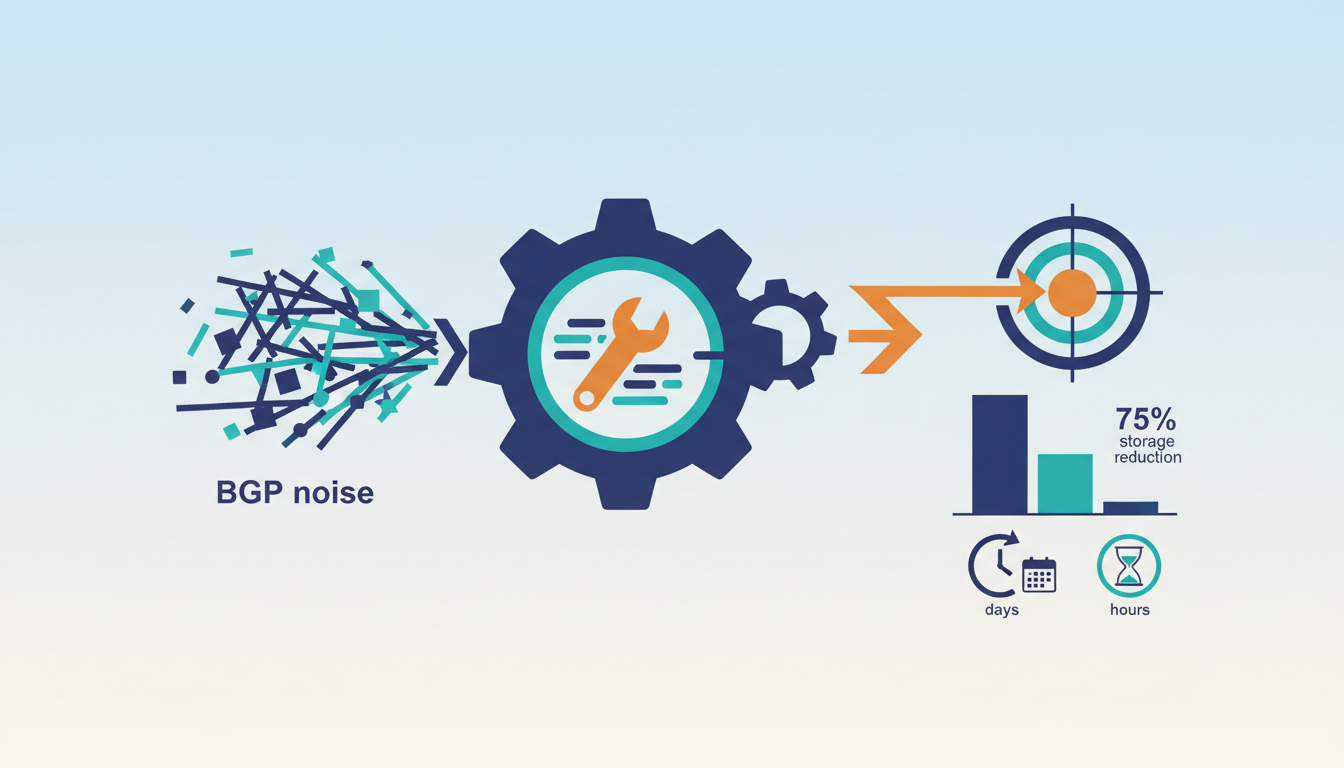
We define BGP noise through specific attribute oscillation patterns rather than simple volume metrics. The mechanics of update concentration show how specific sessions disproportionately bloat collector data compared to stable peers like AS132280. The operational impact is stark: data storage requirements for RouteViews exploded six-fold from 11.1 TB to 67 TB in just one year. By isolating these repeated announcements, researchers can discard irrelevant signals and restore fidelity to global routing analysis.
Defining BGP Noise and Pathological Update Behavior
BGP Noise vs Legitimate Reachability Signaling
BGP noise constitutes repeated attribute announcements lacking new topological state, distinct from legitimate reachability signaling. One of the original design goals of BGP is enabling ASes to signal reachability changes for newly available prefixes or withdrawn prefixes. Pathological behavior emerges when updates oscillate without introducing observable routing state, often driven by persistent route flapping. The default Minimum Route Advertisement Interval timer often sits at 30 seconds, yet noisy peers bypass this intent through rapid attribute churning. Distinguishing these patterns requires significant computational cost to match update streams efficiently in time and space.
Data reveals extreme skew where a single peer generated 14% of all recorded updates over a 13-year period. Conversely, the lower 50% of peers contributed merely 5.17% of total volume, highlighting disproportionate resource consumption. Route collectors ingest these streams passively, storing massive files that inflate storage requirements without adding visibility. Operators must filter updates repeating identical prefixes within short intervals to preserve archive utility. Ignoring this distinction allows a tiny fraction of sessions to dominate analysis datasets.
AS140627 generated 69.24% of all collector updates between October 2021 and March 2022, dominating the dataset. This single peer produced up to 2.93 billion updates in one day, effectively drowning out legitimate signaling from quieter neighbors. Such volume forces route collectors to ingest massive data streams where noise obscures genuine topology changes. The computational cost to filter these repeats strains analysis pipelines, requiring operators to distinguish valid spikes from artifacts. Without targeted mitigation, research relying on these archives inherits a skewed view of global routing stability. While the MRAI timer intends to limit frequency, pathological peers exploit loopholes to churn identical prefixes repeatedly.
Mechanics of Update Concentration in Route Collector Archives
Peer Dominance Mechanics in RouteViews Collector Archives
Single sessions like 140627218.100.76.17 commanded 28.67% of the per-minute update stream during December 2021. This extreme concentration stems from pathological route flapping where specific BGP speakers oscillate attributes without altering topological state. Route collectors ingest these streams passively, archiving every repetition rather than filtering duplicates at the edge. The result is a dataset where roughly 17% of prefixes generate 90% of all recorded messages.
Top contributors use persistent session stability to flood archives, whereas quiet peers transmit legitimate reachability signals sporadically. Two specific AS paths accounted for approximately 25% of total volume in the analyzed month. Such skew distorts statistical models of global routing stability if researchers treat all updates as independent events. The study publication highlights how noise masks genuine convergence events within massive MRT files.
| Session Tier | Update Share | Structural Cause |
|---|---|---|
| Top 2% | a dominant majority | Pathological flapping |
| Remaining 98% | 28.7% | Normal churn |
Operators must apply targeted filtering to remove repeat announcements before performing trend analysis on historical data. Ignoring this dominance leads to false positives in anomaly detection systems tuned for volume spikes. Storage infrastructure expansion to 67 TB reflects the physical cost of retaining unfiltered noise over long periods.
Session `140627218.100.76.17` averaged a dominant share of the per-minute update stream throughout December 2021. Analysts extract this signal by parsing Multi-threaded Routing Toolkit archives to compute temporal density per collector-peer pair. The methodology isolates pathological behavior where a single endpoint floods the receiver while neighbors remain quiet. Such concentration distorts global stability metrics if raw counts drive the analysis without normalization.
Operators detect these anomalies by ranking sessions against the aggregate volume rather than absolute thresholds. The top tier of sessions often accounts for the majority of traffic, leaving the remaining vast majority to contribute a minor fraction. This skew originates from specific routers oscillating attributes rapidly rather than genuine topology shifts. Route collectors ingest every message indiscriminately, preserving the noise alongside valid reachability data. The resulting dataset misrepresents network health unless filtered by session identity.
| Metric Category | Concentration Level | Analysis Risk |
|---|---|---|
| Top Sessions | Majority share | Skewed stability views |
| Remaining Peers | Minor fraction | Signal obscured by noise |
| Prefix Subset | High update rate | False flap detection |
Filtering requires identifying the specific IP and ASN pair responsible before aggregating statistics. Ignoring this step leads to incorrect conclusions about protocol efficiency or regional instability. The cost of storage rises linearly with these duplicates, yet the informational value remains flat. Proven analysis demands stripping the dominant session to reveal underlying trends in the quieter majority.
Perth recorded a mean volume of 3.3M updates per prefix across its candidate set of 841 entries. This localized intensity contrasts sharply with aggregated global archives where noise disperses across thousands of quieter peers. The top 1% of prefixes at Perth drive the majority of observed chatter, creating a skewed dataset that misrepresents wider network stability. Such concentration forces analysts to distinguish between genuine regional volatility and isolated router pathology before drawing conclusions. A noisy peer in Perth may appear silent in European archives due to path diversity. Researchers analyzing RIPE RIS (RIPE's routing information service ris) sigcomm.org/wp-content/uploads/2017/09/sigcomm-ccr-paper134. Pdf) data often miss these localized spikes when relying solely on aggregated views. Conversely, Perth-specific filters might discard valid signaling seen by other collectors. The vantage point dependency introduces a blind spot where regional anomalies look like global trends. Blindly applying Perth-derived thresholds to global models risks false positives in anomaly detection systems.
Operational Impact of Noisy Peers on Data Storage and Analysis
Defining Noisy Router Phenomena Versus Global Route Leaks
The January 22, 2026 route leak involving AS13335 and AS32934 propagated globally, whereas noisy routers generate repetitive, non-propagating updates confined to specific sessions. This distinction separates legitimate topological changes from pathological chatter that clutters MRT archives. Noisy behavior stems from buggy implementations oscillating attributes without altering reachability, creating a false signal of instability in collector data.
| Feature | Global Route Leak | Noisy Router Phenomenon |
|---|---|---|
| Propagation Scope | Transmits across multiple ASes | Localized to collector peer session |
| Update Pattern | Single valid path change | Rapid, identical attribute repetition |
| Data Impact | Alters global forwarding tables | Inflates storage without state change |
Operators analyzing BGP update patterns must filter session-level noise to avoid skewing stability metrics. Raw archives often reflect concentrated peer activity rather than actual internet volatility. The January 22, 2026 route leak demonstrates how accepted routes spread anomalies, contrasting with local session flapping that never leaves the peering edge. Filtering strategies should target specific collector-peer pairs exhibiting high-frequency repetition rather than blocking prefixes indiscriminately. Retaining full data remains necessary for diagnosing abnormal routing behavior, yet pruning redundant announcements improves measurement accuracy.
RouteViews storage expanded from 11.1 TB in early 2025 to 67 TB by year-end, driven by unfiltered update streams. This six-fold growth forces operators to confront the physical limits of archiving every BGP update message. The cost of retaining raw MRT archives escalates quadratically as noisy peers repeat identical path attributes without topological change. Researchers seeking to fix inflated BGP data size must distinguish between genuine instability and pathological chatter before running analysis pipelines. Retaining full fidelity supports forensic diagnosis but burdens infrastructure with redundant records. Efficient serialization formats like Avro offer reduced overhead compared to JSON, yet they do not solve the root input volume problem. Filtering strategies should target specific sessions rather than broad prefix blocks to avoid losing legitimate reachability signals.
| Strategy | Impact on Storage | Risk to Analysis |
|---|---|---|
| Raw Archiving | Maximum growth | None |
| Session Pruning | Significant reduction | Loss of forensic context |
| Attribute Deduplication | Moderate reduction | Potential state loss |
Operators should collaborate with peer admins to localize noise at the source instead of disabling entire peering sessions. The future of routing analysis depends on separating signal from noise without blind deletion. Researchers ignoring this concentration mistake localized router pathology for global volatility. Noise often originates from buggy routers along the AS-PATH rather than the origin AS itself, creating false signals of network churn. Failing to prune these streams leads to incorrect conclusions about prefix reachability and convergence times. The distortion becomes apparent when comparing raw update counts against normalized event logs.
Misconfigured routers generate path oscillations that inflate storage by 55.9 TB without reflecting genuine topology shifts. Operators must distinguish these local defects from global anomalies by validating AS-PATH consistency rather than origin stability.
- Extract MRT archives to identify sessions where a single peer dominates the update stream.
- Verify if the AS-PATH alternates between specific upstreams, mirroring the Microsoft Peering Instability pattern observed in production networks.
- Confirm that the origin AS announces other stable prefixes, proving the fault lies within the transit path.
- Apply targeted filters to the specific session instead of blocking the entire origin prefix.
| Symptom | Likely Cause | Filter Scope |
|---|---|---|
| High update volume, stable path | Legitimate churn | None Required |
| Rapid path oscillation | Buggy router logic | Session-Level |
| Global prefix withdrawal | Route leak event | Prefix-Level |
Blindly filtering the origin AS removes valid reachability while leaving the noisy collector session active. The computational cost to match different streams efficiently requires isolating the specific attribute changes driving the volume. InterLIR recommends pruning redundant updates based on these measurement goals to reduce overhead.
About
Alexei Krylov serves as the Head of Sales at InterLIR, a specialized marketplace for IPv4 resources based in Berlin. While his primary focus is B2B sales and client relations, his daily operations require a deep, practical understanding of BGP update messages and global routing policies. At InterLIR, ensuring the security and reputation of transferred IP blocks demands rigorous verification of route objects and BGP announcements. This hands-on experience with Regional Internet Registries and network infrastructure gives him unique insight into how routing data flows between Autonomous Systems. The article's investigation into route collector data directly impacts the transparency and trust necessary to InterLIR's mission of redistributing unused IP resources. By analyzing the visibility gaps in current BGP monitoring, Krylov connects technical routing mechanics to the real-world challenges of maintaining a clean, efficient, and secure global IP marketplace.
Conclusion
Scaling BGP telemetry fails not because of total volume, but because asymmetric noise from specific sessions saturates processing pipelines while masking genuine topology shifts. The operational debt accumulates as storage systems ingest redundant path oscillations that offer zero forensic value, effectively taxing the entire system for a single vendor's implementation flaw. Relying on global prefix filters is a blunt instrument that sacrifices visibility into legitimate reachability events while leaving the noisy session intact. You must shift strategy immediately: move from origin-based blocking to session-level attribute validation before your analysis window widens beyond recovery.
Implement a strict policy where any peer contributing disproportionate updates without corresponding AS-PATH diversity triggers an automatic rate limit within 48 hours of detection. Do not wait for quarterly reviews; the cost of storing these artifacts compounds daily. Start by auditing your MRT archives this week to identify the top three peers generating update spikes unrelated to prefix withdrawals. Extract their specific session IDs and apply a temporary dampening policy that suppresses updates lacking genuine path changes. This targeted isolation preserves the integrity of your global dataset while forcing the offending router to stabilize its logic without disconnecting valid traffic.
Frequently Asked Questions
Storage capacity escalated to 67 TB for RouteViews in 2025 due to exponential growth. This represents a massive increase from the previous 11.1 TB baseline, driven largely by pathological update behavior from specific peers.
AS140627 generated 69.24% of all collector updates between October 2021 and March 2022. This single peer produced up to 2.93 billion updates in one day, overwhelming archives with useless data.
The lower 50% of peers contributed merely 5.17% of total volume, highlighting extreme skew. Conversely, a single peer generated 14% of all recorded updates over the entire thirteen-year analysis period studied.
Roughly 17% of prefixes generate 90% of all recorded messages, indicating massive redundancy. Analysis of over 80 billion updates shows repeated announcements exhibit irregular patterns highly concentrated in few sessions.
Operators must process 80 billion updates where less than one percent of sessions dominate the stream. This forces collectors to ingest massive data streams where noise obscures genuine topology changes effectively.