Capacity reservations kill five-minute scaling lag
Reserving capacity kills the five-minute scaling lag that crashes trading platforms during sharp traffic surges. We built cross-account automation on the ELBV2 API, managed via AWS Organizations, to coordinate hundreds of Application Load Balancers at once. This isn't theory; it's operational ROI. Tagging-based fleet management prevents human error while optimizing costs through precise pre-warming and post-event reset cycles.
We rely on AWS CloudFormation templates from the public GitHub repository. This replaces clumsy manual clicks with scalable logic that finds resources by specific tags. The solution plugs the critical gap where traffic doubles before Elastic Load Balancing reacts organically-a delay that kills ticket sales platforms and product launches. Automated controls ensure your ALB infrastructure absorbs immediate spikes without bleeding cash on over-provisioning during quiet periods.
Theoretical durability means nothing without execution speed. Amazon Web Services data confirms organic scaling handles standard variance, but anticipated volatility demands pre-emptive capacity locking. This methodology turns capacity provisioning from a reactive panic into a scheduled, cost-effective routine. It secures the entry point for external and internal traffic flows.
The Strategic Role of LCU Reservations in Modern Cloud Infrastructure
Defining LCU Dimensions and Provisioned Capacity Thresholds
One Load Balancer Capacity Unit equals the hourly maximum of 25 new connections per second, 3,000 active connections, or 1 GB of processed data. This metric sets the baseline floor for sharp traffic increase preparation, not a hard ceiling. Provisioned capacity guarantees a minimum so the Application Load Balancer absorbs sudden spikes without dropping packets during the initial scaling lag. Standard auto-scaling reacts to metrics after the damage starts. Reservations pre-allocate resources before the surge hits.
Operators trigger reservations when anticipating volume doubling in under five minutes. The reservation impact on ALB remains limited to the minimum floor. Organic scaling occurs above the reserved level if traffic exceeds expectations. This distinction prevents over-provisioning costs while eliminating cold-start latency. Variable usage costs sit at $0.008 per LCUhour above the fixed $0.0225 hourly base rat. Failing to reserve ca er second, 3,000 active connections, or 1 GB of processed data. This metric defines at $0.0225 hourly base rate. Failing to reserve capacit gger Time Action : : : Discovery Tminus 4 hours Scan accounts for tagged ALBs Activatio ounts for tagged ALBs Activation Tminus 1 hour Apply reserved capacity values Reset Po milliseconds of jitter that financial trading platforms cannot tolerate. Paying for idle capacity during off-peak windows guarantees performance during critical events. Market open at 9:00 AM and close at 4:00 PM create two daily spikes requiring proactive capacity management. Financial services operators deploy 3 EventBridge Schedulers alongside 2 Lambda Functions to automate this LCU Reservation workflow across multi-account environments. This architecture scans for specific tags to identify targets. Manual errors disappear during high-stakes trading windows. The shift from reactive auto-scaling to proactive capacity management guarantees bandwidth before traffic doubles in under five minutes.
Meanwhile, operators pay only for reserved units plus excess usage. Surprise costs vanish while securing cost optimization via reservation Strict tag governance forms the limitation. Missing the `LCU-SET` value on any load balancer leaves it vulnerable to organic scaling latency. Standard rates apply normally. The reserved floor ensures stability during Monday reopenings when volume surges exceed normal baselines. Failure to reset capacity post-event wastes budget on unused guaranteed throughput. This approach supports disaster recovery optimization by maintaining ready capacity in secondary regions without full-time expenditure. Increased operational complexity arises when managing tag consistency across hundreds of accounts. Financial predictability emerges when fixed reservation costs undercut variable on-demand rates during sustained high utilization. Operators adopting a Pilot Light Pure on-demand scaling suits unpredictable bursts. Reserved capacity guarantees throughput without provisioning latency. This flat fee becomes negligible when Gateway Load Balancer architectures require consistent throughput across multiple availability zones. Reserving capacity for idle periods wastes capital if actual traffic remains below the committed floor. Reservations increase spend when organic scaling would have sufficed for minor fluctuations.
Inside the Architecture of Cross-Account ALB Automation Systems
Cross-account ALB management fails without explicit IAM trust relationships linking the management account to member resources. The architecture deploys two AWS Lambda functions that apply AWS Security Token Service (AWS STS) Assume Role operations to traverse account boundaries. This mechanism requires every member account to host a role permitting `elasticloadbalancing:ModifyCapacityReservation` actions while trusting the central executor. A common failure mode involves omitting the `sts:ExternalId` condition, leaving the deployment vulnerable to the confused deputy problem during metadata scanning. Centralized control simplifies operations but introduces a single point of configuration error; one malformed policy blocks capacity updates across the entire organization. The security model shifts from distributed manual edits to a centralized code-set perimeter.
| Component | Function | Access Method |
|---|---|---|
| Management Account | Orchestrates scans | Native permissions |
| Member Account | Hosts ALBs | STS Assume Role |
| DynamoDB | Stores metadata | Cross-account write |
Operational complexity grows as organizations expand beyond simple hierarchies into nested organizational units. The shift toward flexible credit systems like the $200 entry-level model encourages experimentation with multi-account topologies that demand rigorous access controls. Security teams often resist broad trust policies, creating friction between automation speed and governance requirements. Recent expansions of reservation capabilities to security-focused load balancing further complicate these trust matrices by adding firewall appliances to the automation scope. The trade-off is increased policy maintenance overhead for every new account onboarded to the system.
EventBridge Scheduler Triggers for Lambda-Based Capacity Updates
Amazon EventBridge Schedulers initiate the MetadataCollectorFunction hours before peak windows to scan member accounts for ALBs tagged with ALB-LCU-R-SCHEDULE. This first workflow aggregates ARNs and target LCU values into a central DynamoDB table, creating a single source of truth for the subsequent update phase. The second scheduled trigger activates the LCUModificationFunction, which reads this inventory and executes the `modify-capacity-reservation` API call against each identified load balancer. Distributing reserved capacity across Availability Zones triggers an internal rebalancing status that temporarily stalls new connection acceptance while the fleet redistributes resources.
Scanning functions ignore untagged resources, requiring the ALB-LCU-R-SCHEDULE key to trigger metadata collection. Stock trading firms using complex multi-account structures must propagate these tags consistently to avoid silent discovery failures. The automation logic explicitly filters for the value `Yes`, leaving any ALB without this specific marker outside the reservation window. Operators often misconfigure tag inheritance across organizational units, causing the central scanner to miss critical assets during market open.
| Tag Key | Required Value | Function |
|---|---|---|
| ALB-LCU-R-SCHEDULE | Yes | Identifies target for scan |
| LCU-SET | Integer | Defines reserved capacity |
Missing tags result in zero reserved capacity, forcing reliance on standard auto-scaling which may lag behind sudden volume spikes. This gap exposes platforms to latency during regulatory-mandated trading windows where performance SLAs are strict. Teams adopting Express Mode solutions might assume automatic provisioning covers these custom reservation needs, yet manual tagging remains mandatory for this specific workflow. Shifting free tier models do not apply to reserved capacity billing, making accurate identification financially.
LCU Reservation Mechanics for Application Load Balancer Capacity Control
The 100 LCU minimum threshold establishes a guaranteed capacity floor distinct from reactive auto-scaling behaviors. Prior to 2024, infrastructure relied solely on automatic scaling based on detected workloads, often introducing latency before sufficient resources became available during sudden spikes. This legacy approach fails when traffic volumes more than double in under five minutes, a common occurrence at market open. The industry now shifts toward proactive capacity management Operators configure this static minimum to handle sharp traffic increases without dropping connections while retaining auto-scaling for peaks above the reserve.
| Mode | Trigger Mechanism | Latency Risk |
|---|---|---|
| Reactive Auto-scaling | Metric threshold breach | High during cold start |
| Reserved Capacity | Time-based schedule | None (pre-provisioned) |
Setting a reservation locks billing at the fixed hourly rate regardless of actual utilization below the floor. The cost implication remains constant even if trading volume stalls unexpectedly after the 9:00 AM spike. Over-provisioning wastes capital, yet under-provisioning risks packet loss during order bursts. Financial firms must balance guaranteed throughput against idle capacity costs. Monday market open surges demand pre-warmed capacity because organic scaling cannot absorb weekend-backlog traffic fast enough. Manual LCU provisioning fails when traders flood systems at 9:00 AM, often leaving portfolios inaccessible during critical windows. Automated strategies shift operations from reactive auto-scaling to proactive capacity stewardship. This approach mirrors cost optimization via reservation Operators should reserve Load Balancer Capacity Units whenever anticipated spikes exceed double normal volume in under five minutes. The 9:00 AM trigger activates reservations across tagged ALBs in member accounts, ensuring the 100 LCU minimum floor exists prior to market bell.
| Strategy | Reaction Time | Risk Profile |
|---|---|---|
| Manual Provisioning | Hours | High failure chance |
| Organic Auto-Scaling | Minutes | Latency during spike |
| Automated Pre-Warm | Seconds | Guaranteed capacity |
Product launch scenarios similarly apply Capacity Unit reservations to pre-scale above calculated requirements, avoiding the latency inherent in organic growth. The limitation remains strict: reservations apply only to tagged resources, so missing the ALB-LCU-R-SCHEDULE marker leaves an ALB vulnerable.
Manual LCU provisioning across hundreds of accounts fails when operators miss the 9:00 AM spike due to tagging errors. Human oversight in applying the `ALB-LCU-R-SCHEDULE` tag leaves critical trading engines exposed during weekend backlogs. This reliance on manual entry contradicts the industry shift toward Express Mode Without automated tagging, a single missed Application Load Balancer creates a bottleneck that reactive scaling cannot resolve within five minutes. The financial impact extends beyond downtime, as unreserved capacity forces reliance on variable rates rather than fixed commitments. Unlike A10 Networks, which shifts peak bandwidth risk to customers via licensing, AWS allows flexible adjustment but penalizes unpreparedness with latency. Operators managing multi-account environments face compounded risks when tag inheritance breaks across organizational units.
| Failure Mode | Trigger Condition | Consequence |
|---|---|---|
| Silent Discovery | Missing `Yes` value | Scanner ignores asset |
| Timing Drift | Manual scheduling | Capacity arrives late |
| Inconsistent Tags | OU policy gaps | Partial fleet protection |
The cost of manual intervention grows linearly with account count, whereas automated systems maintain constant operational overhead.
Deploying Centralized LCU Management via CloudFormation and Tagging Strategies
Mandatory Tagging Keys for ALB Automation Scope
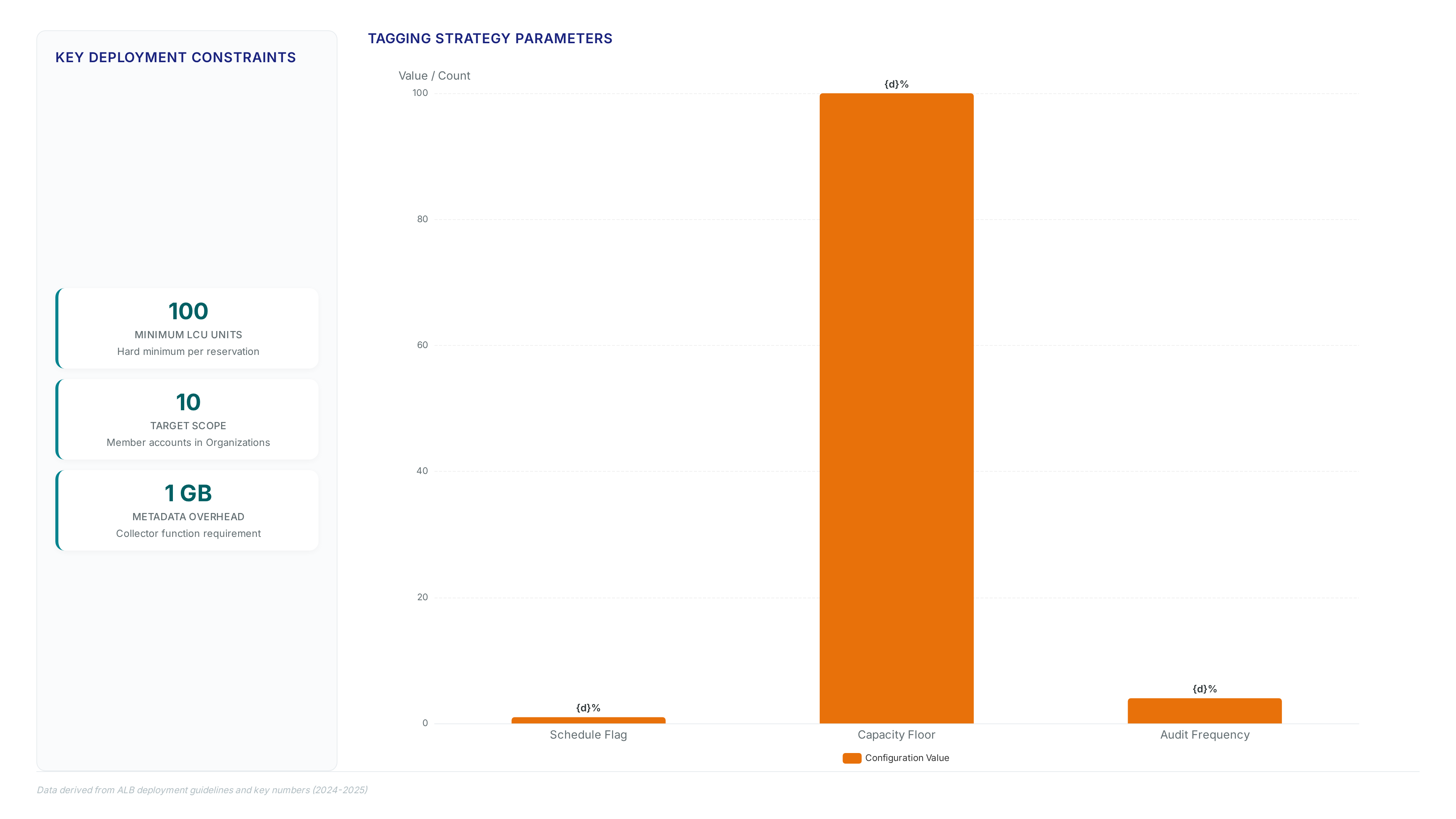
Applying the ALB-LCU-R-SCHEDULE tag with value `Yes` explicitly flags an Application Load Balancer for automated pre-warming scans.
- Assign ALB-LCU-R-SCHEDULE equal to `Yes` on every target ALB to trigger the metadata collector function.
- Define the LCU-SET tag with an integer value, respecting the hard minimum of 100 units per reservation.
- Verify tag propagation across all member accounts within Organizations to prevent silent discovery failures during market open.
Missing either key excludes the load balancer from the reservation window, leaving it vulnerable to latency spikes. The LCU-SET value dictates the guaranteed floor, shifting operations from reactive scaling to proactive capacity supervision Unlike models charging for peak bandwidth regardless of use, this approach aligns costs with actual consumption models Operators must calculate dimensions carefully, as ALBs track complex connection states unlike the throughput-focused NLB metric dimensions Inconsistent tagging creates a fragmented defense where some assets scale while others stall. InterLIR recommends auditing tag inheritance policies quarterly to maintain coverage across flexible environments.
Deploying CloudFormation Stacks with IAM Resource Acknowledgement
Deploying the `ALBCapacityAutomationMgmtAccount. Yaml` template fails immediately unless operators explicitly acknowledge [IAM](https://docs.aws.amazon.com/AWSCloudFormation/latest/TemplateReference/aws-resource-elasticloadbalancingv2-loadbalancer.) resource creation with custom names during stack initialization.
- Upload the management account template to the CloudFormation console and select "Create stack with new resources.
- Check the mandatory box stating "AWS CloudFormation might create IAM resources with custom names" to bypass deployment guards.
- Modify the three EventBridge scheduler triggers using standard cron syntax to align with market open and close windows.
- Repeat the process for member accounts using `ALBCapacityAutomationMemberAccount. Yaml`, ensuring no naming conflicts exist with existing roles.
Verify reservation application by monitoring the ReservedLCUs metric in CloudWatch, which reports values on a per-minute basis.
- Observe the metric stream to confirm the system divides hourly reservations into minute-level increments for accurate tracking.
- Inspect [Lambda](https://docs.aws.amazon.com/elasticloadbalancing/latest/application/request-capacity-unit-reservation.) function execution logs if the reported capacity fails to match the tagged LCU-SET value.
- Delete the associated CloudFormation stack via the console to initiate resource removal across all member accounts.
- Monitor the stack status strictly until it transitions to DELETE_COMPLETE to prevent orphaned IAM roles.
Failure to wait for the final state leaves behind security roles that compromise the Organizations trust boundary. The per-minute reporting granularity allows operators to detect scheduling drift before market open windows close. This validation step ensures the automation loop closes without leaving residual permissions active in the management account.
About
Evgeny Sevastyanov serves as the Support Team Leader at InterLIR, a Berlin-based IPv4 marketplace dedicated to optimizing network resource availability. While his daily work focuses on managing IPv4 leasing and maintaining clean BGP route objects, his deep expertise in network infrastructure makes him uniquely qualified to discuss Application Load Balancer automation. At InterLIR, ensuring high-availability and smooth traffic distribution is critical for clients relying on scarce IP resources. This article on automating LCU reservations directly connects to his experience solving complex connectivity challenges. By using his background in RIPE database management and customer support, Evgeny provides a practical perspective on scaling AWS environments efficiently. His insights bridge the gap between raw network capacity and intelligent load distribution, helping organizations prevent outages during traffic surges while maintaining the cost efficiency that defines InterLIR's mission.
Conclusion
Variable pricing models fracture when traffic spikes exceed the reserved window, turning predictable infrastructure into a financial leak that erodes margins quicker than engineering can optimize code. The operational burden shifts from simple provisioning to continuous capacity arbitrage, where missing a reservation window by minutes incurs disproportionate penalties during critical trading hours. You must treat LCU reservations as flexible inventory rather than static configuration, adjusting thresholds weekly based on actual minute-level consumption patterns observed in CloudWatch. Commit to a quarterly review cycle starting next month to audit tag propagation across all member accounts, ensuring no fleet segment falls back to expensive on-demand rates during volatility. Start by scripting a daily diff check between your `ALB-LCU-R-SCHEDULE` tags and active CloudWatch `ReservedLCUs` metrics before Friday's market close to identify immediate coverage gaps. This proactive validation prevents the silent drift that leaves high-value endpoints exposed to unbuffered latency when automated pipelines stall. Real cost control demands continuous reconciliation of policy intent against runtime reality, not just initial deployment success.
Frequently Asked Questions
The variable usage cost sits at $0.008 per LCU-hour above the fixed base rate. This specific charge applies only to capacity consumed beyond your reserved floor or standard hourly baseline allocation.
Every Application Load Balancer incurs a fixed $0.0225 hourly base rate regardless of traffic volume. This constant fee exists alongside variable costs to ensure the load balancer remains active and ready.
One Load Balancer Capacity Unit equals the hourly maximum of 1 GB of processed data. This metric also covers twenty-five new connections per second or three thousand active connections simultaneously.
Operators trigger reservations when anticipating volume doubling in under five minutes to prevent latency. This proactive step ensures the Application Load Balancer absorbs sudden spikes without dropping packets initially.
Market open and close times create two daily spikes requiring proactive capacity management. These predictable surges demand pre-allocated resources because organic scaling cannot react fast enough to sudden volume increases.